The useful question after a home lift is not “Which Fairlife has the most protein?” It is “How much protein am I actually short after this session?” Fairlife’s lineup runs from 13g of protein in one cup of ultra-filtered milk to 26g in Core Power, 30g in Nutrition Plan, and 42g in Core Power Elite.[1][2][3][4][5] That range is wide enough to cover anything from a quick dumbbell session to a high-volume hypertrophy day, but the biggest bottle is not automatically the best match.
A practical post-workout target usually lands somewhere in the middle. Mass General Brigham describes 15–25g of protein within 2 hours after exercise, while ISSN guidance cited in the same article points to 20–40g protein every 3–4 hours to support muscle protein synthesis.[6] ACSM’s broader daily range for active people is 1.2–1.7g protein per kilogram of body weight per day.[6] Those are ranges, not a command to chase 42g every time you pick up a dumbbell.
The Fast Match
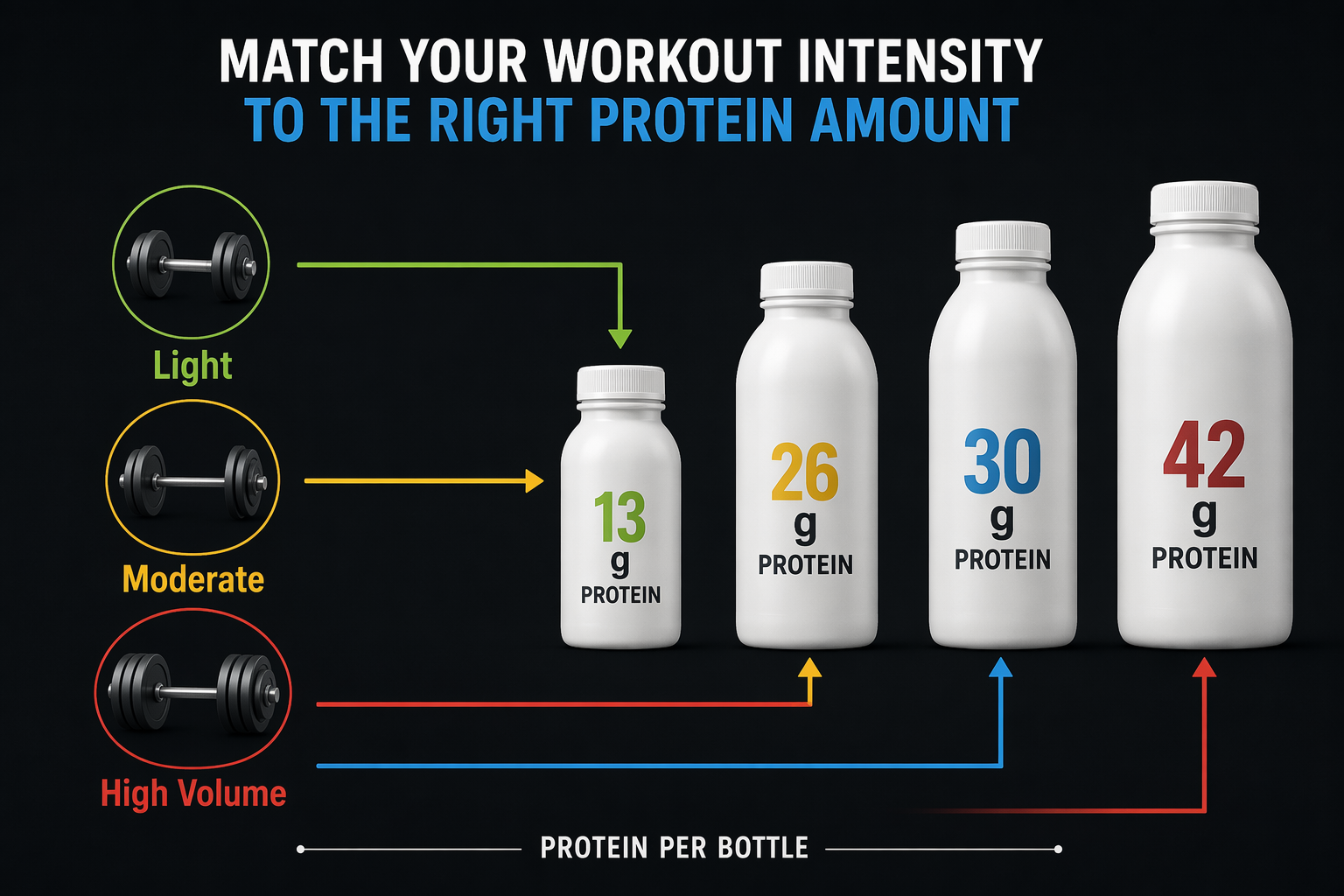
If you want the shortest usable answer, match the bottle to the training stress before you match it to the label number.
| Training situation | Fairlife match | Why it fits |
|---|---|---|
| Light session: bands, technique work, short dumbbell lift | 1–2 cups ultra-filtered milk, or Core Power 26g if convenience matters | One cup gives 13g; two cups give 26g, which already reaches the lower-to-middle post-workout range. |
| Ordinary full-body home lift | Core Power 26g or 16oz ultra-filtered milk | Both land at 26g, a clean fit for many moderate resistance sessions. |
| Moderate to higher-volume resistance training | Core Power 26g or Nutrition Plan 30g | The 26–30g range covers most post-workout needs without jumping straight to the largest bottle. |
| High-volume hypertrophy day, larger athlete, or bigger daily protein gap | Core Power Elite 42g | The 42g bottle makes more sense when the single dose fits the person’s body size, workout volume, and remaining daily protein target. |
This is also where workout context matters. A short accessories session in the garage does not create the same recovery demand as a hard full-body lift with multiple compound movements. If you are trying to judge whether your training day counts as light, moderate, or high volume, the logic in full-body dumbbell workouts for fat loss and recovery is a better place to start than staring at shake labels.
What Fairlife’s Protein Numbers Actually Give You
Fairlife ultra-filtered milk is the plainest option and often the most overlooked. One 240ml cup provides 13g protein, compared with 8g in regular milk, and Fairlife says the protein is concentrated through ultrafiltration rather than added protein powder.[1][2] The milk keeps the natural dairy protein split of about 80% casein and 20% whey.[1]
That matters because casein and whey do different jobs at different speeds. Whey is faster-digesting; casein digests more slowly. You do not need to turn that into kitchen chemistry, but it explains why milk can be a sensible recovery base rather than just a drink that happens to contain protein.
The ready-to-drink bottles mostly change dose and convenience. Core Power 26g provides 170 calories, 5g sugar, and 26g protein.[3] Nutrition Plan chocolate provides 150 calories, 2g sugar, and 30g protein, giving it the strongest protein-to-calorie ratio in this lineup.[4] Core Power Elite chocolate provides 230 calories, 7g sugar, and 42g protein.[5]
Light Sessions: Ultra-Filtered Milk Is Usually Enough
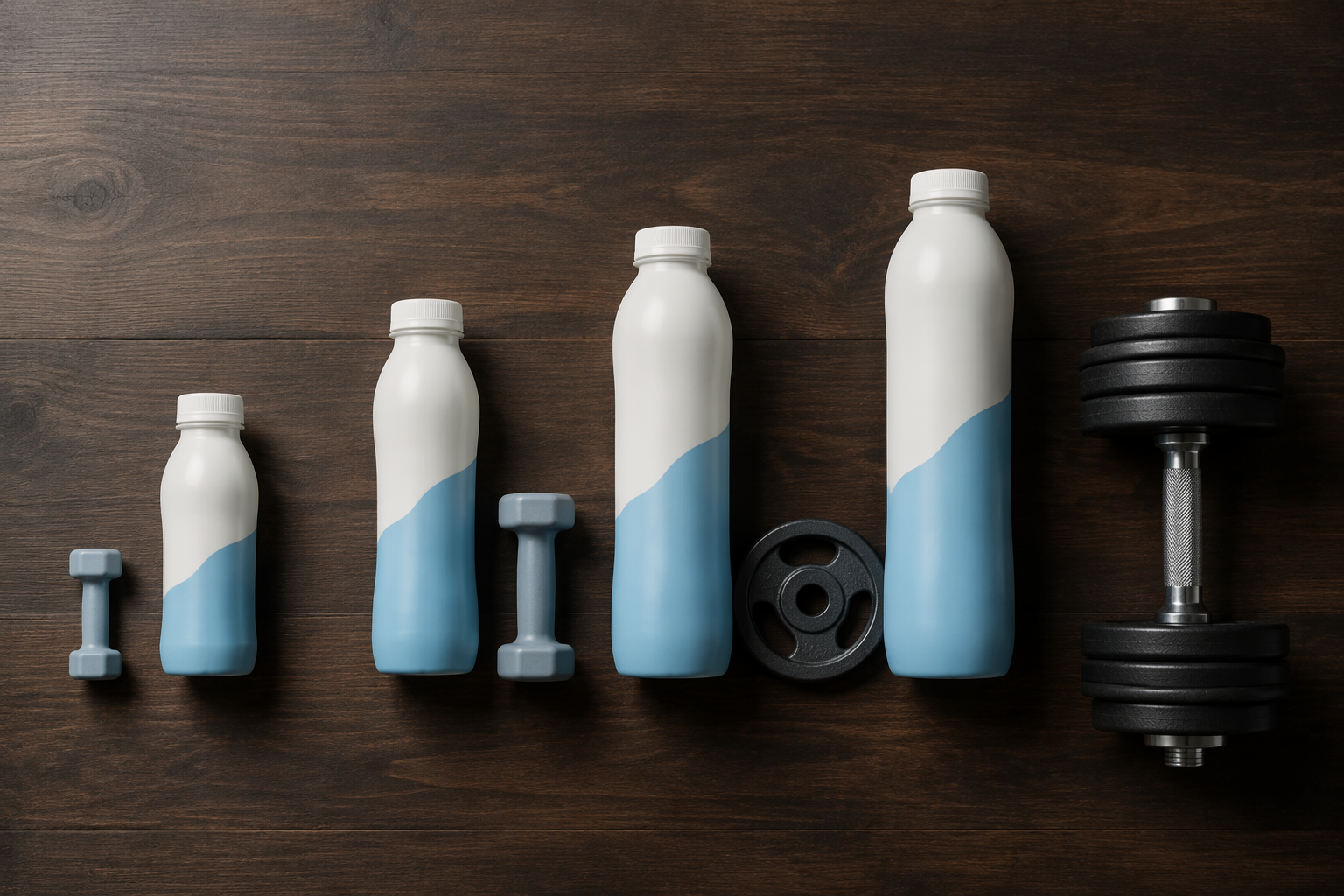
For a lighter home session, the 13g cup has a real job. Think of a short band workout, a technique session, a low-volume dumbbell circuit, or the kind of lift you squeeze in when dinner is already half started. If the rest of the day has included normal meals with protein, one cup may be enough to close the gap. If the session was more substantial, two cups bring you to 26g.
That two-cup option is the quiet value play. A 16oz glass of Fairlife ultra-filtered milk delivers the same 26g protein as a Core Power 26g bottle, and a dietitian review estimated it at roughly half the per-gram cost of the ready-to-drink version, while noting that exact pricing varies by retailer and location.[7] If you are training at home and standing within five steps of your refrigerator, that tradeoff is hard to ignore.
The bottle still has a place. Core Power 26g makes sense when the workout ends away from the kitchen, when you train before work, or when measuring and rinsing a glass is one more tiny obstacle between you and doing this consistently. Convenience is not fake value. It just has to be value you are actually using.
Moderate Full-Body Lifts: 26g Is the Clean Middle
A normal full-body home lift is where Core Power 26g starts to look like the default bottle rather than the compromise bottle. After squats or lunges, presses, rows, and some accessory work, 26g sits comfortably inside the commonly cited post-workout range.[3][6] It is enough protein to matter without assuming that every garage workout was a two-hour bodybuilding session.
The same number from ultra-filtered milk works just as well on paper: two cups, 26g protein. The difference is packaging, portability, calories from the specific product you choose, and whether you want a shake-style drink or milk you can pour into coffee, oats, cereal, or a smoothie. For home training, that flexibility can be more useful than another branded recovery product in the fridge.
The recovery window should not turn into a panic window. If your next full meal is coming soon, the shake may simply bridge you there. If your next meal is several hours away, it matters more. For a broader timing setup around protein, carbs, hydration, and sleep, use Your Complete Post-Workout Recovery Routine at Home as the fuller recovery map.
Higher-Volume Training: Nutrition Plan 30g Has a Narrow but Useful Edge
Nutrition Plan 30g is not automatically “better” than Core Power 26g, but it does solve a specific problem neatly: more protein with fewer calories and less sugar than the Core Power 26g bottle. Its chocolate version lists 30g protein, 150 calories, and 2g sugar.[4] For someone cutting calories, managing appetite, or trying not to stack a recovery drink on top of a large meal, that protein-to-calorie ratio is the point.
This is the bottle I would look at after a harder hypertrophy-style session that still does not justify 42g by itself: more sets, shorter rests, legs plus upper body, or a workout where you know dinner will be light. It also fits the person who consistently undershoots daily protein and wants one dependable 30g anchor after training.
The caution is simple: do not count the same need twice. If you finish training and then eat a protein-heavy meal right away, a 30g shake may be unnecessary. If you train between meetings and lunch is two protein-poor snacks, it may be the cleanest option in the lineup.
When the 42g Bottle Makes Sense
Core Power Elite 42g is the product most likely to be overused because the number looks decisive. It has 42g protein, 230 calories, and 7g sugar.[5] That can be a good fit for a larger athlete, a very high-volume lifting day, or a day when you are genuinely behind on total protein. It is less compelling after a short workout if your meals already cover the rest.
Body weight is where the 42g bottle becomes easier to justify. A 200 lb person is about 91 kg. Using the ACSM active-person range of 1.2–1.7g/kg/day, that person’s daily target would be roughly 109–155g protein.[6] In that context, 42g may be a reasonable single serving, especially after hard training. For a smaller person with a lower daily target and a normal dinner coming, the same bottle can crowd out protein that would have been easy to get from food.
There is nothing wrong with using Elite because it fits the day. The mistake is using it because “more protein” sounds more serious. Muscle gain depends on consistent training, adequate total protein, enough calories, and recovery habits that repeat. One oversized bottle cannot cover for a week of missed meals or sloppy sleep.
Use Daily Protein to Check the Bottle
The cleanest way to choose is to work backward from the day, not forward from the shelf. Estimate your daily protein range, look at what you have already eaten, then use Fairlife to fill the remaining gap around training.
- If your workout was light and your meals are protein-solid, 13g from one cup may be enough.
- If your workout was moderate and your next meal is not immediate, 26g is a sensible target.
- If your workout was higher volume and calories matter, Nutrition Plan 30g is the leanest bottle in the group.
- If you are larger, trained hard, or still have a large daily protein gap, Core Power Elite 42g can fit.
- If budget matters and you are at home, compare every bottle against two cups of ultra-filtered milk before buying a case.
This also keeps post-workout protein in its proper lane. Recovery is not only a bottle decision. Hydration, carbs when needed, sleep, and managing soreness all decide whether the next session is productive. If you are building out the rest of that setup, the home recovery tools guide is more relevant than adding a second shake.
What the Milk Research Can and Cannot Prove
The best evidence here is not that Fairlife itself has been proven superior in resistance-training trials. The stronger, narrower claim is that milk’s natural casein-whey protein blend has recovery research behind it, and Fairlife concentrates that same dairy protein profile into a higher-protein serving.
Dairy Nutrition Canada summarizes resistance-training studies in which milk after training produced greater Type II muscle fiber area and fat-free mass gains than soy or carbohydrate-only recovery drinks.[8] A PubMed-indexed review also describes milk as a source of high-quality protein and notes its potential role after resistance exercise.[9] Those findings support milk as a recovery option; they do not prove that one Fairlife bottle beats another for muscle gain.
That distinction matters because it keeps the recommendation honest. Fairlife’s advantage is convenient dosing: 13g, 26g, 30g, or 42g in familiar dairy formats. The training result still depends on whether that dose fits the work you did and the food you eat the rest of the day.
Budget and Convenience Decide More Than Flavor
For a home lifter, the value comparison is unusually practical. If you are already near a refrigerator, 16oz of ultra-filtered milk gives you 26g protein and may cost roughly half as much per gram as the Core Power 26g bottle, based on one dietitian’s market check.[7] Prices change, and the exact gap may not hold in your store, but the basic comparison is worth doing.
| Priority | Best Fairlife choice | Tradeoff |
|---|---|---|
| Lowest cost per gram at home | Ultra-filtered milk | You give up grab-and-go convenience. |
| Simple post-workout bottle | Core Power 26g | You pay more for portability and no measuring. |
| Most protein per calorie | Nutrition Plan 30g | It is more of a nutrition shake than a classic post-workout sports bottle. |
| Largest single dose | Core Power Elite 42g | Useful when justified; easy to overbuy when it is not. |
Lactose tolerance, dairy preference, and flavor matter only if they affect whether you will actually drink the product. Fairlife says its ultra-filtered milk is lactose-free.[1] Beyond that, the muscle-gain decision is mostly dose, calories, cost, and timing.
A Practical Selection Rule
Use Fairlife ultra-filtered milk when you train at home, want the best grocery value, or only need 13–26g protein. Use Core Power 26g when you want the same 26g dose in a ready-to-drink bottle. Use Nutrition Plan 30g when you want a tighter protein-to-calorie option after a harder session. Use Core Power Elite 42g when your body size, workout volume, or daily protein gap actually calls for a larger serving.
Fairlife can support muscle gain across the lineup. The best choice is the one that fills the post-workout protein gap for that session and that day, not the one with the largest number on the label.
References
- Frequently Asked Questions, fairlife.
- Reduced Fat 2% Ultra-Filtered Milk, fairlife.
- Core Power, fairlife.
- Nutrition Plan Chocolate, fairlife.
- Chocolate Protein Shake 42g, fairlife.
- How Much Protein Do You Need When Working Out?, Mass General Brigham.
- Is Fairlife Milk Healthy? A Dietitian Review, The Balanced Nutritionist, March 2024.
- Sports recovery: why milk is an ideal choice, Dairy Nutrition Canada.
- Milk and Resistance Exercise: A Review, PubMed.

Comments
Join the discussion with an anonymous comment.