
The uncomfortable truth about shopping for an affordable fitness tracker in 2026 is that the cheap ones no longer look very cheap. A band around $50 can have an AMOLED screen, blood oxygen tracking, basic heart-rate monitoring, sleep trends, multi-day battery life, and enough water resistance for ordinary workouts and swimming. That is why the real question is not whether a $100 tracker is “better.” It usually is. The question is whether the extra money changes what you can actually do on a Tuesday morning.
For most casual movers, the sensible stopping point is around $50. The jump to $80–$100 starts to make sense when you need built-in GPS, more serious recovery or sleep analysis, or a specific ecosystem feature you know you will use. If your plan is steps, gym sessions, basic sleep, and walks where your phone is already in your pocket, a $50 band is not a compromise in the way it used to be.
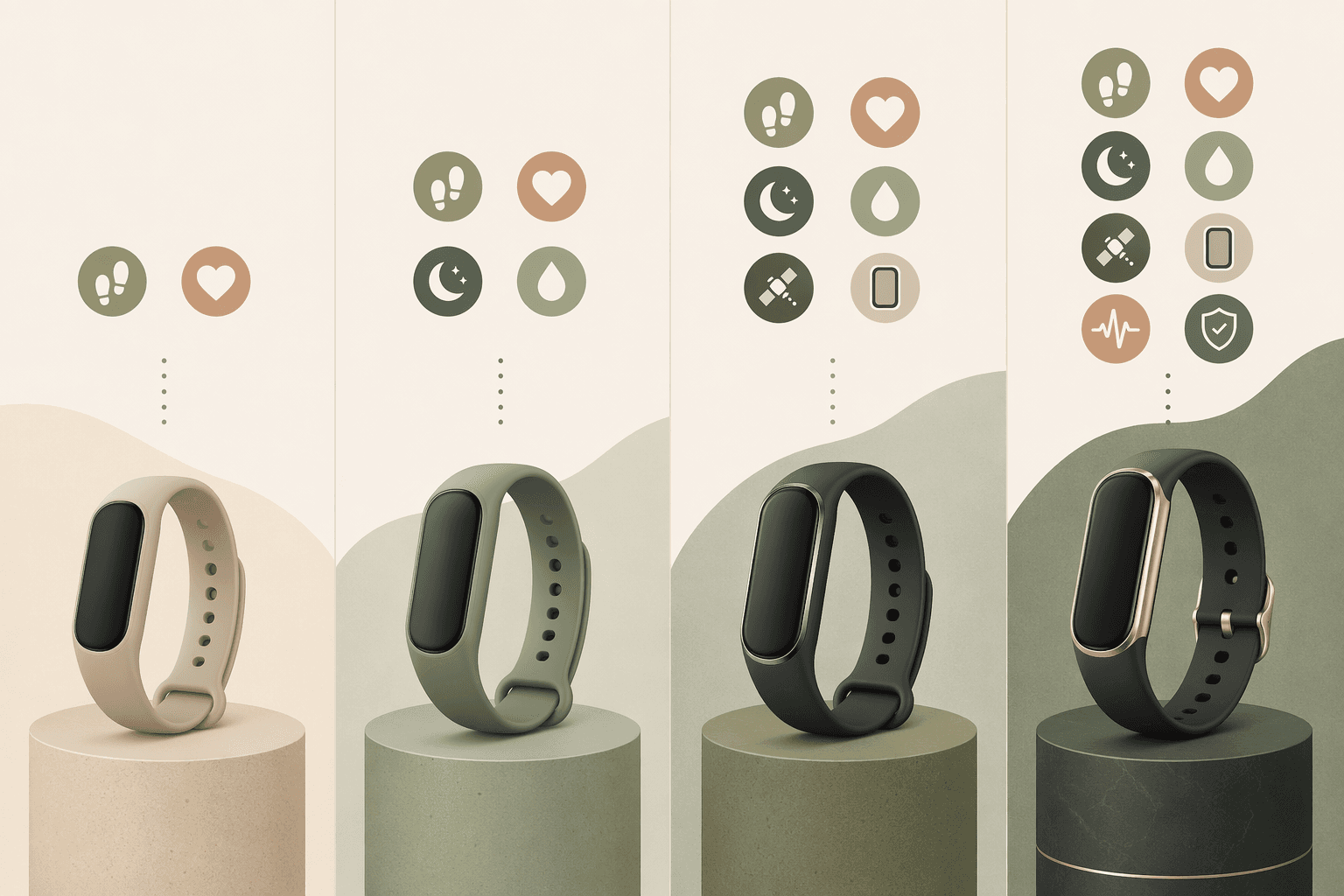
The price-tier map
Prices move around constantly, especially during sales, so it is more useful to think in tiers than in exact shelf tags. The pattern below is the one that matters: basic health tracking has moved downmarket, while standalone GPS and deeper analytics still tend to cost more.
| Price tier | What you usually keep | What is usually missing | Who should consider it |
|---|---|---|---|
| Around $30 | Steps, basic heart rate, simple sleep tracking, phone notifications, sometimes AMOLED or strong battery life depending on the model | Built-in GPS, richer app analysis, stronger build quality, more reliable sensors, polished software | Someone buying a first tracker and accepting compromises, especially if the model is on sale |
| Around $50 | AMOLED display, SpO2, basic heart rate, sleep trends, long battery life, 5ATM water resistance on strong budget bands | Standalone GPS, more advanced recovery analysis, premium ecosystem features | Most casual daily movers, walkers, gym beginners, and people who want a low-maintenance band |
| Around $80 | Better app experience, stronger sleep scoring on some models, more polished hardware, sometimes built-in GPS depending on the device | Some advanced insights may require a subscription; not every model in this tier has GPS | Users who care about sleep analysis, app quality, or a better overall device feel |
| Around $100 | Built-in GPS becomes more realistic, HRV and recovery features appear more often, smartwatch-style designs become available | Premium analytics may still sit behind paid plans; accuracy is still consumer-grade | Phone-free runners, outdoor walkers mapping routes, and users who will actually act on recovery trends |
The $30 tier is not junk, but it is narrow
A $30 tracker can be a perfectly reasonable way to find out whether wearing anything on your wrist helps. It can count steps, nudge you to move, show calls or messages, and give you a rough sleep pattern. For a beginner who mainly wants visibility, that is not nothing.
The problem is the price gap. Once a good $50 band is available, the $30 choice has to earn its place. A cheaper band may have a dimmer or less pleasant screen, a less refined app, fewer workout modes that feel useful, or more uneven sensor behavior. Those tradeoffs are acceptable when the budget is firm. They become harder to defend when another $15 or $20 buys a screen you can read outside and a battery you do not have to think about every other night.
Around $50 is where budget bands got surprisingly complete
The Xiaomi Smart Band 9 and its Smart Band 10 successor are the cleanest examples of why the middle of the budget range matters. Across the roughly $33–$53 range cited in current coverage, this family brings together an AMOLED display, 14–21 day battery claims, SpO2 tracking, and 5ATM water resistance.[1][2][3] That feature set would have sounded aspirational for a cheap band not that long ago. Now it is the baseline a budget shopper should know exists before paying more.
Those features are not decorative. A readable AMOLED screen means you are more likely to glance at your step count during the day instead of treating the tracker like a data logger you check at night. Long battery life means the device spends more time on your wrist than on a charger. 5ATM water resistance reduces the small friction of removing it for showers, sweaty workouts, or pool time. Basic sleep trends are enough for many people to notice that late caffeine, alcohol, stress, or inconsistent bedtimes are showing up in their week.
This is where a budget band can be better than a more ambitious device that annoys you. If you are starting from no routine, the tracker’s job is to make walking, workouts, and sleep visible without adding another monthly bill or another charging schedule. The $50 tier does that well enough that casual users should not feel pushed into a watch-shaped device just to be taken seriously.
There are still tradeoffs. You should expect fewer premium materials, less elegant software, and less sophisticated interpretation of the data. If you want the longer version of what you give up, the useful next read is what you actually lose with a $50 fitness tracker. But for steps, basic heart rate, gym sessions, walks, simple sleep trends, and a low-maintenance wristband, this is the tier where spending can stop.
The upgrade that most clearly justifies $80–$100 is built-in GPS
Built-in GPS is the feature that still draws a bright line through the affordable tracker market. Sub-$60 bands generally do not give you standalone GPS. Some lower-cost devices can use your phone’s GPS, but that means the phone has to come along. Current testing and buyer coverage place true built-in GPS in the higher budget range, with devices such as the Fitbit Charge 6, Amazfit Bip 6, and Amazfit Active 2 entering the phone-free tracking conversation.[4][5]
That distinction matters if you run, hike, or walk outdoors and want route, pace, and distance without carrying your phone. It matters much less if your phone is already with you for music, safety, photos, or family availability. In that case, connected GPS is not elegant, but it may be good enough.
This is also where people accidentally overbuy. They imagine the person they want to become — phone-free morning runner, neatly tracked intervals, tidy maps afterward — and buy for that person before the routine exists. If you already know you hate carrying your phone while running, pay for built-in GPS. If you are still trying to walk after dinner three times a week, the GPS line can wait.
Sleep and recovery features need a second look, not a bigger price tag by default
Sleep scores, stress scores, readiness scores, HRV trends, and recovery labels all sound more decisive than they are. They can be useful, but only when you treat them as trend tools. A rough pattern over several weeks can help you notice that hard workouts, poor sleep, and elevated stress are clustering together. A single daily score should not decide whether you are healthy, sick, lazy, recovered, or medically okay.
The Fitbit Inspire 3 is the interesting case here because it is not impressive in the same way a spec-heavy watch is impressive. Its appeal is testing performance and sleep-tracking polish. Wirecutter found a 0.32% step-count error for the Inspire 3, the best result among the trackers it tested, and also highlighted its strength for sleep tracking.[6] That matters if you want a small, simple band that behaves consistently.
The catch is ownership cost. Fitbit’s ecosystem has moved under Google Health branding, and the advanced sleep detail and stress insights require Google Health Premium at $10 per month or $100 per year.[6] A tracker that looks affordable at checkout can become a different purchase over three years. If you are comparing Fitbit to subscription-light alternatives, run the numbers before deciding; the fitness tracker subscription cost guide is built for exactly that calculation.
This does not make the Inspire 3 a bad buy. It makes the real price less obvious. If you are happy with the included features and like the Fitbit app, it remains a strong small tracker. If the feature that sold you is locked behind a recurring plan, compare it against hardware that gives you more analysis without a subscription.
Amazfit Active 2 shows what hardware-per-dollar can look like
The Amazfit Active 2 is the device that makes the $80–$100 discussion less tidy, because current testing coverage has placed it around $65 while noting a stainless steel case, AMOLED display, built-in GPS, and 10-day battery life.[4] That is the kind of spec sheet that used to make budget bands look like toys. It also puts pressure on more expensive trackers to justify themselves with better software, better testing performance, or an ecosystem you genuinely prefer.
The subscription split is also more buyer-friendly for the features many people actually want. Readiness scores and advanced sleep analytics are free in the Zepp app, while the paid premium tier gates meditation and AI coach features at $10 per month.[4] That is a meaningful distinction. A recovery score included in the app is different from a recovery score that quietly turns into a monthly fee.
The right response is not to declare it the universal winner. Some users will prefer Fitbit’s app, smaller band shape, or sleep presentation. Others may want a more watch-like display and built-in GPS without climbing toward premium smartwatch prices. If your decision is starting to become less about price tier and more about workout type, wrist size, and app feel, move from this guide to a broader smart watch fitness buyer’s guide.
Accuracy is useful, but do not turn it into false precision
Affordable trackers are good enough to guide habits. They are not medical instruments. Step counts can be directionally useful while still missing some movement. Optical heart-rate sensors can work well during steady exercise and struggle more with rapid intensity changes, wrist movement, skin contact, and fit. Calorie estimates are especially easy to over-trust. Sleep staging is best treated as an estimate, not a lab result.
Published accuracy findings also come from different methods. Wirecutter’s step-count result for the Inspire 3 used a pedometer reference, while other outlets use different comparison tools for heart-rate testing, including chest straps in some cases.[5][6] Those results can help you identify stronger performers, but they should not be mashed together as if every test measured the same thing in the same way.
If accuracy is the part keeping you stuck, read how accurate your fitness band watch really is before paying for sensors you may not interpret differently. Better data only helps when it changes a decision: taking a rest day, extending a walk, adjusting bedtime, or leaving the phone at home because the tracker can map the route by itself.
Where to stop spending
Buy around $50 if your routine is steps, basic sleep, gym sessions, indoor workouts, and occasional walks. In that tier, a strong band can already give you the screen, battery life, water resistance, and everyday tracking that make a fitness tracker feel useful instead of fussy.
Move toward $80–$100 when the extra feature changes behavior. Built-in GPS is worth paying for if you want phone-free runs or route tracking. HRV and recovery metrics are worth paying for if you will watch trends over time instead of obeying a single score. Stronger sleep analysis is worth paying for if you will use it to adjust your schedule, not just judge yourself in the morning.
Be cautious with any tracker whose best insights require a subscription. The device may still be good, but the affordable price on the box is not the whole cost. Once the tracker fits the routine you actually have, you have permission to stop shopping.
References
- Best fitness tracker 2026: tested and compared — Wareable
- Xiaomi Smart Band 9 review — PCMag
- Xiaomi Smart Band 9 review — The Gadgeteer
- The 7 Best Fitness Trackers of 2026, Tested and Reviewed — NBC Select
- Best fitness trackers for 2026 — CNET
- The 3 Best Fitness Trackers of 2026 — Wirecutter / The New York Times
Comments
Join the discussion with an anonymous comment.