
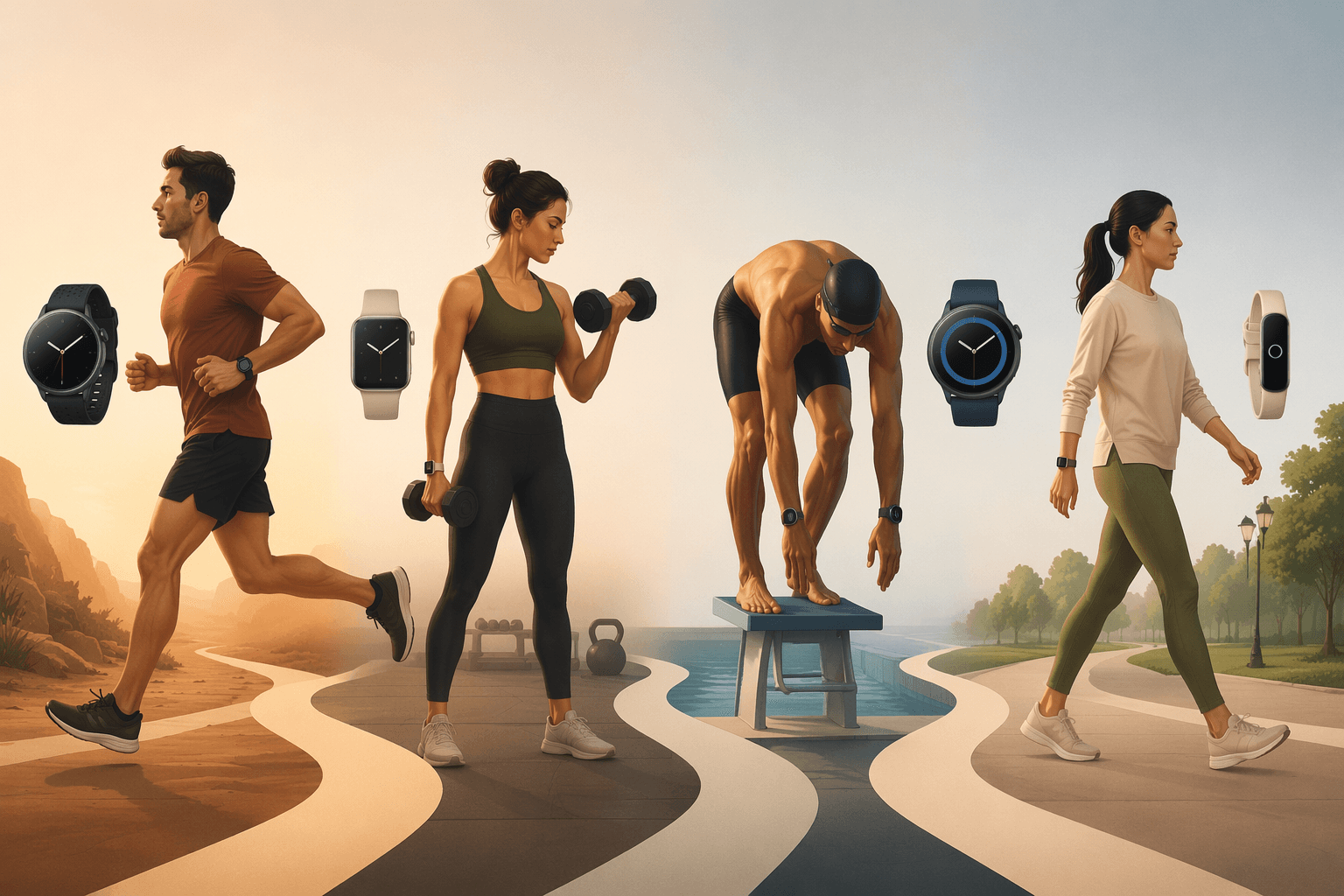
The easiest way to buy the wrong smart watch for fitness is to compare every spec as if every workout asks the same question. A bright screen, ECG app, dual-frequency GPS, sleep score, titanium case, and seven-day battery life do not have equal value to a distance runner, a dumbbell lifter, a lap swimmer, and someone who just wants credit for daily walks.
A better order is simpler: choose by your main workout first, remove watches that do not work well with your phone, then decide how often you are willing to charge. Prices and availability here reflect the June 2026 market, and subscription prices should be checked again before purchase because they can change quietly while the sticker price stays attractive.
| If your main workout is… | Start your search with… | Do not overpay for… |
|---|---|---|
| Distance running or race training | GPS running watches from Garmin, COROS, Polar, or similar training-first brands | A general smartwatch just because it has more apps |
| Gym strength training | A comfortable watch with solid heart-rate trends, good workout logging, and an app you will actually review | Advanced running metrics you will ignore |
| Lap swimming | A swim-ready watch with pool/open-water modes and buttons or a usable wet-screen interface | Prestige materials if the swim data is basic |
| Walking and general health | A lighter tracker or smartwatch with long enough battery life and simple goals | Elite training load tools |
Start with the workout, not the watch
A fitness watch is only as useful as the signal it captures during the thing you repeat every week. If you run outside, GPS behavior and training load context matter. If you lift, the useful part is usually heart-rate trend, rest awareness, workout logging, and comfort under wrist flexion. If you swim, water behavior matters more than a fancy app grid. If you mostly walk, battery life and ease of use can beat almost every premium metric.
That is why a single “best overall” smart watch fitness recommendation gets slippery. It usually rewards the watch that does the most things acceptably, not the one that does your main workout cleanly.
For runners: treat GPS, battery, and training context as core features
If you are training for distance, especially if your weeks include long runs, intervals, or race-specific blocks, start with GPS running watches before you get seduced by general smartwatch features. GearJunkie’s fitness-watch testing covered more than 50 watches and more than 150 miles, and its running-oriented recommendations include models such as the Garmin Forerunner 570, COROS Pace 4, and Polar Pacer Pro for buyers who care about battery life and training metrics like VO₂ max, recovery time, and HRV status. [1]
The point is not that an Apple Watch, Galaxy Watch, or Pixel Watch cannot record a run. They can. The question is what happens after the run starts becoming training instead of exercise. Runners usually benefit from seeing whether load is rising too fast, whether recovery signals are trending down, and whether long GPS sessions will finish without battery anxiety. Those are the places where dedicated GPS watches tend to feel calmer and less compromised.
Battery is part of the running feature set, not a side note. General smartwatches from Apple, Samsung, and Google commonly sit in the 1–3 day battery range, while GPS-focused watches such as Garmin fenix 8 and Enduro 3 can offer much longer GPS tracking windows, with reported GPS ranges from 10 to 320 hours depending on model and mode. [1][2][3]
A runner who only does two short neighborhood runs a week may not need the full training-watch universe. But if you are logging long outdoor sessions, traveling for races, or already using terms like “recovery time” and “HRV status,” it is usually worth looking at the Garmin, COROS, and Polar shelf before the lifestyle-smartwatch shelf.
If recovery data is a major part of your decision, compare how brands explain HRV, readiness, and training load before you buy. Our guide to the best fitness trackers for recovery in 2026 is a better next stop than a generic smartwatch ranking.
For gym training: use heart rate, but do not pretend it explains every lift
For strength training, circuit work, and home fitness, the watch has a harder job. Wrist heart-rate sensors can be useful for seeing general intensity, rest periods, and conditioning trends. They are less magical during gripping, wrist extension, fast transitions, kettlebell work, or anything that shifts the watch against the skin.
The public accuracy evidence is stronger for running and cycling than for every kind of gym movement. The sources used here did not include a strong comparison of smartwatch performance across bodyweight training, yoga, dumbbell sessions, and other home-fitness exercises, so any buying advice for those workouts has to be more modest. For strength training, look for comfort, easy workout start/stop controls, useful heart-rate trends, and an app that does not bury your sessions under wellness confetti.
A general smartwatch can make sense here, especially if you want music, notifications, timers, and phone-like convenience during workouts. A lighter fitness tracker can also be enough if you mainly want activity minutes, resting heart-rate trends, sleep, and a lower price. If you are still deciding between those categories, the fitness tracker vs. smartwatch decision framework is worth reading before you spend smartwatch money for tracker-level needs.
For swimmers: check water behavior before health features
Swimmers should not start with the longest feature list. Start with whether the watch supports the kind of swimming you do, whether the screen or buttons are usable when wet, and whether the app presents swim sessions clearly. Pool swimmers need lap and interval behavior that does not turn every session into cleanup work afterward. Open-water swimmers should be more demanding about GPS behavior.
This is also a place where comfort matters more than it gets credit for. A bulky premium watch may be fine for trail running and annoying in a pool lane. If swimming is your secondary workout, a mainstream smartwatch may be enough. If swimming is your anchor workout, do not let a beautiful screen distract you from swim-mode usability.
For walkers and casual health tracking: lighter may be smarter
If your main activity is walking, daily movement, and general health monitoring, you probably do not need a premium GPS adventure watch. You need something comfortable enough to wear all day, simple enough to check without fiddling, and durable enough that charging does not become the reason it lives on a dresser.
This is where budget and mid-range devices can be perfectly sensible. The June 2026 market spans rough tiers from budget devices around $50–$160, including options such as Amazfit Active 2 and Fitbit Inspire 3, to mid-range devices around $200–$600, including Apple Watch SE 3 at $249, Garmin Venu Sq 2, and Fitbit Charge 6, then premium watches from roughly $600 to $1,200 or more, including Garmin fenix 8 and Apple Watch Ultra 3. [1][3]
Battery life is the trade-off people feel every day
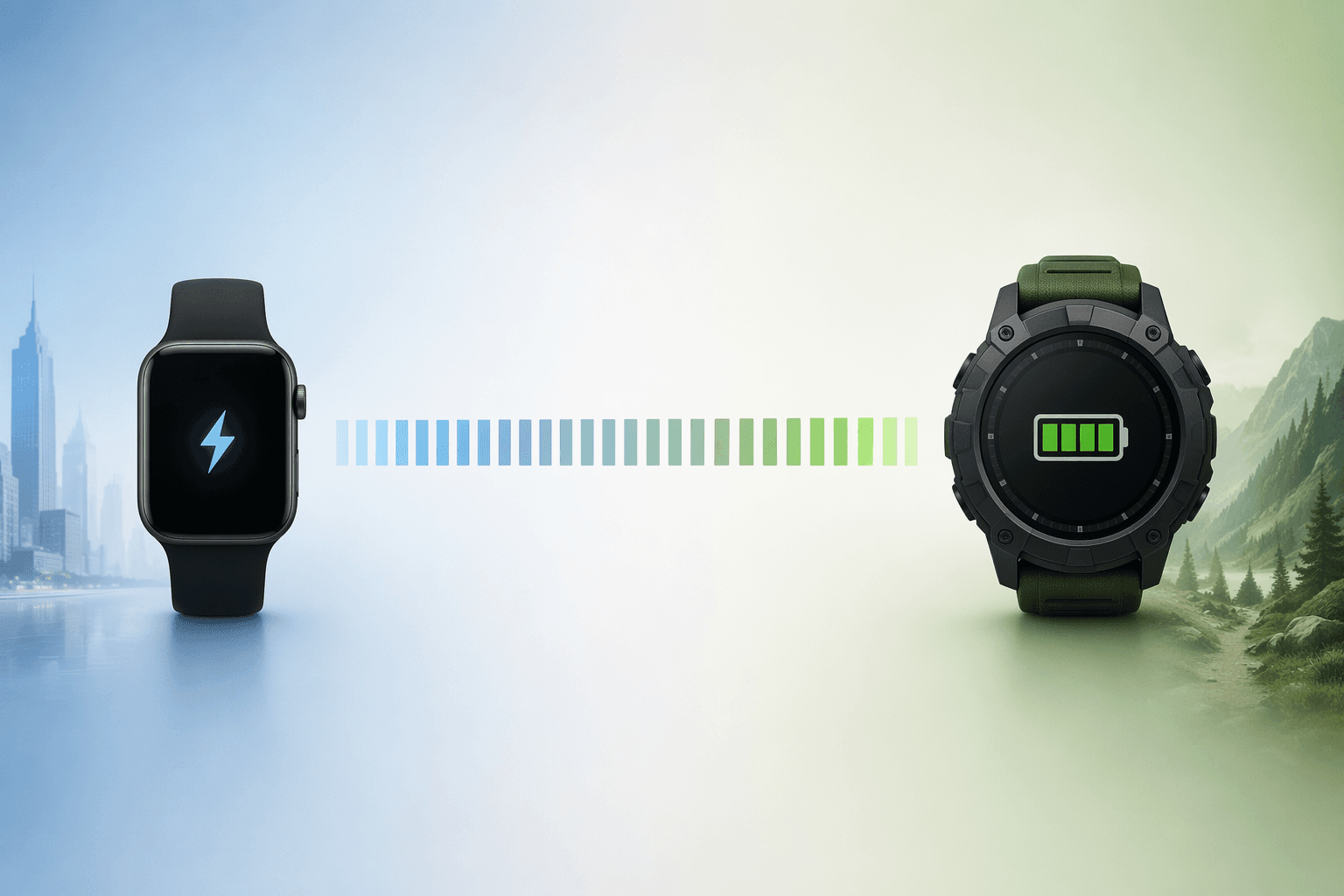
Battery life is not glamorous in a comparison chart, but it is the thing that interrupts real use. A watch that needs charging every night can still be excellent if you already charge your phone, headphones, and watch together. It becomes a problem when you want sleep tracking, early workouts, long hikes, travel days, or simply fewer chores.
The basic split is clear: Apple, Samsung, and Google-style smartwatches tend to give you richer phone features with shorter battery life, commonly around 1–3 days. Dedicated GPS watches often give up some app polish in exchange for much longer endurance, especially during tracked workouts. [1][2][3]
| You prefer… | You are probably leaning toward… | Best fit |
|---|---|---|
| Apps, calls, messages, payments, voice assistants, and a bright general-purpose screen | Apple Watch, Samsung Galaxy Watch, Google Pixel Watch, or another smartwatch | Gym users, casual exercisers, iPhone or Android users who want phone features on the wrist |
| Long GPS sessions, fewer charges, training load, recovery context, and sport-first controls | Garmin, COROS, Polar, or similar GPS fitness watches | Runners, outdoor athletes, endurance training, people who hate daily charging |
| Basic activity, sleep, steps, and lighter wear | Fitness bands or slim trackers | Walkers, beginners, budget buyers, people who dislike bulky watches |
Neither side is foolish. The mistake is buying the wrong inconvenience. If you want the watch to behave like a tiny phone, daily or near-daily charging may be the price. If you want it to disappear into training week after training week, a dedicated fitness watch may feel less shiny on day one and less irritating by month three.
Phone compatibility can eliminate half the shelf
After workout fit, check your phone. Apple Watch requires an iPhone. Samsung Galaxy Watch models work best with Samsung phones, even though Google Wear OS broadly serves Android. Garmin, COROS, Fitbit, and Amazfit are more cross-platform and generally work across both iPhone and Android with full functionality.
This is not the fun part of shopping, but it is decisive. A watch can have the right sensors and the wrong ecosystem. If you are choosing among Fitbit, Garmin, and Apple Watch and want the broader ecosystem comparison, use our Fitbit vs. Garmin vs. Apple Watch guide before narrowing by model.
Can you trust the heart-rate and GPS data?
For most non-medical fitness use, modern wrist wearables are good enough to show useful trends, but not perfect enough to treat every reading as truth. CNET’s 30-mile smartwatch test found that heart-rate readings across tested watches were within 8% of chest straps, and Apple Watch Series 11 had less than 1% error, about 1.4 beats per minute, in that specific test. [4]
That is encouraging, but it is still one tester’s runs under specific conditions. Skin tone, fit, wrist movement, temperature, tattoos, sensor placement, and workout type can all affect optical heart-rate readings. A strength workout with gripping and flexion is not the same measurement problem as a steady outdoor run.
Sampling behavior can matter too. In the same CNET reporting, Garmin Venu 4 sampled every second compared with every 5 seconds on Apple, while showing a 3.89% overall error rate; for serious athletes, the shape and frequency of the data can matter even when a headline error number looks slightly worse. [4]
GPS results are similarly useful but not absolute. CNET’s controlled GPS distance test found all tested watches within 0.1 miles per measured mile, with Apple most accurate at 0.99 miles and Amazfit Bip 6 recording 0.95 miles despite its $80 price. [5]
If accuracy is your main concern, do not stop at a model ranking. Look at test conditions, sample size, firmware timing, and whether the tested activity matches yours. Our Fitness Tracker Accuracy Report 2026 goes deeper on that problem.
Subscriptions change the real price
Sticker price is not the full price if the useful analysis lives behind a subscription. This is where a cheap-looking device can become less cheap, and an expensive-looking watch can become easier to justify if the core features are included.
Whoop is the clearest warning because the hardware model is tied to membership, with reported annual costs around $199–$359, making it one of the highest total-cost-of-ownership wearables in this comparison set. [6]
Fitbit can also look different after two years. Fitbit Premium at $80 per year adds $160 over two years to a Fitbit Charge 6 listed at $160, bringing that two-year total to $320 if you keep the subscription. [3][4]
Garmin’s newer Connect+ subscription has been reported at $70 per year, but most Garmin features remain free, so it should not be treated the same as a mandatory subscription for basic usefulness. A Garmin Vivoactive 5 at $300 with no mandatory subscription remains $300 over two years before accessories or sales tax. [1][3]
| Device or service example | Up-front price noted in research | Subscription example | Two-year ownership implication |
|---|---|---|---|
| Fitbit Charge 6 | $160 | Fitbit Premium at $80/year | $320 if Premium is kept for two years |
| Garmin Vivoactive 5 | $300 | No mandatory subscription for core use | $300 before accessories or taxes |
| Whoop | Membership-centered model | $199–$359/year | Higher ongoing cost than a one-time tracker purchase |
| Garmin Connect+ | Varies by watch | $70/year optional subscription | Optional for most users because most features remain free |
The annoying part is that subscriptions often attach themselves to exactly the features shoppers care about: readiness, recovery, deeper sleep analysis, or coaching. Before buying, open the brand’s current pricing page and check which features are free, which are trial-only, and which require a recurring payment.
A practical narrowing process
Use this order. It prevents the most common overbuying mistake: paying for the most impressive watch instead of the most relevant one.
- Name your primary workout. If it is running, start with GPS training watches. If it is gym training, prioritize comfort, logging, and useful heart-rate trends. If it is swimming, check swim behavior first. If it is walking, do not overbuy.
- Remove incompatible ecosystems. Apple Watch is for iPhone users. Samsung Galaxy Watch is best for Samsung users. Wear OS is broadly Android. Garmin, COROS, Fitbit, and Amazfit are more cross-platform.
- Choose your charging reality. If daily charging sounds normal, a full smartwatch may fit. If it sounds like a future annoyance, look harder at GPS watches or simpler trackers.
- Check whether the accuracy evidence matches your activity. Running and cycling tests do not automatically prove performance during every home workout or lifting session.
- Calculate two-year cost. Add subscriptions you actually plan to keep, not just the checkout price.
For home-workout buyers in particular, the best answer may be a tracker rather than a full watch. If your routine is mostly bodyweight work, dumbbells, mobility, and indoor cardio, our guide to which fitness tracker works best for your home workout type will be more specific than a running-watch comparison.
If your main workout, phone, and charging tolerance are clear, the category usually becomes clear too. Distance runners should look first at GPS training watches. Gym users can choose more freely, but should be honest about what wrist heart rate can and cannot show. Swimmers should check swim usability before smart features. Walkers can often save money and wrist space. That is a better buying stance than chasing a universal winner.
References
Sources here include expert reviews and controlled tests, not a single lab trial across every workout type. Some review sites also use affiliate links, so treat model recommendations as decision support rather than proof that one watch is best for everyone.
- Best Fitness Watches of 2026, GearJunkie
- Best smartwatch 2026 tested and rated: Apple, Samsung, Google and more, Wareable
- The best fitness trackers to buy right now, The Verge
- I Ran 30 Miles Testing 5 Smartwatches to Find Out Which Ones You Can Actually Trust, CNET
- GPS accuracy test, CNET
- Whoop 5.0 Review, GearJunkie
Comments
Join the discussion with an anonymous comment.