
The first number to check is not the sticker price. It is the bill after two years, when the free trial is gone, the recovery score still wants a membership, and the “budget” tracker has quietly become a recurring expense. For women choosing a fitness tracker in 2026, that matters because the features that often drive the purchase—cycle tracking, fertility insights, pregnancy logging, sleep stages, readiness, HRV trends, stress, and recovery—are not always included in the box.
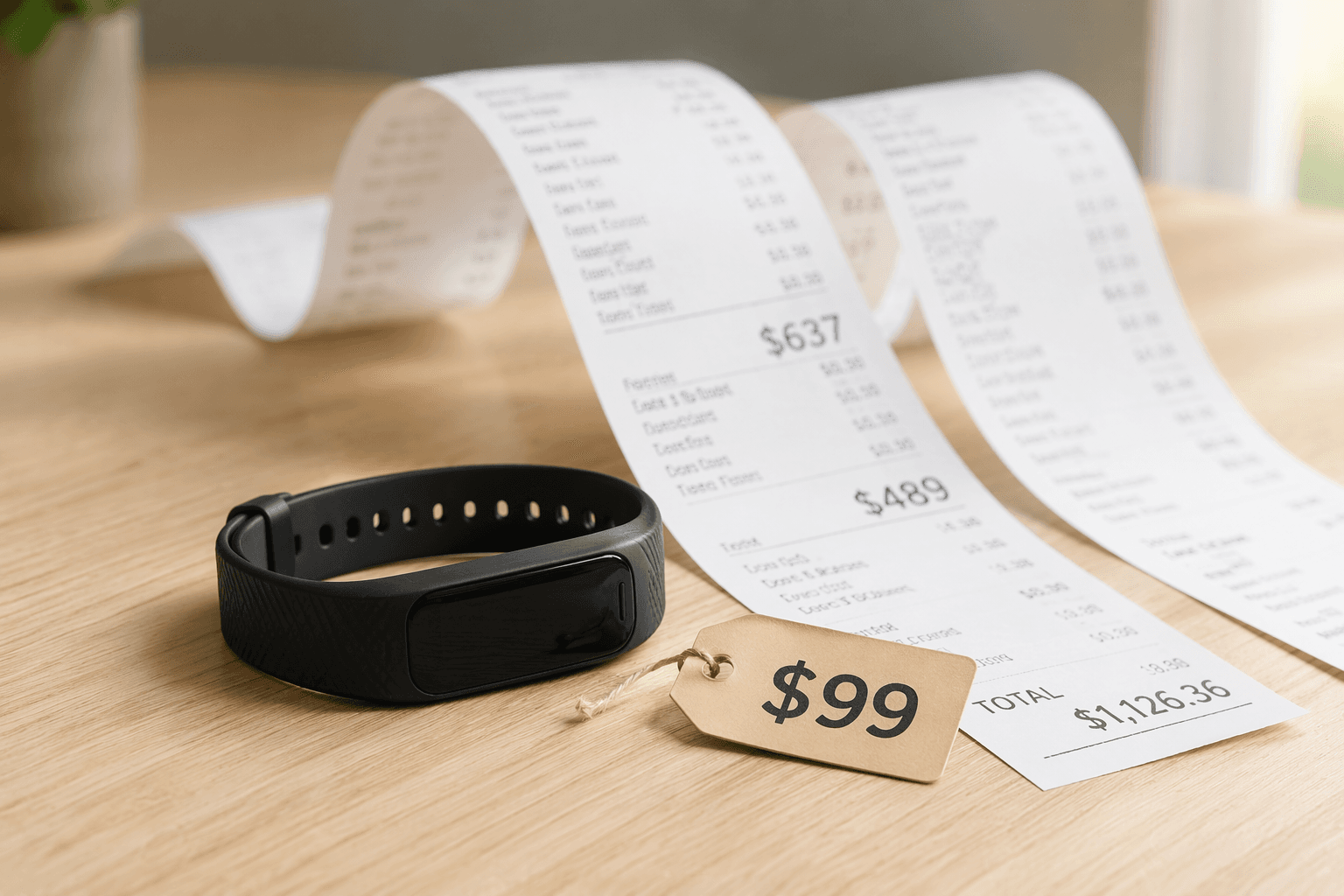
The two-year bill changes the ranking
These totals use June 2026 list pricing and known subscription requirements. Sale prices can shift the math, and subscriptions can change, but the pattern is already clear: the cheapest-looking device is not always the cheapest device to own.
| Device | June 2026 hardware price | Required or practical subscription | Two-year estimated cost | What changes the value for women |
|---|---|---|---|---|
| Fitbit Charge 6 | $85–160 | Fitbit Premium, $9.99/month or $80/year after 6-month trial | $245–325 | Sleep stages, stress score, and readiness score are tied to Premium, so the low entry price does not tell the full story. |
| Google Fitbit Air | $99 | Google Health Premium, $9.99/month or $100/year after trial | $299 | Basic data is free, but AI coaching requires the paid layer. |
| Whoop 5.0 | $239 starter | $199/year membership required | $637 | All data requires membership, and the band has no useful hardware ownership if the subscription lapses. |
| Oura Ring 4 | $349 | $5.83/month or $69.99/year membership | $489 | Detailed sleep staging, readiness, and women’s health insights sit behind the membership. |
| Garmin Vivoactive 6 | $300 | $0 | $300 | Sleep stages, HRV, Body Battery, stress, SpO2, and women’s health insights are included in Garmin Connect. |
| Garmin Lily 2 | $250 | $0 | $250 | Core health data stays free, with a smaller design but no onboard GPS. |
| Apple Watch Series 11 | $399+ | $0 required; Fitness+ optional at $9.99/month | $399+ | Core health tracking and women’s health features do not require a separate subscription. |
Fitbit Charge 6 is the cleanest example of why MSRP alone is a bad buying shortcut. Its hardware can look like a bargain at $85–160, but once Fitbit Premium is included after the 6-month trial, the two-year total rises to $245–325; PCMag and Women’s Health note that sleep stages, stress score, and readiness score are part of the paid value calculation rather than a simple free baseline.[1][2] Google Fitbit Air pushes the same issue into a newer package: $99 hardware becomes about $299 over two years once Google Health Premium is counted, with basic data free but AI coaching tied to the subscription layer.[3][4]
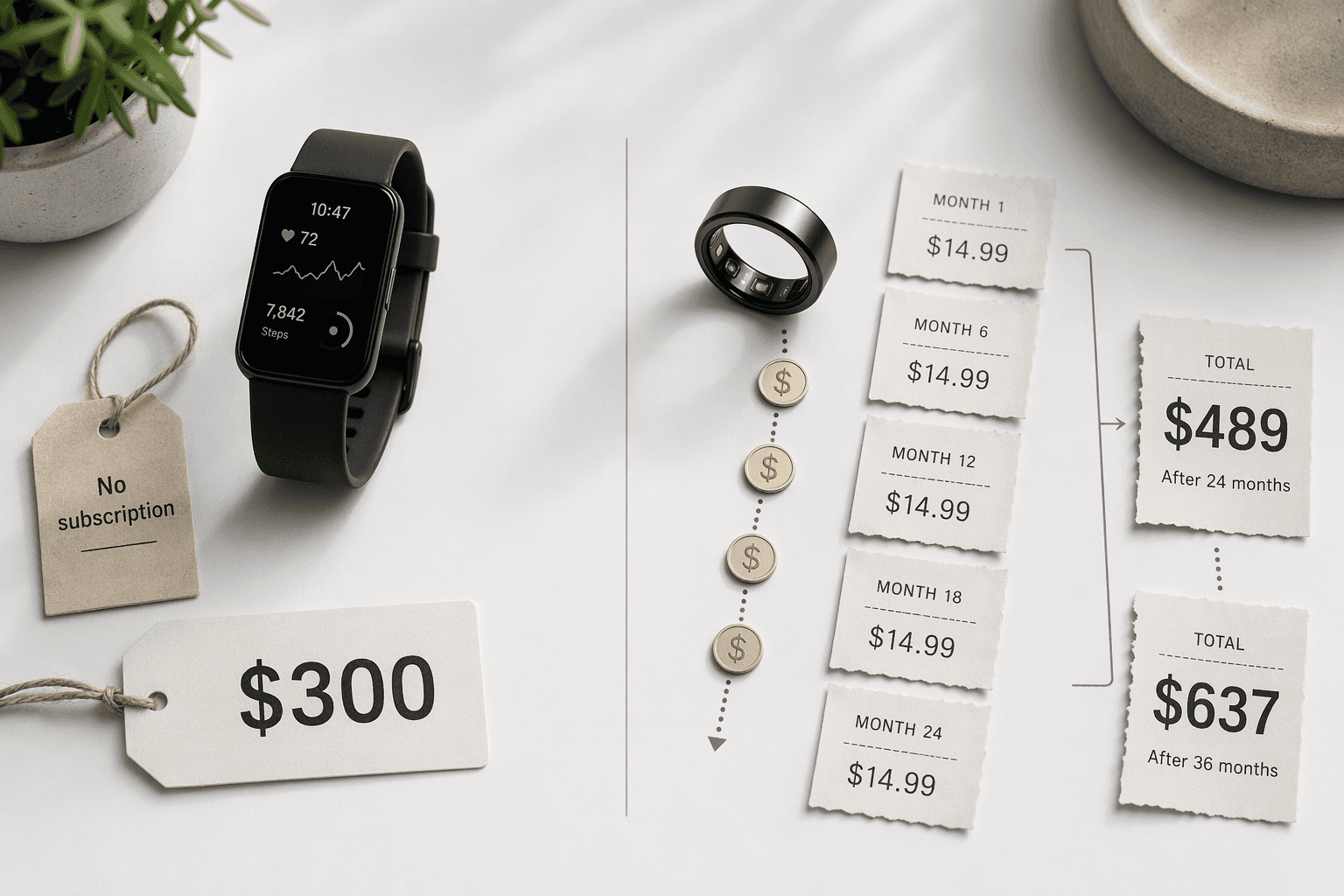
Whoop is even more direct. The Whoop 5.0 starter price is $239, but the $199/year membership brings the two-year cost to $637, and the band is not meaningfully useful without an active membership because all data requires it.[4][3] Oura Ring 4 starts higher at $349 and adds a $5.83/month, or $69.99/year, membership, bringing the two-year total to $489; its detailed sleep staging, readiness, and women’s health insights are part of the paid experience.[2][1][3]
Then there are the devices whose cost stays boring, which is a compliment. Garmin Vivoactive 6 is $300 over two years because there is no subscription required for sleep stages, HRV, Body Battery, stress, SpO2, or women’s health insights in Garmin Connect; WIRED named it the best overall fitness tracker, and PCMag and Women’s Health also place Garmin strongly in their tested coverage.[3][1][2] Garmin Lily 2 is $250 over two years, with core data free, a wrist fit range of 4.3–6.9 inches, and the important caveat that it does not have onboard GPS.[5][2]
What is actually locked behind the fee
A subscription is not automatically a trick. Ongoing coaching, algorithm updates, sleep interpretation, and recovery guidance take work. The fair question is whether the recurring fee pays for something you will actually use, or whether it is simply the toll required to reach the reason you bought the tracker.
That distinction is especially sharp for women. If a product advertises recovery, readiness, cycle-aware insights, fertility support, pregnancy logging, or detailed sleep interpretation, those features should be counted as part of the real price. A free step count is not the same thing as a complete health-tracking experience. With Oura, the ring’s appeal is obvious: it weighs 3.3–5.2 grams, avoids the wrist-fit problem entirely, and is easier to sleep in for people who dislike wearing a watch at night.[2][1][3] But if the buyer wanted the ring for sleep staging, readiness, and women’s health insights, the membership is not an optional extra in any practical sense.
Whoop has a different kind of honesty. It is a coaching and recovery subscription first, with hardware attached. For a serious athlete who reviews strain, recovery, sleep debt, and training response every day, the $637 two-year cost may be easier to justify than a cheaper tracker that produces data she ignores.[4][3] For someone who mostly wants steps, resting heart rate, sleep duration, and a nudge to move more, that same membership can become an expensive way to rent motivation.
The strongest value picks are not the flashiest ones
For most budget-conscious women, Garmin Vivoactive 6 is the safest place to start. It is not the cheapest sticker price in the group, but it is one of the cleanest purchases: $300 in, $300 after two years, with the core health features still available. The 11-day battery also matters in a less glamorous way; a tracker that spends less time on a charger has more chances to capture sleep, recovery, and daily movement patterns.[3][1][2]
Garmin Lily 2 is the better Garmin answer for someone who wants a smaller, more jewelry-like tracker and does not need onboard GPS. The wrist sizing range of 4.3–6.9 inches makes it worth considering for smaller wrists, and PCMag named the Lily 2 an Editors’ Choice.[5] The trade-off is real: without onboard GPS, outdoor run and walk tracking depends on a connected phone. That is fine for many walkers and casual exercisers, but it is not a small detail for someone who wants to leave her phone at home.
Apple Watch Series 11 belongs in a different lane. At $399 and up, it is not a budget tracker, and it is more smartwatch than minimalist fitness band. But it does not require a health subscription for core tracking, and CNET’s 30-mile lab test found it had the most accurate wrist-based heart-rate performance among tested smartwatches, averaging less than 1% error—0.98%—against a Polar H10 chest strap.[4] Fitness+ can add $9.99/month, but that is a workout-content choice, not a gate placed in front of the watch’s basic health data.
When the subscription devices still make sense
Oura Ring 4 still deserves a serious look if wrist comfort is the problem. Some women do not want a screen in bed, cannot get a watch to sit comfortably during sleep, or prefer a ring that looks less like workout gear. The subscription is easier to defend when sleep optimization is the point of the purchase, not a nice bonus. The mistake is buying it as a cheaper alternative to a watch without counting the membership that makes its deeper insights available.
Whoop 5.0 makes sense for a narrower buyer: someone who wants coaching more than a device, and who will actually use the membership. It has no display, no ordinary watch identity, and no graceful fallback if the subscription stops.[4][3] That can be perfectly acceptable for an athlete who wants a screenless recovery system. It is much harder to justify for a casual user who wanted an affordable tracker and ended up with the highest two-year bill in the comparison.
Fitbit Charge 6 and Google Fitbit Air sit in the caution zone. They can still be good choices for people who like the Fitbit interface, want a familiar ecosystem, or find a strong sale price. But the buyer should compare the paid version against Garmin, Apple, Oura, and Whoop—not the teaser hardware price against everyone else’s full cost. If Premium or Google Health Premium is part of the experience you want, write that into the price before you fall in love with the device.
A practical buying call
- Choose Garmin Vivoactive 6 if you want the best overall subscription-free value with fuller health metrics and longer battery life.
- Choose Garmin Lily 2 if you want a smaller tracker, can live without onboard GPS, and want the two-year cost to stop at $250.
- Choose Apple Watch Series 11 if you already want a smartwatch and care about strong wrist heart-rate accuracy without a women’s health paywall.
- Choose Oura Ring 4 if comfort, ring form factor, and sleep optimization matter enough to make the $489 two-year cost feel intentional.
- Choose Whoop 5.0 only if you want the coaching membership itself and will use recovery and training guidance enough to justify $637 over two years.
- Choose Fitbit Charge 6 or Google Fitbit Air with extra scrutiny, because the low hardware price can hide the paid layer that makes the device feel complete.
Accuracy should also stay in perspective. Optical heart rate, calorie estimates, sleep stages, and readiness scores vary by fit and individual physiology, even in devices that test well. A beautiful device that you wear consistently can beat a more powerful one left on the nightstand. But once two devices are both wearable enough, the bill deserves to break the tie.
If you are still comparing ecosystems, look next at broader tracker cost comparisons, Garmin-specific buying guides, Fitbit model breakdowns, and recovery-focused comparisons between Oura, Whoop, and Fitbit. Just do that after the two-year price is on the page, not before.
References
- The Best Fitness Trackers We've Tested for 2026, PCMag
- The 10 Best Fitness Trackers of 2026, Tested by Fitness Editors, Women's Health
- The Best Fitness Trackers of 2026: Garmin, Google Fitbit, and More, WIRED
- The Best Fitness Trackers of 2026 for Every Type of Workout, CNET
- Garmin Lily 2 Review — Editors' Choice, PCMag
Comments
Join the discussion with an anonymous comment.