
Screenless Fitness Tracker Accuracy Showdown: Which Device Gets Your Heart Rate Right During Real Workouts?
We analyze head-to-head accuracy test data from DC Rainmaker and TechRadar to show how screenless tracker placement (wrist vs. bicep vs. finger) and workout type (steady-state vs. HIIT vs. strength) dramatically affect heart rate readings — and which devices actually rival chest straps.
Why Screenless Tracker Accuracy Depends on Where You Wear It
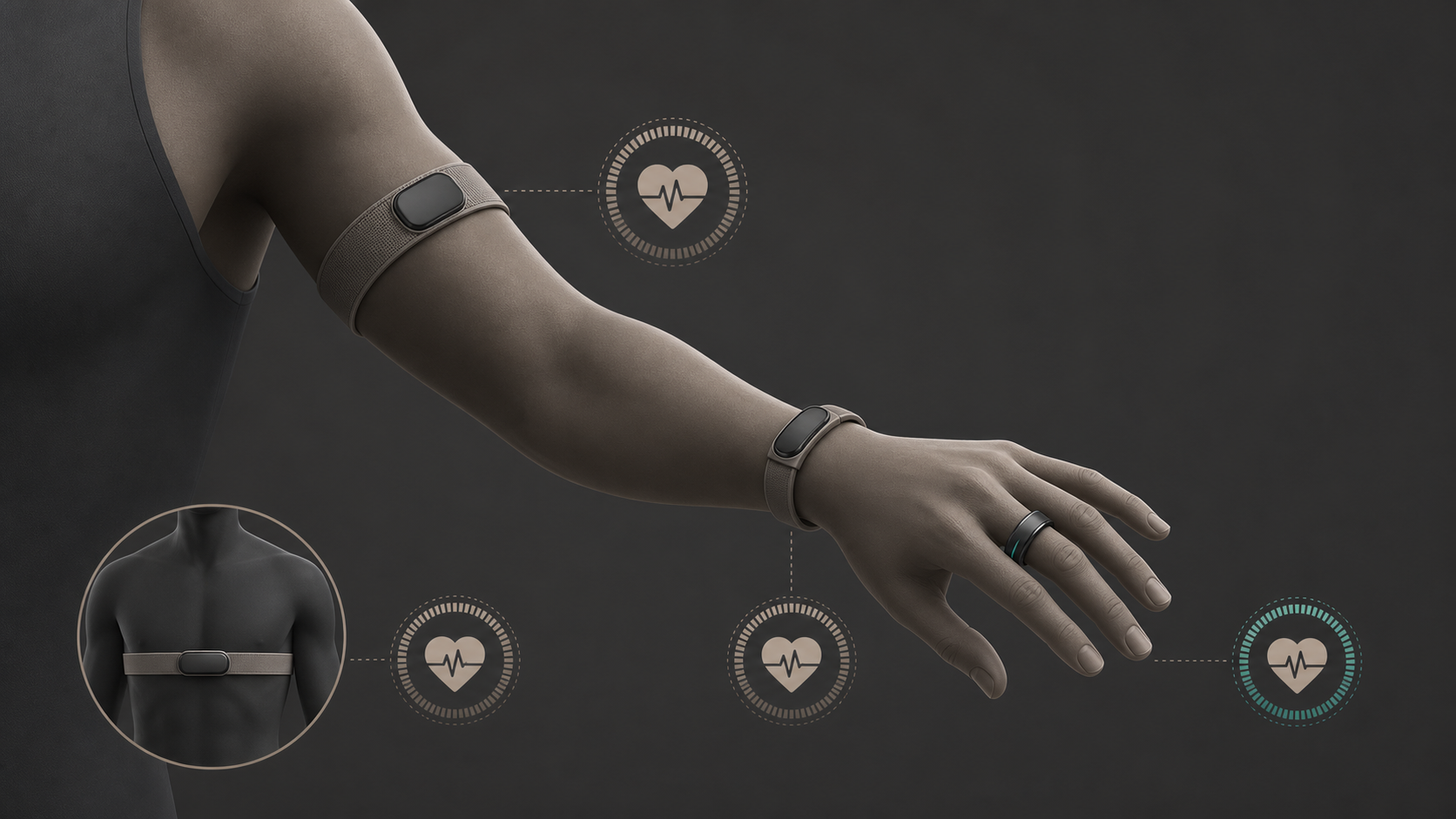
Every screenless fitness tracker — whether a fabric band like the Whoop 5.0 or a smart ring like the Oura Ring — relies on photoplethysmography (PPG) to measure heart rate. PPG works by shining LEDs into your skin and measuring how much light is scattered by blood flow beneath the surface. The sensor then translates those light fluctuations into a beats-per-minute (BPM) reading.
The problem is that PPG is highly sensitive to motion artifact and optical interference. When you run, lift, or swing a kettlebell, the tracker shifts on your skin. Ambient light leaks under the sensor. Muscles contract and change the tissue density under the device. All of these factors introduce noise into the optical signal, and the tracker's algorithm has to guess whether that noise is movement or a genuine heartbeat.
This is where placement becomes the single most important variable for screenless tracker accuracy. A band worn on the wrist experiences more movement, more tendon flex, and more light leakage than the same band strapped to the upper arm. A smart ring on the finger deals with cadence interference from gripping and swinging. A bicep band, by contrast, sits on a relatively stable muscle belly with consistent tissue contact and minimal ambient light exposure.
This result comes from one real apartment under the stated conditions — it is a strong signal, not a guarantee your space will measure identically.
Builds this evidence supports
No build currently links to this specific test. Browse all builds with a matching tag.
Spot something off?
If this result didn't match your own space, let us know — floor-damage and noise claims carry real deposit-risk consequences if we get them wrong.