
A fitness band watch makes very different measurements look equally official. Steps, active heart rate, sleep stages, HRV, SpO2, and calories all land in the same clean app interface, often with the same confident decimals and color-coded advice. That is the trap. “Accurate” does not mean the same thing for every metric, and using the wrong number for the wrong decision is where wearables become misleading: eating back a calorie estimate, canceling a workout because of one shaky sleep-stage chart, or treating a wrist heart-rate spike during intervals like chest-strap data.
The most useful starting point is the Kygo.app synthesis of 17 peer-reviewed studies, which compares Apple, Garmin, Fitbit, Oura, WHOOP, and Samsung across nine wearable metrics. It is helpful because it separates metric-by-metric performance instead of crowning one overall winner. It is also a secondary compilation, so the exact figures should be treated as a map to the underlying studies when a number will drive a serious decision. In that synthesis, Garmin leads step-count accuracy at 82.58%, Apple Watch leads active heart rate at 86.31% and SpO2 with a mean absolute error of 2.2%, and Oura Gen 4 leads nocturnal HRV and resting heart rate with concordance correlation coefficients of 0.99 and 0.98, respectively.[1]
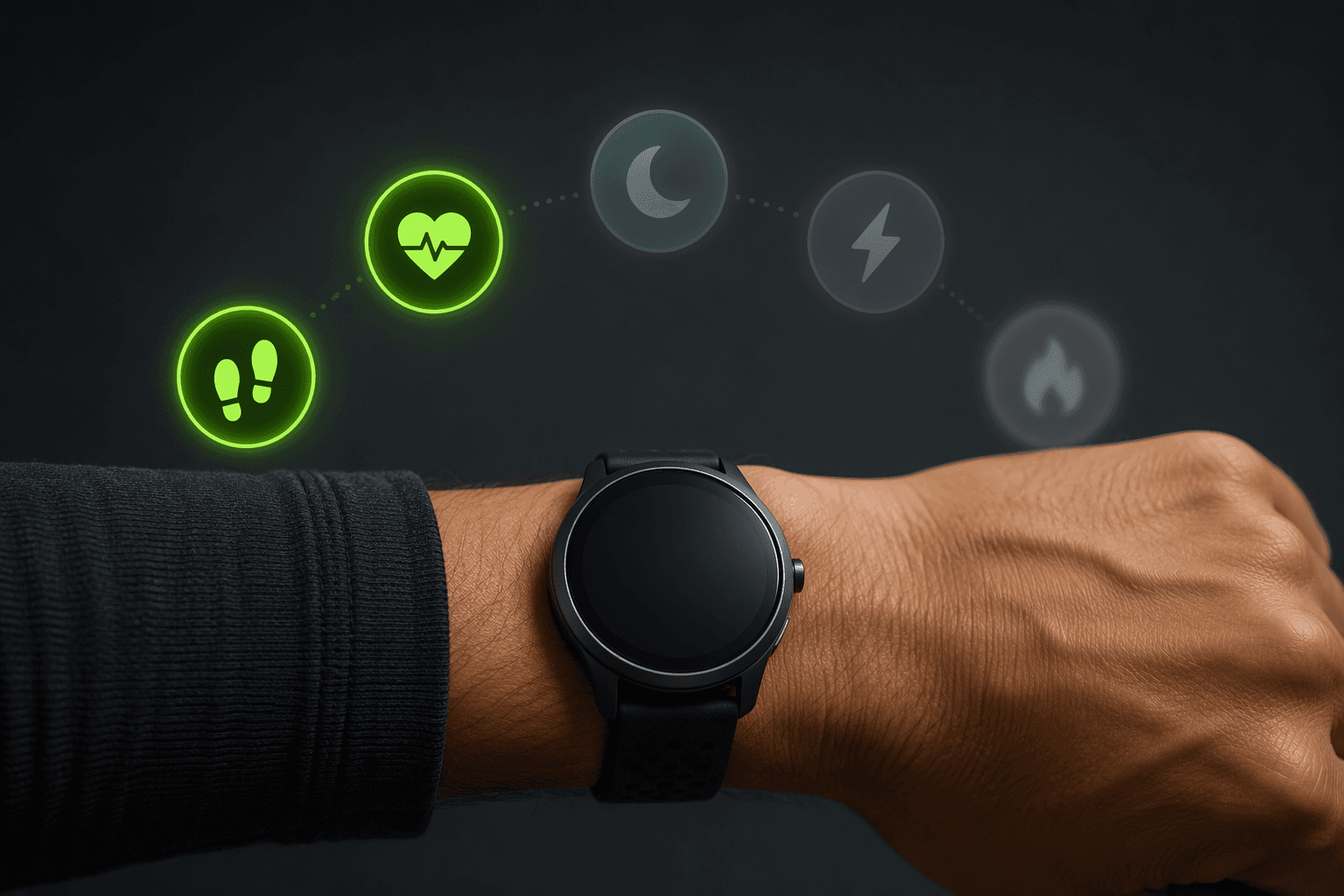
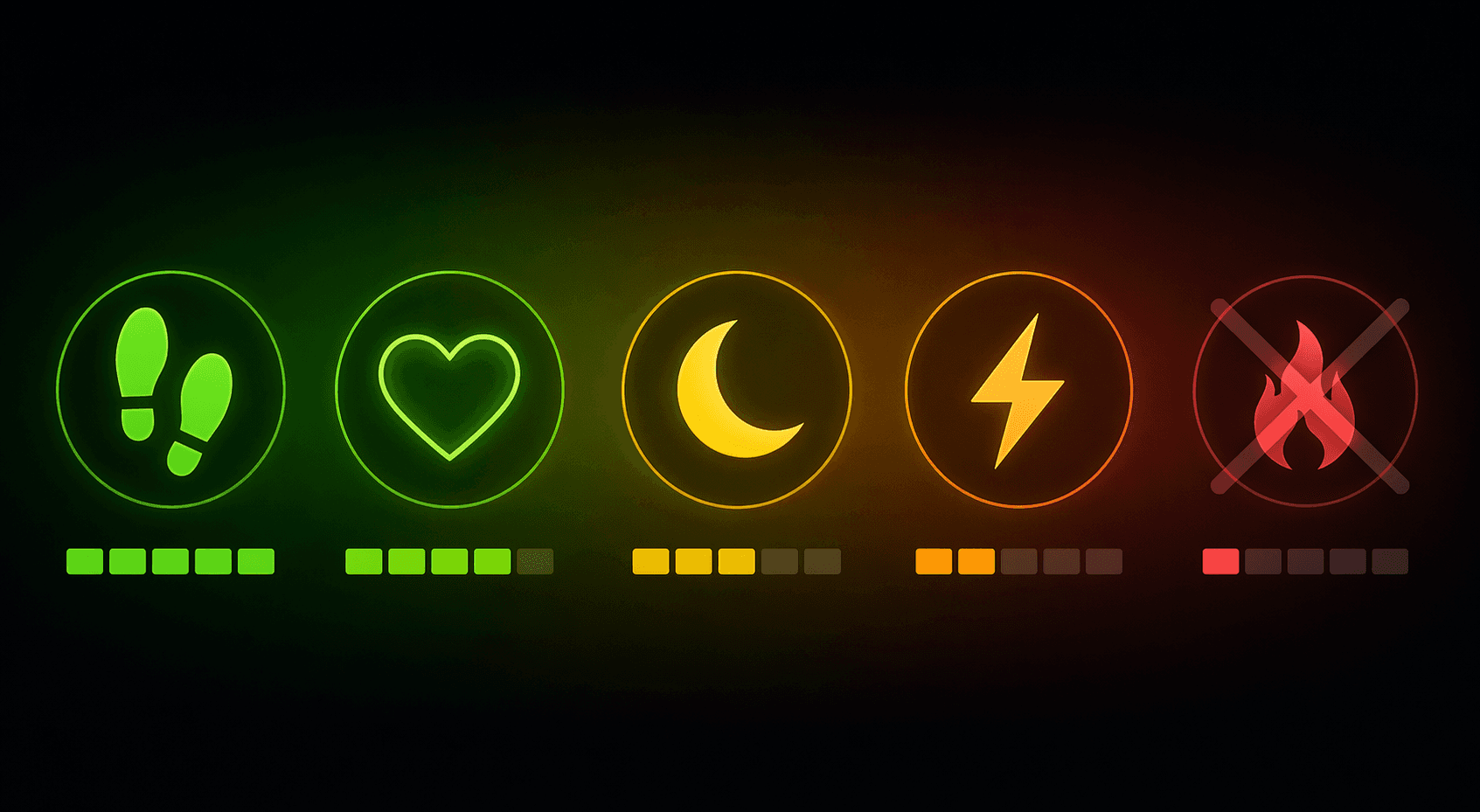
A practical trust map looks like this: step count is usually good enough for trend tracking, especially when the device is worn consistently; active heart rate can be useful for steady and moderate workouts, but wrist optical sensors become less dependable during high-motion sessions; HRV and resting heart rate can be strong recovery signals on the right device, especially overnight; sleep duration is more useful than fine-grained sleep staging; calorie burn is too weak for precision food decisions. None of that makes a wearable useless. It just means the same fitness band watch can be trustworthy for one behavior and too noisy for another.
Step count is the cleanest example of why testing setup matters. Kygo.app’s compiled ranking puts Garmin first on step accuracy, but Wirecutter’s controlled testing found the Fitbit Inspire 3 had a 0.32% step-count error rate, making it the standout in that test.[1][2] Those results do not really contradict each other; they describe different evidence environments. A lab-style or controlled walking test can reward one tracker, while a broader peer-reviewed synthesis across devices, conditions, and study designs can point elsewhere. For a home-training reader, the better lesson is not “Garmin always wins” or “Fitbit always wins.” It is that step count is one of the safer wearable metrics for comparing your own days, especially if you keep the same device and wear position.
Heart rate deserves more caution because people use it to change effort in real time. Apple Watch’s active heart-rate result in the Kygo.app synthesis makes it one of the stronger wrist options, and its SpO2 result is also comparatively strong, but consumer SpO2 features should not be treated as medical-grade evidence.[1] Wrist PPG still has known weak points: high-motion workouts, tattoos, and darker skin tones can degrade signal quality, and many validation studies have predominantly sampled Caucasian participants.[1] If workout heart rate is the number that changes your intervals, zone training, or rest periods, it is worth comparing wrist readings against a chest strap or armband rather than assuming the watch is equally reliable in every movement pattern. For more on that specific trade-off, see a form-factor comparison such as Wrist vs. Chest Strap vs. Armband vs. Smart Ring.
Recovery metrics sit in a narrower but interesting zone. Oura Gen 4’s nocturnal HRV and resting-heart-rate results are strong in the compiled evidence, with CCC values of 0.99 and 0.98.[1] That supports using those metrics as overnight trend signals: whether your resting heart rate is drifting upward, whether HRV is suppressed after a hard block, or whether travel and poor sleep are showing up physiologically. It does not mean a readiness score should automatically overrule how you feel or what your training plan requires. If recovery tracking is the main reason you are buying a device, the relevant comparison is less “best smartwatch” and more “which device measures overnight physiology well enough for the decisions I actually make.” A deeper recovery-focused branch belongs in a comparison like Whoop vs Oura vs Garmin: Choosing the Best Recovery Tracker.
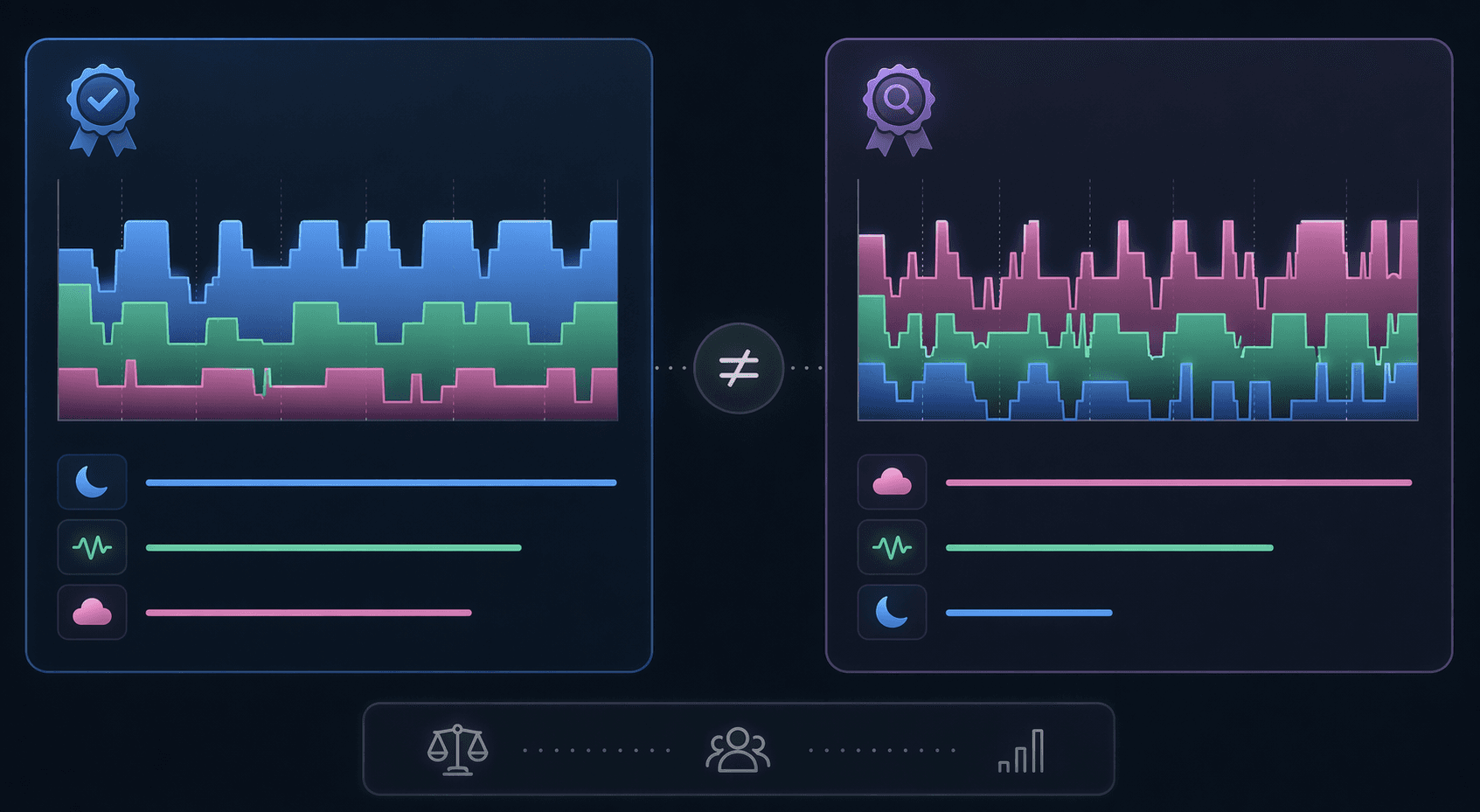
Sleep is where the neat buying-guide answer breaks down. In the Kygo.app summary, sleep staging results vary by study design and funding context rather than producing one stable winner.[1] The Oura-funded Brigham study ranked Oura first for sleep staging with κ=0.65, while an independent Antwerp study with 62 participants ranked Apple Watch first with κ=0.53.[1] A funded study is not automatically useless, and an independent study is not automatically definitive. But the split is exactly why a sleep-stage graph should be treated as an estimate, not a lab verdict. The device may be useful for bedtime consistency, total sleep trends, and noticing repeated disruption. It is much less safe as a reason to declare that last night’s REM or deep sleep number was precisely right.
Calories are the bluntest category. The Kygo.app synthesis reports calorie-tracking accuracy as poor across brands, with Apple Watch the best performer at 71% accuracy and Garmin at 48%.[1] The 2022 systematic review by Germini et al. reached the same practical conclusion: wrist-worn devices do not come close enough on energy expenditure to support precise calorie decisions.[3] That is enough evidence to draw a firm boundary. Use calorie burn as a rough activity signal if you like the motivation, but do not use it as a precise number to eat back after a treadmill walk or dumbbell session.
Device generation also matters. Some studies in the reviewed evidence tested older hardware, such as WHOOP 4.0 rather than WHOOP 5.0 or Garmin Fenix 6 rather than Fenix 8.[1] That does not make the results worthless, but it should lower confidence when a current purchasing decision depends on a precise ranking. The same caution applies to budget trackers: a cheaper band may be perfectly acceptable for steps and broad heart-rate trends while being less convincing for harder recovery or workout-intensity decisions. If price is the constraint, a guide like What You Actually Lose With a $50 Fitness Tracker is the more honest next question than pretending every low-cost tracker fails equally.
The best fitness band watch is therefore not the one with the longest feature list. It is the one whose strongest measurements match the behavior you will actually change. If steps are your main accountability tool, prioritize step accuracy and comfort. If workout intensity matters, be stricter about heart-rate validation and consider whether a chest strap belongs in the setup. If recovery drives your training decisions, look at overnight HRV and resting-heart-rate evidence before buying into a readiness score. Treat sleep stages and calories as rough trend signals. Do not treat any consumer wearable as medical-grade proof.
References
- What’s the Most Accurate Wearable Data? A 2024–2025 Study Breakdown by Device, Kygo.app.
- The Best Fitness Trackers, Wirecutter, 2026.
- Accuracy and Acceptability of Wrist-Wearable Activity-Tracking Devices: Systematic Review of the Literature, Journal of Medical Internet Research, 2022.
Comments
Join the discussion with an anonymous comment.