
A fitness tracker ring can be lovely in exactly the way home workout gear rarely is: small, quiet, and not asking for wrist space while you sleep, work, stretch, cook, or recover. That does not make it the right tracker for every home gym. The better question is simpler: during a normal week, which two or three metrics would you actually change your behavior around?
If those metrics are sleep duration, resting heart rate, HRV trends, and readiness-style recovery scores, a ring deserves a serious look. If they are live heart rate during intervals, pace on a treadmill or walking pad, strength-session logging, or checking data without stopping mid-set, the prettier device may be the less useful one.
The Short Version: Let the Workout Decide
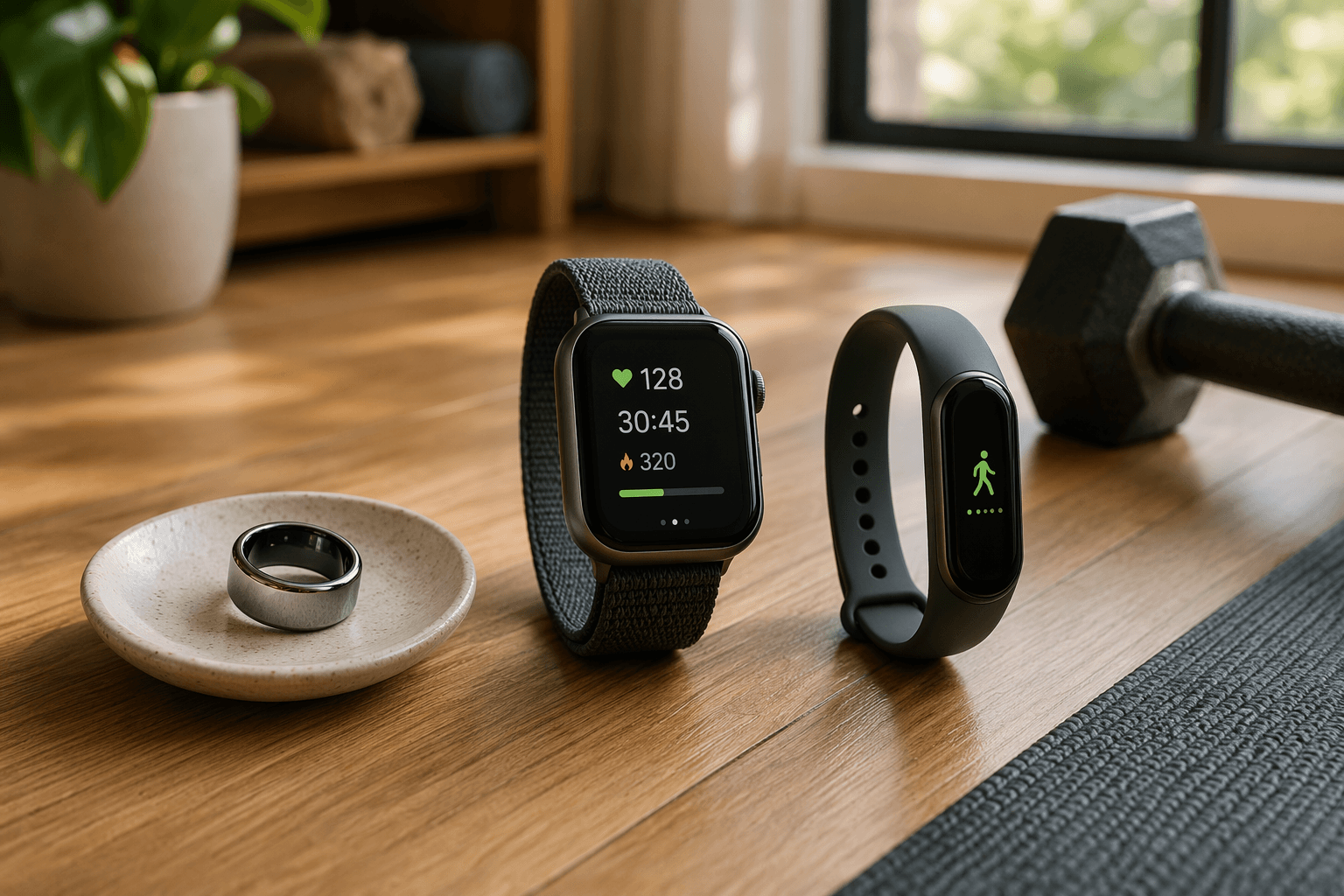
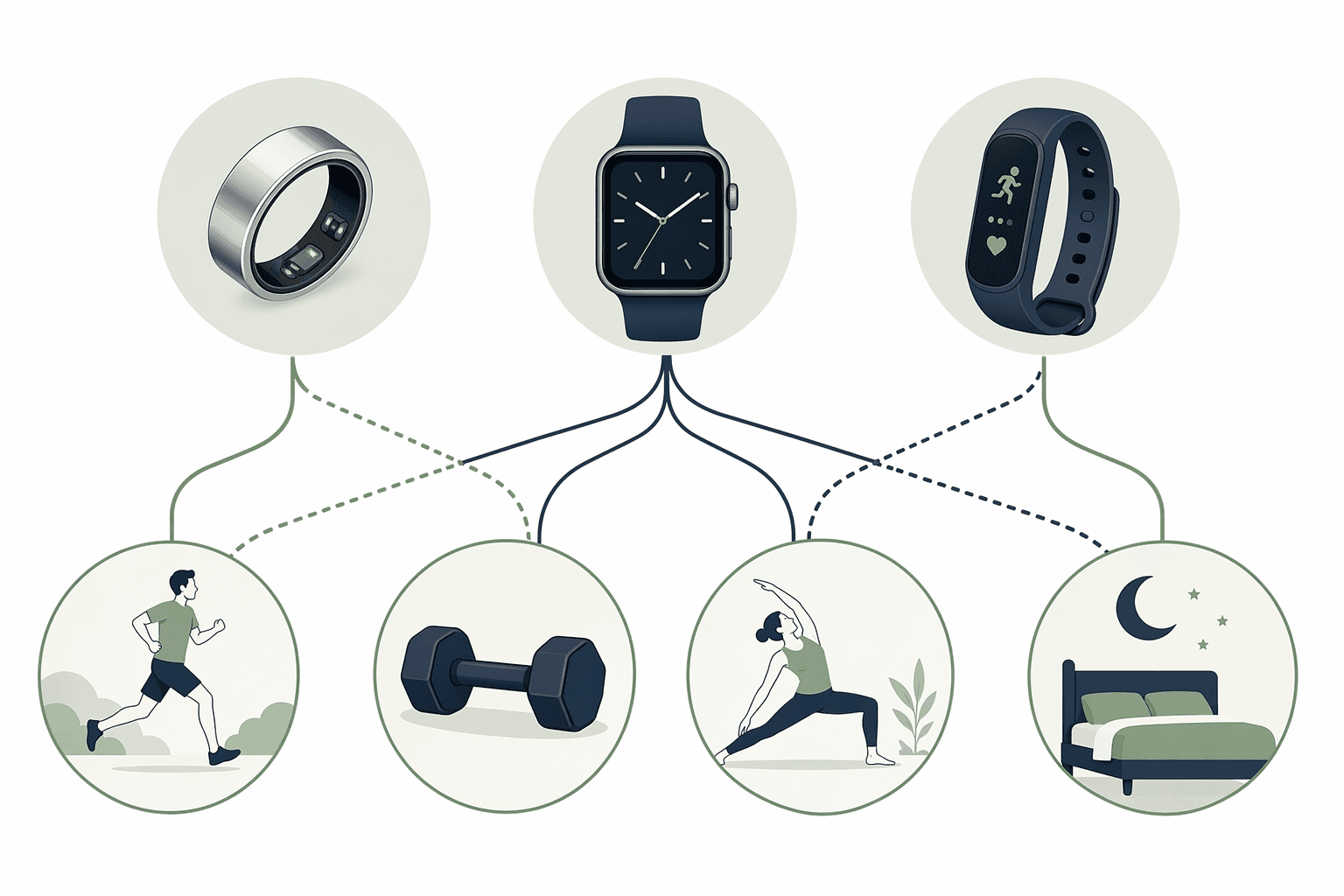
No form factor wins the whole spare-room gym. Rings are structurally good at disappearing overnight and collecting quiet recovery data. Watches are better when you need a screen, richer workout modes, GPS-related features, and mid-session feedback. Fitness bands sit in the middle: less bulky than a watch, usually more workout-visible than a ring, and often enough for people who want basic heart rate, steps, and exercise tracking without turning their wrist into a tiny phone.
| Home Fitness Scenario | Best Fit | Why |
|---|---|---|
| Treadmill, walking pad, stationary bike, rower | Smartwatch or fitness band | You usually benefit from a visible display, active heart-rate feedback, and stronger step or workout tracking. |
| Dumbbells, kettlebells, barbell, cable machine | Smartwatch or fitness band | A ring can interfere with grip and is easier to dislike once metal meets metal. |
| Yoga, Pilates, stretching, mobility | Ring, watch, or band | Movement interference is lower, so comfort and app preference matter more. |
| Sleep, HRV, recovery trends | Fitness tracker ring | This is where rings have their strongest evidence and their least annoying form-factor advantage. |
| General wellness and all-day tracking | Ring if comfort comes first; band or watch if workouts matter too | A ring is easier to wear continuously, but a wrist device is easier to use during exercise. |
That table is the real buying fork. The rest is about making sure the tradeoff you accept is the one you meant to accept.
Why Rings Are So Persuasive for Sleep and Recovery
The strongest case for a fitness tracker ring is not that it is futuristic. It is that people are more likely to keep it on when the useful recovery data is being collected. A systematic review covering 107 studies and about 100,000 participants found that smart rings reached 92–95% accuracy for sleep/wake detection compared with polysomnography, the clinical sleep-measurement standard used as the reference point in the review.[1]
That sentence needs a careful pause. Sleep/wake detection is not the same thing as perfectly identifying light, deep, and REM sleep. The same review reports lower accuracy for four-stage sleep classification, around 79%, while binary sleep/wake classification sits higher at 93–96%.[1] So when a ring brand talks about “sleep accuracy,” the useful follow-up is: accurate at what part of sleep?
Still, the ring advantage is real enough to matter. Fingers are a good place to measure quiet physiology. The systematic review reports that finger-based photoplethysmography, or PPG, produced 95% analyzable waveforms, compared with 67–86% for wrist measurements, because fingers have higher vascular density.[1] That helps explain why rings can perform very well on resting heart rate and HRV during stillness: the review reports r²=0.996 for resting heart rate and r²=0.980 for HRV versus medical ECG in the evidence it examined.[1]
This is where rings feel less like jewelry-with-an-app and more like a sensible recovery tool. If you are sleeping in it consistently, charging it less often, and collecting cleaner overnight pulse data while still, the trend line becomes more useful. Jointcorp’s comparison claims 98% of ring users wear them overnight versus 67% of smartwatch users, which is useful context but should be treated as vendor-side comparison data rather than peer-reviewed evidence.[2]
Battery life helps the same argument. Smart rings commonly last 7–12 days per charge, while feature-rich smartwatches often sit closer to 18 hours to 2 days.[2] Fewer charging gaps matter most at night. A tracker that is on the charger at 11 p.m. because it barely survived an interval session is not collecting the recovery data you bought it for.
For recovery-first buyers, this is the cleanest ring recommendation: choose the ring if you want comfortable overnight wear, HRV and resting-heart-rate trends, sleep consistency, and a lower-friction way to keep the device on. If that is your priority, a deeper comparison of recovery metrics belongs in a dedicated fitness tracker for recovery guide.
Where the Ring Starts to Struggle: Active Cardio
Home cardio is where elegant wearables meet the messy details: a walking pad under a desk, a treadmill in the basement, a rower tucked against the wall, a stationary bike with its own console, or intervals where you want to know whether your heart rate has actually settled before the next push.
A ring can record a workout, but it is not built around live workout control. No fitness tracker ring has built-in GPS, so distance and route data rely on a connected phone when GPS matters. No display also means no quick glance at heart rate, pace, elapsed time, or training zone while you are moving. If your watch buzzes and shows you that you are drifting too hard on a recovery interval, that is not a luxury feature; it is the feedback loop.
The step-counting gap also matters more for home cardio than it does for sleep tracking. Jointcorp reports step-counting accuracy of 85–92% for rings versus 96–98% for wrist bands.[2] The systematic review also found that the Oura Ring overestimated daily steps by about 1,416 steps on average compared with research-grade ActiGraph accelerometers.[1] For someone using a walking pad to hit a daily movement target, that is not just a nerdy accuracy quibble. It can change whether the device says you hit the goal.
A treadmill runner who cares mostly about sleep may still tolerate those limits. A treadmill runner who trains by zones, pace blocks, incline intervals, or time-at-intensity probably should not. The same goes for anyone who wants a wearable to pair neatly with other home gym equipment, show workout data during the session, or help structure the workout rather than merely summarize it afterward.
For cardio-heavy home workouts, start with a watch or band. If you have already decided against a ring because your workouts need visible data and equipment compatibility, the more useful next stop is a home gym fitness tracker comparison that focuses on wrist-based options.
Strength Training Is Less Friendly to Rings Than Product Photos Suggest
A smart ring looks harmless next to a dumbbell until you actually wrap your hand around the handle. Strength training adds pressure, friction, chalk, knurling, kettlebell rotation, cable attachments, and the occasional awkward re-rack. Even when a ring does not get damaged, it can change how a lift feels in your hand.
That is the practical issue: a ring occupies the exact place that many strength movements load. Dumbbell rows, deadlifts, pull exercises, farmer’s carries, kettlebell swings, and barbell work all ask your fingers to close around metal. A wrist device may be imperfect during strength training, but it is not sitting between your grip and the implement.
There is also the feedback problem. During a strength session, you may want a timer, set logging, rest alerts, heart-rate trend, or a quick way to mark the workout without taking your phone out. A ring gives you less direct control because there is no screen. That may be fine for a recovery tracker that passively watches your sleep. It is less fine when you are between sets and trying not to lose the thread of the workout.
For most strength-focused home gyms, a band or watch is the safer first wearable. The details depend on your equipment and app setup, especially if you want heart-rate broadcasting, machine pairing, or reliable use around dumbbells and bars. Those fit questions are covered more directly in the home gym fitness tracker compatibility guide.
Yoga, Pilates, and Mobility Are More About Preference
Yoga, Pilates, stretching, and mobility work do not punish the ring form factor in the same way a barbell can. There is less gripping, less impact, and less need to stare at live metrics. If your sessions are mostly mat-based and you want the wearable to stay out of the way, a ring can make sense.
A watch or band can still be better if you like guided sessions, visible timers, heart-rate zones, or starting and stopping workouts from your wrist. But this is one of the few home-fitness categories where the decision can honestly be driven by comfort, app taste, and whether you dislike sleeping in a wrist device.
General Wellness: Decide Whether “Always On” Means Recovery or Workouts
For general wellness, rings are easy to over-recommend because they feel so effortless. If your real goal is to understand sleep consistency, resting heart rate, HRV, general activity, and recovery trends, the ring’s comfort advantage is meaningful. A device you willingly wear all day and overnight will usually beat a more capable device left on the bathroom counter.
But “general wellness” often quietly includes workouts. If you expect your tracker to guide a walking-pad habit, capture a strength block, show live heart rate, or replace your phone during exercise, the ring becomes less complete. In that case, a lightweight fitness band may be the better compromise: still smaller than a smartwatch, but with a screen and more workout-facing controls.
The Cost Question: Subscriptions Change the Ring Math
Rings are not all priced the same after purchase. Oura requires a $5.99 monthly membership for full features, or $71.88 per year. Over three years, a $349 Oura Ring reaches $564.64 in total cost, while Samsung Galaxy Ring, RingConn, and Ultrahuman Ring AIR are positioned as subscription-free alternatives in the comparison data.[2]
That does not automatically make one ring better than another. It does mean the subscription belongs in the first round of buying math, not as a surprise after the sizing kit arrives. Recovery scores, sleep insights, and trend history are the main reasons many people buy a ring; if those features sit behind a membership, the membership is part of the device.
Model availability and legal disputes can also shift quickly in the smart-ring category. That is a reason to check current retailer availability before buying, not a reason to build the whole decision around patent headlines. The bigger question remains whether a ring matches your workouts in the first place.
A Practical Buying Filter
Use this filter before getting pulled into model names:
- Choose a fitness tracker ring if your top priorities are sleep, HRV, resting heart rate, recovery trends, comfort, and overnight wear consistency.
- Choose a smartwatch if you want the richest workout tools, visible metrics, alerts, GPS-related features, and the most control from the wrist.
- Choose a fitness band if you want a lighter wrist device with a screen, basic workout tracking, and less bulk than a smartwatch.
- Avoid making a ring your only tracker if your week is built around treadmill sessions, walking-pad goals, barbell work, dumbbell circuits, or mid-workout feedback.
- Check subscription costs before comparing ring prices, because recovery insights and long-term trends may depend on paid access.
The neatest device is not always the best home workout device. A ring can be the right answer when recovery is the job. A watch or band is often the better answer when the workout itself needs attention. If your next purchase is really about sleep and readiness, continue with the recovery tracker guide. If your next purchase needs to survive cardio equipment, dumbbells, and actual mid-session use, move to the best home-gym tracker guide or the home gym compatibility guide.
Comments
Join the discussion with an anonymous comment.