
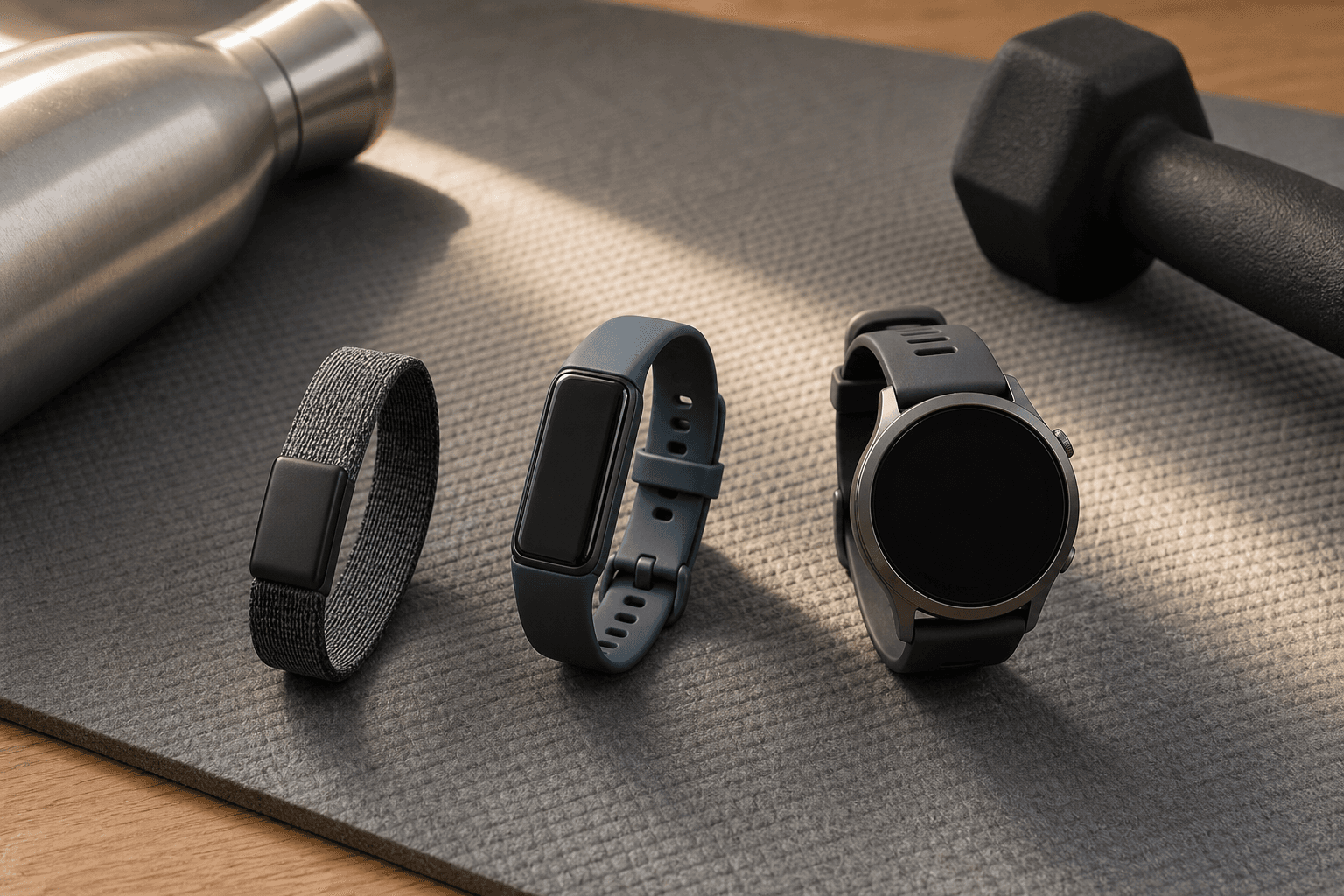
The Real Question: Do You Check It Mid-Workout or Ignore It Until the App?
For years, the buying decision was framed as a binary: smartwatch or fitness tracker. That distinction has all but dissolved. The Apple Watch tracks your sleep. The Fitbit Charge 6 shows notifications. The Garmin Vivoactive 6 runs apps. The lines are so blurred that asking "smartwatch or tracker?" no longer produces a useful answer.
What actually matters is a single behavioral question: Do you want a tool you glance at during a set, or a background collector you strap on and ignore until the data lands in your phone? Your answer determines which of three distinct form factors — screenless band, fitness-first tracker in a watch body, or full smartwatch — will actually serve your home workouts.
This guide walks through each form factor, the trade-offs you actually feel day to day, and the real costs — both upfront and ongoing — so you can match a device to how you train, not to a feature checklist.
Form Factor 1: Screenless Bands — For the 'Set It and Forget It' Athlete
Screenless bands — like the Fitbit Air, Whoop 5.0, and Hume Band 2.0 — are designed for people who want continuous data collection with zero in-the-moment distraction. You wear it 24/7, it logs activity, sleep, and recovery metrics, and you review everything later in the companion app. There is no screen to glance at mid-rep, no notification buzz to break your focus.
The Fitbit Air, released in May 2026, is the current standout in this category. At $100 with a 7-day battery, it offers automatic activity detection and optional Google Health Coach integration ($100/year). Wirecutter and PCMag both praise its highly accurate heart rate and sleep tracking for a device at this price point. The Whoop 5.0 takes a different approach: no upfront hardware cost, but a subscription of $199 to $359 per year, with a 14-day battery and on-wrist charging.
The trade-off is straightforward: you trade mid-workout stats for maximum battery life and minimal wrist bulk. If your home workouts are steady-state cardio, bodyweight circuits, or strength training where you don't need real-time pace or heart rate data, a screenless band is likely the best fit. For a deeper look at this category, see our Screenless Fitness Tracker Buyer's Guide 2026.
Form Factor 2: Fitness-First Tracker in a Watch Body — The Sweet Spot for Most Home Workouts
If you want to see your heart rate during a HIIT interval, check your pace on a run, or glance at rep counts without pulling out your phone, a fitness-first tracker in a watch body is the middle ground. Devices like the Huawei Watch Fit 4, Fitbit Charge 6, Xiaomi Smart Band 10, and Amazfit Active 2 offer a color display, workout-specific metrics, and often built-in GPS — but they stop short of a full app ecosystem. You won't be installing third-party apps or replying to messages from your wrist.
Wareable calls the Huawei Watch Fit 4 the best value fitness tracker on the market, noting it delivers 90% of the features for 30% of smartwatch prices. It packs a 1.82-inch AMOLED display, dual-frequency GPS, and a 7–10 day battery life. The Xiaomi Smart Band 10, at roughly $53 with a 14-day battery and 5ATM water resistance, is the budget king of this category.
The Fitbit Charge 6, at $160, is CNET's best overall for general fitness tracking and includes Google Maps and Wallet integration. However, Wirecutter found its GPS connection to be spotty, so if you run outdoors and need reliable distance tracking, the Huawei or a Garmin may serve you better.
| Device | Price | Battery Life | Key Features | Caveat |
|---|---|---|---|---|
| Huawei Watch Fit 4 | ~$150–200 | 7–10 days | 1.82" AMOLED, dual-frequency GPS | Limited US availability |
| Fitbit Charge 6 | $160 | 7 days | GPS, Google Maps/Wallet, 40 exercise modes | Spotty GPS (Wirecutter) |
| Xiaomi Smart Band 10 | ~$53 | 14 days | Large AMOLED, 5ATM water resistance | Basic smart features |
| Amazfit Active 2 | ~$80 | 10 days | Offline maps, sub-$80 price | Less accurate HR during intervals |
Comments
Join the discussion with an anonymous comment.