
A $99 fitness tracker can be a genuinely good buy. It can also be the start of a three-year bill that quietly passes the price of a better, subscription-free watch. That is the subscription trap: the checkout price looks like the budget decision, while the useful sleep, recovery, readiness, coaching, or long-term trend features live somewhere else.
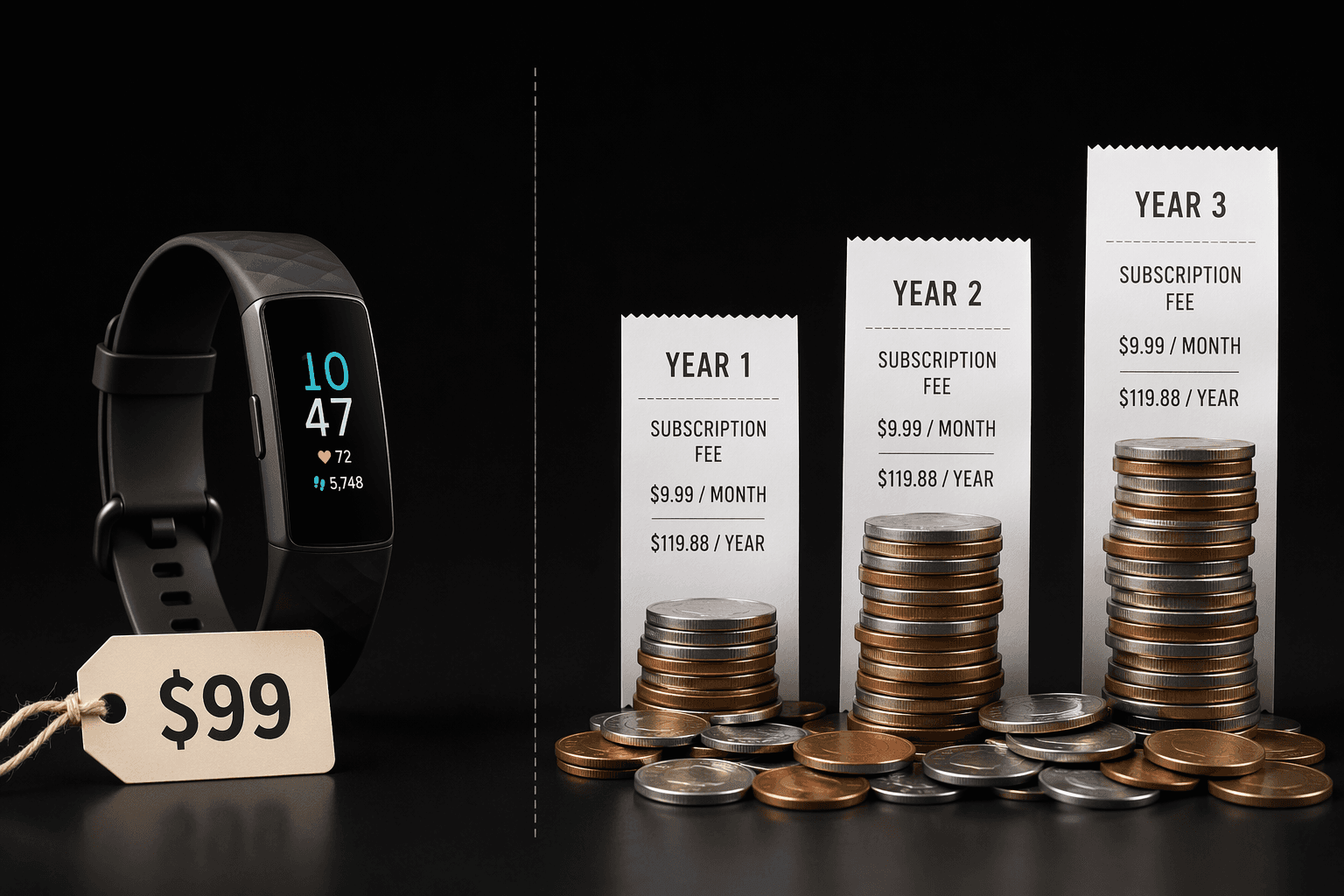
If you are shopping for the best fitness tracker on a real budget, the useful comparison is not “Which one is cheapest today?” It is “What will I pay before I replace this thing?” For most people, that means looking at one, two, and three years of ownership before getting attached to a brand’s recovery score.
| Tracker | Ownership model | Upfront price in brief | 1-year total | 2-year total | 3-year total | What changes the value |
|---|---|---|---|---|---|---|
| Xiaomi Smart Band 10 | No required subscription | $53 | $53 | $53 | $53 | The low price stays low because the brief does not identify a recurring fee for core use. |
| Amazfit Active 2 | No required subscription | $65 | $65 | $65 | $65 | Another low-cost option where the ownership math is not reshaped by a required plan. |
| Fitbit Inspire 3 | Hybrid, but usable without Premium | $80–$100 | $80–$100 without Premium; about $160–$200 with one year of Premium | $80–$100 without Premium; about $240–$300 with two years of Premium | $80–$100 without Premium; about $320–$400 with three years of Premium | Core metrics do not require a subscription, but deeper sleep and readiness data are paywalled. Wirecutter measured 0.32% step-count error in controlled treadmill testing, which is impressive but not the same as free-living accuracy. [1] |
| Fitbit Air | Hybrid, new screenless model | $100 | $100 without optional AI; $200 with one year of Google Health Coach AI | $100 without optional AI; $300 with two years of Google Health Coach AI | $100 without optional AI; $400 with three years of Google Health Coach AI | Released May 26, 2026, and rated 4.5/5 Editors’ Choice by PCMag. Basics do not require a subscription, but the optional $100/year AI layer is still a moving target this early in the product’s life. [2] |
| Garmin Vivoactive 6 | No subscription needed for core features | $300 | $300 | $300 | $300 | Garmin’s new $70/year Connect+ tier adds AI features, but sleep, stress, HRV, readiness, and training-load data remain usable without it. [3] |
| Fitbit Charge 6 | Hybrid, with persuasive features behind Premium | $120–$160 | $200–$260 with Premium | $280–$360 with Premium | $360–$460 with Premium | The device can be cheap at checkout, but Daily Readiness Score, detailed sleep analysis, and personalized coaching move the real purchase into Premium territory for many buyers. [2][4] |
| Oura Ring 4 | Subscription strongly shapes ownership | $349 device + $70/year | $419 | $489 | $559 | The ring is not pretending to be a $99 tracker, but the annual membership still matters because the device price is only the start. [4] |
| Whoop 5.0 | Mandatory membership | $199–$359/year membership, plus device | $199–$359 plus device | $398–$718 plus device | $597–$1,077 plus device | This is the cleanest example of a device where the subscription is not an add-on. It is the ownership model. [4] |
The table is intentionally blunt because that is how the purchase should be judged. A Garmin Vivoactive 6 at $300 looks expensive next to a discounted Fitbit Charge 6. After three years with Premium, the Charge 6 can land at $360–$460. A Fitbit Inspire 3 can stay a bargain if you are satisfied with the included metrics. A Whoop 5.0 can cost $597–$1,077 over three years before counting the device itself.
For a shorter version of this math, the site’s two-year total-cost comparison is still useful. The three-year view is harsher because recurring fees have more time to overtake the device price.
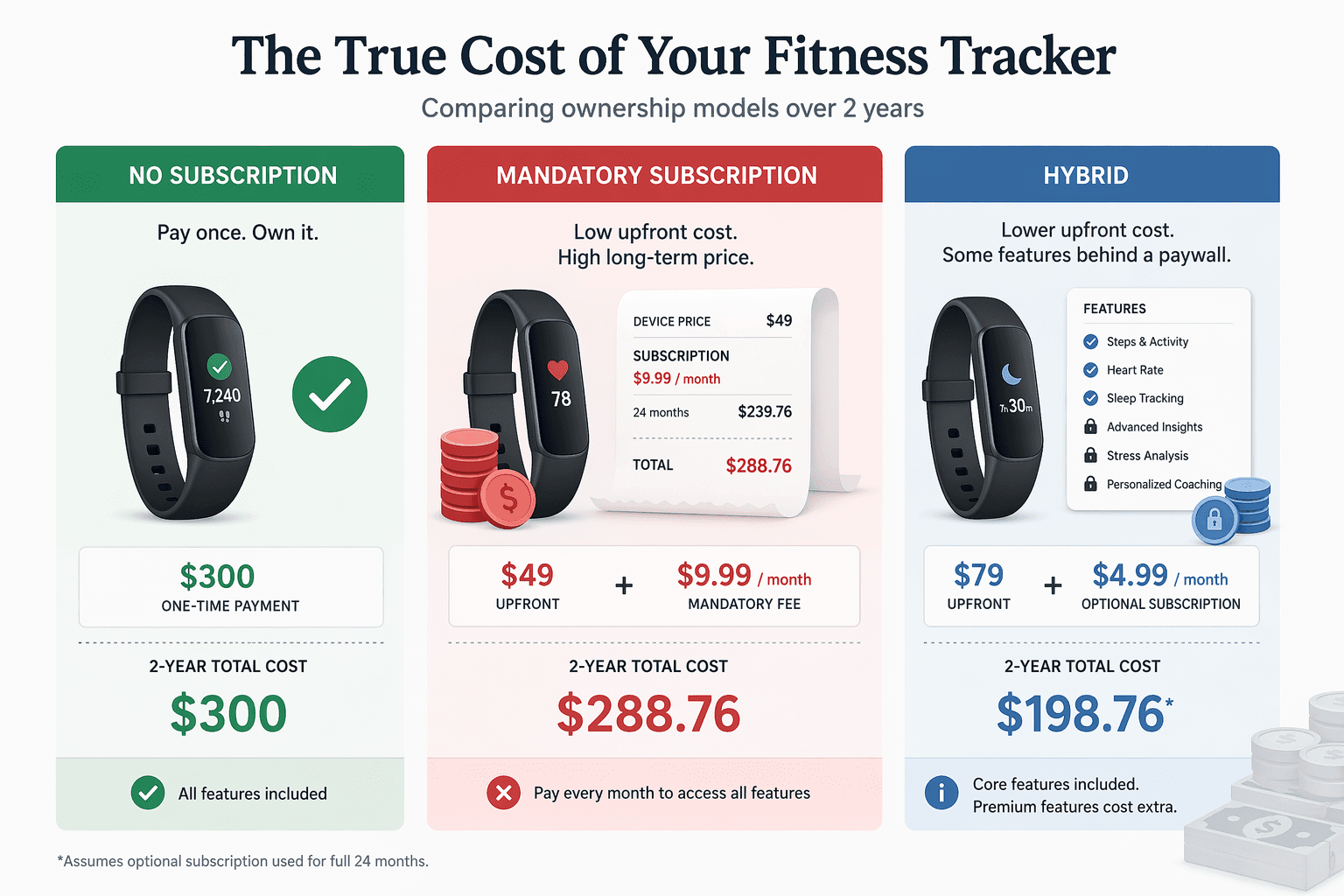
The three ownership models matter more than the brand names
Fitness trackers are often compared by sensors, app polish, battery life, GPS, and workout modes. Those details matter once two devices have the same ownership model. They matter less when one device lets you keep using your sleep, HRV, stress, and training data without a monthly bill while another turns the most persuasive insights into an annual payment.
No-subscription champions
This is the cleanest category for budget-conscious buyers. Xiaomi Smart Band 10 at $53 and Amazfit Active 2 at $65 keep the basic promise of budget gear: you pay once, then use the device. They may not give you the most refined coaching experience, and they may not be the right pick for every athlete, but the cost does not keep re-opening every year.
Garmin Vivoactive 6 is the more interesting case because it costs more up front. At $300, it can look like the less frugal choice in a store search. But Garmin’s core sleep, stress, HRV, readiness, and training-load data remain available without the new $70/year Connect+ plan, which makes the three-year ownership cost much easier to defend. [3]
Connect+ is not irrelevant; some buyers will want its AI-driven extras. The important point is that Garmin is not using that tier to make the baseline health and training picture feel broken. If you want the deeper Connect+ question, read the dedicated Garmin Connect+ review rather than treating the subscription as mandatory.
Mandatory-subscription devices
Whoop 5.0 sits at the opposite end. Its membership tiers are $199/year, $239/year, or $359/year, and all are mandatory. Over three years, that is $597–$1,077 plus the device itself. [4] This may be perfectly acceptable for someone who wants Whoop’s coaching style and is already prepared to pay for it. It is not a cheap tracker in any practical ownership sense.
Oura Ring 4 is less extreme but still subscription-shaped. The device is $349 and the membership is $70/year, bringing the three-year total to $559. [4] That is not a hidden catastrophe; it is a premium wearable with a recurring software layer. The problem starts when shoppers compare only the device price against watches that do not need an annual plan for their core health dashboards.
Hybrid trackers: where the sticker price can still be honest, or not
Fitbit is the category that deserves the most care because it is easy to flatten into either “cheap and great” or “subscription trap.” Both are too simple.
Fitbit Inspire 3 is still one of the strongest low-cost arguments in the market. It costs $80–$100, does not require Premium for core metrics, and Wirecutter found 0.32% error in step counting during controlled treadmill testing. [1] That test result should not be inflated into a claim that it is the most accurate tracker in every real-world setting. Still, for a first tracker, the combination of low price, solid basics, and no required subscription is unusually defensible.
Fitbit Charge 6 is a different calculation. The device price of $120–$160 can look budget-friendly, especially during discounts, but Fitbit Premium adds $80–$100/year if you want Daily Readiness Score, detailed sleep analysis, and personalized coaching. Over two years, that pushes the total above $300; over three years, it reaches $360–$460. [2][4]
That does not make the Charge 6 a bad tracker. It means the buyer should decide at checkout whether the Premium layer is part of the purchase. If the answer is yes, compare it with $300 subscription-free devices, not only with $99 or $120 bands.
Fitbit Air complicates the screenless category in a useful way. It launched on May 26, 2026, at $100, with PCMag rating it 4.5/5 and naming it an Editors’ Choice. [2] Its basics do not require a subscription, while the optional Google Health Coach AI costs $100/year. That makes it a serious alternative to Whoop for shoppers who like the screenless form but do not want mandatory membership economics. Because it is so new, and because Google’s health-app transition is still settling, its final feature map deserves caution rather than overconfident verdicts.
For that narrower comparison, the site’s Fitbit Air vs. Whoop 5.0 guide is the better place to dig into screenless trade-offs.
The real trap is not only the bill. It is the history you build.
A subscription lapse on a fitness tracker is not like declining a new watch band or skipping a software add-on you never used. The more faithfully you wear the device, the more valuable your history becomes. Sleep trends, resting heart-rate changes, HRV patterns, recovery scores, workout strain, and readiness data are most useful after they have had time to become personal.

That is where data lock-in becomes a budget issue. If a service limits storage access, shortens the visible history, or removes the trend views that helped you understand your sleep and recovery, quitting does not simply save money. It can make the device feel smaller than the one you originally bought.
The pain is practical. You may still see last night’s sleep, but lose the longer view that showed whether late workouts were hurting recovery. You may still record exercise, but lose the readiness or coaching layer that made the watch feel personal. You may still own the hardware, but the accumulated context becomes harder to use.
This is why “optional” needs scrutiny. Optional is fine when the unpaid product remains coherent. Optional is less fine when the device is priced to attract budget buyers and then saves its most persuasive interpretation for the paid tier. Fitbit Inspire 3 is easier to recommend because its core use remains low-cost. Fitbit Charge 6 requires more self-knowledge: if you know you will want Premium, calculate it from day one.
Mandatory subscriptions are at least clearer. Whoop is not asking you to discover the real model after six months. The membership is the product. That clarity helps, but it does not make it a budget pick.
What to buy if you are trying to stay under budget
Start with the no-subscription price as the benchmark, not the cheapest sticker in search results. If a $300 tracker gives you the health and training data you want without a recurring fee, then a $120 tracker with three years of $80–$100 Premium is not the cheaper option anymore.
- Choose Xiaomi Smart Band 10 or Amazfit Active 2 if the main goal is keeping the purchase genuinely inexpensive and avoiding recurring cost.
- Choose Fitbit Inspire 3 if you want a low-cost tracker with strong step-count performance in controlled testing and you are comfortable living without the deeper Premium insights.
- Choose Garmin Vivoactive 6 if you can spend more up front to avoid long-term friction around sleep, stress, HRV, readiness, and training-load data.
- Choose Fitbit Charge 6 only after deciding whether Premium is part of the real purchase. If it is, compare the three-year total against Garmin and other subscription-free options.
- Choose Oura Ring 4 or Whoop 5.0 only if the paid layer is the reason you want the device, not something you hope to ignore.
- Treat Fitbit Air as promising but still new. Its no-subscription basics make it interesting; its optional AI layer needs more time in ordinary use.
If you want a broader buying guide that weighs workout types, phone compatibility, and smartwatch features alongside subscription costs, use the main best fitness tracker guide. If you train mostly at home, the home-workout tracker guide narrows the field without pretending subscriptions are a footnote.
The safest default for a budget-conscious buyer is simple: buy the tracker whose unpaid version you would still be happy using in year two and year three. If the unpaid version feels incomplete, put the subscription in the price before you buy.
References
- The Best Fitness Trackers — The New York Times Wirecutter
- The Best Fitness Trackers — PCMag
- The Best Fitness Trackers — WIRED
- The best fitness tracker — Wareable
Comments
Join the discussion with an anonymous comment.