
Do you need $239 a year for a wrist band? No — but you might need a $99 one. The Fitbit Air launched in May 2026, and within weeks every reviewer was calling it a Whoop killer. I spent a week with the specs, the accuracy data, and the fine print, and I think the headline is mostly right — but not for everyone.
What $99 Gets You
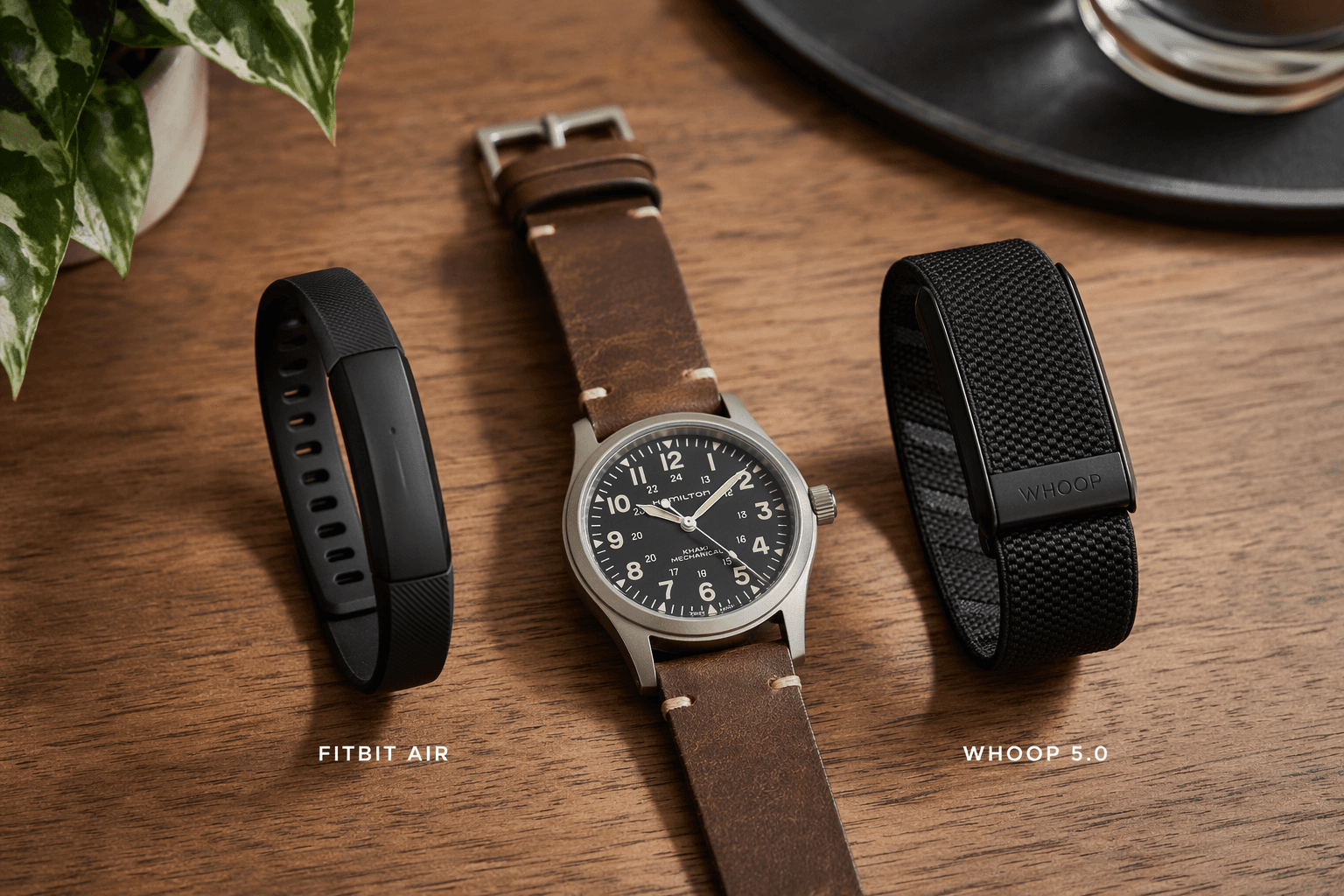
The hardware differences are minor. Fitbit Air: $99, no subscription, 12 grams, 7-day battery, 50m water resistance, SpO2, skin temperature. Whoop 5.0 Peak: $239/year (device included), 27 grams, 14-day battery, IP68 (10m), no SpO2 or skin temp, but a wireless recharging pack so you never take it off. The real difference isn't the hardware — it's the price model.
| Spec | Fitbit Air | Whoop 5.0 |
|---|---|---|
| Price (first year) | $99 | $239 |
| Required subscription | None | $239/year (Peak) |
| Weight with band | 12 g | ~27 g |
| Battery life | 7 days | 14 days |
| Water resistance | 50 meters | 10 meters (IP68) |
| GPS | Connected GPS | Connected GPS |
| Auto-detected activities | ~6 (run, walk, bike, row, elliptical, swim) | 45+ |
| Sleep/stage tracking | Yes (enhanced with Premium) | Yes |
| SpO2 | Yes | No |
| Skin temperature | Yes | No |
The Five-Year Math
Here's the calculation that settles it for most people. Fitbit Air costs $99 and stays there unless you want Google Health Premium ($99/year after a three-month trial). Whoop 5.0 Peak costs $239 a year, forever. Over five years: $99 (no Premium) or $499 (with Premium) versus $1,195. The math is not close.
| Time Horizon | Fitbit Air (no Premium) | Fitbit Air (with Premium) | Whoop 5.0 Peak |
|---|---|---|---|
| Year 1 | $99 | $198 | $239 |
| Year 3 | $99 | $396 | $717 |
| Year 5 | $99 | $499 | $1,195 |
The $99 figure assumes you never pay for Premium. If you do want AI coaching and deeper sleep analysis, it's $99/year after three months. That's $499 over five years — still dramatically cheaper than $1,195. I want to be clear about this so you don't feel tricked. The fair comparison for someone who wants those features is $499, not $99. And that's still a gap of nearly $700.
For the full breakdown of how subscriptions inflate costs across the market, read Best Fitness Tracker 2026: The Subscription Trap That Triples Your Cost (and How to Avoid It).
The Heart Rate Problem (20–40 BPM)
The most common objection: "Sure, Fitbit is cheap, but does it work?" Fair question. DC Rainmaker's testing found that the Fitbit Air's wrist-based heart rate occasionally overshoots by 20 to 40 beats per minute during certain workouts. That's a real gap. It means your Cardio Load scores get inflated, and the recovery advice may be wrong — telling you to rest when you don't need to, or pushing you harder than you should.
But let me sit with that number for a moment. A 20–40 BPM overshoot matters if you are a competitive cyclist trying to nail zone 2 threshold. For a Tuesday jogger who just wants to see a trend over weeks, it's less concerning. The data is still directionally useful: if your resting heart rate trends up over several days, that's a signal regardless of whether a single workout peaked at 162 or 182. Whoop's wrist-based heart rate is more consistent across more workout types, but both devices are beaten by a bicep band. Most people never wear a bicep band.
For deeper cross-device accuracy data, check out our Screenless Fitness Tracker Accuracy Showdown.
The AI Coach: Overhyped but Not a Dealbreaker
You've probably seen the viral snippet: a user told Google Health Coach they ate "nachos and rosé" for dinner, and the AI kept suggesting it as a recommended meal. Hallucination — DC Rainmaker documented it. Easy to mock. But it's an early-adopter bug that will get patched. The more important difference: Whoop Coach stays grounded in training context and doesn't generate plans that ignore your sleep data. Google Health Coach creates adaptive fitness plans that respond fluidly to schedule changes and food photo logging — when it works, it's genuinely useful.
Both AIs are good enough for daily readiness scores and basic workout suggestions. Google is more ambitious but less mature. Whoop is more conservative but more reliable. Neither is a reason to spend $239/year, unless you specifically need Whoop Coach's groundedness and cannot tolerate the occasional hallucination. Most people can.
45 Activities vs 6: Whoop's Real Advantage
Here is where Whoop earns its keep. Whoop automatically detects 45+ activity types — from rowing and yoga to CrossFit and mountain biking. Fitbit Air auto-detects about six: run, walk, bike, rowing, elliptical, swim. You can manually log others, but that requires pulling out your phone after every workout.
So ask yourself: how many different activities do you actually do in a week? If the answer is running, walking, maybe a stationary bike, and an occasional swim, Fitbit covers 95% of your workouts without manual intervention. If you are a cross-trainer who lifts, does yoga, rows, and hits the assault bike on back-to-back days — and you want all of that logged automatically without tapping labels — Whoop's breadth becomes a real advantage. This is the single feature that justifies the subscription for serious athletes.
If you're still considering Whoop after this, read our full Whoop 5.0 Review: Is the Subscription Worth It for Home Fitness?.
Who Should Buy What
If $239 a year gives you even a moment's hesitation, buy the Fitbit Air and don't look back. You get 80-90% of the Whoop experience — sleep tracking, step counts, resting heart rate trends, basic recovery scores — for a fraction of the cost. Whoop is only for the serious multi-sport athlete who trains in five or more different activities each week, wants passive automatic detection for all of them, and doesn't mind a subscription.
One more angle: the Fitbit Air works beautifully as a sleep companion for smartwatch owners. It weighs only 12 grams — you can wear it on one wrist while your Apple Watch or Pixel Watch charges on the nightstand. You get the detailed sleep data without the bulk, and your smartwatch stays ready for the next day. I wrote about this in Why the Best Fitness Band Setup for Home Gym Users Is Two Devices (Not One).
The screenless market just got a reset. Fitbit proved you don't need a subscription for good data. Whoop will have to answer with a cheaper tier or a better reason to keep paying. Until then, for most people, the answer is $99.
Comments
Join the discussion with an anonymous comment.