
Oura Ring for Fitness Tracking: Workout-by-Workout Assessment Across Strength, Cardio, HIIT, and More
Thinking about buying an Oura Ring for fitness? This article delivers a candid, modality-by-modality breakdown of how the ring performs during strength training, cardio, HIIT, swimming, and daily movement — backed by scientific accuracy benchmarks and real-world reviewer experience.
The Ring That Knows Your Sleep But Not Your Squat
The Oura Ring’s sleep staging hits 94–95% sensitivity in peer-reviewed data. Its Readiness Score has a cult following. And every major review says activity tracking is the weak link. Forbes Vetted: “Activity tracking is the weakest feature of the Oura Ring 4 – it works best as a retroactive activity tracker.” Wareable: “Workout tracking … still glitchy.” You can buy a ring that tracks recovery better than anything else, and still not know whether yesterday’s deadlift registered. So the question isn’t whether the Oura is a good tracker. It’s: which workouts does it handle, and which ones fail so badly that you’ll reach for a wrist device anyway? That’s what this article walks through, modality by modality.
That 0.996 HR Correlation – Read the Fine Print
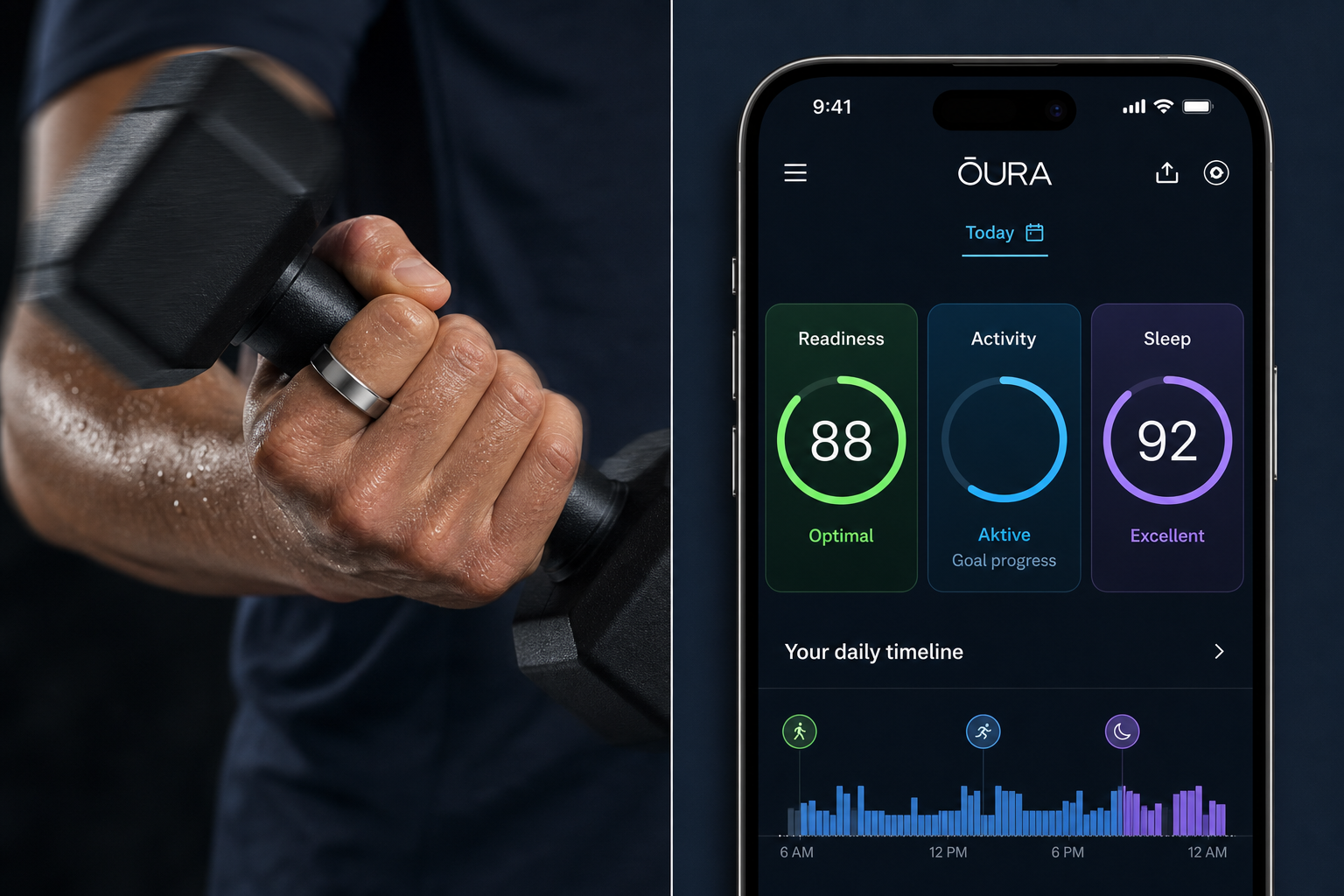
The most impressive number in Oura’s marketing: heart rate r² = 0.996 versus medical‑grade ECG, from Kinnunen et al. (2020). The PMC systematic review also shows HRV r² = 0.980. Strong numbers. But the study was partially supported by Oura providing equipment. That doesn’t invalidate it, but it’s not an independent benchmark. And the validation was done at rest, not during barbell lifts or sprint intervals. Forbes Vetted notes: “Heart rate tracking during exercise is slow to respond compared to a chest strap, but overall heart rate range and peaks were accurate.” The ring will get the 30‑minute average right, but it may miss the spike at the top of a heavy set. I would not use that 0.996 as proof that the Oura tracks workouts. It proves the ring can read your pulse while you sit still.
Strength Training: Where the Design Fights You
If you lift weights, this section is the dealbreaker. Every independent reviewer who tried strength training with the Oura Ring hit the same wall: the ring does not stay out of the way.
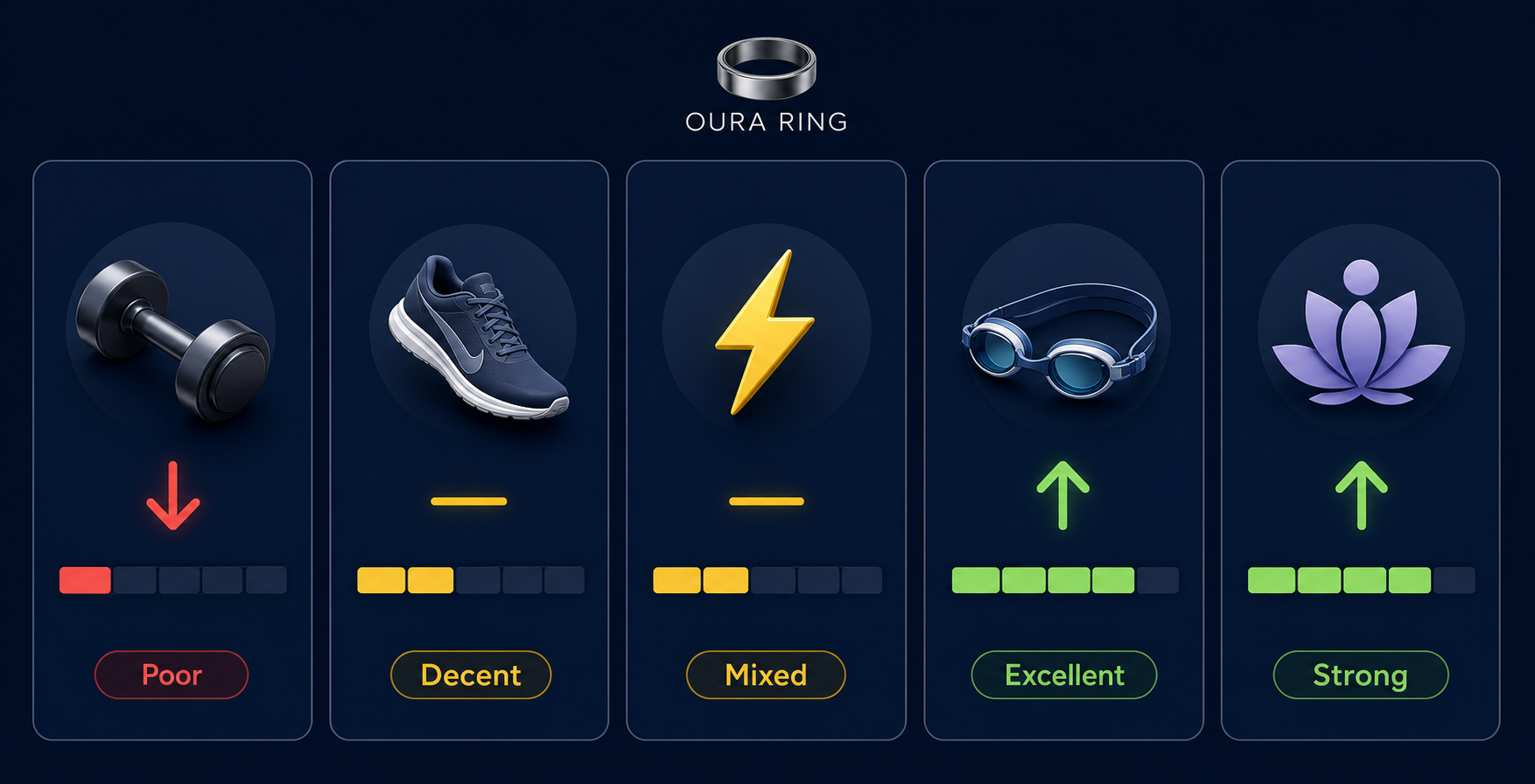
Business Insider calls the grip interference “a hindrance during tight‑grip lifts.” The Sleep Foundation stopped wearing the ring during workouts altogether. NBC Select reports that the ring does not automatically detect yoga or strength training — you have to tag it manually after the fact. And even if you tolerate the physical friction, the tracking itself is minimal. No rep count, no set logging, no real‑time heart rate during the set. The ring gives you a retroactive summary of the session’s heart rate range and estimated calorie burn. If you want to know whether your bench press volume increased from last week, you are writing it down yourself. I have not found a single independent source that calls strength tracking acceptable. That tells me it is not a reviewer’s opinion; it is a design limitation baked into the ring form factor.
Cardio and HIIT: Decent Logs, No Real‑Time Edge
For runners, cyclists, and HIIT lovers, the picture is less bleak — but still a compromise. The ring’s auto‑activity detection logs runs, walks, cycling, and even pickleball after the fact. Forbes found that “estimated calorie burn and heart rate range were on par with a Polar H10 chest strap.” That is genuinely decent for a device with no armband. But the Oura has no GPS. If you log a run manually, the ring uses your phone’s location data, and NBC Select reports that “GPS data during manually logged runs was sometimes inaccurate.” You won’t get pace, cadence, or route from the ring alone. Business Insider puts it bluntly: “Serious runners or athletes who need running mileage, pace, or deeper training insights should choose a more robust fitness tracker.” HIIT is mixed. The ring catches elevated intensity — it correctly identified HIIT in the Forbes test — but the heart rate sensor is slow to react, so interval peaks may register lower than they were. For someone trying to dial in zone‑specific intervals, it is not enough. If your primary cardio is steady‑state running with no need for real‑time feedback, the Oura is usable. If you want to know your mile split during the run, buy a watch.
For a deeper comparison across HIIT, yoga, and bodyweight strength, see Which Fitness Tracker Works Best for Your Home Workout Type?.
Swimming and Daily Movement: The Genuine Strengths
After the bad news, here is where the ring genuinely shines. The Oura is water‑resistant to 100 meters — twice the rating of the Apple Watch. Swimming detection works automatically, and multiple reviewers confirm it logs laps and heart rate without issue. If you swim regularly, the ring is arguably better than most watches because you don’t have to deal with crown buttons or touch screens in the water. Just as strong is non‑exercise activity thermogenesis (NEAT) tracking. The ring automatically detects over 40 activities — housework, walking the dog, gardening, even boxing and skiing. Forbes, Cosmopolitan, and PCMag all confirm that auto‑detection improves over time as you verify activities. This is Oura’s genuine fitness differentiator: it gives you credit for the movement you might not think of as a workout. But there is a catch. The step count overestimation is real: the Niela‑Vilen (2022) study found the Oura overestimates by about 1,416 steps per day compared to an ActiGraph accelerometer. That doesn’t kill the NEAT tracking value, but it means you cannot treat your daily step count as a precise metric.
The Evidence in One Table
Here is the condensed evidence. All figures come from the PMC systematic review unless otherwise noted.
| Metric | Value | Context |
|---|---|---|
| Sleep sensitivity | 94–95% | Svensson 2024 (Oura Gen 3, 421k epochs) |
| Heart rate r² vs ECG | 0.996 | Kinnunen 2020; Oura provided equipment |
| HRV r² vs ECG | 0.980 | Same study as above |
| Daily step overestimation | ~1,416 steps/day | Niela‑Vilen 2022 vs ActiGraph |
| Study bias risk (high/moderate) | 65% | Across 107 studies in the review |
For a deeper dive into screenless trackers during real exercise, see Screenless Fitness Tracker Accuracy Showdown.
First‑Year Cost: What You’re Paying For
The Oura Ring 4 starts at $349. The Oura Ring 5, launched May 28, 2026, starts at $399. All models require a $5.99/month membership ($69.99/year) after the first free month. First‑year totals:
| Ring tier | Ring price | 1‑year membership | First‑year total |
|---|---|---|---|
| Ring 4 Silver/Black | $349 | $69.99 | $419 |
| Ring 5 Silver/Black | $399 | $69.99 | $469 |
| Ring 5 Gold/Stealth | $499 | $69.99 | $569 |
Compare that to an Apple Watch Series 9 at $399 with no subscription, or a Garmin Forerunner at $450, also subscription‑free. PCMag calculated the three‑year Oura total at $558.97 versus $717 for Whoop 5.0 — but Whoop also has a subscription. The only way to make Oura cheaper over time is to keep it past year one without the subscription, which disables most features. For a full ecosystem comparison, see Garmin vs. Whoop vs. Oura: Which Fitness Tracker Ecosystem Is Right for Your Home Fitness Practice?.
The Workaround: Oura Plus a Watch – and Its Hidden Costs
Some serious athletes run a two‑device stack: Oura for sleep and recovery, a Garmin or Apple Watch for workouts. Business Insider notes it is a common pattern. But the hidden costs are real. Two charging schedules — the Oura lasts six to eight days, the watch needs daily charge. Two subscriptions if you add Whoop. And the cognitive load of interpreting separate readiness scores and workout loads: the ring tells you to rest, the watch says you barely trained. Reconciling that takes attention. For a price‑conscious buyer, the two‑device route pushes first‑year spend to $800 or more. That is not a seamless stack. It is a commitment to two platforms.
Final Verdict
The thesis holds: Oura is peerless for sleep and recovery but its workout tracking is inconsistent enough that most active fitness enthusiasts will need a wrist‑based tracker or accept the two‑device compromise. Buy the Oura if:
- You prioritize sleep and recovery data above all else and already own a watch for workouts.
- Your exercise is primarily swimming, yoga, walking, or daily movement (NEAT).
- You are willing to pay the subscription for the ring’s wellness insights.
Skip the Oura if:
- You lift weights seriously — the physical design fights you.
- You need real‑time GPS pace, cadence, or interval heart rate.
- You want one device that does it all without a subscription.
The Oura Ring 5 is too new to have independent workout testing. Its hardware is smaller and the sensors are redesigned, but the form factor and the real‑world grip issues remain. If you are hoping the next generation fixes strength tracking, wait for third‑party validation — the Ring 4 track record should give any strength athlete pause. For a broader buying guide that includes competitor smart rings, see Fitness Tracker Rings in 2026: A Buying Guide for Home Gym Enthusiasts. And if recovery metrics are your primary interest, Best Fitness Tracker for Recovery goes deeper on that angle.
This result comes from one real apartment under the stated conditions — it is a strong signal, not a guarantee your space will measure identically.
Builds this evidence supports
No build currently links to this specific test. Browse all builds with a matching tag.
Spot something off?
If this result didn't match your own space, let us know — floor-damage and noise claims carry real deposit-risk consequences if we get them wrong.