
The annoying supplement-label moment usually happens after the workout is already planned: one protein powder says sucralose, another says stevia, the pre-workout is “zero sugar,” and the hydration mix looks clean until the ingredient panel gets tiny. If you are trying to understand the artificial sweeteners effect on gut health for fitness, the useful answer is not that every zero-calorie sweetener is dangerous. It is that some are easier to justify as daily defaults than others.
For a home fitness routine, the practical ranking looks like this:
| Tier | Sweeteners | Best use judgment |
|---|---|---|
| Lower risk / preferred | Stevia, monk fruit | Better first choices when the full label is simple and the dose is reasonable |
| Mixed / dose-sensitive | Acesulfame-K, erythritol | Worth watching for symptoms, especially in blends or frequent daily use |
| Higher risk / avoid as daily defaults if possible | Sucralose, saccharin, aspartame | More reason for caution when gut symptoms, glucose concerns, or recovery problems are already on your radar |
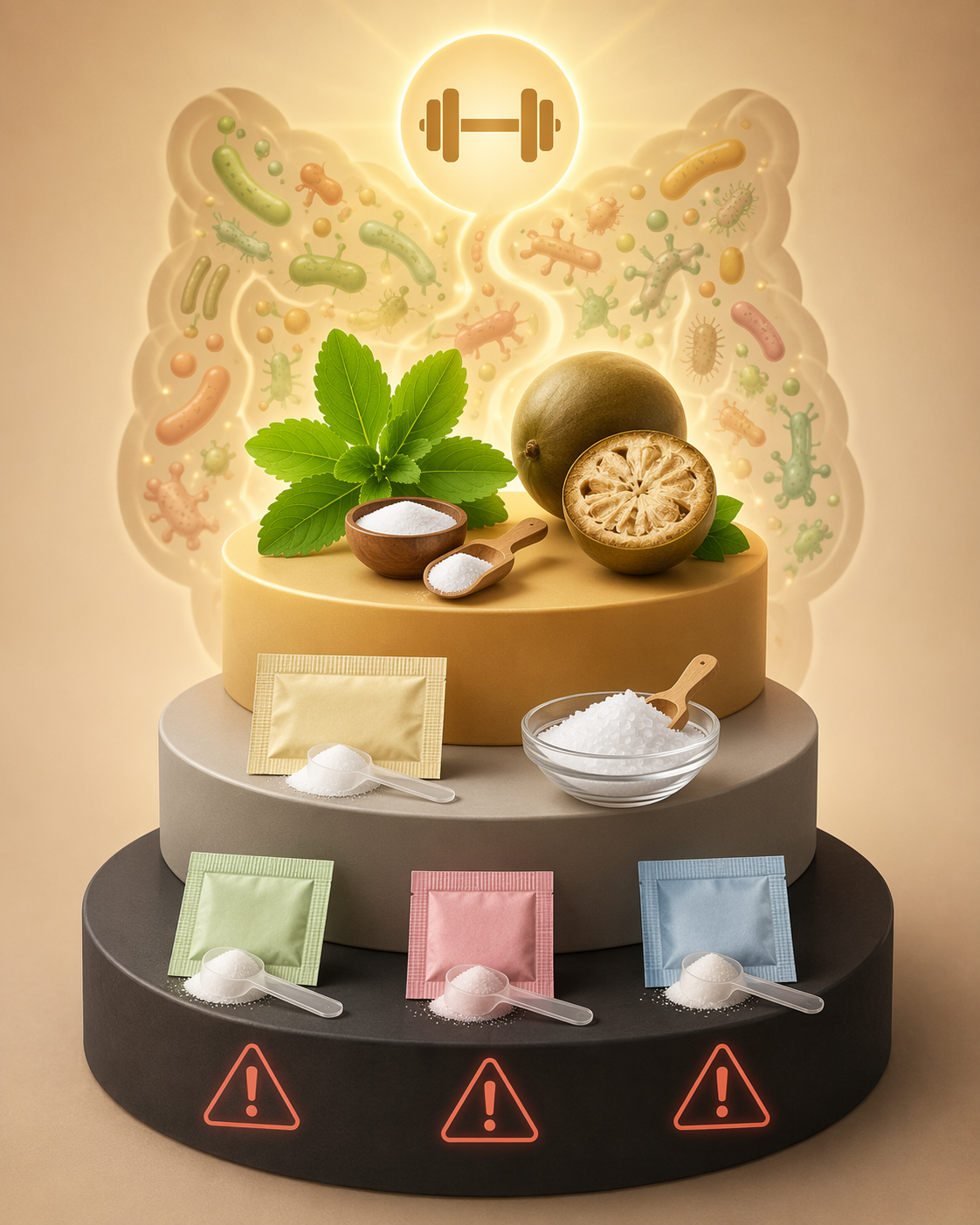
That ranking is not a morality scale. It is a shopping filter. If two products are otherwise similar, the stevia- or monk-fruit-sweetened option is usually easier to defend. If the label leans on sucralose or saccharin, especially in something you use every day, the evidence gives you a reason to keep looking.
Why sucralose and saccharin deserve the most caution
Sucralose is everywhere in fitness products because it is intensely sweet, cheap to formulate with, and familiar to consumers. That does not make it automatically harmful in every serving, but it does make the evidence around repeated exposure more relevant. A 2025 bioreactor study comparing several sweeteners found that sucralose and saccharin significantly reduced microbial diversity, while rebaudioside A, the stevia compound studied, and xylitol were less disruptive. The same study was small in an important way: it used fecal samples from only three donors, so it should not be treated as a population-wide verdict by itself.[1]
Still, the concern does not come from one lab model alone. A 2026 Tufts summary of a meta-analysis of 21 randomized controlled trials reported that non-nutritive sweeteners raised fasting insulin and HbA1c, with gut microbiome changes proposed as one mechanism.[2] That is not the same as saying your pre-workout directly ruins recovery. It does mean that the “no sugar, no problem” shortcut is too simple, especially when the sweetener appears in protein powder, an energy drink, a powdered hydration mix, and a diet soda on the same day.
The most useful human caveat comes from the 2022 Cell study by Suez and colleagues. Saccharin and sucralose altered the microbiome and impaired glucose tolerance in some participants, but not all. The study’s responder/non-responder pattern matters because it explains why one person can use a sucralose-heavy protein powder for years without obvious trouble while another gets bloated, hungry, or weirdly flat after switching products.[3]
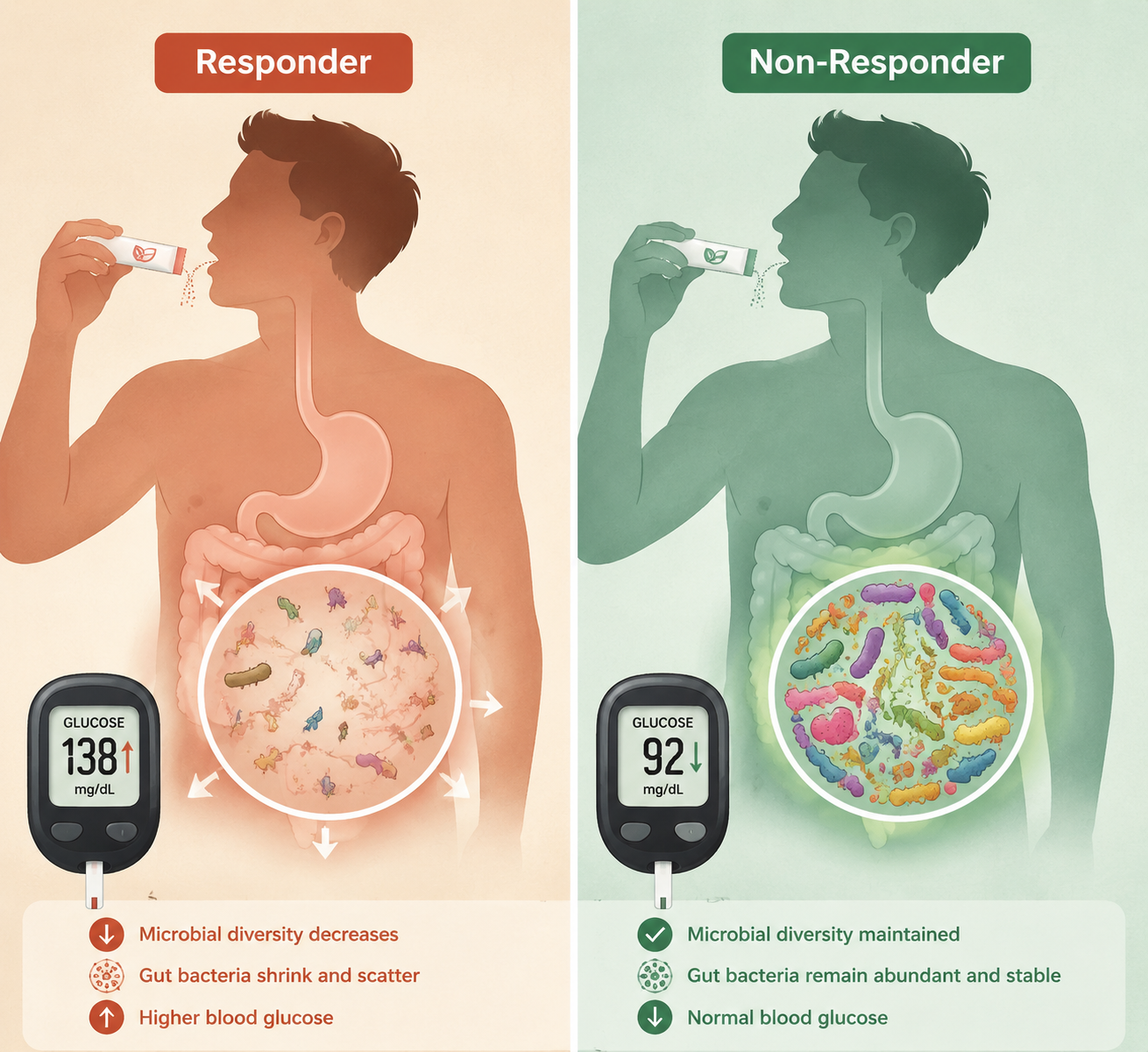
For fitness, glucose tolerance is not just a lab value floating outside the gym. Training adaptation depends on eating, absorbing, storing, and using fuel well enough to repeat workouts. If a sweetener pattern is associated with worse glycemic markers in some people, that is a reasonable reason to reduce exposure before blaming your program, your sleep, or your willpower.
Saccharin is less common than sucralose in modern protein powders, but when it appears, it belongs in the same cautious bucket. The evidence tying it to microbiome shifts and glucose-tolerance effects is stronger than the evidence for the lower-risk options, and there is rarely a compelling training reason to choose it when better-labeled alternatives exist.[1][3]
Aspartame fits the avoid-if-possible tier, with less to say
Aspartame belongs in the higher-caution group because the broader non-nutritive-sweetener literature raises metabolic and gut-health concerns, but the strongest material here is not as product-specific as it is for sucralose and saccharin. In plain supplement-order terms: if aspartame is the sweetener in a product you use occasionally, it is not the first place to panic. If it is part of your daily stack and you are already troubleshooting digestion or recovery, it is one of the ingredients worth removing during a self-test.
Stevia is the safer default, as long as the label is honest
Stevia is the easiest sweetener to recommend first because the human evidence is more reassuring. In a 2024 double-blind randomized controlled trial, 12 weeks of stevia did not significantly change the composition of the human gut microbiota.[4] That does not prove stevia improves the microbiome, and it does not prove every stevia product is comfortable for every stomach. It does make stevia a better default than sweeteners with repeated signals for dysbiosis or glucose-tolerance effects.
The dose context also helps. The FDA acceptable daily intake for steviol glycosides is 4 mg per kilogram of body weight, which is roughly nine packets per day for a 150-pound adult. Most people using a scoop of protein powder or a single hydration drink are not approaching that amount. The more realistic issue is not stevia overload; it is the rest of the sweetener blend hiding behind a stevia-friendly front label.
Monk fruit is also a reasonable preferred option, but the confidence level is lower. Mogroside V, a monk fruit compound, promoted Bifidobacterium and Lactobacillus growth in an in vitro study.[5] That is interesting and directionally reassuring, but in vitro work is not the same as a long-term human trial in people using supplements around training. Monk fruit can be a good label sign; it should not be treated as proof that the whole product is gut-friendly.
The middle tier: acesulfame-K and erythritol
Acesulfame-K often shows up beside sucralose because the combination gives brands a cleaner sweetness profile. That pairing is exactly why it can be hard to judge in real life. If a pre-workout contains both, and your stomach feels off, you cannot neatly blame one ingredient from the couch. The practical move is to test a product with a simpler sweetener system rather than trying to interpret a four-sweetener blend like a clinical trial.
Erythritol is a different kind of problem. It is often used in “natural” or stevia-branded products because it adds bulk and rounds out sweetness. That means a front label can say stevia while the ingredient list still includes a sugar alcohol that can cause gastrointestinal distress at higher doses. If the symptom is bloating, gas, cramping, or urgent bathroom timing, erythritol deserves suspicion even when the product looks cleaner than a sucralose version.
This is where supplement shopping gets irritating but useful: “naturally sweetened” is not specific enough. The ingredient list has to say whether the sweetness comes only from stevia or monk fruit, or whether it is carried by erythritol, xylitol, sorbitol, maltitol, or another sugar alcohol. For a once-a-week dessert protein bar, that may not matter. For a daily shake after training, it can.
Responder or non-responder: why your friend’s supplement review may be useless
The responder finding should not be used as an escape hatch where every recommendation collapses into “it depends.” It should make the ranking more practical. Start with the lower-risk choices, then use your own digestion, energy, and training consistency as the filter. If sucralose or saccharin affects glucose tolerance only in some people, the task is not to prove you are special. It is to notice whether a product change lines up with symptoms or performance changes you can actually observe.[3]
A simple self-test works better than rotating five powders at once. Pick one product you use most often, keep your training and meals as stable as reasonably possible, and swap only the sweetener profile for two to three weeks. Track bloating, stool changes, appetite, energy during workouts, and whether your usual post-workout meal sits well. If the new product is also higher or lower in caffeine, fiber, magnesium, or creatine, that is not a clean test; those ingredients can change digestion too.
A 10-week sucralose study in healthy young adults found dysbiosis and altered glucose and insulin levels, but longer human trials are still needed.[6] That is enough to justify caution, not enough to diagnose every rough stomach day as a microbiome injury. Home training already has plenty of variables: sleep, total calories, fiber swings, stress, and whether dinner was eaten standing at the counter. The sweetener is one variable worth isolating, not the only possible culprit.
How to read the label before the next order
The front of the tub is advertising. The useful part is the ingredient list, and the order matters. For protein powders, pre-workouts, electrolyte packets, and ready-to-drink shakes, scan for these patterns before deciding whether the product belongs in your daily routine.
- Best first pass: stevia, rebaudioside A, monk fruit, or mogroside V, without a long sugar-alcohol blend.
- Caution flag: sucralose, saccharin, or aspartame, especially in a product you use most days.
- Blend trap: “stevia-sweetened” plus erythritol or other sugar alcohols high in the ingredient list.
- Testing problem: multiple sweeteners plus caffeine, magnesium, fiber, or sugar alcohols, because symptoms become harder to attribute.
- Recovery context: a sweetener swap will not fix under-eating, low protein, or poor meal timing.
That last point matters because gut comfort and recovery nutrition overlap. If your shake is easy on your stomach but your actual meals are low in protein, fiber, and total calories, the sweetener is not the main recovery bottleneck. For the broader food side, it is worth tightening the basics in daily eating habits for home fitness recovery and looking at simple recovery meals such as protein-and-fiber pasta options.
Sports drinks: zero sugar is not always the training goal
For short home sessions, a stevia-sweetened electrolyte drink can be a reasonable way to get flavor and sodium without adding sugar you do not need. The calculation changes for long endurance work. A stevia-sweetened hydration product such as Mortal Hydration contains about 10 grams of carbohydrate, while traditional sports drinks are often around 25 grams or more; endurance athletes may need 60 grams or more of carbohydrate per hour depending on the session.[7]
In other words, a lower-sugar drink may be easier on your daily sugar intake, but it may not fuel a long ride, run, or hard hybrid session by itself. If the workout is long enough that carbohydrate intake matters, use a fueling plan rather than assuming the cleanest-looking hydration label is automatically the best training choice. For that scenario, the next decision is closer to endurance fueling strategy than sweetener avoidance.
The buying standard
For most home fitness users, the cleanest practical standard is straightforward: choose stevia or monk fruit when possible, be cautious with erythritol-heavy blends, and avoid making sucralose, saccharin, or aspartame your daily default if gut symptoms or recovery concerns are already present.
If you have diabetes, a diagnosed gut condition, or medically significant blood-sugar concerns, make sweetener changes with a healthcare provider instead of relying on supplement-label experiments. For everyone else, the useful test is less dramatic: simplify the label, change one product at a time, and keep the sweetener that lets you train, eat, and recover without second-guessing the tub on the counter.
References
- Non-nutritive sweeteners influence the structure and function of the human gut microbiome in a donor-specific manner, Frontiers in Microbiology, 2025.
- Growing Evidence Sugar Substitutes Disrupt Gut Health and Metabolism, Tufts Now, June 30, 2026.
- Personalized microbiome-driven effects of non-nutritive sweeteners on human glucose tolerance, Cell, 2022.
- Stevia and its effects on the human gut microbiota: a randomized, double-blind, placebo-controlled trial, Nutrients, 2024.
- Mogroside V improves the growth of Bifidobacterium and Lactobacillus in vitro, ACS Omega, 2021.
- Sucralose consumption affects the serum insulin and glucose concentrations and the gut microbiota composition in healthy young adults, 2022.
- A New Crop of Sports Drinks Is Taking on Gatorade, Triathlete.



Comments
Join the discussion with an anonymous comment.