
What the 2026 ACSM Guidelines Say About Home Injury Recovery
The first major update to ACSM resistance training guidelines in 17 years confirms that bodyweight and resistance band exercises at home produce real recovery benefits. This article breaks down what the evidence says about healing an injury without a gym membership.
Primary source: 2026 ACSM Resistance Training Guidelines
Claim type: explainer
Last reviewed:
ACSM reset the baseline
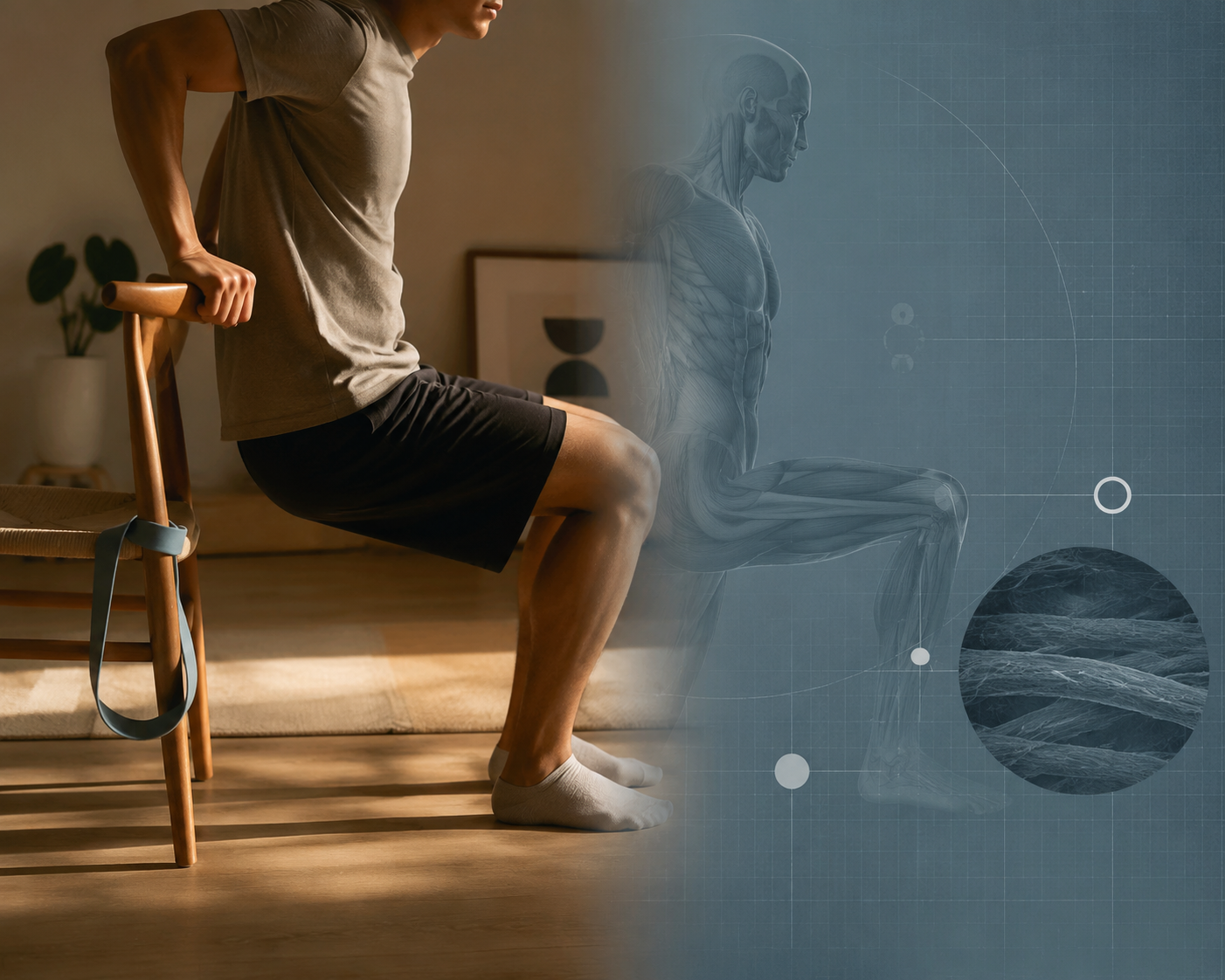
The 2026 ACSM Resistance Training Guidelines are the first major update in 17 years, and they synthesize 137 systematic reviews and more than 30,000 participants. The part that matters for injury recovery exercises at home is not a gadget or a complicated protocol: ACSM explicitly validates bodyweight work, elastic bands, and home-based routines as producing marked benefits in strength, hypertrophy, and physical function. [1]
The public ACSM summary is enough to act on, even if the full Position Stand lives behind journal access. For the person trying to recover in a small apartment with a band, that is not a footnote. It is the main point.
FITT is the usable translation
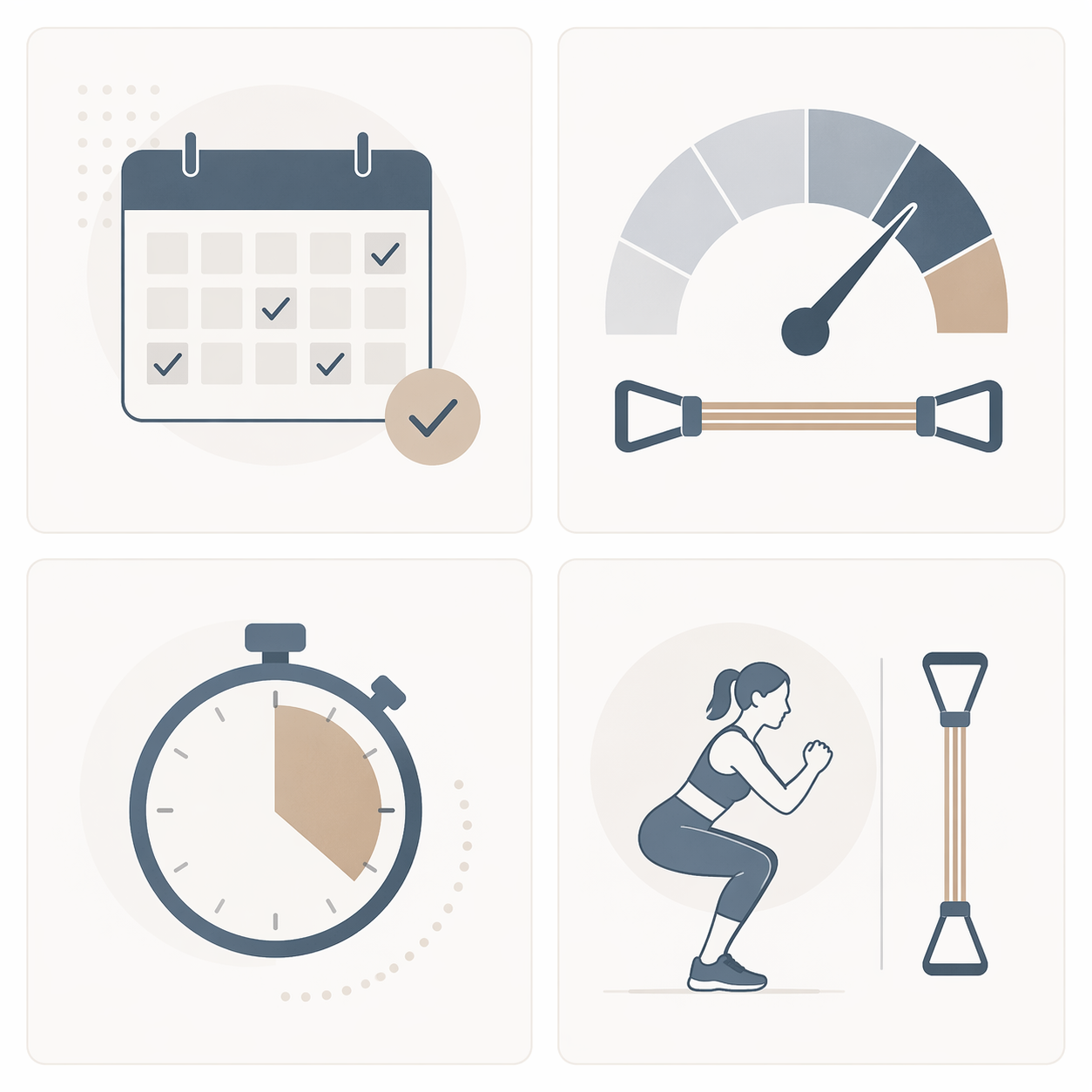
FITT is useful because it keeps the decision-making on the ground: how often, how hard, how long, and what type. At home, that means choosing a dose you can repeat on a bad day, not building a program that only works when motivation is perfect. The guideline summary does not make a specific machine, a failure set, or a flashy periodization block the price of entry. [1]
| FITT element | What it means at home |
|---|---|
| Frequency | Use a schedule you can repeat without rearranging your life. |
| Intensity | Make the work meaningful, but not so hard that every session becomes a test. |
| Time | Keep the session long enough to matter and short enough to finish. |
| Type | Choose bodyweight, bands, and movement patterns that fit the injury stage. |
That is the quiet advantage of a standards-first framework. It tells you what to control without pretending that complexity is a virtue by itself.
Why simple plans get followed
Home programs fail most often at the point nobody likes talking about: follow-through. A review of home exercise adherence reported noncompliance rates of 30% to 50%, which is exactly why the simplest repeatable plan usually outperforms the clever one. [2] If a routine looks elegant on paper but falls apart when you are tired, sore, or alone, it is not really a recovery plan yet.
This is where the home setup stops being second-rate and starts being honest. A chair, a wall, a band, and a timer are often enough to make a plan more repeatable than one that depends on perfect equipment or a clinic visit for every session.
Controlled movement beats waiting
ACSM's direction is not to wait for perfect conditions. Extended inactivity delays healing, while controlled movement introduced early is the evidence-supported path. [1] That does not mean loading every joint the same way on day one; it means the body is usually better served by appropriate motion than by a long pause dressed up as caution.
A functional rehabilitation framework has made that logic familiar for years: range of motion, then strengthening, then proprioception, then activity-specific work. [3] The timing details are injury-specific, especially in ankle literature, so the framework is the useful part, not a rigid calendar.
Examples already on this site
- Rehab Your Ankle at Home With These Phase-Based Exercises
- Phased Knee Injury Recovery Exercises at Home
- How to Recover From a Wrist Injury at Home With Phased Exercises
- Cycling Injury Recovery Exercises You Can Do at Home
- Exercises and Tips for Every Stage of Concussion Recovery
Where home guidance stops
Home-based injury recovery exercises are a good starting point when the problem is minor, the motion is controlled, and the trend is improving. They are not a replacement for assessment when pain is severe, the limb looks deformed, weight bearing is impossible, symptoms are unusual, or things are simply not improving. That is the line worth respecting: use the home plan when it is clearly a support, and hand off when it is no longer enough.
References
- ACSM Publishes Updated Resistance Training Guidelines - First Update in 17 Years - ACSM.org, 2026
- Adherence to home exercise programmes in people with musculoskeletal conditions: a systematic review - PubMed Central, 2018
- Rehabilitation of the ankle after acute sprain or chronic instability - PubMed Central, 2002
Source: 2026 ACSM Resistance Training Guidelines
Have a question about this guidance?
This is a question and correction channel, not an open discussion thread — recovery topics sit close to a medical-advice boundary, so we review submissions rather than publishing them instantly.