Home Fitness Routine from the Drill Sergeant of the Year AFT
A home fitness routine based on the five events of the Army Fitness Test used in the Drill Sergeant of the Year competition, with bodyweight and sandbag alternatives that work in small spaces and under a $300 equipment budget.
Before you start
- Equipment required
- Bodyweight, sandbag, dumbbell
- Assumes build tier
- No specific tier required
The five events are the routine
The drill sergeant of the year fitness routine is not a mystery package. It is the five Army Fitness Test events: 3RM hex-bar deadlift, hand-release push-ups in two minutes, sprint-drag-carry with five 50-meter shuttles, plank hold, and the 2-mile run; the passing score is 300, or 60 points per event, and combat MOS require 350.[1] There is no published winner's personal plan to copy here, so this is a synthesized routine built from the official competition standard.
The label changed midstream. The Army switched from ACFT to AFT on June 1, 2025, but a May 2026 Army competition writeup still used the older ACFT name, so the event list matters more than the acronym.[2][3] The competition itself is not a sideshow: in the 2025 cycle, more than 6,500 drill sergeants competed at unit level and only 13 reached the Army-level event, and the program has existed since 1969.[4][5]
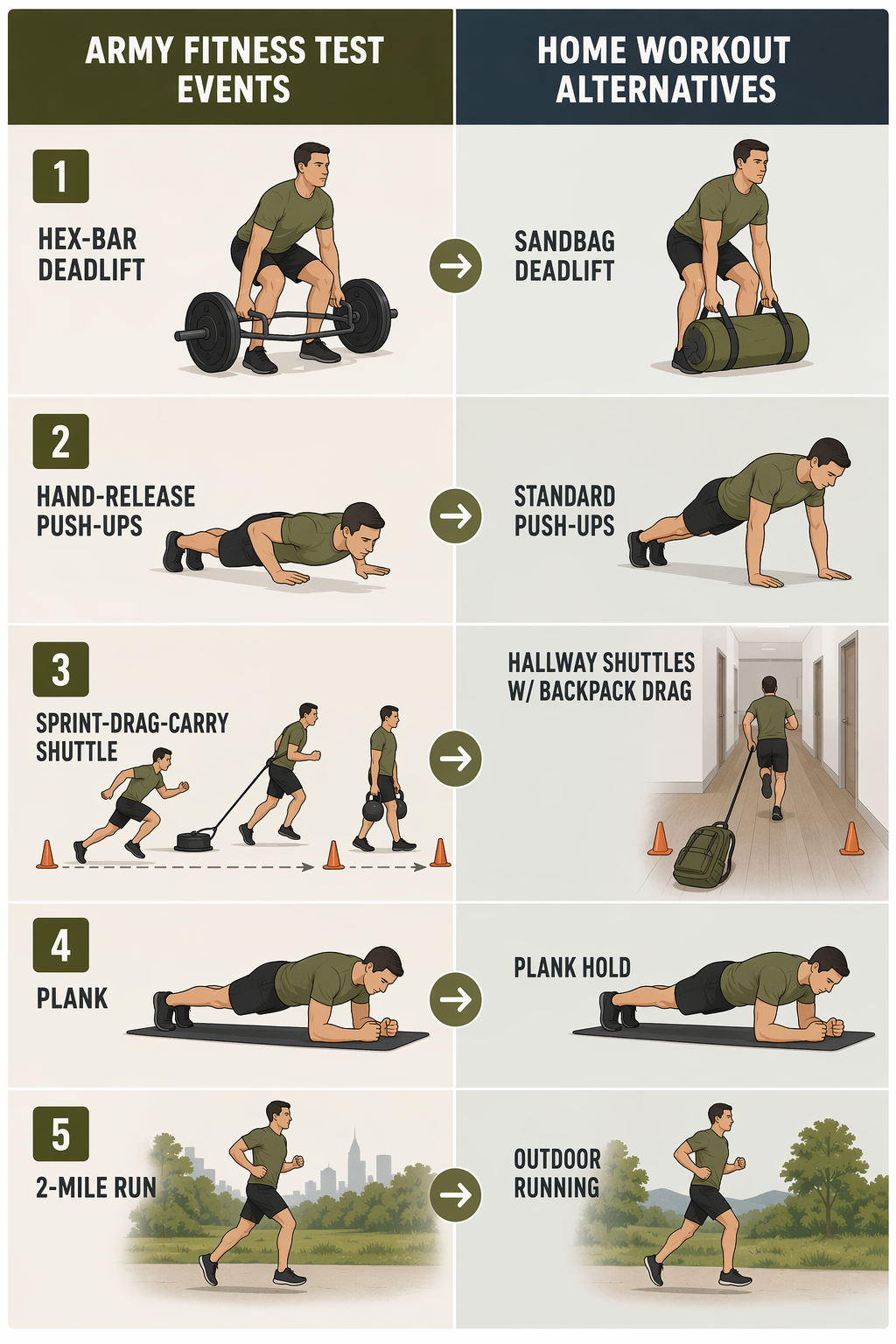
| Official event | Small-space home version | Cheapest workable setup | Space note |
|---|---|---|---|
| 3RM hex-bar deadlift [1] | Sandbag or dumbbell deadlift; if there is no budget, use loaded backpack hip hinges and slow tempo work | One sandbag or one adjustable dumbbell | One small open patch of floor |
| Hand-release push-ups, 2 min [1] | Standard hand-release push-ups, with incline regression if full reps break down | Floor only | No extra space |
| Sprint-drag-carry, 5 x 50 m [1] | Hallway shuttles, short accelerations, and a backpack drag on a smooth floor | A straight segment and a backpack | Any usable strip of floor or sidewalk |
| Plank hold [1] | Front plank and side plank work | Floor only | No extra space |
| 2-mile run [1] | Outdoor run or run-walk intervals | Shoes and a route | Sidewalk, path, or street loop |
How each event trains in a small space
Deadlift
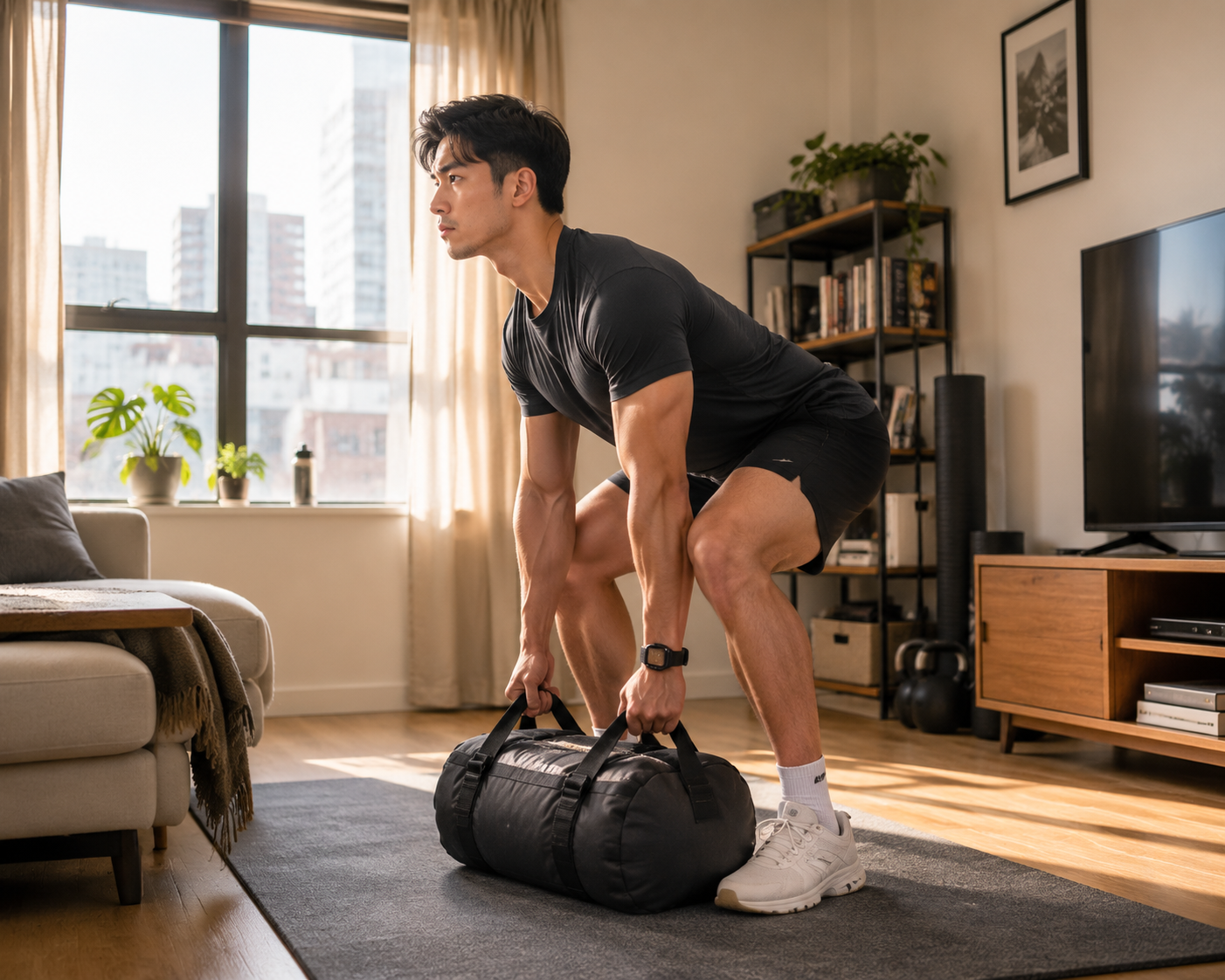
The deadlift is the one event where a small purchase pays off immediately. A sandbag or adjustable dumbbell gives the hinge pattern real load without taking over the room, and a single bag can live in a closet better than a rack of gear. If there is no budget, use backpack deadlifts, slow hip hinges, and split-stance work to teach position, but keep the goal honest: the body should learn how to brace under load, not how to wave a backpack around.
Hand-release push-ups
Hand-release push-ups need floor space and discipline, not equipment. The useful rep starts chest to floor, leaves the floor cleanly, and keeps the hips from sagging into a half-rep that only looks hard. If full reps break down, use incline push-ups on a counter or sturdy table, then lower the angle as the set quality improves.
Sprint-drag-carry
This is the event that exposes apartment training, because it asks for repeated accelerations, direction changes, and a drag. Short shuttle work still teaches the turn and the push-off if the space is tight: a hallway, driveway, or sidewalk segment can stand in for the long lanes, even if it cannot copy them exactly. A backpack on a towel gives a cheap drag surface on smooth floors, and quick feet plus a hard brace do more for this event than pretending a living room is a track.
Plank
The plank is cheap to train and easy to fake. If the lower back sags, the set is done, because endurance in the wrong position does not help the test. Use repeated hard holds, side planks, and dead bug work, but keep coming back to the actual front plank so the body learns the exact test position.
2-mile run
The 2-mile run still needs real running. Easy neighborhood miles, short intervals, and one longer steady effort each week cover more ground than a pile of indoor gadgets. A route outside also teaches pacing in the same air and footing the test will use.
What the budget changes
The $0 route is plain: push-ups, planks, running, and shuttle work, with backpack loading borrowed from whatever is already in the apartment. The $100 to $300 route mainly buys one thing that actually matters, a loadable sandbag or dumbbell, so the hinge and carry work feel like strength instead of calisthenics in disguise.
- On a $0 setup, keep the week centered on hand-release push-ups, plank work, hallway shuttles, and outdoor running, then use a backpack for any loaded hinge or drag practice.
- On a $100 to $300 setup, buy one sandbag or adjustable dumbbell first, then use it for deadlift patterns and drag or carry work while the rest of the routine stays bodyweight.
- If space is tight, one loadable bag matters more than a pile of cheap extras that never match the actual events.
The 35-lb ruck march from the 2026 competition is real, but it sits on top of the five-event test rather than replacing it.[3] If it gets trained at home, it belongs after the core week is stable: one loaded walk, starting easy, on a route that is already familiar. It should not become the main personality of the program, because the competition itself still turns on the AFT.
Use the five AFT events as the baseline, then add the ruck only after the core week is stable and the space and budget are already set.
References
- Army Fitness Test & Requirements — goarmy.com
- Army introduces new fitness test for 2025 — JBSA
- MEDCoE names 2026 Drill Sergeant of the Year — U.S. Army
- Two Drill Sergeants Stand Above the Rest — DVIDS
- Competition | U.S. Army Drill Sergeant Competition — U.S. Army
Don't have the gear this routine assumes? Find the build that covers it.
Wondering how much rest you need after this? Read our ACSM-cited recovery reference.
Questions about form, substitutions, or a correction? Leave it below.
Comments
Join the discussion with an anonymous comment.