
How to Do the Parris Island Drill Instructor Workout at Home
Learn the exact bodyweight circuit used at Marine Corps Drill Instructor Schools on Parris Island and San Diego — a zero-equipment workout that builds strength, endurance, agility, and coordination in a small apartment corner.
Before you start
- Equipment required
- none
- Assumes build tier
- No specific tier required
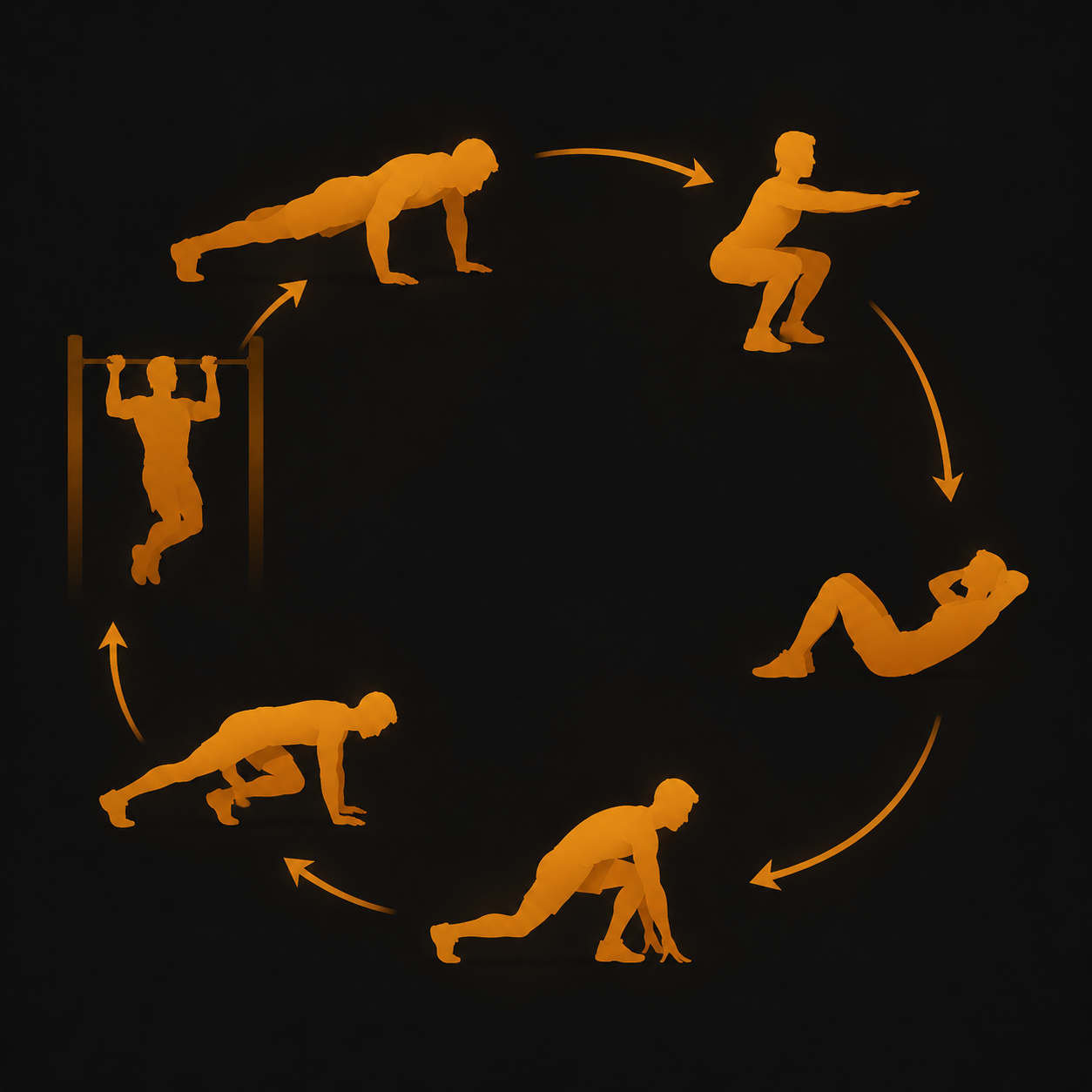
The Parris Island drill instructor workout worth talking about is not a viral “Marine-style” circuit. It is the official DI School PT Program workout card: push-ups, air squats, crunches, burpees, heel-toe rocks, mountain climbers, and pull-ups arranged as a repeatable bodyweight round for drill instructor candidates.[1]
Here is the card first, before the interpretation.
| Order | Exercise | Reps |
|---|---|---|
| 1 | Push-ups | 30 |
| 2 | Air squats | 30 |
| 3 | Crunches | 30 |
| 4 | Burpees | 10 |
| 5 | Heel-toe rocks | 10 |
| 6 | Push-ups | 30 |
| 7 | Mountain climbers | 30 |
| 8 | Crunches | 30 |
| 9 | Burpees | 10 |
| 10 | Pull-ups | 15 or max |
| 11 | Push-ups | 30 |
| 12 | Burpees | 10 |
| 13 | Air squats | 30 |
| 14 | Mountain climbers | 30 |
| 15 | Crunches | 30 |
One round gives you 90 push-ups, 60 air squats, 90 crunches, 30 burpees, 60 mountain climbers, 10 heel-toe rocks, and up to 15 pull-ups. That is the useful part: the load is visible. You can count it, repeat it, scale it, and know when you are no longer guessing.
What the DI School card is built to train
The San Diego Drill Instructor School expectations page describes the pre-conditioning program as a tool for developing four components of fitness: strength, endurance, agility, and coordination.[2] That matters because it tells you what this circuit is supposed to be. It is not a chest-and-arms challenge with some burpees thrown in. It is a compact conditioning round that keeps changing the job your body has to do.
Push-ups and pull-ups carry the obvious upper-body strength demand. Air squats and burpees keep the legs involved without needing a rack, sled, bike, or hill. Crunches and mountain climbers keep trunk endurance under fatigue. Burpees and mountain climbers also force repeated transitions between standing, plank, and floor positions, which is where the agility and coordination piece starts to show up.
The card also lives inside a specific preparation context. The DI School expectations page says candidates are expected to arrive with high cardiovascular endurance and upper- and lower-body strength, and it places the PT program inside a four-week pre-conditioning period.[2] So the honest reading is this: the workout is a conditioning tool for already serious candidates, not a beginner fitness test and not a full replacement for every run, ruck, swim, mobility session, or strength plan a Marine may do elsewhere.
That narrower claim is stronger than the usual internet version. The official card does not need to promise that one bodyweight circuit turns a civilian into a drill instructor. It gives a repeatable way to train the physical qualities the school names, using movements that can be done almost anywhere.
Why this counts as the authentic home version
The strongest evidence is boring in the best way: the workout comes from the DI School PT Program card published by MCRD Parris Island.[1] The San Diego Drill Instructor School expectations page also identifies the same program as applying to both East and West DI Schools, which means this is not a local rumor or a one-off Parris Island handout floating around without context.[2]
That does not make it secret, extreme, or magically superior to every other bodyweight circuit. It makes it traceable. If you want to train from the same source material instead of copying a workout that merely borrows Marine language, this is the cleanest starting point.
The Marine Corps Association’s overview of Marine physical fitness places conditioning inside a larger training flow that includes a dynamic warm-up, a conditioning event, cool-down, and flexibility training.[3] The DI School card is best treated as that conditioning event. Warm up before it. Cool down after it. Do not pretend the card itself includes every preparation and recovery piece just because the main round is simple.
How to run one round correctly at home
Clear a roughly 6 by 6 ft area. That is enough for a push-up plank, a squat stance, a crunch position, a burpee sprawl, and mountain climbers, provided you are not kicking furniture on the burpees. A bare floor, mat, or low-pile rug works. Shoes are optional indoors if the surface is safe and your feet are not sliding.
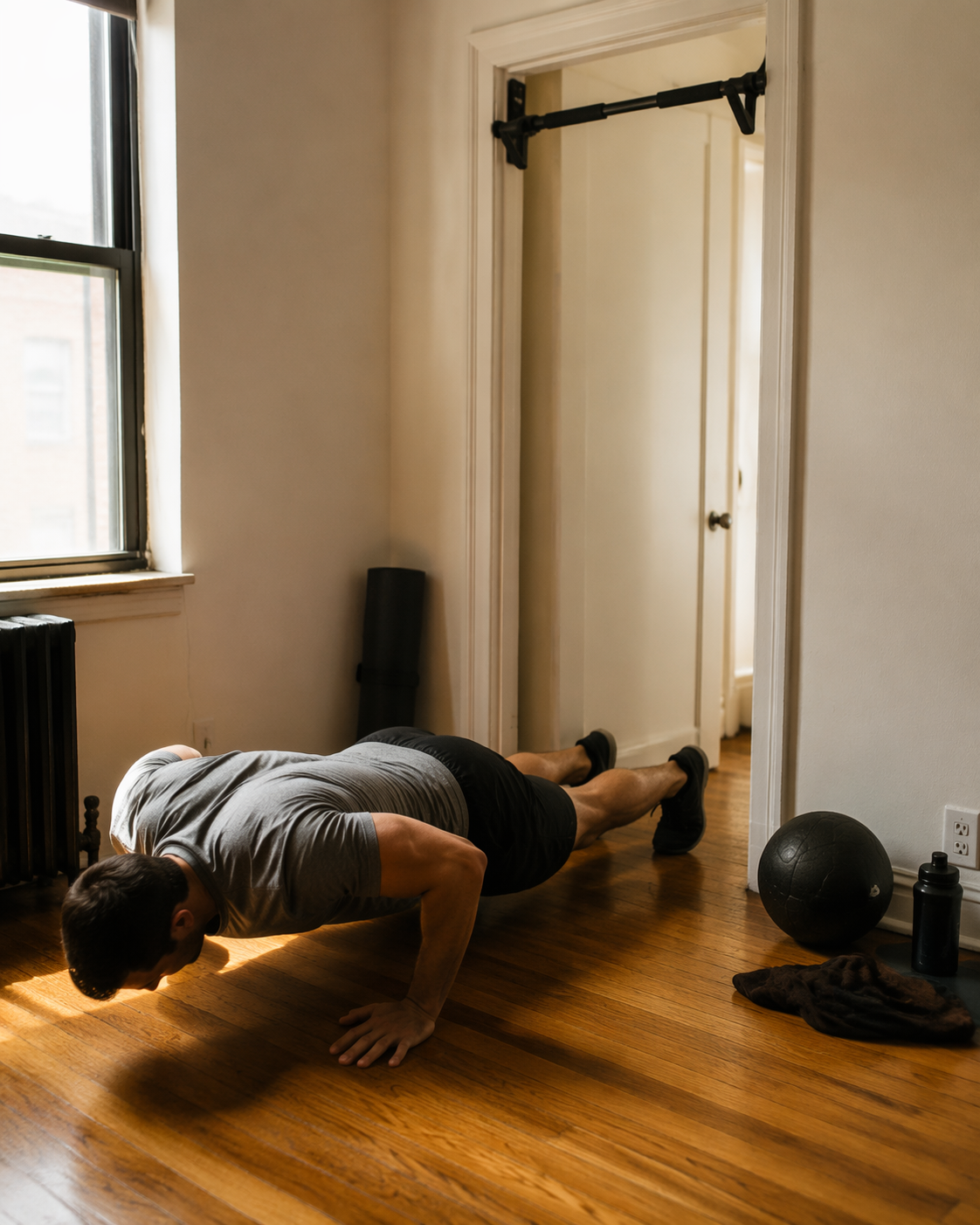
Do the exercises in order. Do not turn the first set of push-ups into a max-effort event if you still owe two more sets. The card is dense enough that pacing is part of the work.
- Push-ups: lock in a straight plank, lower under control, and stop the set before your hips start sagging.
- Air squats: use a stance you can repeat for all 30 reps; depth matters more than rushing.
- Crunches: keep the reps strict enough that your abs, not your neck, do the work.
- Burpees: move deliberately from standing to floor and back; sloppy sprawls make the next push-up set worse.
- Mountain climbers: count reps consistently, either total knee drives or per side, and use the same method every round.
- Pull-ups: use full control and stop at max if 15 clean reps are not there.
Heel-toe rocks are the odd-looking movement on the card, but they are not filler. Keep them controlled. Rock from heel emphasis to toe emphasis without bouncing around the room. In a small apartment, this is one of the easiest pieces to do well and one of the easiest to rush because it feels less dramatic than burpees.
A simple first-session rule
Start with one clean round. Time it if you want a benchmark, but do not race the first attempt. The better target is no skipped movement, no invented rest station, and no rep standard changing halfway through. Once one round is repeatable, add another round on a later session or shorten rest between movements.
The pull-up problem, solved without pretending it disappears
The card is bodyweight, but pull-ups are the one movement that changes the home setup. The official prescription is 15 pull-ups, or max.[1] If you have a safe doorway bar, garage beam, rack, or outdoor bar, use it. If you do not, the circuit can still stay honest, but the substitution should train a pull, not another push.
| If you have | Use | How to keep it honest |
|---|---|---|
| Doorway pull-up bar | Pull-ups | Do up to 15 clean reps or stop at max. |
| Low sturdy bar or table setup | Inverted rows | Keep the body rigid and pull the chest toward the edge or bar. |
| Towel and a secure door setup | Towel rows | Use only if the door and anchor point are genuinely secure. |
| No safe anchor | Bent-over bodyweight tempo rows or prone pull motions | Treat it as a temporary fallback, not an equal pull-up replacement. |
A substitution is not the same as the card. It is a way to preserve the movement category until you can train the real thing safely. For a recruit-minded reader, that distinction matters. If pull-ups are part of the standard you eventually need to meet, rows help build toward the pattern; they do not erase the need to practice hanging, pulling, and controlling your bodyweight on a bar.
How often to repeat it
The official card is repeatable, but repeatable does not mean you should turn every day into a wrecking session. Use one round as the base unit. If form holds, a second round makes sense. If push-ups collapse, burpees become a crawl, or the pull-up substitute turns into yanking, the useful training is already over.
For home use, the cleanest progression is boring and measurable:
- Complete one round with consistent form.
- Reduce unnecessary pauses between exercises.
- Add a second round only when the first round is not falling apart.
- Track pull-ups separately if they are the limiting movement.
- Keep warm-up, cool-down, and flexibility work around the conditioning event.
That progression respects the card instead of decorating it. More rounds are not automatically better if the later work no longer resembles the listed exercises.
How it differs from the MARSOC Short Card
If this sequence feels familiar, there is a reason. It shares the same general bodyweight-circuit language as the MARSOC Short Card: push, squat, core, burpee, mountain climber, pull. The difference is the source and the prescription. The DI School card uses its own rep scheme and is tied to drill instructor school pre-conditioning, not a special-operations-branded challenge.[1][2]
That comparison is useful only up to a point. If the question is “what is the actual Parris Island drill instructor workout card?” the answer is the DI School PT Program card above. Borrowing the harder reputation of another community does not make the workout more authentic.
The verdict
This is the rare military-style home workout where the source is more interesting than the mythology. The official DI School PT Program card gives you the exact round, the San Diego expectations page places it inside the drill instructor school preparation framework, and the exercises match the four-component fitness target the school names: strength, endurance, agility, and coordination.[1][2]
At home, it works because almost everything happens in place. You need floor space, discipline with the rep standards, and ideally a pull-up bar. Without the bar, use a pull-focused substitute and understand what you are replacing. Do one round cleanly, repeat only when the work stays honest, and you have the most authentic home version of a “train like a Marine DI” circuit available from the official material.
References
- DI School PT Program, MCRD Parris Island Official PDF, https://www.mcrdpi.marines.mil/Portals/76/Docs/DISchool/DI%20School%20PT%20Program_1.pdf?ver=4OAqDrp7kDGfstrqSQ6JSQ%3D%3D
- Drill Instructor School Expectations, MCRD San Diego, https://www.mcrdsd.marines.mil/Units/Subordinate-Units/Recruit-Training-Regiment/Drill-Instructor-School/Expectations/
- Physical Fitness, Marine Corps Association, https://www.mca-marines.org/physical-fitness/
Don't have the gear this routine assumes? Find the build that covers it.
Wondering how much rest you need after this? Read our ACSM-cited recovery reference.
Questions about form, substitutions, or a correction? Leave it below.
Comments
Join the discussion with an anonymous comment.