
What Does Marine Drill Instructor Fitness Training Look Like at Home?
Recreate the core of Marine Corps drill instructor physical training at home with minimal equipment — a pull-up bar, floor space, and optionally a kettlebell or sandbag. This routine adapts DI School principles of progression and overload for apartment dwellers on a budget under $100.
Before you start
- Equipment required
- pull-up bar, floor mat, kettlebell or sandbag
- Assumes build tier
- No specific tier required
- Difficulty
- beginner to intermediate
- Noise level
- quiet
Marine drill instructor fitness training is less mysterious once the costume drama gets pushed out of the room. The useful part is not yelling, campaign covers, or pretending a living room is a recruit depot. It is repeated calisthenics, pull-ups, running capacity, loaded movement, and the unpleasant little skill of continuing to work when the first round has already made the second round worse.
The real benchmark is demanding enough without decorating it. Marine Corps Drill Instructor School is an 11-week course with 55 training days, and the expectations published by MCRD San Diego include an 8:00-per-mile pace maintained on all runs.[1] For physical testing, the Marine Corps PFT still gives the clearest home-testable targets: dead-hang pull-ups and a 3-mile run. The PFT pull-up standard ranges from 4 to 23 reps depending on age, while the max-score 3-mile run time for males ages 17–26 is 18:00; DI School expectations are more immediately practical for most home athletes at 10 or more pull-ups and a sub-23:00 3-mile run.[2][1]
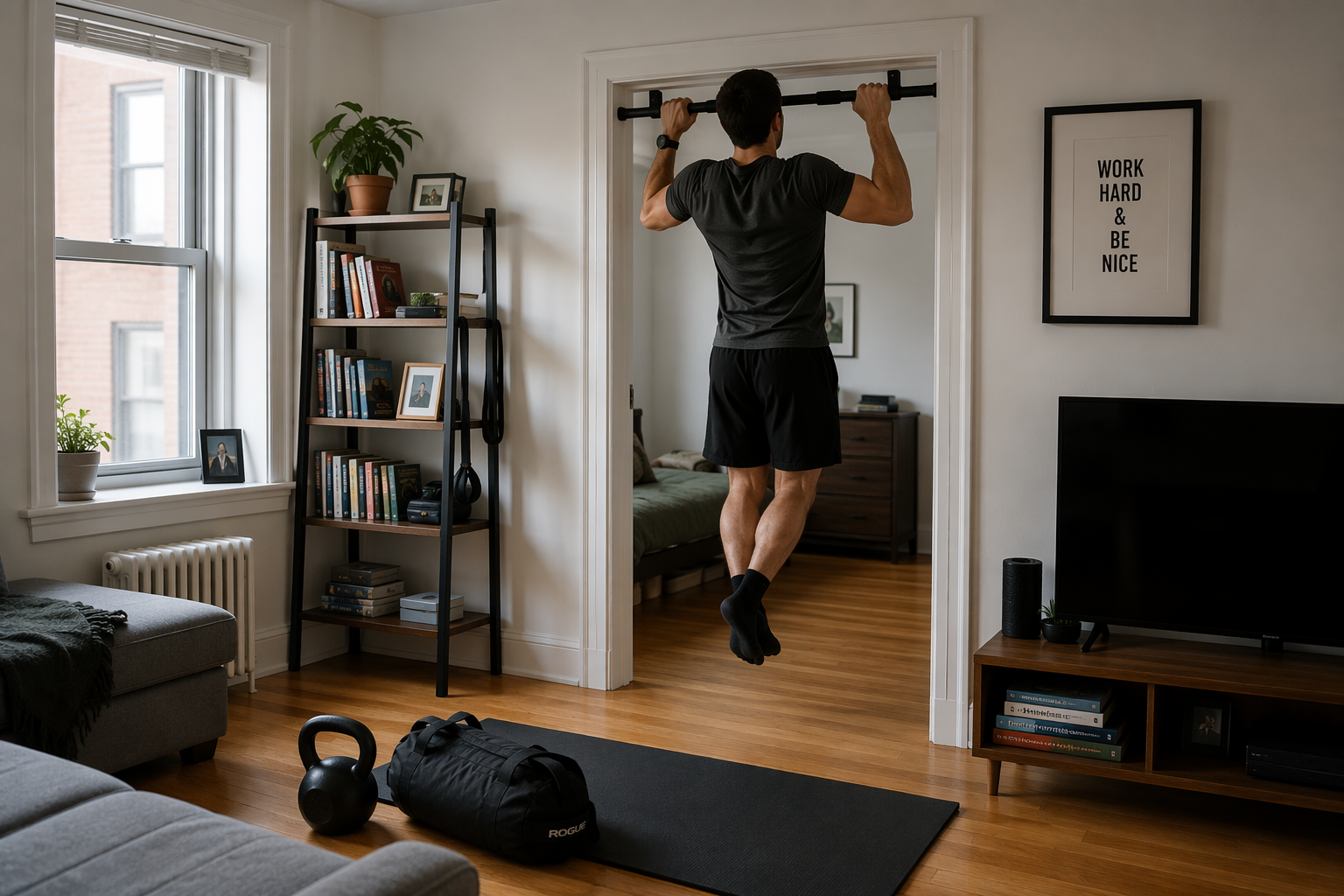
That gives the home version its boundaries. A serious version of marine drill instructor fitness training at home should make pull-ups better, make running or conditioning harder to break, and build enough trunk, leg, and grip endurance that loaded work does not feel like a novelty. It does not need a squat rack, a sled lane, or a garage full of flags. It does need progression.
The Training Logic Matters More Than the Military Theater
The Marine Corps training framework commonly summarized through eight principles—progression, regularity, overload, variety, recovery, balance, specificity, and synergy—is a useful filter because it kills most of the cosplay quickly.[3] If the home routine is random suffering, it is not training. If every session is a heroic test, it is not progression. If it improves only push-ups while pull-ups and running stay unchanged, it is not specific enough.
At home, those principles translate into a few plain rules:
- Train pull-ups often enough to improve the skill, not just to prove you are bad at them once a week.
- Use bodyweight circuits for muscular endurance, but change reps, rounds, rest, or tempo so the load actually rises over time.
- Keep a running plan if you can run outside; use quiet conditioning only when neighbors, weather, or schedule make running unrealistic.
- Carry something heavy enough to challenge grip, posture, and breathing without turning the apartment hallway into a demolition site.
- Recover on purpose, because regularity collapses quickly when every workout is treated like a final exam.
The DI School context is useful as a benchmark, not as a script. You are not recreating an 11-week institutional course in a one-bedroom apartment. You are borrowing the parts that survive contact with a doorway, a floor mat, a sidewalk route, and a budget that does not want to become a personality.
The Under-$100 Setup
The equipment list is almost disappointingly normal, which is good. A doorway pull-up bar in the $15–30 range is the central purchase. Add a mat if your floor punishes elbows and knees. If the budget allows, a kettlebell or sandbag in the $35–75 range gives you loaded carries, front-loaded squats, hinges, and awkward holds. Running shoes matter if outdoor running is part of the plan.
| Item | Why it earns space | Apartment note |
|---|---|---|
| Doorway pull-up bar | Pull-ups are one of the clearest DI-style strength benchmarks. | Use a no-drill option only if the doorway and bar design are compatible. |
| Floor mat | Planks, push-ups, mountain climbers, mobility, and recovery work all happen on the floor. | A mat also reduces noise from hands, knees, and light transitions. |
| Kettlebell or sandbag | Carries and front-loaded work build trunk, grip, legs, and breathing under load. | A sandbag is quieter if set down carefully; a kettlebell is smaller. |
| Measured run route | The 3-mile run benchmark needs actual running if your body tolerates it. | A loop outside avoids treadmill dependence and keeps noise out of the apartment. |
Two PFT-relevant pieces—pull-ups and plank-style trunk endurance—can be trained with a pull-up bar and floor space. The run is the part most home articles quietly replace with sweatier jumping. That is fine for conditioning on bad days, but it is not the same adaptation. If the goal includes a better 3-mile time, running needs to appear regularly.
Build the Week Around Pull, Push, Run, Carry
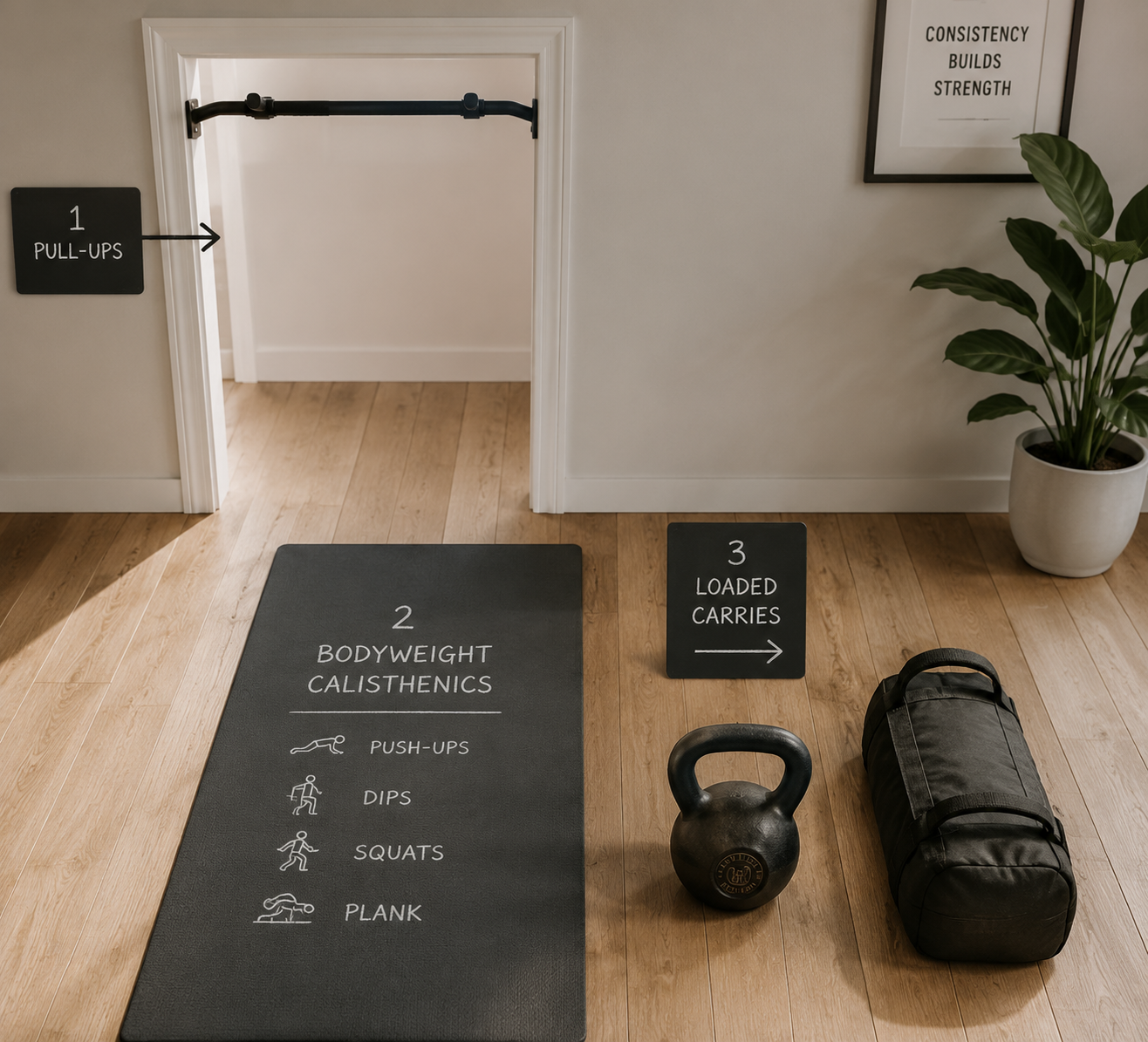
A home DI-style week should not be a daily punishment circuit with a different name. It should expose the same qualities repeatedly: upper-body pulling, high-rep calisthenics, trunk endurance, running or conditioning, and loaded movement. The exact schedule can move around work, kids, neighbors, and whether the hallway is shared by people who did not volunteer for your training plan.
Here is a practical five-day structure. Treat the numbers as a starting template, not a claim about DI School programming.
| Day | Main work | Purpose |
|---|---|---|
| Day 1 | Pull-ups plus calisthenics circuit | Build upper-body pulling and muscular endurance. |
| Day 2 | Run intervals or quiet conditioning intervals | Build pace tolerance and breathing control. |
| Day 3 | Loaded carries plus trunk work | Build grip, posture, legs, and midline endurance. |
| Day 4 | Easy run, brisk walk, or low-impact recovery circuit | Maintain regularity without stacking fatigue recklessly. |
| Day 5 | Mixed benchmark circuit | Practice moving between pull, push, legs, trunk, and conditioning under fatigue. |
| Days 6–7 | Rest, mobility, or easy walking | Recover enough to repeat the next week. |
The point is the rotation. Pull-ups get priority because they are a real benchmark and a slow-moving skill. Running gets its own attention because conditioning improves differently when the legs actually cover distance. Carries sit in the middle because they make the whole body negotiate fatigue without requiring a barbell or much floor space.
Day 1: Pull-Ups Before the Circuit
Do pull-ups while fresh. That is not romantic, but it works. A beginner who can do only one or two clean reps can use singles, controlled negatives, or foot-assisted reps. Someone closer to the DI School expectation can accumulate multiple submaximal sets instead of testing max reps every session.
- Pull-up block: 10 total clean reps by any honest method, then build toward 20, 30, and beyond.
- Circuit: push-ups, squats or reverse lunges, plank, and mountain climbers.
- Progression: add one round, add reps per round, reduce rest, or slow the lowering phase.
- Noise control: step feet back for mountain climbers instead of snapping them into the floor.
Keep a rep or two in reserve on most pull-up sets. Failing early makes the rest of the session look tougher while making total useful pulling volume smaller. That is a bad trade, unless the goal is mainly to look ruined.
Day 2: Run Work, With Quiet Substitutes When Needed
The official expectation that DI School runs maintain an 8:00-per-mile pace is useful because it gives the home athlete a real pace reference, not because everyone should open week one by chasing it.[1] If your current 3-mile pace is slower, the first job is consistency: finish the distance, then add controlled faster work.
A simple outdoor session might be 6 to 10 repeats of faster running with walking recovery, followed by easy jogging or walking. Another day can be an easy 2- to 3-mile run. The benchmark can be tested occasionally, but weekly 3-mile time trials are a quick way to turn training into dread.
For apartment days, choose quiet conditioning that keeps breathing high without repeated floor impact. Step-back burpees, shadow boxing, fast step-ups if you have a stable low platform, marching high knees, loaded marches in place, and low-impact mountain climbers all work. Jump rope and full burpees are effective, but they are not neighbor-neutral. The person downstairs gets a vote, even if they never asked to be part of your chain of command.
Day 3: Carries in a Hallway, Not a Parade Field
Loaded carries are the easiest part to underestimate in a small apartment because they look too simple to matter. Pick up a kettlebell, sandbag, backpack, or other stable load. Walk the hallway. Turn around. Keep the ribs down, shoulders active, and steps controlled. Set the load down like someone lives below you.
- Farmer carry: load at one or both sides for grip and posture.
- Bear-hug carry: sandbag or backpack held against the chest for trunk and breathing pressure.
- Suitcase carry: one-sided load for anti-lean trunk work.
- Front rack hold or march: kettlebell held high, feet moving softly in place.
Progress carries by increasing total time under load, using a heavier object, reducing rest, or pairing carries with squats and push-ups. Do not progress by moving faster around blind corners with a kettlebell. The training effect comes from controlled fatigue, not from making your lease more interesting.
Day 5: The Mixed Session
The mixed session is where the routine starts to feel DI-inspired rather than merely “some calisthenics.” It links pulling, pushing, legs, trunk, and conditioning while fatigue accumulates. This is also where restraint matters. If every station is maximal, form collapses early and the later work becomes noise.
One example circuit:
- Pull-ups or assisted pull-ups: 3 to 6 reps, or 2 controlled negatives.
- Push-ups: 10 to 25 reps.
- Reverse lunges or squats: 10 to 20 reps.
- Plank: 30 to 60 seconds.
- Carry or loaded march: 30 to 60 seconds.
- Quiet conditioning: 60 to 120 seconds.
Run 3 to 5 rounds. Rest long enough that the next round is still trainable. If the pull-ups disappear by round two, lower the reps, use assistance, or place pull-ups only in the first half of the circuit. Protect the movement you most want to improve.
How to Progress Without Turning Every Workout Into a Test
Progression is the difference between a routine and a rough afternoon. Start with a version you can complete with clean reps and repeat next week. Then raise one variable at a time.
| Training piece | Week-to-week progression | Do not fake it by |
|---|---|---|
| Pull-ups | Add total clean reps, add sets, or reduce assistance. | Kipping, half reps, or maxing out every session. |
| Calisthenics | Add reps, add rounds, reduce rest, or slow tempo. | Rushing sloppy reps to beat a clock. |
| Running | Add easy mileage slowly, add controlled intervals, or improve pace at the same distance. | Replacing all runs with random jumping and calling it the same thing. |
| Carries | Add time, distance, load, or density. | Dropping the load loudly or racing turns in a small space. |
| Recovery | Keep rest days, easy days, and sleep consistent. | Assuming soreness proves the plan is working. |
A clean four-week wave can be enough before retesting. Week one establishes the baseline. Week two adds a small amount of volume. Week three adds either density or intensity. Week four reduces volume slightly and tests one or two benchmarks, such as max dead-hang pull-ups and a 3-mile run time if running is part of the plan.
The pull-up benchmark is especially useful because it is brutally clear. A rep starts from a dead hang and finishes with the chin over the bar. The PFT standard range of 4 to 23 dead-hang pull-ups should be read as a scoring context, while the DI School expectation of 10 or more pull-ups is a practical target for this style of training.[2][1] If you currently have zero, the target is not fake toughness. The target is the first strict rep, then repeatable sets.
Quiet Conditioning That Still Does Work
Apartment training fails when it confuses intensity with impact. A downstairs neighbor hears landings, not your intent. Fortunately, fatigue does not require jumping. It requires enough muscle mass working long enough, with rest kept honest.
| Noisy choice | Quieter substitute | What it preserves |
|---|---|---|
| Jump squats | Tempo squats or squat-to-calf-raise | Leg endurance and local burn. |
| Full burpees with a jump | Step-back burpees without the jump | Whole-body conditioning with less impact. |
| High-knee running in place | Marching high knees with hard arm drive | Breathing demand and hip flexor work. |
| Jump rope | Fast shadow boxing or low step-ups | Rhythm, coordination, and heart-rate elevation. |
| Sprints in a hallway | Loaded march intervals | Conditioning under trunk and grip fatigue. |
Agility and coordination are harder to train in a tiny room than strength endurance, but they are not impossible. Use controlled direction changes, bear crawls if your floor and wrists tolerate them, plank shoulder taps, lateral step patterns, and get-up variations. Keep the radius small and the intent high. There is no prize for clipping a coffee table.
A 12-Week Home Track
The Corps has published home-fitness material, and secondary commercial analysis also exists around DI School preparation plans, but the official DI School programming details available publicly are not complete enough to copy session by session from primary documents. Mountain Tactical Institute sells a USMC Drill Instructor School Training Plan, which is useful to note as secondary analysis, not as proof that every home athlete needs a specialized product.[4]
For a home athlete, 12 weeks is a better organizing frame than trying to impersonate the 11-week school calendar. It gives enough time to build capacity, push volume, and test without pretending that an apartment routine is an institutional course.
| Phase | Main emphasis | What changes |
|---|---|---|
| Weeks 1–4 | Base and technique | Establish pull-up volume, complete circuits cleanly, build easy running or quiet intervals. |
| Weeks 5–8 | Volume and density | Add rounds, shorten rest, increase total carries, and introduce more demanding run intervals. |
| Weeks 9–11 | Benchmark preparation | Practice mixed sessions under fatigue and test pieces separately rather than all the time. |
| Week 12 | Retest and unload | Retest pull-ups and the 3-mile run if applicable, then reduce volume before restarting. |
Testing should be boring and repeatable. Same bar. Same pull-up standard. Same route if running outdoors. Same timing method. If the test conditions change every month, the result measures creativity as much as fitness.
What This Home Version Can and Cannot Claim
This routine can build much of the training effect people usually mean when they search for marine drill instructor fitness training: better pull-ups, more calisthenics tolerance, stronger trunk endurance, improved conditioning, and more comfort carrying load while tired. It can also do that with a doorway bar, floor space, and one optional heavy object.
It cannot honestly claim to reproduce DI School. The school has institutional demands, coaching, evaluation, daily schedule pressure, and professional context that a home routine does not have. The useful comparison is narrower: the physical qualities are trainable without a gym, and the benchmarks give you a way to keep the plan honest.
If the budget is under $100, buy the pull-up bar first. Use the floor you already have. Run outside when possible. Add a sandbag or kettlebell if carries are missing. Then progress the work with enough discipline that the routine gets harder for a reason, not just louder. That is the part worth keeping: hard, structured, apartment-aware training that builds the same broad qualities without pretending the living room is the Corps.
References
- Expectations, MCRD San Diego, https://www.mcrdsd.marines.mil/Units/Subordinate-Units/Recruit-Training-Regiment/Drill-Instructor-School/Expectations/
- USMC Physical Fitness Test, Military.com, https://www.military.com/military-fitness/marine-corps-fitness-requirements/usmc-physical-fitness-test
- Physical Fitness, Marine Corps Association, https://www.mca-marines.org/physical-fitness/
- USMC Drill Instructor School Training Plan, Mountain Tactical Institute, https://mtntactical.com/shop/usmc-drill-instructor-school-training-plan/
Don't have the gear this routine assumes? Find the build that covers it.
Wondering how much rest you need after this? Read our ACSM-cited recovery reference.
Questions about form, substitutions, or a correction? Leave it below.
Comments
Join the discussion with an anonymous comment.