
Rainy Day Home Workout Ideas for Any Budget
Rainy day got you stuck inside? These three workout routines are matched to your home gym budget — from bodyweight only to a full dumbbell setup — so you always have a plan that fits exactly what you own.
Before you start
- Equipment required
- bodyweight, resistance bands, dumbbells
- Assumes build tier
- No specific tier required
- Noise level
- quiet
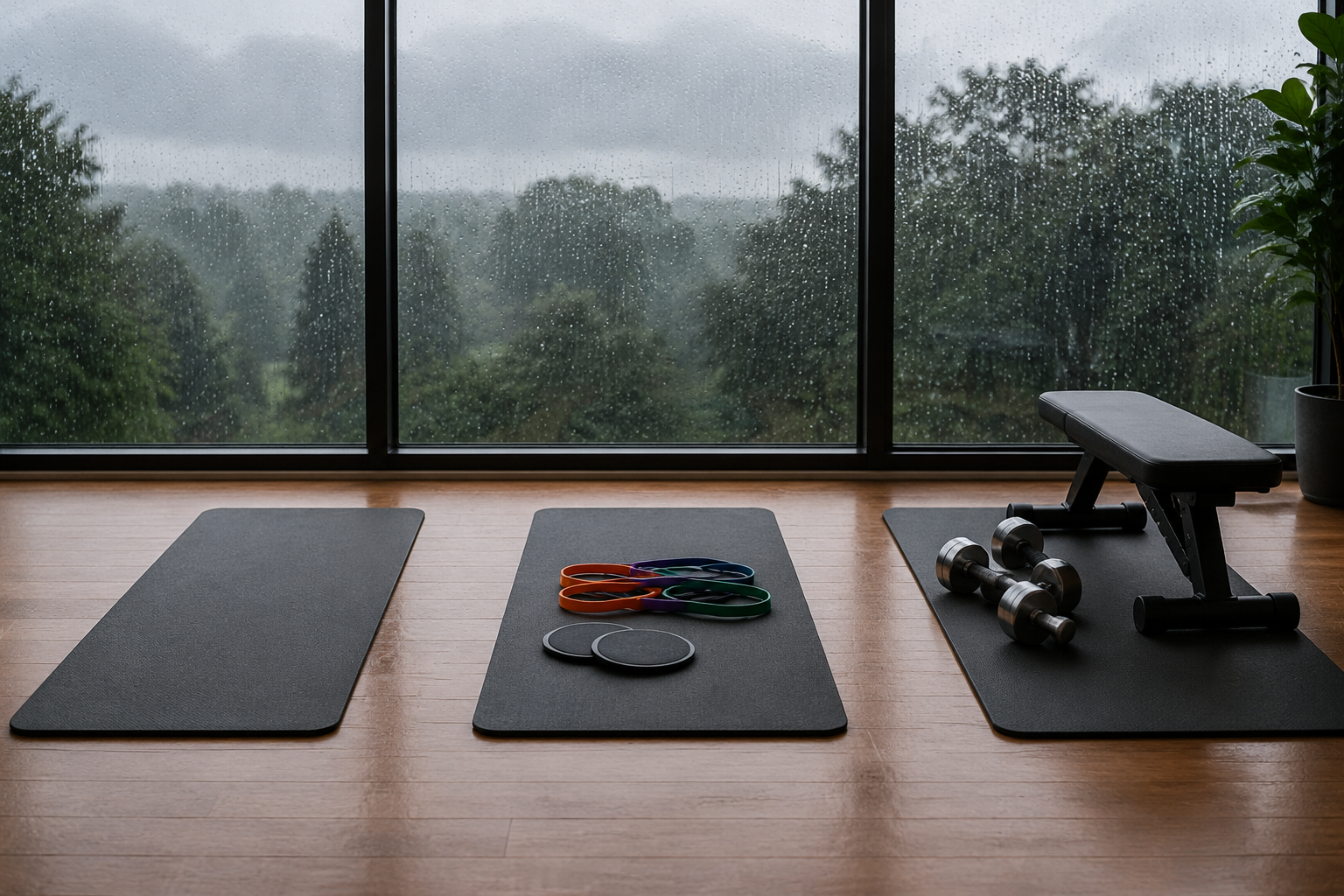
Rain closed the outside option, so the useful question is not how to stay motivated but what the room already makes possible. Pick the tier that matches the gear in reach, then run the session that fits it.
| Tier | What to do tonight | What this tier unlocks |
|---|---|---|
| $0 bodyweight | Run the six-move quiet circuit | A complete baseline for push, squat, hinge, core, posterior chain, and isometric work |
| $0-100 bands + sliders | Choose the strength circuit or the faster interval version | Pulling, pressing, tension, and slider work that bodyweight alone cannot load well |
| $100-300 dumbbells + adjustable bench | Run the EMOM or the AMRAP | Loadable strength work and progression that keep the same moves useful for a long stretch |
Bodyweight only: the quiet baseline
A $0 rainy-day plan should feel complete, not like the place you end up when the real equipment is missing. A six-exercise circuit built from push-ups, split squats, glute bridges, hollow holds, superman holds, and wall sits covers the whole body without noise, clutter, or setup, and it follows the same small-space logic used by Nerd Fitness and the full-body rainy-day circuit structure used by Macros Inc.[1][2]
- Push-ups — 6 to 15 reps
- Split squats — 8 to 12 reps per side
- Glute bridges — 12 to 20 reps with a 2-second squeeze at the top
- Hollow holds — 20 to 30 seconds
- Superman holds — 20 to 30 seconds
- Wall sits — 30 to 45 seconds
Run 2 to 4 rounds, rest 30 to 60 seconds between rounds, and keep the transitions tight enough that the workout still fits an apartment afternoon. The point is coverage: push, squat, hinge, core, posterior chain, and one isometric hold each show up once, so the circuit feels like a real session instead of a placeholder.
Bands and sliders: the smallest upgrade with the biggest payoff
A resistance-band set plus sliders changes the indoor menu in a way bodyweight never quite does. Rows, presses, pull-aparts, banded squats, and slider lunges enter the picture fast, so the useful exercise pool feels close to doubled once you can add tension instead of only moving your own mass.[3][4]
Strength circuit
- Banded squat — 10 to 15 reps
- Band row — 10 to 15 reps
- Half-kneeling band press — 8 to 12 reps per side
- Slider reverse lunge — 8 to 10 reps per side
- Band Romanian deadlift — 10 to 15 reps
- Band pull-apart — 15 to 20 reps
Do 3 rounds, slow the lowering phase, and keep rest periods short enough that the bands stay under tension instead of turning the session into a long reset.
Faster version
If the weather has you restless, keep the same exercise pool but switch to 30 seconds of work and 15 seconds of rest. That format keeps the session quiet while making the sliders and bands do more of the intensity work.
Dumbbells and an adjustable bench: where progression stops feeling patched together
This is the first tier where load can keep increasing instead of the workout simply getting harder in a vague way. Sunny Health & Fitness and Key to Life both lean on dumbbell-based indoor training, and the point of this tier is not novelty; it is repeatable progression with the same core movements.[5][6]
25-minute EMOM
| Minute | Move | Target |
|---|---|---|
| 1 | Goblet squat | 8 to 10 reps |
| 2 | Dumbbell bench press or floor press | 8 to 10 reps |
| 3 | One-arm bench-supported row | 8 reps per side |
| 4 | Romanian deadlift | 10 reps |
| 5 | Reverse lunge | 6 to 8 reps per side |
Repeat the five-minute block five times. If the set of dumbbells is truly loadable in useful increments, this format stays relevant because the same movement slots can keep getting heavier without needing a completely different plan.
15-minute AMRAP
- 8 dumbbell thrusters
- 10 Romanian deadlifts
- 8 floor presses
- 10 bench-supported rows
- 8 reverse lunges per side
Move steadily and keep the reps clean. The bench turns the rows and presses into work you can repeat, while the dumbbells handle the load in a way the lighter tiers cannot.
What each tier actually changes
The weekly target from the Physical Activity Guidelines for Americans is 150 minutes of moderate activity or 75 minutes of vigorous activity, plus two muscle-strengthening days.[7] A rainy-day session from any of these tiers can count toward that week; the real difference is how much repeatable strength work each tier lets you do without improvising.
| Tier | What it unlocks | What still feels limited |
|---|---|---|
| $0 bodyweight | A quiet baseline that covers the whole body with no equipment and no setup delay | No loaded pulling or pressing, so progression depends mostly on leverage, tempo, and volume |
| $0-100 bands + sliders | Rows, presses, pull-aparts, banded lower-body work, and more tension options in the same floor space | Resistance ceiling and anchor setup still matter |
| $100-300 dumbbells + adjustable bench | Loadable strength work, bench-supported rows and presses, and easier long-term progression | Takes more room and more money than the lower tiers |
That is the practical answer to rainy-day home workouts: match the session to the tier already in the room. The $0 plan keeps the door open for anyone with a mat, the band tier makes a small purchase feel useful instead of decorative, and the dumbbell tier turns a wet afternoon into repeatable strength work without asking for a different house.
References
- How to Work Out in Small Spaces: The No-Space Workout — Nerd Fitness
- Rainy Day Workouts — Macros Inc
- Quiet Workouts for Small Spaces — Sweat
- Shh! Quiet Exercises for an Apartment-Friendly Workout — Centr
- Rainy Day Activities at Home Workout — Sunny Health & Fitness
- Top 5 Indoor Workouts for Bad Weather Days — Key to Life
- Physical Activity Guidelines for Americans, 2nd edition — U.S. Department of Health and Human Services
Don't have the gear this routine assumes? Find the build that covers it.
Wondering how much rest you need after this? Read our ACSM-cited recovery reference.
Questions about form, substitutions, or a correction? Leave it below.
Comments
Join the discussion with an anonymous comment.