
Work Out Indoors During a Tropical Storm Without Equipment
This article provides a tiered bodyweight circuit sequence for apartment dwellers stuck indoors during a tropical storm with possible power outages. It covers no-equipment, low-noise, and battery-conserving workouts for up to 72 hours.
Before you start
- Equipment required
- none
- Assumes build tier
- No specific tier required
- Noise level
- quiet
If you are looking for indoor workouts during a tropical storm, the first answer is not a harder workout. It is: stay inside, stay away from windows if conditions worsen, keep your phone available for alerts, and use a written no-equipment circuit that does not depend on streaming video, jumping, or a dry balcony. CDC hurricane safety guidance tells people to stay indoors during tropical storms, and NOAA-described tropical-storm-force winds can turn loose debris, falling branches, flooding, and lightning into real hazards outside.[1][2]
That changes the workout problem. This is not a normal rainy-day “get your steps in” situation. During Hurricane Helene in September 2024, affected customers in South Carolina averaged 53 hours without power, which is long enough for a single peppy circuit to become useless by the second night if it assumes lights, air conditioning, charged devices, and fresh energy.[3]
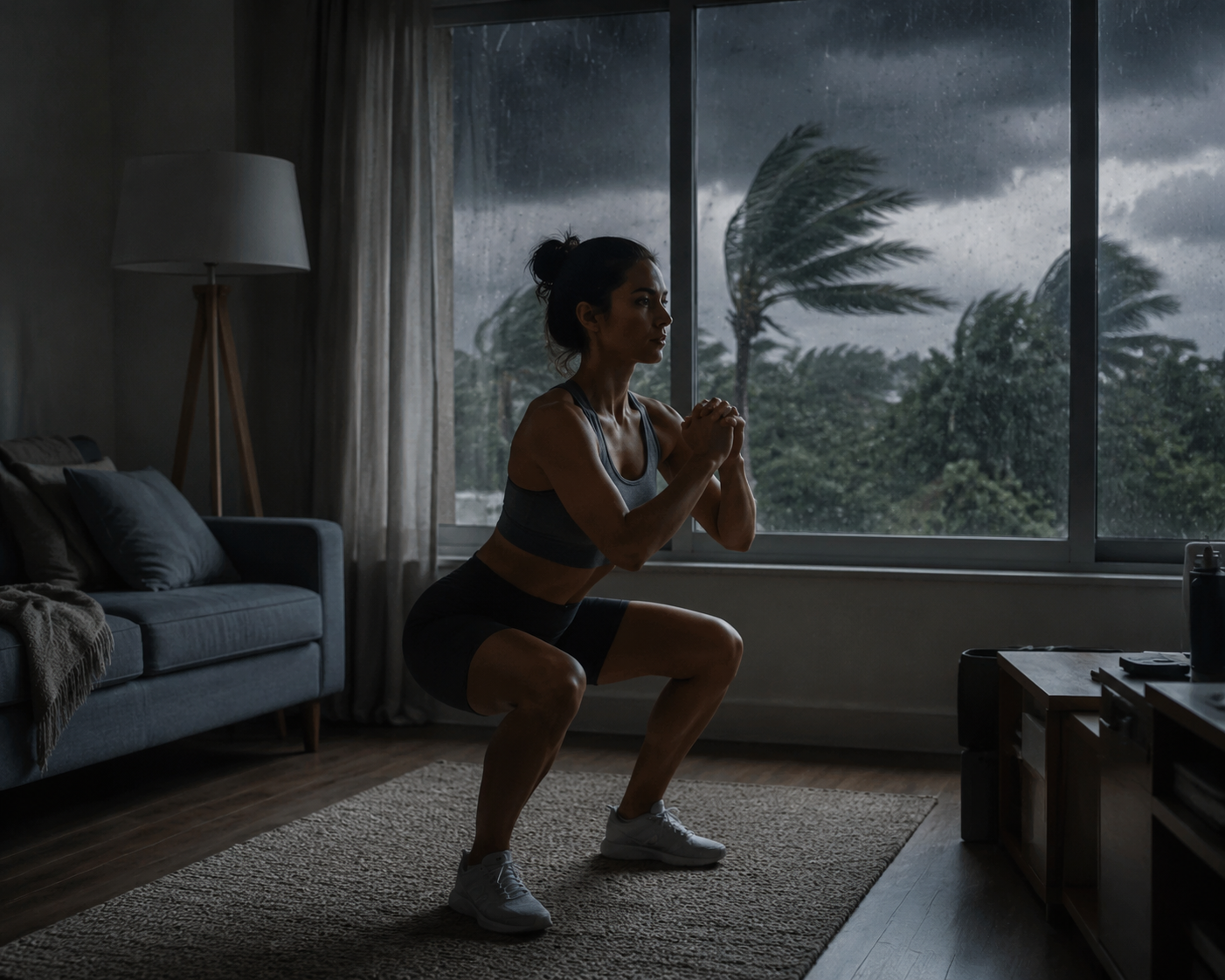
The plan below is built for a renter with a small cleared patch of floor, a wall, maybe a rug, and neighbors below. It is not an official CDC, NOAA, or ACSM tropical-storm workout protocol; those agencies do not provide a storm-specific exercise routine. It is a conservative home-workout plan shaped around their safety boundary: do not make the storm part of the workout.
The 72-hour no-equipment storm workout
Use the phase that matches your conditions, not the calendar perfectly. If it is Day 1 but the power is already out, skip to Day 2. If it is Day 3 and you slept well, have safe temperatures indoors, and no evacuation instructions are active, you can repeat Day 2 instead of doing only mobility.
| Storm phase | Best use | Workout | Effort target |
|---|---|---|---|
| Day 1: Power likely on, energy higher | You want a real full-body session before conditions deteriorate | 3–4 rounds: slow squats, incline or floor pushups, step-back lunges, plank shoulder taps, glute bridges | Moderate; you should still be able to speak short sentences |
| Day 2: Power out or battery-saving mode | You need a quiet circuit you can remember without a video | 2–3 rounds: wall sit, wall pushups, reverse lunges or split-squat holds, dead bug, side plank, calf raises | Easy to moderate; no breathless intervals |
| Day 3+: Fatigue, poor sleep, heat/cold, possible evacuation | You need movement without draining yourself | 10–20 minutes: cat-cow, wall slides, hip hinges, seated or standing hamstring stretch, ankle circles, slow marching in place | Low; you should finish calmer than you started |
Write the version you plan to use on paper or save it as a note you can open offline. A 30-minute workout video can use 300–600 MB of data and drain about 5–8% of phone battery, which is a silly trade when that same phone may be your weather radio, flashlight, and message line.[3]
Day 1: a full-body circuit while you still have margin
Day 1 is the only part of this plan that should feel like a normal workout. The goal is to get a clean strength-and-conditioning session without doing anything that shakes the floor. Similar rainy-day bodyweight circuits commonly use squats, lunges, pushups, and planks in timed intervals; that structure works, but storm conditions call for quieter movement and an easier exit if alerts change.[4]
- Warm up for 3 minutes: neck turns, shoulder circles, hip circles, ankle rolls, then 30–60 seconds of slow marching in place.
- Do 3 rounds if you are unsure; 4 rounds only if the apartment is safe, the indoor temperature is comfortable, and you are not already exhausted.
- Rest 30–60 seconds between exercises, or longer if the room is warm, humid, dark, or stressful.
Day 1 circuit
- Slow bodyweight squats — 8 to 12 reps. Stand with feet about shoulder-width apart. Lower for two or three counts, pause briefly, then stand without bouncing. If your knees or balance dislike squats, sit back toward a chair or couch and stand again.
- Incline pushups or floor pushups — 6 to 12 reps. Use a wall, counter, couch arm, or floor depending on your strength. Keep the reps smooth; no clapping, no fast drops.
- Step-back lunges — 6 to 10 reps per side. Step one foot back softly, bend both knees, then return to standing. The back knee does not need to touch the floor. Use a wall for balance if the room is dim.
- Plank shoulder taps — 10 to 20 total taps. From a high plank, tap one shoulder with the opposite hand. Widen your feet to reduce rocking. If this is too much, hold a forearm plank instead.
- Glute bridges — 10 to 15 reps. Lie on your back, feet planted, lift your hips, squeeze briefly, lower with control. This gives you posterior-chain work without stomping or needing furniture.
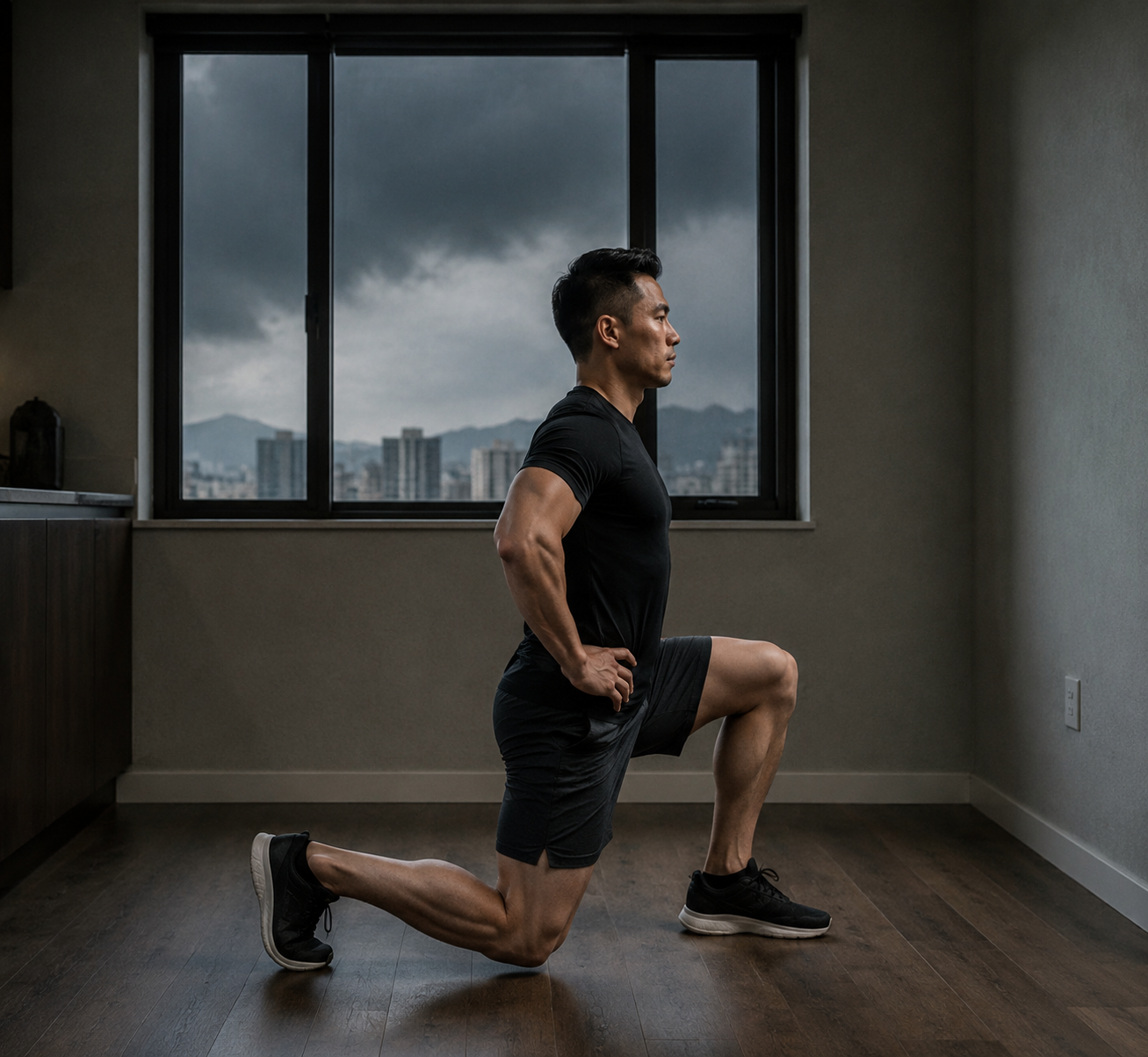
This is the highest-effort session in the plan, and it still avoids jump squats, burpees, and mountain climbers. Those moves show up often in indoor rainy-day exercise lists, but they are a poor default for upper-floor apartments during a storm: they add impact noise, require more attention, and become harder to control when the lights flicker or the floor is cluttered.[5]
Day 2: the battery-conserving circuit
Day 2 assumes the annoying version of reality: the power is out, the room is darker, the fridge is being opened as little as possible, and you are checking your phone only when you need to. The workout has to be easy to remember because “just stream a class” is no longer a harmless suggestion.
Do 2 or 3 rounds. Count breaths instead of using a timer if you are saving battery. For example, hold a wall sit for 6–10 slow breaths, then move on. That is less precise than an interval app, but it works when precision costs power.
Day 2 circuit
- Wall sit — 6 to 10 slow breaths. Slide down a wall until your thighs are working but not shaking hard. If your knees complain, stay higher.
- Wall pushups — 8 to 15 reps. Stand arm’s length from a wall, lower your chest toward it, press back. This is not glamorous; it is quiet, visible in low light, and easy to stop.
- Reverse lunges or split-squat holds — 5 to 8 reps per side, or 5 slow breaths per hold. If stepping back feels unstable, take a split stance and hold the bottom half of the movement instead.
- Dead bug — 6 to 10 reps per side. Lie on your back, arms up, knees bent. Slowly extend one leg and the opposite arm, then return. Keep your low back from arching.
- Side plank from knees — 4 to 8 slow breaths per side. Stack your knees, brace gently, lift your hips. Use the easier version before you need it.
- Slow calf raises — 10 to 20 reps. Hold a wall lightly, rise onto the balls of your feet, lower without dropping your heels hard.
If the circuit starts to feel like a choreographed routine, simplify it further: wall sit, wall pushup, glute bridge, dead bug. Repeat that sequence twice. A storm workout should not require you to remember twelve cues while listening for building alarms or emergency messages.
Day 3 and beyond: mobility when recovery is already compromised
By the third day, the problem is often not motivation. It is sleep, temperature, stale air, damp clothes, interrupted meals, and the mental tax of waiting. This is where a lot of fitness advice gets irritating. If the building is hot, cold, noisy, or under active alerts, the win may be circulation and joint movement rather than a workout score.
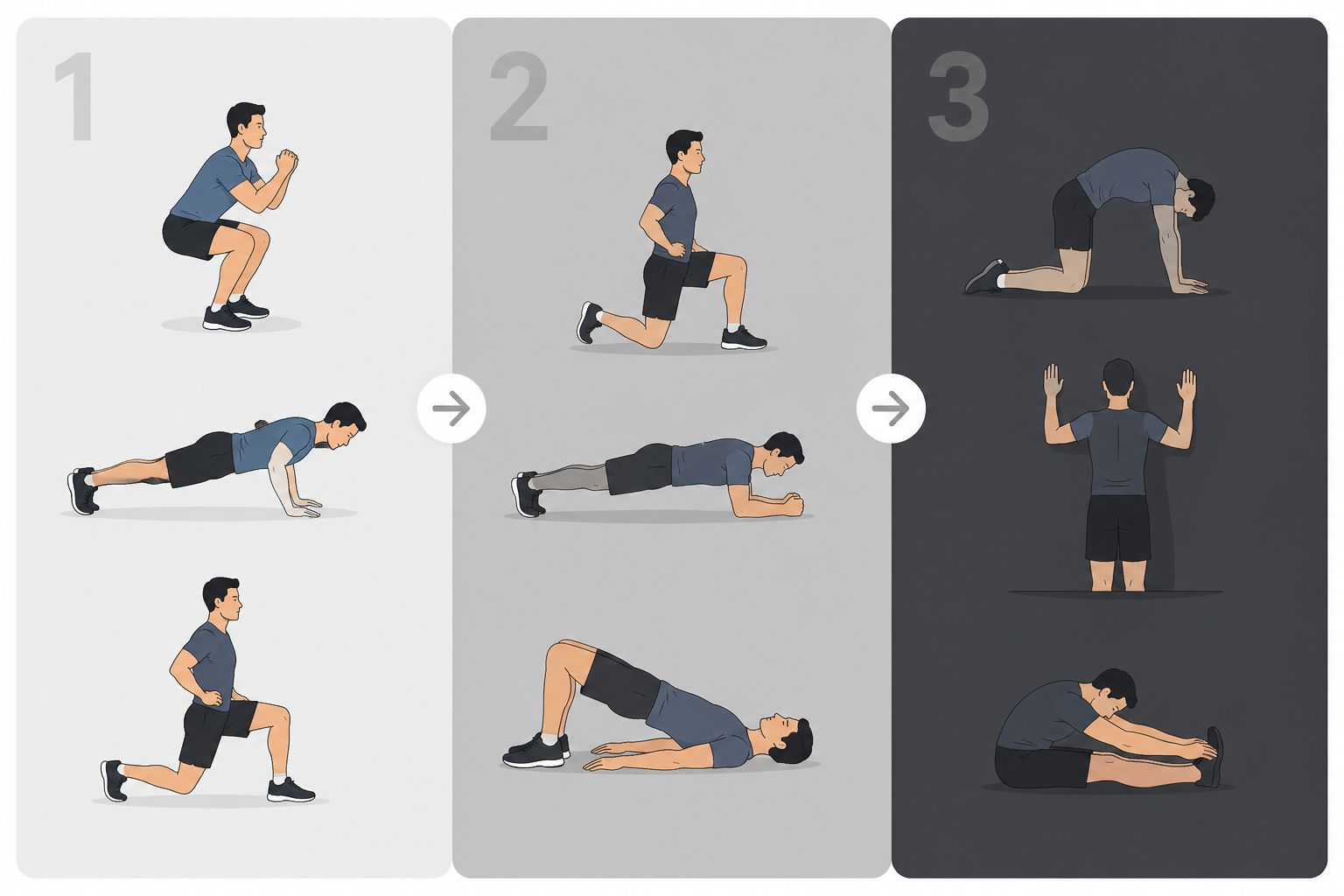
Choose 10–20 minutes. No timer is required. Move slowly enough that you could stop at any point without feeling dizzy.
- Cat-cow — 6 to 10 slow reps. On hands and knees, round your back, then gently arch it. If getting on the floor is awkward, do the same spinal motion with hands on a wall or countertop.
- Wall slides — 6 to 10 reps. Stand with your back near a wall, slide your arms up and down as comfortably as you can. Do not force overhead range.
- Hip hinges — 8 to 12 reps. Put hands on hips, push hips back, keep the back long, then stand. This is a quiet way to keep the hamstrings and glutes awake.
- Standing or seated hamstring stretch — 3 to 5 slow breaths per side. Pick the version that does not challenge balance.
- Ankle circles and calf pumps — 10 each direction per side. Useful if you have been sitting for long stretches.
- Slow marching in place — 30 to 90 seconds. Lift the feet quietly. Stop before it turns into stomping.
If evacuation instructions appear, the workout is over. If indoor temperatures feel unsafe, you are lightheaded, you have chest pain, you are short of breath beyond normal exertion, or you are rationing water, stop. PowerOutage.us frames very cold or very hot indoor conditions as a practical reason to change plans; its temperature thresholds are a synthesis of broader safety guidance, not a storm-exercise rulebook, so treat them as a caution sign rather than a permission slip to push until a number is crossed.[3]
How to make the workout apartment-safe
Most apartment workout problems come from impact, not effort. A squat done slowly on a rug is usually less offensive than a set of jumping jacks done with heroic intent. The downstairs neighbor does not care that the burpees were “bodyweight only.” They hear the landing.
| Common exercise | Storm-apartment replacement | Why the replacement works better |
|---|---|---|
| Jumping jacks | Step jacks or slow marching | Keeps the heart rate moving without repeated floor impact |
| Burpees | Squat to incline pushup | Trains legs and pushing without dropping to the floor fast |
| Jump lunges | Step-back lunges | Removes landing noise and lowers balance risk |
| Mountain climbers | Dead bug or plank hold | Reduces floor vibration and wrist fatigue |
| High knees | Quiet march with braced posture | Keeps movement simple in low light |
Use a rug, yoga mat, folded towel, or carpeted area if you have one. Keep your feet under control on every rep. If a movement makes the floor shake, replace it immediately. For more detailed apartment noise tradeoffs after the storm, the compact home gym equipment guide for apartments is more useful than trying to turn a dangerous weather day into a gear experiment.
Plan for no power and no app
The circuit should survive the exact moment when your normal routine falls apart: Wi-Fi down, lights off, phone at half battery, and the only clear floor space is between a couch and a pushed-aside coffee table. That is why the plan uses four to six familiar moves per day instead of a long exercise library.
- Before the storm: write Day 1, Day 2, and Day 3 on paper, or save them in an offline note.
- During the storm: use breath counts instead of timer apps when battery matters.
- At night: choose wall-based and floor-based movements you can feel your way through safely.
- If alerts increase: stop mid-round. There is no fitness penalty for paying attention.
Workout apps are still useful before hurricane season or before a forecasted storm, especially if you download routines for offline use. If you want that setup ahead of time, start with free workout apps for home fitness. Once the power is out, though, the best storm routine is the one you can run from memory.
When to scale down or skip the session
Storm exercise has different stopping rules than a normal home workout. You are not only managing training stress; you are managing weather risk, building conditions, sleep loss, temperature, hydration, and the need to respond quickly.
- Skip or stop if local officials issue evacuation instructions or you need to prepare to leave.
- Skip high-effort circuits if the power is out and the apartment is becoming uncomfortably hot, cold, or poorly ventilated.
- Scale down to mobility if you slept badly, feel shaky, have eaten little, or are conserving water.
- Avoid floor exercises if water has entered the apartment or the floor is slick.
- Do not exercise near windows during the worst wind bands.
- Stop immediately for dizziness, chest pain, unusual shortness of breath, confusion, or anything that feels medically wrong.
A lighter session is not a failed session here. On a normal day, training can chase progression. During a tropical storm, the useful target is keeping your body from stiffening up while leaving enough attention and energy for the actual emergency.
After the storm passes
Do not turn the first clear hour into a punishment workout. Check local guidance before going outside, assume debris and flooding may still be present, and return to training in layers. If you want more structure once conditions are normal, a progressive no-equipment plan like the 6-week no-equipment home MMA workout program makes more sense than trying to extend a storm circuit forever.
This is also when household objects can come back into the picture. A 1-gallon water jug weighs about 8.3 pounds, and canned goods in a backpack or a filled detergent bottle can add load once the emergency phase is over.[3] During the storm itself, extra loading is optional at best. Clear exits, quiet movement, and simple execution matter more.
Tropical storms interrupt the normal logistics of fitness: the gym closes, the sidewalk is unsafe, the balcony is wet, the phone battery matters, and the building may sound like it is arguing with the weather. That does not require a full reset. A quiet, memorized, electricity-free circuit staged for Day 1, Day 2, and Day 3+ is enough to keep momentum alive without pretending the storm is just background noise.
References
- Hurricanes and Your Safety — CDC — https://www.cdc.gov/hurricanes/safety/index.html
- NOAA tropical storm safety guidance — ClimeRadar — June 2026 — https://climeradar.com/
- Apartment & Renter Power Outage Checklist — PowerOutage.us — https://poweroutage.us/
- No Rain Checks: Try out the Perfect At-Home Exercise Circuit for Stormy Days — Fitness Connection — https://fitnessconnection.com/
- 10 Great Exercises to Stay Fit Indoors on a Rainy Day — Alvarado Health — https://alvaradohealth.com/
Don't have the gear this routine assumes? Find the build that covers it.
Wondering how much rest you need after this? Read our ACSM-cited recovery reference.
Questions about form, substitutions, or a correction? Leave it below.
Comments
Join the discussion with an anonymous comment.