
Train the CrossFit Games 2026 Masters Workouts at Home
The 2026 Masters CrossFit Games tested seven distinct movement families, but you don't need a professional gym to train for them. This article maps each event to affordable home equipment across three budget tiers, with movement substitutions that keep the stimulus intact.
- Equipment required
- Pull-up bar, rings, adjustable dumbbells, jump rope, box, resistance bands
- Space needed
- Compact area (e.g., 6x6 ft room or apartment corner)
- Noise level
- Low (with quiet equipment choices)
Don't have this yet? Compare options in Equipment, or see which build tier already includes it in the build matrix.
The CrossFit Games 2026 masters workouts looked like they belonged to a full competition floor: weighted running, high-volume pulling, rope climbs, sandbag cleans, Echo Bike intervals, and DT-style barbell cycling. That does not mean a returning masters athlete needs to rebuild a CrossFit affiliate in a garage bay.
The useful question is smaller and more honest: what movement families did the 2026 Masters Games actually test, and what home equipment preserves those training effects?
| 2026 Masters Games pattern | What it tested | Home-training translation |
|---|---|---|
| Event 1: 600m run, 600m weighted run, repeated for 3 rounds | Sustained load carriage, breathing under load, leg durability | Ruck walk/run intervals, farmer carries, or suitcase carries |
| Event 4: 45 pull-ups, 35 chest-to-bar pull-ups, 25 bar muscle-ups | Extended grip endurance and repeat pulling volume | Pull-up bar work, ring rows, banded pulldowns, jumping chest-to-bar progressions |
| Event 6 for ages 35-44: shuttle runs, rope climbs, sandbag cleans | Odd-object loading plus upper-body pulling under fatigue | Shuttles, seated banded rope pulls, heavy dumbbell or kettlebell cleans |
| Event 7: descending Echo Bike intervals plus DT-style rounds of 12 deadlifts, 9 hang power cleans, and 6 shoulder-to-overhead | Hard cyclical conditioning before barbell cycling | Burpees, jump rope, or shuttle intervals before a single-barbell, dumbbell, or kettlebell complex |
| Other listed patterns across the week, including dumbbell snatches, thrusters, box step-overs, double-unders, and overhead work | Unilateral loading, overhead stability, jumping rhythm, and mixed-modal fatigue | Adjustable dumbbells, a jump rope, a box or step, and a safe pulling station |
Those event details come from FloElite’s published Masters CrossFit Games 2026 workout list, including the Event 1 run-and-weighted-run format, Event 4’s 105 total pulling reps, Event 6’s 35-44 shuttle-run, rope-climb, and sandbag-clean combination, and Event 7’s Echo Bike plus DT structure.[1]
FloElite also reported that the 2026 Masters CrossFit Games took place in San Jose and included eight age divisions, from 35-39 through 70+.[2] That matters because a 38-year-old with a garage and a 63-year-old training in a spare room may both be watching the same Games week, but they should not copy it the same way.
The Seven Movement Families Behind the Workouts
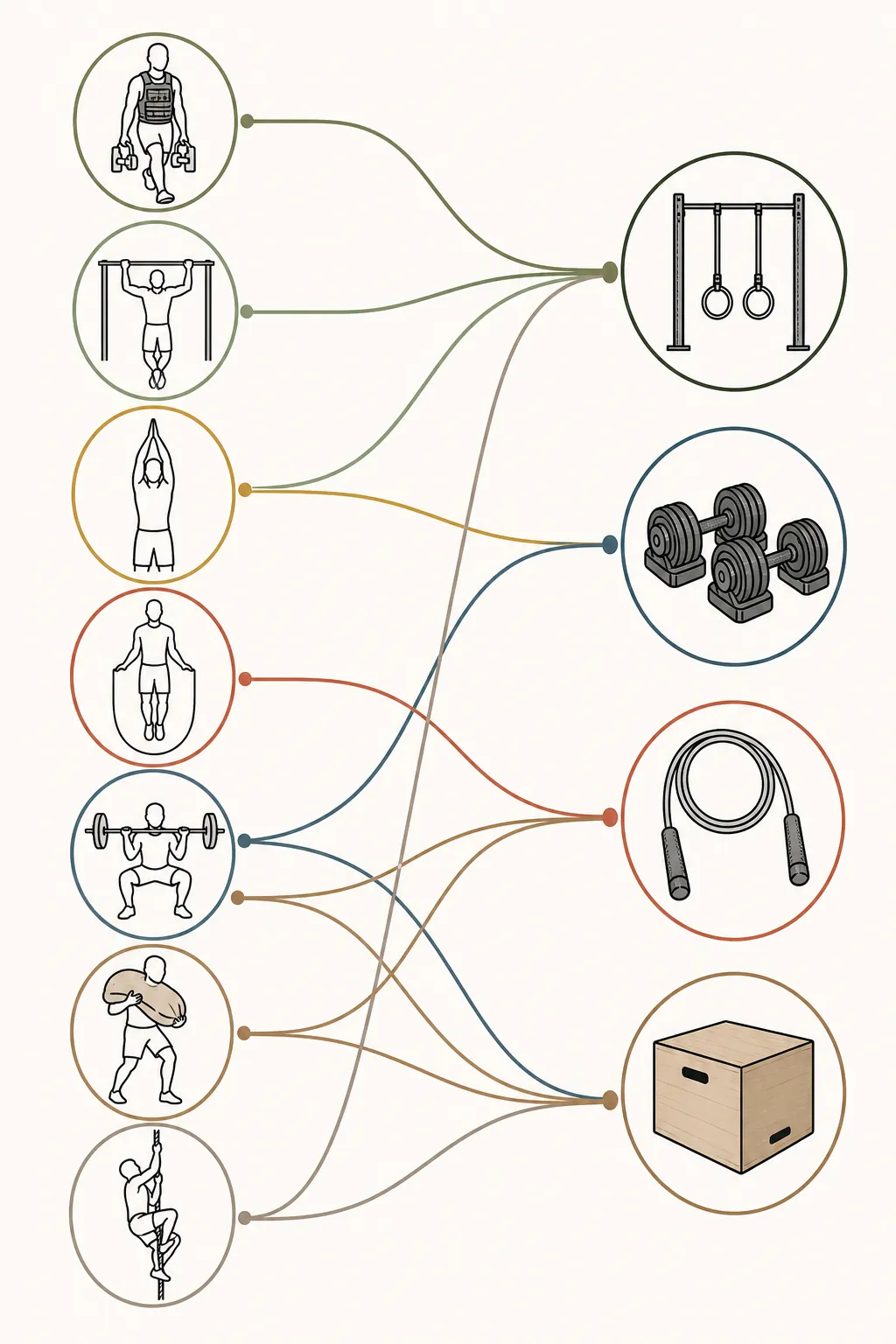
Strip away the competition staging and the 2026 masters programming sorts into seven families: weighted running, gymnastics pulling, overhead stability, double-unders, barbell cycling, odd-object lifting, and rope climbing. The equipment list gets much less intimidating once those are the targets.
Event 1 is the cleanest example. A 600m run followed by a 600m weighted run, repeated for 3 rounds, is not primarily a lesson in owning the exact implement from the competition floor. It is sustained load carriage. The athlete has to keep moving while the breathing gets expensive and the legs lose their bounce.[1]
At home, that can be a weighted vest if you already own one. It can also be a backpack loaded sensibly, farmer carries with dumbbells, or suitcase carries if your space is too tight for running. The substitution is acceptable when the load changes posture, taxes breathing, and forces continuous movement. It is not acceptable if it turns into a casual walk because the garage only gives you eight steps before you turn around.
Event 4 is the opposite kind of test: less about moving through space, more about whether the hands, lats, shoulders, and pulling rhythm keep working after the easy reps are gone. FloElite listed 45 pull-ups, 35 chest-to-bar pull-ups, and 25 bar muscle-ups, which is 105 total pulling reps and a grip-heavy workout expected to run deep into the 15-minute range.[1]
Most home athletes should not pretend that 105 competition pulling reps are just a toughness problem. Ring rows, banded lat pulldowns, jumping chest-to-bar reps, and strict pull-up clusters can all preserve the grip-and-pull demand when chosen deliberately. The mistake is replacing pulling fatigue with something that only raises heart rate. Grip endurance is the test; sweating is just one byproduct.
Event 6 deserves a narrower reading because the available source confirms it for the 35-44 divisions only. FloElite listed shuttle runs, rope climbs, and sandbag cleans for that event.[1] The available reports do not confirm whether older divisions had a different sixth event or simply faced a different schedule, so it is better not to invent one.
For home training, the rope climb is the obvious space problem. A 15-foot rope is not happening in most apartments, spare rooms, or single-car garages. But the Games pattern was not “own a tall ceiling.” It was upper-body pulling under fatigue, with hip flexion and grip demand showing up between shuttles and odd-object cleans. Seated banded rope pulls, towel pulls anchored safely, or foot-assisted rope pulls from a low anchor can keep much of that demand alive.
Event 7 is where people get distracted by the Echo Bike. FloElite listed descending Echo Bike intervals paired with DT-style barbell work: 12 deadlifts, 9 hang power cleans, and 6 shoulder-to-overhead per round.[1] The bike creates high-output cyclical fatigue before the athlete has to pick up the bar again. If you do not own an Echo Bike, the training question is not “what machine should I buy?” It is “what can safely spike output before cycling weight?”
Burpees, fast single-unders, double-unders, shuttle runs, or step-up intervals can all work, depending on joints and space. For some masters athletes, burpees are a poor trade because the shoulders, wrists, or low back pay too much for the conditioning effect. In that case, jump rope intervals or fast step-ups may be the better substitute. The point is to arrive at the lifting fatigued, not beaten up before the work that matters.
Four Equipment Categories Cover Most of the Map
Once the movement map is visible, the home setup gets simple. A masters athlete does not need a squat rack, a rope hanging from a competition-height ceiling, a sandbag collection, and a dedicated cardio machine to train the patterns. Four categories carry most of the work.
- Pull-up solution: a doorframe or wall-mounted pull-up bar, plus rings if the space allows, covers pull-ups, chest-to-bar scaling, ring rows, muscle-up progressions, and pulling volume.
- Adjustable dumbbells or one barbell: this covers snatches, thrusters, deadlifts, hang power cleans, shoulder-to-overhead, farmer carries, and sandbag-clean substitutes.
- Jump rope: this covers double-under practice and gives a compact conditioning option when a machine is unnecessary or unavailable.
- Box or stable step: this covers box step-overs, step-up conditioning, jump variations, and lower-body work when running space is limited.
The prices can stay modest if you buy for coverage instead of fantasy. A doorframe pull-up bar plus rings can fit into a $40-80 category. A pair of adjustable dumbbells in the 50-70 lb range is the expensive piece at roughly $200-250. A jump rope can sit around $5-15, and a simple 20-inch plyo box or DIY step can fall around $40-80. At the low end, especially with a DIY box or an existing step, the four-category build can land near or under $300; at the higher end, it moves beyond that.
Why the Pull-Up Station Comes First
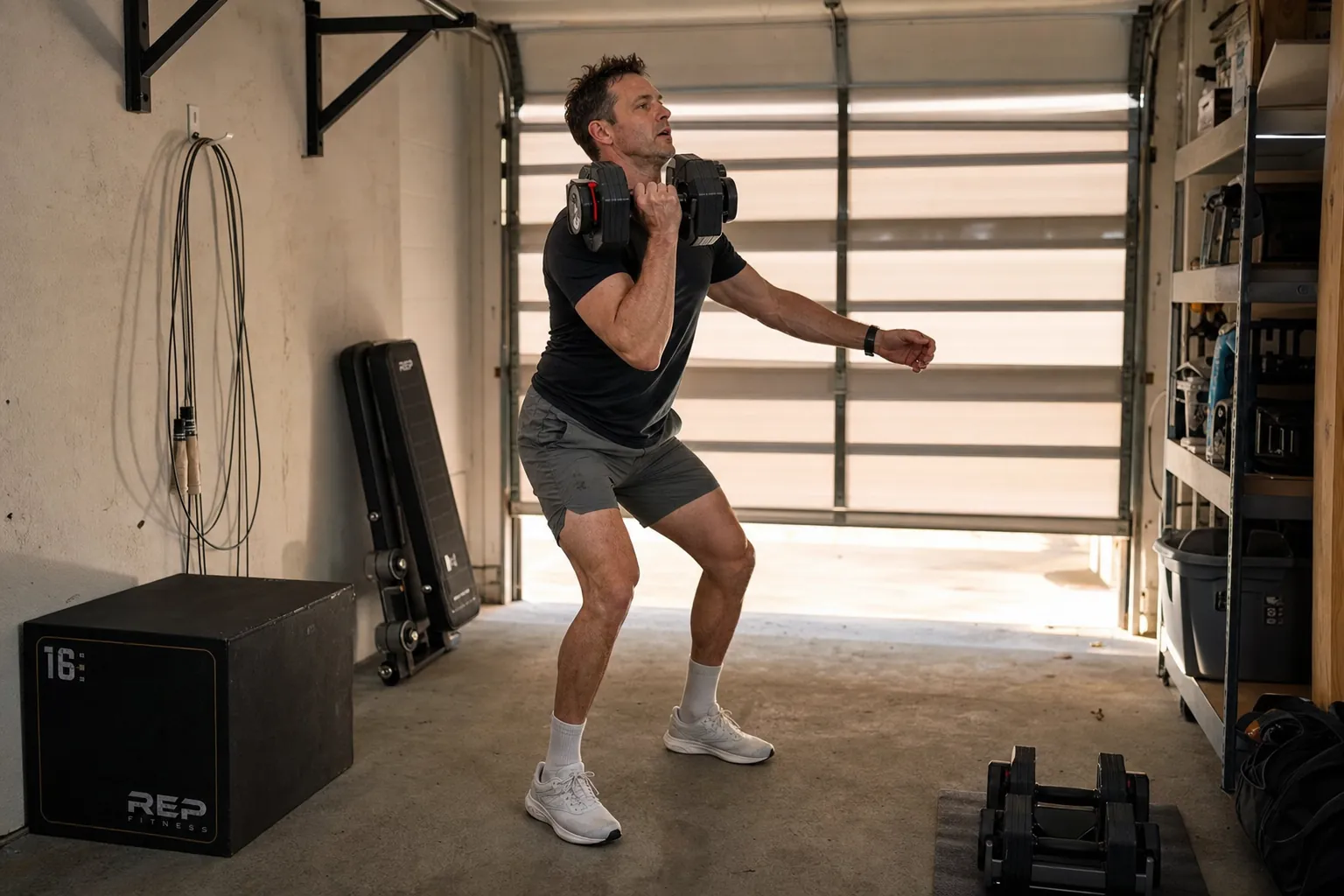
If I had to protect one category from being cut, it would be pulling. Events 2, 4, 5, and 7 all involve patterns that are better served when the athlete has some way to hang, row, pull, or control the shoulder under fatigue.[1] Bands alone can be useful, but a safe bar or rings give the hands and shoulders the kind of repeated contact that Games-style gymnastics exposes quickly.
That does not mean every masters athlete should start with strict pull-ups. A smart pulling station lets you scale down: feet-assisted ring rows, slow negatives, banded pull-ups, dead hangs, scap pulls, and jumping chest-to-bar reps. The station is not valuable because it makes you feel like you own a box. It is valuable because grip, shoulder position, and pulling endurance are hard to replace with floor exercises.
Dumbbells Beat a Barbell for Many Small Spaces
A barbell is the cleanest way to mimic DT: deadlift, hang power clean, shoulder-to-overhead. If you already have one and enough floor space to cycle safely, use it. The problem is that a barbell quietly demands more than the bar itself: plates, collars, storage, noise tolerance, and enough room to bail or lower weight without annoying everyone in the building.
Adjustable dumbbells are less romantic and often more useful. They cover dumbbell snatches from Event 2, thrusters from Event 5, dumbbell box step-overs from Event 4, and heavy dumbbell or kettlebell clean substitutions for Event 6’s sandbag cleans.[1] They also give a better path for asymmetry work, which matters when the athlete is old enough to have a “good side” and a “don’t ask” side.
The Cardio Machine Is Optional
Event 7 used the Echo Bike, but the home requirement is not an Echo Bike. The requirement is repeatable high-output conditioning that does not interfere with the next piece so much that the workout changes into something else.[1]
| Competition element | Stimulus to preserve | Home options |
|---|---|---|
| Echo Bike interval | Hard cyclical fatigue before lifting | Burpees, jump rope intervals, shuttle runs, fast step-ups |
| Weighted run | Loaded breathing and leg stamina | Ruck, farmer carry, suitcase carry, weighted step-ups |
| Rope climb | Grip-heavy vertical pulling with hip involvement | Seated banded rope pulls, towel pulls, foot-assisted low-rope pulls |
| Sandbag clean | Awkward hip extension and odd-object loading | Heavy dumbbell clean, kettlebell clean, loaded backpack clean if safe |
| Bar muscle-up volume | Grip endurance, pulling turnover, shoulder control | Ring rows, jumping transitions, banded pulldowns, chest-to-bar progressions |
Jump rope is the cheapest conditioning tool in the setup, but it is not automatically the right choice for every athlete. Double-unders can punish calves and Achilles tendons if volume jumps too quickly. Burpees can irritate wrists, shoulders, or backs. Step-ups can be safer for some athletes and too knee-dominant for others. The substitution should fit the joint history and still create the same training problem.
A Tiered Build for Apartments, Small Rooms, and Garages
FitAtHome’s broader small-space equipment framework uses three practical budget bands: $0-100, $100-300, and $300-800. For general setup principles beyond this Games-specific map, the broader guide to home exercise equipment for small spaces is the better reference. Here, the budget tiers are aimed only at the CrossFit Games 2026 masters workout patterns.
| Space and budget | Best first buys | Movement families unlocked | What remains limited |
|---|---|---|---|
| Apartment, $0-100 | Jump rope, resistance bands, sturdy step, loaded backpack | Double-unders or single-unders, weighted carries, step-ups, banded rope-pull pattern, light odd-object work | True hanging work, heavy cycling, high-volume pulling |
| Apartment, $100-300 | Doorframe pull-up bar if safe, rings, jump rope, one adjustable dumbbell or used dumbbell pair | Pulling progressions, grip endurance, unilateral loading, conditioning intervals, dumbbell cleans and snatches | Barbell-specific DT feel, heavy sandbag loading, overhead work if ceiling is low |
| Apartment, $300-800 | Adjustable dumbbells, quality pull-up solution, rings, foldable box or step, bands | Nearly all seven families with quiet substitutions | Running distance, rope-climb height, machine-style cyclical output |
| Small room, $0-100 | Bands, jump rope if ceiling allows, DIY step, towel or rope attachment for seated pulls | Rope-pull pattern, jump rhythm, step-over conditioning, light loaded breathing | Safe hanging, heavy odd-object work, barbell cycling |
| Small room, $100-300 | Pull-up bar or wall-mounted solution, rings, jump rope, used dumbbells | Grip endurance, gymnastics scaling, double-unders, thruster and snatch patterns | Heavy DT loading, long shuttle work |
| Small room, $300-800 | Adjustable dumbbells, sturdy box, pull-up bar, rings, bands, optional sandbag | Weighted running substitutions, pulling, overhead stability, dumbbell cycling, odd-object loading | Full rope climbs and competition-style barbell cycling |
| Garage, $0-100 | Jump rope, bands, DIY box, loaded backpack or buckets for carries | Loaded carriage, conditioning, step-overs, banded pulling | Heavy cycling and real gymnastics pulling |
| Garage, $100-300 | Pull-up bar, rings, jump rope, used dumbbells or one kettlebell, DIY box | Most movement families at moderate load | Heavy barbell DT and sandbag specificity |
| Garage, $300-800 | Adjustable dumbbells or barbell, pull-up bar, rings, plyo box, jump rope, optional sandbag | All seven families with the closest home translation | Only full-height rope climbs and exact machine output remain meaningfully different |
The $0-100 tier is not fake training. It is just limited training. Bands, a step, a backpack, and a rope can build useful conditioning and introduce the movement patterns. What they cannot do well is expose the hands and shoulders to real hanging volume or let you cycle meaningful load under fatigue.
The $100-300 tier is where the setup starts to look honest. A pull-up bar, rings, jump rope, and at least one meaningful load give you enough tools to train most of the Games patterns without pretending they are identical. If the dumbbells are used, borrowed, or bought as a single adjustable handle first, this tier can be surprisingly capable.
The $300-800 tier is not about buying more categories. It is about buying better versions of the same categories: heavier adjustable dumbbells, a safer pull-up solution, a stable box, and maybe a sandbag if your floor and neighbors can tolerate it. Past that point, the next purchases get less universal. An Echo Bike is great if you love it, have room for it, and will use it year-round. It is not required to train the 2026 masters patterns at home.
Event-by-Event Substitutions That Keep the Stimulus
The cleanest way to scale these workouts is not to make every number smaller until it feels comfortable. Dr. CJ DePalma’s WODprep masters training approach emphasizes minimum effective dose, including reducing volume by 20-30%, using EMOM structures, and training with a defined purpose.[3] That is a coaching framework, not a universal law, but it is useful here because home training has to protect both stimulus and recovery.
| Games pattern | If you have minimal gear | If you have the four-category setup | Watch the mistake |
|---|---|---|---|
| Event 1 weighted run | Backpack carry, stair step-ups, suitcase carry | Dumbbell farmer carries or weighted step-up intervals | Do not turn it into unloaded jogging if the test is loaded breathing |
| High-volume pull-ups and chest-to-bar | Banded pulldowns, towel rows, table rows only if safe | Pull-up bar, rings, jumping chest-to-bar, ring rows, timed hangs | Do not replace grip fatigue with pure conditioning |
| Bar muscle-up volume | Low-ring transition drills or banded pulling | Ring rows, jumping transitions, controlled negatives if appropriate | Do not chase advanced skills when shoulders are not prepared |
| Rope climbs | Seated banded rope pulls | Seated rope pulls, towel pulls, foot-assisted low-rope pulls | Do not claim a band pull is identical; use it to train the pull and grip pattern |
| Sandbag cleans | Loaded backpack clean if safe and controlled | Heavy dumbbell or kettlebell cleans, optional sandbag | Do not make the object so neat that the odd-object demand disappears |
| Echo Bike into DT | Burpees, step-ups, shuttle runs, or jump rope before light lifting | Jump rope or shuttle intervals before dumbbell, kettlebell, or barbell DT-style cycling | Do not let the cardio option wreck the joints before the lifting starts |
How to Scale Volume Without Losing the Workout
For a masters athlete training before work, the most useful scale is often density rather than drama. Instead of trying to reproduce Event 4’s 105 pulling reps, a home version might use short EMOM windows: one minute of ring rows, one minute of banded pulldowns, one minute of hangs or scap pulls, then repeat as tolerated. That keeps the grip and pulling theme without turning one session into a week-long elbow problem.
For Event 7, the same idea works. A full DT-style barbell workout under fatigue is a serious dose. A home version can use lighter dumbbells and shorter intervals while preserving the sequence: hard cyclical work, then hinge, clean, and press. If the athlete finishes fresh, the substitute was too easy. If the athlete’s back position collapses in round one, the load or format missed the point in the other direction.
This is where “masters-friendly” should mean more than doing less. It should explain what is being protected. Reduce volume to protect connective tissue. Use EMOMs to control pace and decision fatigue. Choose dumbbells instead of a barbell when the shoulders need more freedom. Swap burpees for step-ups when wrists or backs are the limiting factor, not conditioning.
A Practical Home Version of the 2026 Masters Pattern
A week of training inspired by the CrossFit Games 2026 masters workouts does not need to copy the Games calendar. It can rotate the same movement families with enough recovery to make the next session productive.
| Training day | Focus | Example home session |
|---|---|---|
| Day 1 | Loaded breathing | Run, ruck, or carry intervals using a backpack or dumbbells |
| Day 2 | Grip and pulling | Pull-up, ring-row, banded-pulldown, and hang intervals |
| Day 3 | Jump rhythm and overhead stability | Jump rope practice plus light dumbbell thrusters or shoulder-to-overhead |
| Day 4 | Odd-object and rope-climb substitute | Shuttles or step-ups, seated banded rope pulls, heavy dumbbell cleans |
| Day 5 | Conditioning into cycling | Burpees, jump rope, or step-ups into dumbbell or barbell DT-style rounds |
The missing piece is exact division loading. The available reports do not confirm all age-division weights and standards, so a responsible home version should avoid fake precision. Choose loads that let the intended pattern appear: carries that make breathing change, pulling scales that challenge grip before technique breaks, and cycling weights that can move smoothly while tired.
Most masters athletes do not need a full CrossFit box at home to train the CrossFit Games 2026 masters workouts. They need a pull-up solution, adjustable dumbbells or one barbell, a jump rope, and a box or step. More importantly, they need to choose substitutions by stimulus: loaded breathing for weighted runs, grip endurance for pulling events, odd-object hip extension for sandbag work, and hard cyclical fatigue before DT-style lifting.
For broader buying decisions, use the small-space equipment guide. For these workouts, start with the movement map. Convenience is useful only when it preserves the thing the event was testing.
References
Keep going
How often should you repeat this? See Recovery & Rest for ACSM/NSCA-cited cadence guidance.
Comments
Join the discussion with an anonymous comment.