
The Type of Home Workout That Counteracts Testosterone Decline After 30
Men over 30 can counteract age-related testosterone decline with a home workout strategy that prioritizes training frequency and recovery over maximal loading. This article explains the science behind combined sprint and resistance training and provides a practical routine for limited space and budget.
- Equipment required
- Bodyweight, resistance bands, dumbbell, mat
- Space needed
- Small, about 6 ft x 6 ft
Don't have this yet? Compare options in Equipment, or see which build tier already includes it in the build matrix.
The best testosterone-boosting home workouts for men over 30 are not random burpees, daily punishment circuits, or a heroic attempt to recreate a commercial gym in a spare room. The useful pattern is simpler and harder to fake: combine sprint-style effort with resistance training, repeat it several times per week, and recover well enough that the work can continue.
That matters because the strongest training clue here is not an exercise list. In a 13-week study of trained men, a middle-aged group with an average age of 41 did combined sprint and resistance training three times per week and ended with resting testosterone levels comparable to a trained young group with an average age of 21.[1] That is the kind of result a man with a small home setup should care about: not a one-session hormone spike, but a repeated training signal strong enough to change the resting picture.

After 30, the goal changes from crushing yourself to repeating the right signal
Testosterone does tend to decline with age. Cleveland Clinic describes a gradual decline of about 1% per year after age 30, and HSS notes that muscle mass drops roughly 3% to 5% per decade after age 30.[2][3] Those numbers are worth taking seriously, but they do not mean a man turns fragile on his 30th birthday.
The cutoff is a gradient, not a switch. A 32-year-old who sleeps well, trains consistently, and has no major orthopedic problems is not in the same situation as a 50-year-old returning after a decade off. Still, the old approach often starts to break down somewhere in this window: late-night gym sessions, max-effort lifting whenever motivation appears, skipped warmups, and recovery treated as an optional luxury.
The better home plan asks a different question. Can you create enough large-muscle, high-effort work to matter, then do it again next week without your back, knees, sleep, or schedule rebelling? If the answer is no, the routine is not age-adapted. It is just a younger man’s plan with less equipment.
The machinery still responds
One reason the training conversation gets distorted is that men over 30 are often talked to as if their hormonal response has already gone offline. Baker and colleagues tested men aged 20 to 26, 38 to 53, and 59 to 72 after a heavy resistance exercise protocol and found that all groups showed similar relative testosterone increases after the session.[4] Middle-aged and older men were not non-responders.
That finding is useful, but it should not be oversold. An acute post-workout testosterone increase is not the same thing as a lasting rise in resting testosterone. A hard resistance session can show that the system still responds. It does not prove that any exhausting home circuit will improve your baseline.
This is where many “boost your T” workouts get sloppy. They point to a short-term hormone rise after intense exercise, then imply that the same bump equals a durable testosterone upgrade. The Sellami study is more relevant because the middle-aged men trained repeatedly for 13 weeks and the result was measured at rest.[1] For a man training at home, the lesson is not “find the most brutal workout.” It is “build the strongest repeatable week.”
The weekly home structure
A small-space routine should be built before individual exercises are argued over. The week needs explosive effort, loaded or progressively harder resistance work, and real recovery. Here is the basic flow.
| Day | Training focus | Home version |
|---|---|---|
| Monday | Resistance A | Squat or lunge pattern, push, pull, hinge or bridge, loaded carry or trunk work |
| Tuesday | Recovery | Walking, mobility, easy cycling, or nothing formal |
| Wednesday | Sprint-style intervals | Hill sprints, bike intervals, stair intervals, jump-rope bursts, or low-impact fast intervals |
| Thursday | Recovery | Easy movement and joint-friendly range-of-motion work |
| Friday | Resistance B | Hinge, split squat, overhead or incline push, row, anti-rotation or carry |
| Saturday | Optional short sprint-style session or lighter resistance circuit | Only if recovery is good; otherwise keep it easy |
| Sunday | Rest | No compensation workout |
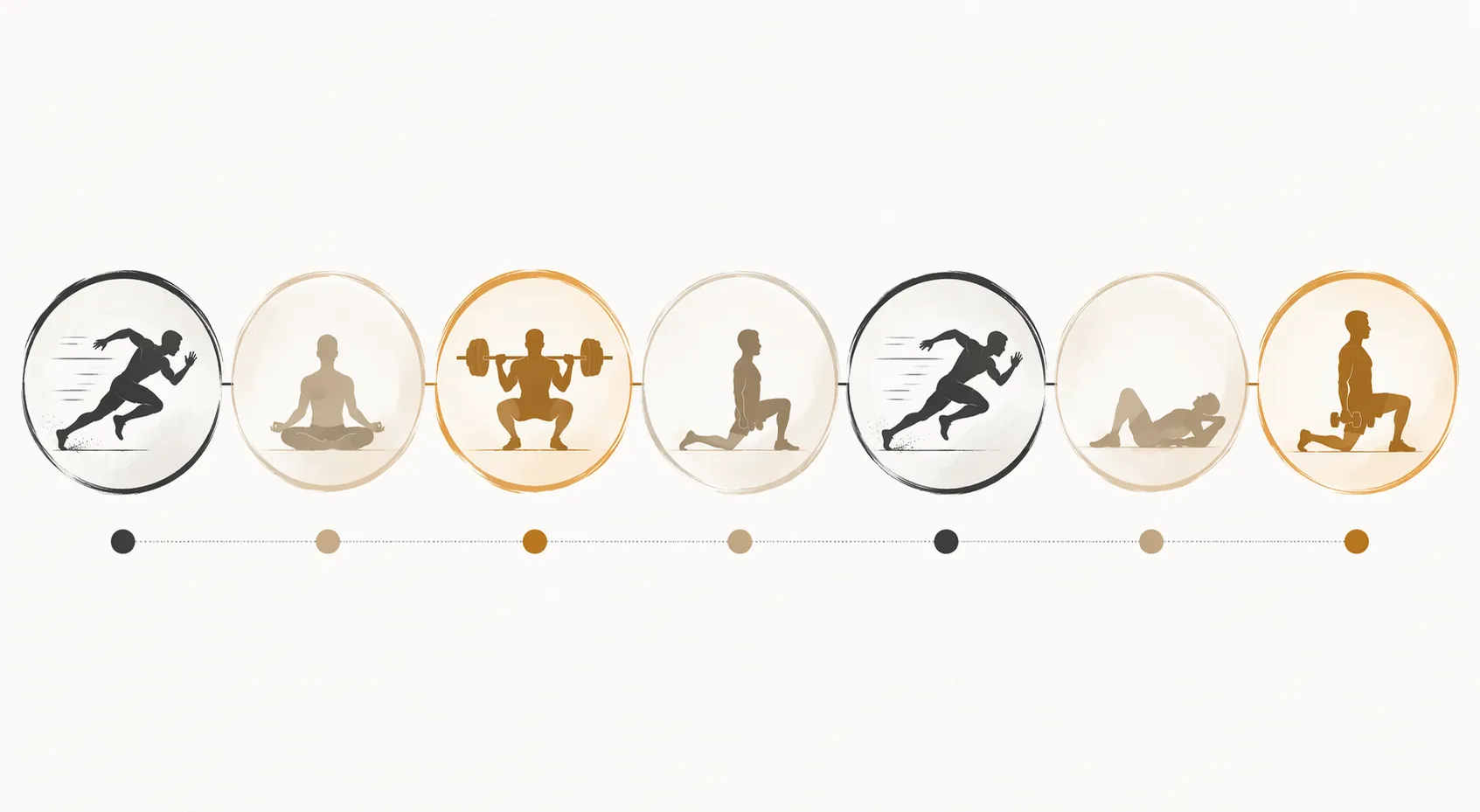
The three-per-week backbone mirrors the combined sprint and resistance frequency used in the Sellami study.[1] The exact home exercises can change. The pattern should not drift into six days of medium-hard fatigue, because that is usually where the plan stops being productive and starts becoming noise.
Resistance days: train big patterns, not just tired muscles
Resistance training for this purpose should use large muscle groups and movements that can progress. A home plan does not need a barbell, but it does need a way to make the work harder over time. Endless pushups and air squats eventually become a conditioning test unless the leverage, load, tempo, range of motion, or density changes.
A good resistance day can be built from four or five patterns:
- Squat or split squat: goblet squat, rear-foot-elevated split squat, step-up, reverse lunge
- Hinge: Romanian deadlift, single-leg Romanian deadlift, hip thrust, banded good morning
- Push: pushup variation, dumbbell floor press, dumbbell overhead press
- Pull: one-arm dumbbell row, band row, suspension row if the anchor is secure
- Carry or trunk: suitcase carry, farmer carry, dead bug, side plank, Pallof press
The load can come from bodyweight at first, then bands, then a single adjustable dumbbell if budget and space allow. That tiered approach is often more realistic than buying a room full of plates before the habit exists. The same bodyweight-to-bands-to-dumbbells logic used in this home golf workout progression works well here because it lets the movement pattern stay consistent while the challenge rises.
For men who like a more athletic resistance-day format, an explosive full-body circuit such as the Terry Crews 24s Circuit can fit the idea, provided the loads and rest periods are scaled so form does not collapse.
How hard should the sets be?
Most working sets should finish with one to three good reps left. That is hard enough to require attention, but not so hard that every set turns into a grinder. On a home floor, with no spotter and work starting again tomorrow, technical failure is usually a bad trade.
Progress one variable at a time: add a rep, add a set, slow the lowering phase, shorten rest slightly, increase band tension, or move up in dumbbell load. If all of those change at once, you will not know what worked, and your joints may notice before your logbook does.
Sprint-style work does not have to mean track sprints
The sprint side of the plan is there because the best central evidence used combined sprint and resistance training, not resistance training alone.[1] But for a 40-year-old training after work, “sprint” should mean short, high-effort intervals selected for the body you actually have.
- Lowest joint impact: stationary bike, air bike, rower, fast incline walk intervals
- Moderate impact: hill sprints, stair climbs, jump-rope bursts
- Highest impact: flat-ground running sprints, shuttle runs, repeated jumps
A practical session might use six to ten short efforts with generous recovery between them. The effort should feel explosive, not sloppy. If the last rounds turn into stumbling cardio, the interval is too long, the rest is too short, or the mode is wrong for your current joints.
For anyone with a cranky lower back, Achilles history, knee pain, or a long layoff, start with a bike, incline walk, or stair option before sprinting on flat ground. The goal is a powerful signal without gambling the next month of training.
Recovery days are part of the dose
The recovery days in this plan are not decorative. They are what let the hard days stay hard. Men over 30 often do not need less ambition; they need fewer fake-hard sessions that sit between real training days and quietly ruin both.
Use the day after resistance training or sprint-style intervals to check the system. If stairs feel normal, sleep was decent, and warmups move smoothly, keep the plan. If your back is guarded, resting heart rate feels unusually high, or every warmup set feels heavier than it should, reduce the optional work before touching the main two resistance days.
That is not softness. It is how the weekly signal survives contact with work, parenting, commuting, and aging connective tissue.
Minimal gear that actually helps
Bodyweight training is a fine starting point, especially for returning lifters and beginners who need movement quality first. But bodyweight-only work has less direct evidence for testosterone elevation than loaded resistance training, and it becomes difficult to progress once basic strength improves. At some point, more pushups are just more pushups.
A compact setup can be enough:
- One adjustable dumbbell or a pair of moderate dumbbells
- A few resistance bands with different tensions
- A sturdy bench, box, or step if space allows
- A mat and enough floor space for lunges, rows, pushups, and carries
If bands are part of the plan, anchor setup matters. A bad door anchor turns a smart small-space choice into an avoidable injury risk, so review resistance band door anchor safety before pulling hard against a closed door. If you are still deciding what belongs in a small apartment, use a compact-equipment filter rather than buying gear that solves a gym fantasy instead of your actual week; this guide to choosing compact home gym equipment is the better place to start.
A four-week starter version
For a healthy man who has trained before but has been inconsistent, begin with three main sessions per week. Keep the first month boring enough to finish. The goal is to establish the rhythm before chasing heroic numbers.
| Session | Work | Progression |
|---|---|---|
| Resistance A | Goblet squat or split squat, dumbbell floor press or pushup, one-arm row, hip bridge, side plank | Add reps first, then load |
| Sprint-style | 6 short hard intervals on bike, hill, stairs, rope, or incline walk with easy recovery between efforts | Add one interval only if recovery is good |
| Resistance B | Romanian deadlift, reverse lunge or step-up, overhead press, band row or dumbbell row, suitcase carry | Add load or one set to one movement |
For a complete beginner, remove the optional Saturday session and spend two to four weeks learning the movements at easier intensities. For a formerly active lifter, keep the same structure but resist the urge to test strength in week one. For a man closer to 50 than 30, the same plan may still work, but the sprint mode and recovery spacing deserve more caution.
The warning signs are plain: sharp pain, repeated sleep disruption after training, soreness that changes your movement for several days, or interval sessions that make the next resistance day worse. When those show up, reduce volume before abandoning the whole approach.
Body weight, testosterone, and what exercise can realistically do
For overweight men, training is only one part of the testosterone discussion. Harvard Health notes that weight loss can help prevent natural age-related testosterone decline, while University of Utah Health describes lifestyle changes, including weight management, as relevant for increasing testosterone levels in older men.[5][6] That does not mean a specific workout guarantees a specific testosterone number.
It means the training plan should support the larger conditions that make progress possible: enough muscle-building stimulus, enough conditioning to improve work capacity, enough recovery to stay consistent, and enough restraint that hunger and fatigue do not rebound into the rest of the week.
What this plan should not promise
It should not promise restored youth. It should not promise that a 12-minute circuit will “boost T” in a way that meaningfully changes your life. It should not pretend a temporary hormone bump after a hard session is the same as a healthier resting profile.
The useful promise is narrower and better: men over 30 can still respond strongly to resistance exercise, and consistent combined sprint and resistance training has evidence behind it as a way to counter the age-related resting-testosterone gap in trained men.[1][4] At home, the job is to turn that into a repeatable week: big movements, short explosive work, progressive overload, and recovery that is respected rather than squeezed in after everything else.
References
- Effects of acute and chronic exercise on steroid hormone fluctuations in young and middle-aged men, Steroids, 2018
- Declining Testosterone Levels, Cleveland Clinic
- Muscle Mass and Testosterone, HSS
- Testosterone responses to resistance exercise in men aged 20 to 26, 38 to 53 and 59 to 72 years, Journal of Strength and Conditioning Research, 2006
- Lifestyle strategies to help prevent natural age-related decline in testosterone, Harvard Health
- Lifestyle Changes Can Increase Testosterone Levels in Older Men, University of Utah Health, 2025
Keep going
How often should you repeat this? See Recovery & Rest for ACSM/NSCA-cited cadence guidance.
Comments
Join the discussion with an anonymous comment.