
Swim Workout Plan for Fitness Test Preparation
This 4-week progressive swim workout plan prepares non-competitive swimmers for timed fitness tests such as the Navy PST or lifeguard certification. With structured sessions, pacing targets, and the 50-50 protocol, you can move from struggling to pass to a confident, passing time in one month.
- Equipment required
- pool, pace clock
- Space needed
- Full-size swimming pool (25-yard or 50-meter)
Don't have this yet? Compare options in Equipment, or see which build tier already includes it in the build matrix.
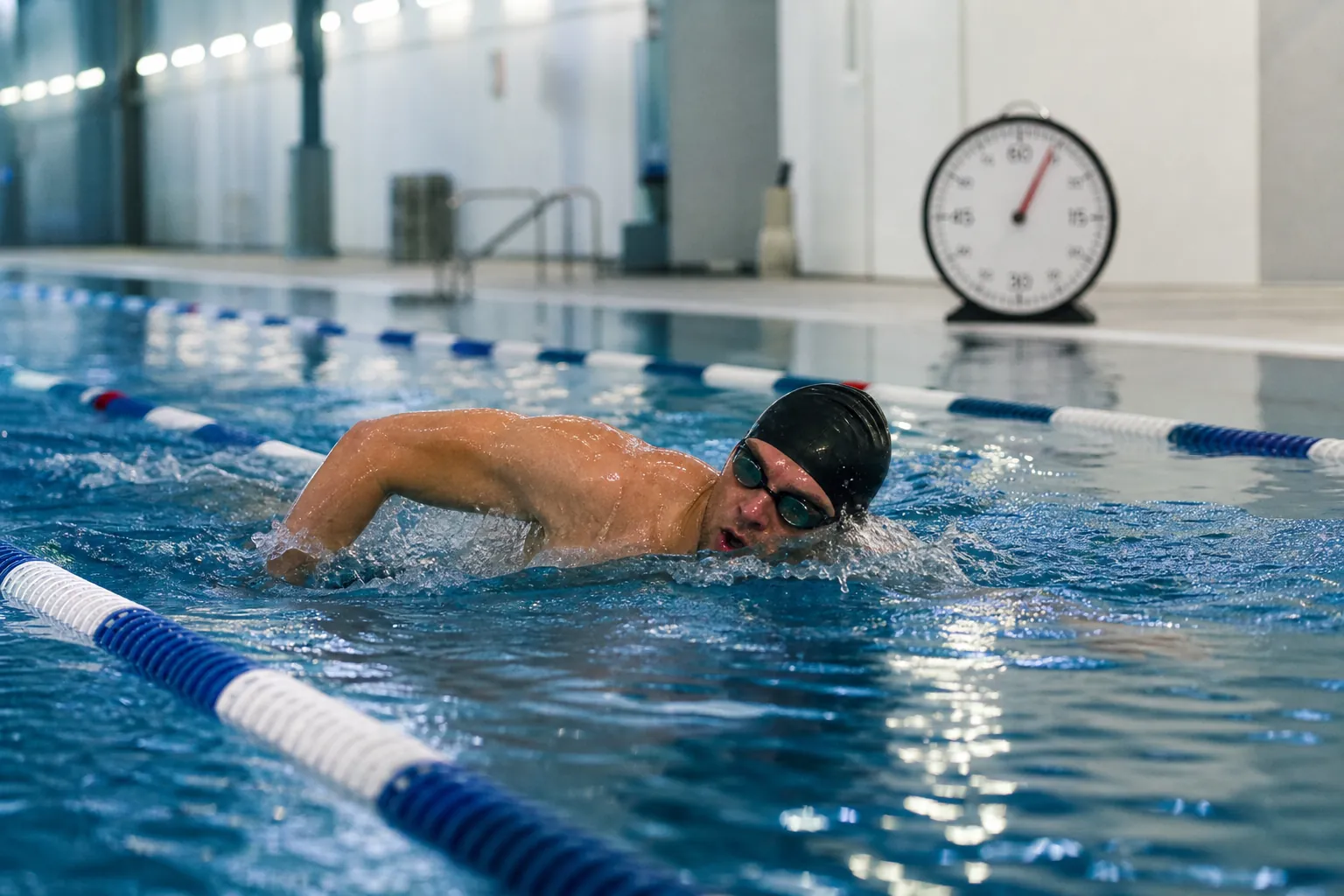
The first 200 yards usually tell the story. A land-fit applicant leaves the wall like the swim is a 400-meter run, kicks hard, breathes late, lifts the head, and turns the rest of the test into damage control. That failure feels like bad conditioning, but for most non-competitive swimmers preparing for a timed test, it is more often a pacing and water-control problem.
The plan below is built around one blunt target: learn to hold about one yard per second without panicking. Stew Smith’s benchmark is simple: 500 yards in 500 seconds equals 8:20, a pace he presents as reachable for land athletes using better technique and his 50-50 protocol.[1] That does not mean every swimmer drops from 10-plus minutes to a comfortable pass in four weeks. His strongest results come from motivated candidates training frequently, often under monitored special-operations-style preparation. It does mean the math gives you something better than “build endurance.”
Set the Pace Before You Add Volume
Before the first workout, confirm three things: the distance, the pool length, and the stroke rules. A 500-yard Navy-style test is not the same problem as a 500-meter test. Military.com notes that Navy tests are in yards, while Air Force and Marine tests use meters; 500 meters equals 546 yards, so copying a 500-yard pace chart into a 500-meter test leaves you short.[2]
Pool length also changes the clock. Military.com reports swimmers can be 20–30 seconds faster in a 25-yard pool than in a 50-meter pool because wall push-offs make up more of the swim in short-course pools: about 50–60% of the distance compared with 25–30% in long-course pools.[2] If your practice pool has more walls than your test pool, your time may be flattering you.
| Test distance | What one-yard-per-second means | Planning note |
|---|---|---|
| 300 yards | About 5:00 | Common lifeguard-style distance; faster pace feels manageable only if you do not sprint the first 100. |
| 500 yards | About 8:20 | Useful benchmark for Navy-style PST preparation and the main pace used in this plan. |
| 500 meters | Longer than 500 yards | Treat it as 546 yards when estimating effort; do not judge yourself by a 500-yard split. |
The official standard may be looser than your target. Topend Sports lists the Navy SEAL minimum for the 500-yard swim as 12:30, while its summary of scoring context notes that times above 9:00 are below competitive but still passing for many situations.[3] The point of training toward the 8:20 neighborhood is not ego. It gives you a cushion for nerves, crowded lanes, poor turns, and the day you discover the test pool is not as friendly as your practice pool.
The Four-Week Plan
Train three days per week, ideally with at least one day between pool sessions. If you are also running, lifting, and practicing other test events, do not bury the hardest swim day after your hardest leg day. The water punishes sloppy breathing faster than the track does.
| Week | Session 1 | Session 2 | Session 3 | Pace target |
|---|---|---|---|---|
| Week 1 | Warmup 200 easy; 8 x 25 relaxed freestyle or CSS with 20 sec rest; 4 x 50 easy; 5 min vertical water practice; 100 cooldown | Warmup 200 easy; 6 x 50 controlled with 20 sec rest; 4 x 25 breathing-control repeats; 5 min vertical water practice; 100 cooldown | Warmup 200 easy; 3 x 100 smooth with 30 sec rest; 4 x 25 easy-fast by feel; 5 min vertical water practice; 100 cooldown | No racing; finish each repeat able to speak |
| Week 2 | Warmup 200; 8 x 50 at goal rhythm with 15–20 sec rest; 4 x 25 easy; 6 min vertical water practice; 100 cooldown | Warmup 200; 4 x 100 at controlled pace with 30 sec rest; 4 x 50 easy; 6 min vertical water practice; 100 cooldown | Warmup 200; 1 x 300 continuous; rest; 6 x 50 at goal rhythm; 6 min vertical water practice; 100 cooldown | Move toward 50 sec per 50 yards |
| Week 3 | Warmup 300; 10 rounds of 50 fast freestyle + 50 CSS or breaststroke, 10–15 sec rest after each 100; 7 min vertical water practice; 100 cooldown | Warmup 200; 5 x 100 negative split with 20–30 sec rest; 4 x 50 easy; 7 min vertical water practice; 100 cooldown | Warmup 200; pool-size simulation set; 1 x 400–500 controlled; 7 min vertical water practice; 100 cooldown | Hold fast work controlled; recover through CSS/breaststroke, not by stopping |
| Week 4 | Warmup 300; 8–10 rounds of 50-50 at test rhythm, not all-out; 6 min vertical water practice; 100 cooldown | Warmup 200; full-distance confidence swim at planned opening pace; easy 4 x 50; 5 min vertical water practice; 100 cooldown | Warmup 200; 4 x 50 at test start pace; 2 x 100 smooth; short vertical water check; 100 cooldown | Arrive fresh; no heroic final workout |
If your test is 300 yards, keep the same structure but shorten the long continuous swims. A 300-yard lifeguard test is a different pacing event from a 500-yard military test, and 4-week plans for that distance typically focus on building comfort across the full 300 rather than stretching every session toward 500.[4] If your test is 500 meters, keep the session format but respect the extra distance. Your goal-pace 50s in a meter pool will not match 50-yard repeats exactly.
Week 1 Is for Making the Water Less Expensive
A fit runner can burn through oxygen in the pool by doing things that feel strong on land: kicking too much, lifting the head to breathe, muscling the pull, and treating every wall like the start of a race. Military.com makes the same point in plainer terms, noting that even sub-5-minute milers and collegiate athletes can struggle to swim a lap at first.[5]
Do not turn Week 1 into a stroke clinic. You need enough technique to stop wasting energy. Breathe on a rhythm you can repeat. Keep the kick small enough that your legs are not the reason your heart rate spikes. Let the head ride low instead of looking forward for reassurance. If freestyle keeps breaking down, practice combat swimmer stroke, elementary sidestroke, or breaststroke as your survival stroke rather than clinging to ugly freestyle because it looks faster on someone else.
Military.com’s beginner swim-test material presents CSS and elementary sidestroke as useful for test conditions, especially for non-swimmers, because they can protect breathing and control pace better than forced freestyle.[5] Freestyle is faster for swimmers who can keep it relaxed. For many applicants trying to pass, the better stroke is the one that prevents the first-200-yard collapse.
Week 2 Turns Pace Into a Repeatable Number
Start using the pace clock in Week 2. For a 500-yard test, the clean target is 50 yards in about 50 seconds. If that is too hot, open at 55–60 seconds per 50 and aim to stop fading. The first correction is not to swim harder; it is to make the first 100 look boring.
| 500-yard split point | 8:20 pace | 9:00 pace | 10:00 pace |
|---|---|---|---|
| 100 yards | 1:40 | 1:48 | 2:00 |
| 200 yards | 3:20 | 3:36 | 4:00 |
| 300 yards | 5:00 | 5:24 | 6:00 |
| 400 yards | 6:40 | 7:12 | 8:00 |
| 500 yards | 8:20 | 9:00 | 10:00 |
Use those splits as guardrails, not decoration. If your goal is simply to beat 12:30, a 10:00 practice swim already gives you a large buffer against the listed Navy SEAL minimum.[3] If your goal is to be competitive for a military pipeline, the sub-9 zone matters more. Either way, the first 200 should feel restrained enough that the third 100 does not become a negotiation.
This is also the week to remove avoidable drag. Military.com reports that switching from board shorts to jammers can cut 20–30 seconds from a 500-yard swim because of reduced drag.[2] That is not fitness. That is not toughness. It is a cheap mistake if you ignore it until test week.
The 50-50 Set Belongs in Week 3
The central hard workout is the 50-50 protocol: swim 50 yards or meters fast freestyle, then 50 yards or meters using CSS or breaststroke, repeat 10–15 times, and rest 10–15 seconds between rounds. Smith describes this as his most effective swim-test workout for non-swimmers and reports candidates dropping from 10-plus-minute 500-yard swims to sub-8-minute swims in less than a month when doing the workout five times per week.[1]
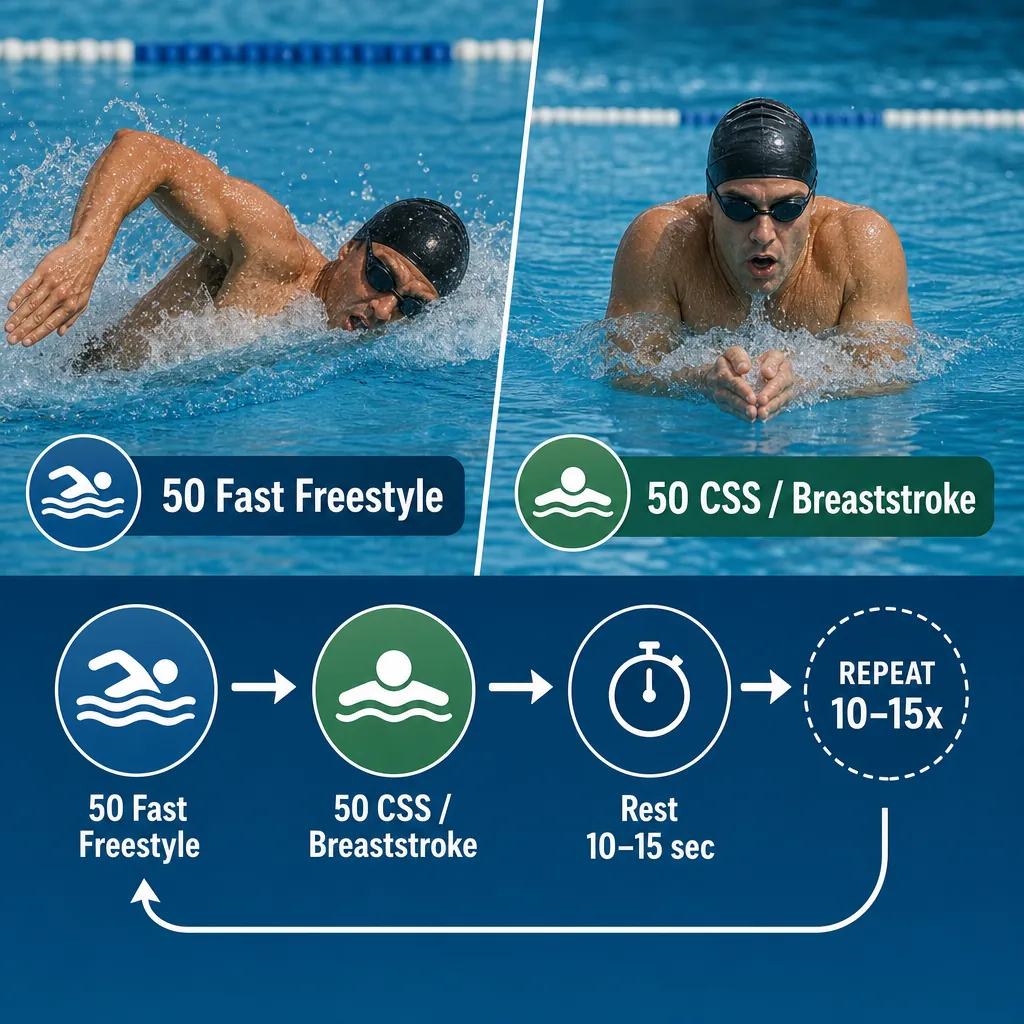
In this three-day plan, use the 50-50 set once in Week 3 and once in Week 4. That is a narrower claim than the original five-day-per-week version, so expect a narrower result. You are borrowing the mechanism, not the full volume. The fast 50 teaches speed without making the entire workout a sprint. The CSS or breaststroke 50 teaches you to keep moving while you bring the breathing back under control.
Do not turn the fast freestyle 50 into a fight for your life. If the second 50 becomes floating survival, the set is too hard. Fast means faster than goal pace with clean breathing. CSS or breaststroke means active recovery at a pace you could still use on test day if freestyle falls apart.
How to Run the Week 3 Pool-Size Simulation
If your test is in a 50-meter pool and you train in a 25-yard pool, remove some of the wall advantage during one Week 3 session. Push off gently. Do not explode off every wall. Delay your first hard pull just long enough to feel what happens when the wall gives you less free distance. This will not perfectly reproduce a long-course pool, but it stops you from believing a short-course time transfers unchanged.
If your test is in a 25-yard pool, practice clean turns without making every turn a max-effort launch. The wall is part of the test, but relying on it too much can hide a pacing problem. The best sign in Week 3 is not your fastest isolated 50. It is a controlled 400–500 where the last 100 does not look like a different swimmer showed up.
Vertical Water Work Is Not Optional
Every session includes treading or vertical swimming because horizontal lap fitness does not automatically become vertical competence. If your test includes treading, drownproofing, object retrieval, or a water-confidence component, five calm minutes after the main set are worth more than pretending another easy 100 will solve it.
- Week 1: tread lightly for 5 minutes total, changing hand and kick patterns before fatigue turns sloppy.
- Week 2: build to 6 minutes, including short hands-out or reduced-hand-use segments if safe and allowed.
- Week 3: hold 7 minutes after harder work so you learn vertical control while breathing is elevated.
- Week 4: shorten the work and keep it calm; this is a confidence check, not a separate conditioning test.
Use a safe lane, stay near the wall if you are new to treading, and do not practice breath-holding alone. The point is repeatable control, not proving how uncomfortable you can make the last five minutes of practice.
Week 4 Is Rehearsal, Not Fitness Hunting
The most common Week 4 mistake is trying to earn confidence by doing the test too hard too often. One full-distance confidence swim is enough. Make it boring on purpose: the first quarter controlled, the second quarter still controlled, the third quarter honest, and the last quarter faster only if the breathing is still yours.
| 500-yard segment | What to do | What to avoid |
|---|---|---|
| 0–100 yards | Leave the wall under control; settle into the stroke you chose before test day. | Do not chase the swimmer in the next lane. |
| 100–250 yards | Hold the pace clock number you trained, even if you feel too comfortable. | Do not increase kick just because the swim feels slow. |
| 250–400 yards | Use CSS, breaststroke, or relaxed freestyle according to your plan, not your panic. | Do not lift the head repeatedly to check distance. |
| 400–500 yards | Build only if the stroke is still organized. | Do not spend the final 100 paying for a reckless first 100. |
For a 300-yard test, the same logic compresses: the first 75 yards should feel too easy, the middle 150 should hold shape, and the final 75 can build if breathing remains controlled. For 500 meters, resist the mental trap of treating the final 46 yards as a small detail. That extra distance matters when you have paced the swim like 500 yards.
If you train at home, a short pool can still be useful if you create a consistent lap setup and count distance honestly. A backyard pool will not behave like a regulation test lane, but it can support repeatable stroke and breathing practice; the practical issue is whether you can mark distance and avoid turning every few seconds. If that is your situation, see how to turn your backyard pool into a lap swimming pool.
Test-Week Rules That Actually Matter
- Wear jammers or another low-drag suit you have already practiced in, not board shorts.
- Choose your stroke before the test: relaxed freestyle if you can hold it, CSS or breaststroke if breathing control is the limiter.
- Know whether the test is yards or meters and whether your practice pool gave you extra wall speed.
- Open slower than your nerves want; your first 100 should set up the swim, not impress anyone.
- Stop hard swimming two or three days before the test; keep only short, clean pace reminders.
A passing swim in four weeks is plausible for a fit adult who practices consistently, fixes drag and pacing, and stops treating the opening 200 like a sprint. It is not automatic. If you are still gasping after easy 50s at the end of Week 2, keep the same structure but lower the pace target. Passing comes from arriving at the final 100 with a stroke you can still use.
References
- THE 50-50 Workout (Crush the Swim Test in Less than a Month) — Stew Smith Fitness
- How Pool Size Can Affect Your Swimming Fitness Test Scores — Military.com
- PRT 500 yard / 450 meter Swim Test — Topend Sports
- The 300-Yard Swim: A 4-week training plan for the non-competitive swimmer — Lifeguard Training NY
- Beginner Workouts for Passing Military Swimming Tests — Military.com
Keep going
How often should you repeat this? See Recovery & Rest for ACSM/NSCA-cited cadence guidance.
Comments
Join the discussion with an anonymous comment.