
A friend of mine bought a folding treadmill last year for his 600-square-foot one-bedroom. He cleared a corner, measured the delivery box, and felt ready. When it arrived and he opened the box he realized the thing stood seven inches taller than his ceiling fan and weighed more than his sofa. The NordicTrack Commercial 1750 I’m talking about — it folds. It just folds vertical: 44.2 by 37 by 69 inches tall, 71.3 pounds. Vertical storage still needs a wall, a clear floor space, and a lot of height. That treadmill is now the most expensive coat rack in his living room.
The story is not unusual. Most folding treadmill roundups lead with price or motor specs and treat folds as a checkmark. They do not ask what kind of folding your home actually needs. So I’ve stopped recommending the same list to everyone with a small space. Instead I ask three questions, and the answers narrow the field faster than any budget filter.
What Most Roundups Miss
The standard best-of list will show you the NordicTrack Commercial 1750 at $1,999, the Horizon 7.4 AT at maybe $1,599, the Sole F63. Compare belt width, motor power, warranty. Then decide. But read the small print on dimensions: the Sole F63 folds to 50 by 35 by 72 inches and weighs over 100 pounds. Can you get that through a narrow hallway? Can you lift it yourself to slide it into a closet? The mechanism is vertical-lift — the deck swings up and locks. That creates a tall, heavy object that still occupies floor real estate with its base.
The WalkingPad C2 on the other hand folds flat to 5.4 inches tall. Tucks under a bed or a sofa. Weighs 55 pounds. Its trade-off: 3.7 mph top speed and a 220-pound limit. For someone who walks, that machine solves the storage problem completely. For a runner, it is useless.
The correct recommendation depends on three home constraints that most roundups skip: storage depth type, noise and vibration risk, and how often the room where the treadmill lives changes purpose. Once you answer those, price becomes a secondary filter.
The Three Questions That Tell You Which Folding Mechanism You Actually Need
Before you scroll through any product list, sit down with a tape measure and a mental picture of your floor plan. These three questions will eliminate 80% of the market right away.
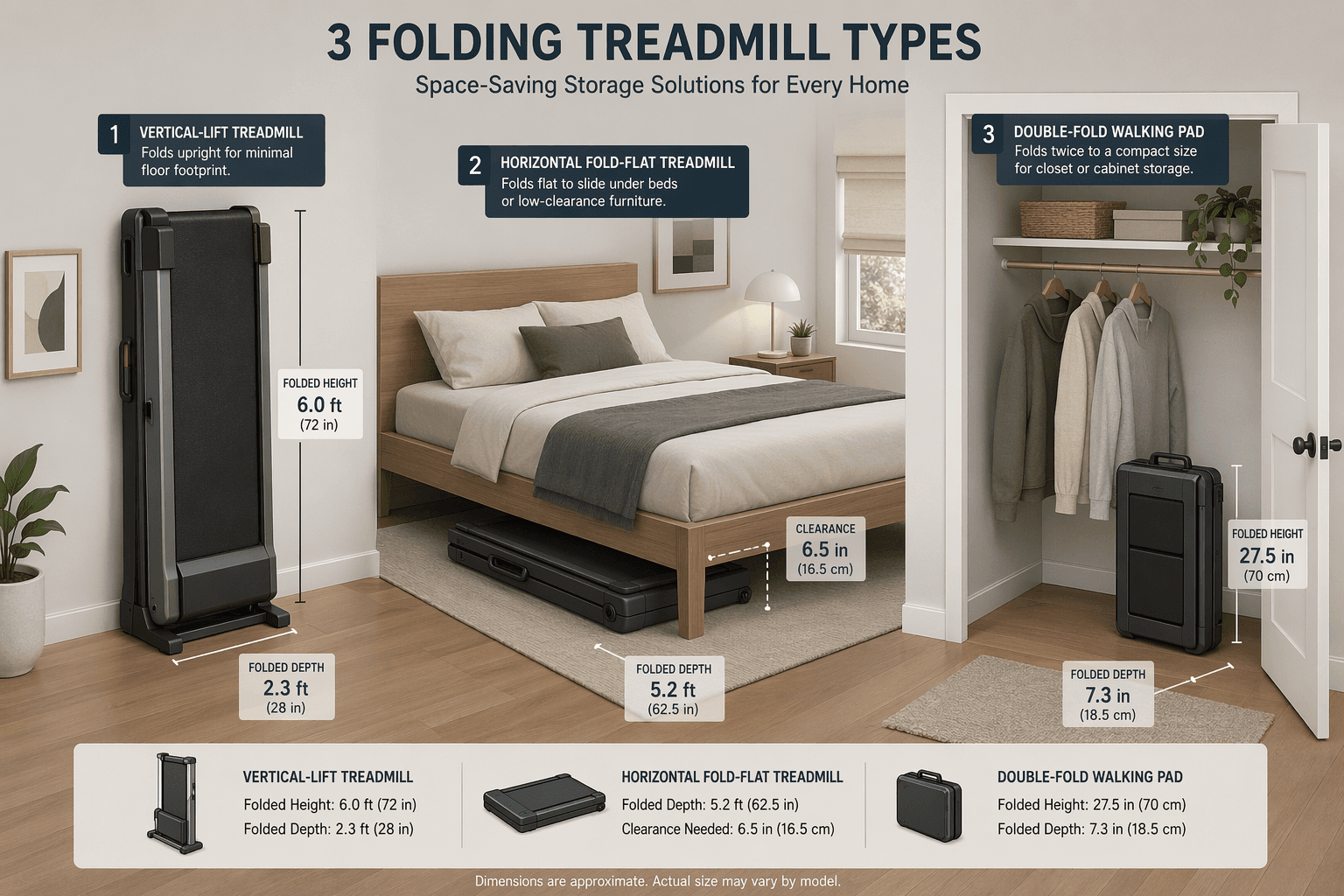
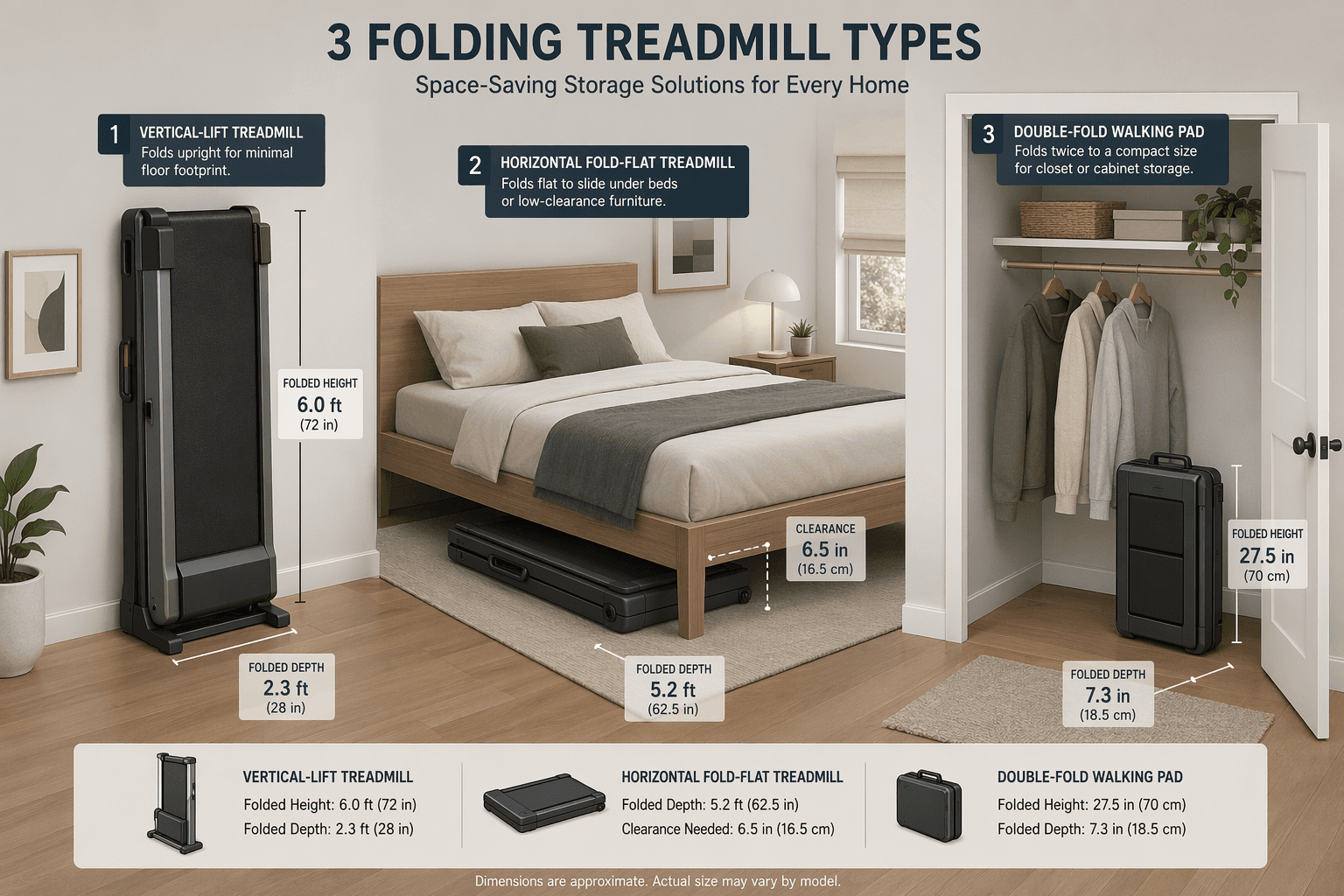
- How deep is the storage space where the treadmill will go when not in use? By deep I mean folded depth. A vertical-lift machine needs roughly 6–7 feet of ceiling clearance and about 42 inches of floor depth in front of the wall — the base stays on the ground. A horizontal fold-flat machine needs a flat surface or a gap under furniture, usually less than 6 inches. A double-fold walking pad needs a shelf or closet. Measure where you will actually stow it.
- What is your floor construction and do you have downstairs neighbors? Vibration through joists is the real noise problem, not motor whine. A 3/4-inch EVA mat cuts floor transfer by 30–50% — that number is from Treadmill Test Lab, and I consider the mat non-negotiable in any apartment. If you are on a ground floor with concrete slab, vibration is less of a concern.
- How often does the room change purpose? If the treadmill sits in a spare room that is also an office, you might fold it once a day. If it is in the living room and you need to clear the floor for guests every weekend, folding ease and weight matter as much as performance. A 71-pound vertical lift machine that requires two hands and a lift-and-pivot motion is a different proposition from a 45-pound walking pad you can slide under the sofa with one foot.
Decibel numbers can help but they don’t capture the vibration story. The NordicTrack 1750 measures 50.8 dB at 3 mph and 61 dB at 10 mph — that’s quieter than a vacuum cleaner. But if the floor joists transmit foot-strike vibration, the neighbor two floors down will still knock on your door. The mat solves that. One more detail that most buyers miss: deck length. A belt shorter than 55 inches forces a stride shortening for runners over 5'10", adding 5–8 dB of heel-strike noise and increasing fall risk. The research on this is directional — the 5–8 dB number comes from belt width data and belt length is correlated — but it is a strong enough signal that I will not recommend a 50-inch deck to a tall runner living above a family.
Your Constraint Profile: Map Your Answers to a Folding Mechanism
Combine your three answers and you land in one of three profiles. Each profile points to a specific folding mechanism, and inside each mechanism there are two or three models worth your attention.
Profile 1: The Apartment Walker
You have shallow storage (under 10 inches clearance under a bed or sofa), you are on a second floor or above, and the room needs to revert to living space daily. You mostly walk or jog easy — you do not need to hit 10 mph.
Your mechanism: horizontal fold-flat. The deck folds down to a flat slab 5–6 inches tall. It slides under furniture or stands against a wall with minimal visual or spatial intrusion.
| Model | Folded Depth | Weight | Deck Size | Max Speed | Warranty |
|---|---|---|---|---|---|
| WalkingPad C2 | 5.4 inches | 55 lbs | — | 3.7 mph | 1 year |
| UREVO Strol 2E | 5.1 inches | 59 lbs | 54.7 x 26.4 inches | — | 1 year |
| Echelon Stride-6 | horizontal fold-flat | — | 20.5 x 60 inches | 12.5 mph | — |
The WalkingPad C2 is my default recommendation for this profile: 5.4 inches high, 55 pounds. You can roll it out from under a bed in ten seconds. The trade-off is speed: 3.7 mph is a brisk walk, not a run. If you want to jog, the Echelon Stride-6 lets go of the 5.4-inch constraint — it folds flat but is larger and heavier, so verify your storage gap. It has a 20.5-by-60 inch deck, tops at 12.5 mph, and requires no assembly.
Profile 2: The Vertical Storage Runner
You have a dedicated corner or wall nook where a machine can stand upright. You have at least 7 feet of ceiling height. You are on a ground floor or have a mat and understanding neighbors. You run at 6 mph or above and need a full-size deck (55+ inches). Room re-use: occasional — the treadmill can stay unfolded for days.
Your mechanism: vertical-lift. The deck pivots up and locks vertically, saving floor space when stored but requiring height. The base remains on the floor.
| Model | Folded Dims (in) | Felt Weight | Deck Size | Max Speed | Subscription |
|---|---|---|---|---|---|
| Horizon 7.4 AT | 42x37x71 in | 45.6 lbs | 60x22 in | 12 mph | None — free |
| NordicTrack Commercial 1750 | 44.2x37x69 in | 71.3 lbs | 60x22 in | 12 mph | iFIT $396/yr |
| Bowflex Treadmill 10 | 44.5x39.6x70 | — | — | — | — |
| Sole F63 | 50x35x72 in | 100+ lbs | 60x20 in | 12 mph | None — free |
The Horizon 7.4 AT stands out even in this profile because of its lifetime frame and motor warranty, a 3.5 CHP motor, and a felt weight of 45.6 pounds — felt weight meaning how heavy it feels to lift when folded due to the hydraulic assist. That is notably lighter than the NordicTrack 1750 (71.3 pounds) or the Sole F63 (over 100). The Horizon also has no subscription requirement. The NordicTrack 1750 is excellent — a 22-by-60 deck, -3% to 12% incline, quiet operation (50.8–61 dB) — but tack on $396 per year for iFIT. Over five years, that is $1,980, roughly the unit price.
For a more budget-friendly vertical-lift option, the Horizon 7.0 AT costs around $999, has a 20-by-60 deck, 3.0 CHP, and the same lifetime frame and motor warranty. Still no subscription. That is a solid middle ground if you do not need the extra power of the 7.4 AT.
Profile 3: The Space Sharer
You need to store the treadmill in a closet, under a desk, or on a shelving unit. The room changes use several times a week — maybe a home office during the day, living room at night. You do not want to see the machine when it is not in use.
Your mechanism: double-fold or under-desk. Some walking pads and compact treadmills fold twice (the deck folds up and the frame folds over) to become a suitcase-sized block.
| Model | Folded Dims (in) | Weight | Max Speed | User Weight Limit |
|---|---|---|---|---|
| UREVO Strol 2E | 54.7x26.4x5.1 in | 59 lbs | — | — |
| WalkingPad C2 | 32.5x20.4x5.4 in | 55 lbs | 3.7 mph | 220 lbs |
| WellFit TM 037 | 6.2 inches tall | 45 lbs | 6.2 mph | — |
The WalkingPad C2 also fits this profile — it slides into a closet easily. But if you want a bit more speed, the WellFit TM 037 does 6.2 mph and weighs 45 pounds, folding to 6.2 inches tall. The UREVO Strol 2E at 5.1 inches folded is another solid under-desk candidate. Note that most under-desk machines have shorter decks — typical length is around 40–43 inches — which works for walking but not comfortable running.
What You Give Up for Each Constraint Profile
The most common mistake: people in the Apartment Walker profile buy a vertical-lift machine believing they can still store it under a bed. They cannot. The second most common: tall runners buy a walking pad because of the low folded height, then find themselves heel-striking and frustrated.
Subscription costs add another layer. The NordicTrack 1750’s iFIT subscription ($396/year) means over five years you spend an additional $1,980 — essentially the purchase price again. A Horizon 7.4 AT has no subscription, so the $1,599 (estimated) stands as your total over the same period. For constrained-space buyers on a budget, the subscription-free route often makes more sense, especially if the screen features are not your primary usage.
Non-Negotiables for Any Constrained-Space Buyer
- Get a 3/4-inch EVA vibration mat. Measured data shows 30–50% floor transfer reduction. It is the single cheapest way to keep neighbors happy and protect your joists. Skip it and you are trusting a 200-pound steel frame on bare wood. Do not.
- Check deck length for your height. If you are over 5'10" and plan to run, a deck under 55 inches will shorten your stride, add 5–8 dB of impact noise, and increase the risk of a misstep. You may be better with a vertical-lift model that offers a 60-inch deck, even if the storage profile is less convenient.
- Run the five-year total cost before buying. (Sticker price + subscription × 5) + mat + any delivery assembly. A $999 Horizon 7.0 AT with no subscription and a lifetime frame warranty may be cheaper over five years than a $1,299 machine requiring $39/month. Subscription prices change frequently — iFIT was $39/month at the time of writing — check current rates.
- Measure storage depth, not just height. A 5.4-inch folded depth is worlds apart from a 69-inch folded height. Trust the number, not the marketing term.
For a deeper dive on noise data and vibration isolation, see our tested guide: The Quietest Treadmills for Home.
You Now Have the Only Filter That Matters for Your Home
Answer three questions: how deep is my storage, what is my floor and neighbor situation, how often will I stow it. That profile tells you whether you need a horizontal fold-flat, a vertical-lift runner, or a double-fold under-desk model. Budget and motor power come after.
If you have a downstairs neighbor and a living room that doubles as a workout space, the WalkingPad C2 at 5.4 inches high is likely your best bet, even though it only goes 3.7 mph. If you have a spare wall and a ground floor, the Horizon 7.4 AT gives you a full run experience without a subscription bill. The framework works because it starts from your actual home, not from a spreadsheet of specs.
For the mechanism details behind each folding type, our Folding Treadmill Buyer's Guide walks through the engineering. And if you are still deciding between a walking pad and a full folding treadmill, the Walking Pad vs. Full Treadmill decision framework covers that choice in detail.
Comments
Join the discussion with an anonymous comment.