
How Podiatrists Pick Walking Shoes for Women Over 50
'Podiatrist recommended' can mean an APMA Seal, a clinic pick list, or plain marketing. Here's how to decode the claim — and which walking shoes for women over 50 have verifiable evidence behind them.
- Test space profile
- Home walking surfaces: carpet, laminate beside walking pad; hallway fit checks; no room dimensions or subfloor data disclosed.
- Floor damage risk
- low
- No-drill compatible
- ✓
- Test date
The irritating part of shopping for the best walking shoes for women over 50 is not that every list has opinions. Opinions are expected. The problem is that “podiatrist recommended” can sit beside a shoe with a real medical-association seal, a shoe one clinic likes, a shoe a podiatrist commented on for a magazine, or a shoe that simply looks supportive in product copy. One older-women walking-shoe roundup, for example, presents recommendations without podiatrist attribution or testing data on the page; that does not automatically make the shoes bad, but it does leave the buyer guessing what kind of evidence, if any, is behind the picks [1].
That distinction matters when you are about to spend real money on a pair you may wear on sidewalks, grocery-store floors, a treadmill, or a walking pad at home. The label becomes useful only after you ask a dull but necessary question: who recommended it, under what process, and what does that recommendation actually prove?
Verified as of August 25, 2026: this article ranks shoes by external evidence and source verification, not by FitAtHome first-party shoe testing. Model names, version numbers, prices, and widths change quickly, so re-check the current model page before buying.
The APMA Seal is useful — and narrower than shoppers are led to believe
The strongest “podiatrist recommended” signal in this category is the American Podiatric Medical Association Seal of Acceptance or Seal of Approval, because it is primary-source and publicly checkable. The APMA Seal Program has been operating since 1967. Products are submitted by companies, reviewed by a panel of APMA podiatrists, and listed in the APMA Seal database when accepted. APMA also states two limits that are easy to miss: it is not a testing laboratory, and it does not make comparisons between products [2].

That is still valuable. A named review process is better than a vague retailer badge. But it is not the same thing as “APMA tested every women’s walking shoe and ranked this one best for women over 50.” It also does not mean every current color, width, or version you see at retail has the same listing status unless the exact product appears in the database or the brand clearly ties that model to the seal.
| Claim you see | What it usually means | What it does not prove |
|---|---|---|
| APMA Seal | The brand submitted the product, and an APMA podiatrist panel reviewed it through the Seal Program [2]. | It is not a cross-brand ranking, and APMA says it is not a testing lab [2]. |
| Clinic-listed | A podiatry clinic or medical practice included the shoe or brand on a recommended list. | It may not disclose testing, scoring, patient sample, or comparison criteria. |
| Podiatrist-quoted in press | A podiatrist commented on or selected a shoe for a magazine or commerce article. | It may be one expert’s pick, not a formal endorsement from a professional association. |
| Lab-tested by a publication | An outlet measured or tested shoes for durability, stability, cushioning, or wear experience. | It is performance evidence, not necessarily podiatrist endorsement. |
Once those lanes are separated, the shopping decision gets calmer. A shoe can be worth considering because it has the APMA Seal. Another can be worth considering because a clinic consistently lists it for stability. Another can be worth considering because a lab found it durable or supportive. Those are different reasons, and they should not be blended into one shiny “doctor-approved” headline.
Evidence-tagged picks for women over 50
The table below is not a normal “best overall, best budget, best cute” roundup. Each row carries the evidence type that put the shoe on the list. A higher rank means the evidence is easier to verify or appears across more than one lane; it does not mean the shoe will fit every foot.
| Rank | Shoe or line | Evidence tag | Best reason to consider it | What to verify before buying |
|---|---|---|---|---|
| 1 | Hoka Clifton | APMA-sealed; podiatrist treadmill pick; clinic-listed Hoka option [2][3][4]. | A cushioned walking shoe with evidence across multiple recommendation lanes. | Check the exact Clifton version, width, and whether the rocker feels stable for your walking stride. |
| 2 | Brooks Ghost | APMA-sealed; podiatrist treadmill pick; Brooks appears on clinic recommendation lists [2][3][4]. | A mainstream neutral trainer that works well for many walking and treadmill shoppers. | If you need motion-control support, compare it with stability models rather than assuming neutral is enough. |
| 3 | Ryka Devotion X | External publication tested pick for women over 50; also appears in podiatrist-quoted press coverage [5][6]. | A women-focused walking option with age-specific testing coverage. | Treat this as publication testing and press-expert evidence, not an APMA Seal claim unless the current model is separately verified. |
| 4 | Orthofeet Kita | Podiatrist-quoted press pick [6]. | A comfort-first option to consider when a roomy, supportive walking shoe is the priority. | Confirm return policy and width availability, especially if you use orthotics or have hard-to-fit feet. |
| 5 | Vionic walking pick cited in press | Podiatrist-quoted press pick [6]. | A brand to consider if you want built-in support and a recommendation traceable to a named commerce source. | Verify the exact current model name in the retailer listing; the evidence is press-based, not a universal podiatry ranking. |
| 6 | ASICS Gel-Kayano 33 | Clinic-listed Kayano stability line; lab-tested model evidence from RunRepeat [4][7]. | A stability-oriented choice for walkers who feel better with guided support. | Make sure the stability features feel helpful, not corrective in a way your body fights. |
| 7 | New Balance 860 | Clinic-listed stability option [4]. | A structured stability shoe to try if neutral shoes let your foot collapse inward. | Version, width, and last can change; try the current model rather than relying on an older 860 experience. |
| 8 | Brooks Glycerin GTS 22 | Lab-tested by RunRepeat, not a podiatrist endorsement [7]. | A plush stability option when measured performance matters more to you than a seal or quote. | Do not confuse lab testing with medical endorsement; use it as durability and ride evidence. |
Why Hoka Clifton and Brooks Ghost sit at the top
The Clifton and Ghost earn the strongest placement here because they show up in more than one kind of evidence. Both have APMA Seal support in the APMA database, and both appear in an EatingWell treadmill-walking article built around podiatrist recommendations [2][3]. Hoka and Brooks also appear in an Achilles Foot and Ankle Center clinical recommendation list, which is a weaker signal than the APMA Seal but still more concrete than a retailer calling a shoe “doctor loved” without attribution [4].
The difference is ride feel. Clifton shoppers are usually chasing a softer, more cushioned platform. Ghost shoppers are usually looking for a familiar neutral trainer that does not feel dramatic underfoot. If you are comparing Hoka models for walking specifically, the site’s Hoka walking shoe guide is the better place to sort Clifton, Bondi, and other Hoka options by home-fitness use.
One caution with high-stack cushioned shoes: softness is not the same as stability. Doctors of Running notes that walking shoes need platform stability and that extreme rockers can be poor choices for walking [9]. That does not rule out a cushioned shoe, but it does explain why the first try-on should include slow turns, short hallway laps, and a few minutes at your normal walking cadence rather than just standing on carpet.
Where Ryka, Orthofeet, and Vionic fit
Ryka belongs in this list for a different reason: Verywell Fit named a Ryka shoe its tested top pick for women over 50 in a seniors walking-shoe guide [5]. That is useful, but it is not the same kind of claim as the APMA Seal. It tells you an external publication tested and liked the shoe for this demographic; it does not tell you APMA compared it against the Clifton, Ghost, or every other walking shoe.
Orthofeet Kita and the Vionic pick are press-and-expert signals. InStyle’s 2026 women-over-50 walking-shoe article includes podiatrist input and names models including Orthofeet Kita, Vionic, and Ryka Devotion X [6]. That is a legitimate lead if you want shoes to try, especially if your feet are sore and you need a short list. It should not be inflated into “all podiatrists recommend this shoe for all women over 50.”
Stability picks are only helpful if you actually need stability
ASICS Gel-Kayano and New Balance 860 show up as stability-oriented clinic-list options, which makes them worth trying if neutral shoes feel sloppy or your foot rolls inward more than is comfortable [4]. RunRepeat also lab-tested the ASICS Gel-Kayano 33 in its seniors walking-shoe coverage, placing it in the lab-tested evidence lane rather than the podiatrist-endorsement lane [7].
The point is not to buy the most corrective shoe on the wall. Too much structure can feel awkward if you do not need it. If you are deciding between soft foam, firmer support, and high-stack cushioning for indoor cardio, the site’s guide to supercritical foam shoes for home cardio explains why foam feel and platform geometry matter once you start walking in a small space.
How to use lab-tested picks without mislabeling them
RunRepeat’s lab-tested seniors guide adds useful performance context for shoes such as the Brooks Glycerin GTS 22, ASICS Gel-Kayano 33, and Hoka Bondi SR [7]. That kind of testing can help with durability, outsole grip, cushioning, and stability comparisons. It should be labeled honestly: lab-tested is not podiatrist-recommended unless the same shoe also has a podiatry source attached.
The Hoka Bondi SR is a good example of why the evidence tag matters. It may be relevant if you need a work-friendly, slip-resistant walking shoe, but that is a different buying problem from choosing a daily home-walking or neighborhood shoe. A lab result can move it onto your try-on list; it does not automatically make it the best choice for a walking pad in a spare room.
The four fit checks matter more than the label on the box
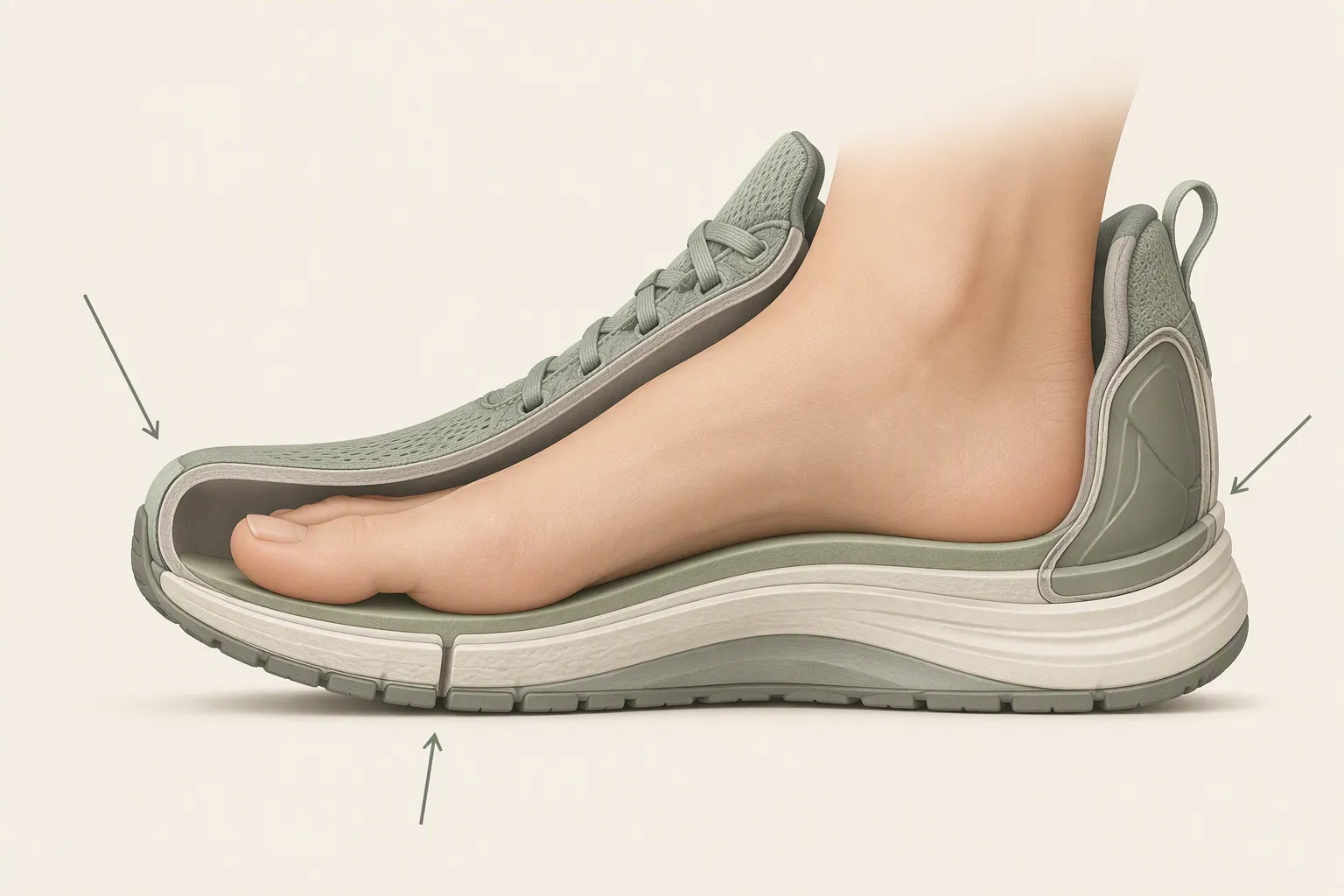
Once you have a verifiable short list, stop reading labels and fit the shoe. Podiatrist advice across InStyle and EatingWell comes back to a few practical checks: leave about a thumb’s width of room in front of the toes, do not depend on a painful break-in period, look for a firm heel counter, and make sure the shoe bends at the forefoot where your toes bend [6][8].
- Toe room: your longest toe needs space at the front, especially because feet can swell during longer walks.
- Heel hold: the heel should feel contained, not pinched and not slipping with every step.
- Forefoot flex: the shoe should bend where your toes bend, not fold in the middle like a slipper.
- No break-in bargain: mild adjustment is normal; pain, rubbing, or numbness is a return signal.
For home walking, add one extra check: wear the shoes on the exact surface where you walk. A shoe that feels lovely on store carpet can feel tall, tippy, or squeaky on laminate beside a walking pad. If you are used to minimalist footwear for strength work, this is also where the difference shows up. Barefoot-style shoes can be useful for some home workouts, but they are a separate category from supportive walking shoes; the site’s barefoot shoes for home workouts test is a better comparison point if you are deciding between minimal and structured footwear.
A simple way to verify a shoe before checkout
Before spending $100–190, run the claim backward. Start with the retailer’s wording, then find the source behind it. If a product page says “podiatrist recommended,” look for a named podiatrist, a clinic page, an APMA database entry, or a publication that explains how the shoe was chosen. If none of those appear, treat the phrase as marketing copy.
- Check the exact model name and version. Ghost 16, Ghost 17, and Ghost 18 should not be treated as automatically identical.
- Look up the evidence type: APMA Seal, clinic-listed, podiatrist-quoted press pick, lab-tested, or none shown.
- Match the evidence to your need. If you want a formal review process, prioritize APMA. If you want measured durability or stability, lab testing may matter more.
- Fit both feet late in the day if possible, with the socks you actually wear for walking.
- Use the return window. A shoe that fails at 20 minutes will not become a smart purchase because it had a convincing quote attached.
This is especially important for anyone building a walking habit at home. A shoe that fits well is the boring piece of equipment that lets the routine happen again tomorrow. If you are pairing new shoes with a structured indoor plan, a routine such as Japanese walking at home will expose bad fit quickly because it alternates pace and makes heel hold, toe room, and platform stability hard to ignore.
Replace walking shoes by miles, not by how clean they look
The most practical podiatry advice is not glamorous: replace the shoe when the midsole is done. Verywell Fit’s podiatrist-informed seniors guide gives a 350–500 mile replacement range [5]. EatingWell cites a 300–500 mile range, or about every six months, depending on use [8]. Those ranges are close enough to point to the same habit: track walking volume, not just visible wear.
That reframes the price. A more expensive shoe that fits, supports your stride, and survives hundreds of comfortable walking miles may be cheaper per walk than a bargain pair you stop wearing. A shoe with an APMA Seal, a clinic mention, a podiatrist quote, or lab data still has to pass your feet, your floor, and your mileage.
So do not crown a universal winner. Choose the shoe whose evidence type you actually trust, fit it by the toe-room and heel-counter rules, and retire it when the cushioning life is gone rather than when the upper finally looks worn out.
References
- Best Walking Shoes for Women Over 50 (2026 Update) — A Well Styled Life.
- APMA Seal Program Footwear & Products (Seal DB) — American Podiatric Medical Association.
- We Asked Podiatrists the Best Shoes for Treadmill Walking—These Are the 4 They Recommend — EatingWell.
- Top 11 Podiatrist Recommended Shoes for Every Foot Type — Achilles Foot and Ankle Center.
- The 12 Best Walking Shoes for Seniors of 2026, Tested — Verywell Fit.
- The 12 Best Walking Shoes for Women Over 50 of 2026, Per Podiatrists — InStyle.
- 7 Best Walking Shoes For Seniors in 2026 — RunRepeat.
- 8 Best Walking Shoes According to Podiatrists — EatingWell.
- Best Running Shoes for Walking — Doctors of Running.
This result comes from one real apartment under the stated conditions — it is a strong signal, not a guarantee your space will measure identically.
Builds this evidence supports
No build currently links to this specific test. Browse all builds with a matching tag.
Spot something off?
If this result didn't match your own space, let us know — floor-damage and noise claims carry real deposit-risk consequences if we get them wrong.