
Can You Do Baseball Off-Season Training in an Apartment?
Can you run a real baseball off-season in an apartment? Yes — with roughly $50 of gear and about 10 feet of open floor. A 30-minute routine run four to five times a week can cover hitting, fielding, pitching mechanics, and athletic development, using ball, floor-protection, and no-drill setup choices that keep it quiet and deposit-safe.
- Equipment tier required
- $0-100
- Duration
- 30 min
- Difficulty
- beginner
- Target area
- full body
- Space footprint needed
- 10 ft of open floor
- Noise level
- low / no jumping
Yes, you can do baseball off-season training drills at home in an apartment. The catch is that the apartment gets a vote. Ten feet of clear floor can be enough for useful indoor baseball work, and a 30-minute routine can cover hitting, defense or pitching mechanics, and athleticism four to five times per week, but only if the setup is built around quiet contact and protected surfaces rather than pretending the living room is a batting cage.[1]
The working version is simple: roughly 10 feet of open floor, one protected wall or no-drill backstop, soft balls only, something under the tee, a towel, and a light resistance-band set. If a drill needs an official baseball, a hard throw into drywall, metal spikes, or a net screwed into a doorframe, it does not belong in this plan. That is not being precious. In a rental, the downstairs neighbor and the security deposit are part of the training environment.
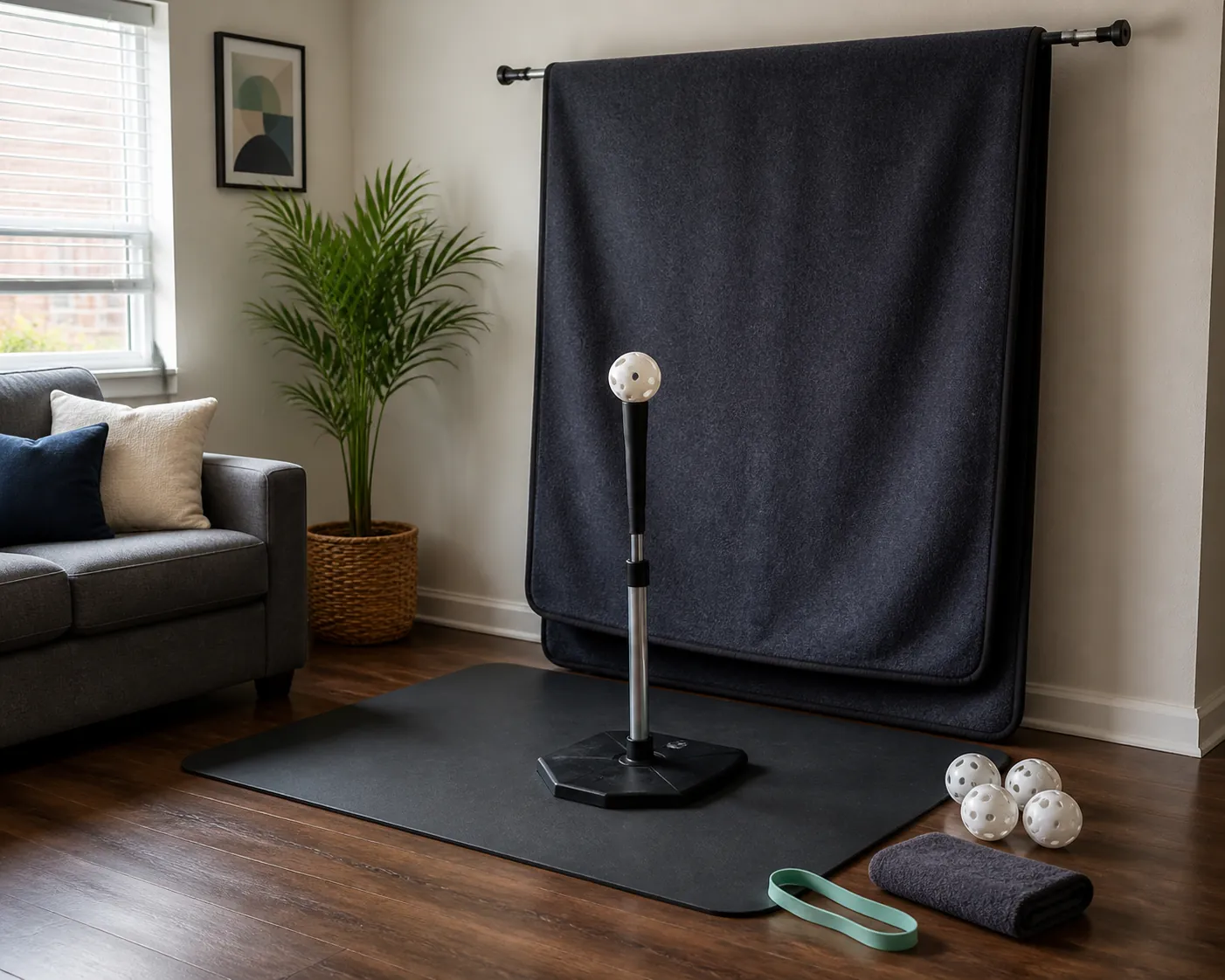
The apartment test: quiet, soft, protected, no drilling
The first decision is not which drill looks most baseball-specific. It is what happens when the ball misses, the bat clips the floor, or a kid takes one more rep after bedtime. BaseballTips identifies wiffle balls, rag balls, and foam balls as the standard workaround for confined indoor practice because official baseballs create real wall and property-damage risk.[2] That one point should shape the whole room.
A hard baseball indoors changes the drill from practice into a liability problem. A wiffle ball off a tee still gives a hitter a ball to square up. A foam ball makes the miss quieter. A rag ball is ugly in the best way: it dies quickly, does not ricochet across the room, and teaches the hitter whether the barrel arrived on time without punishing the baseboard.
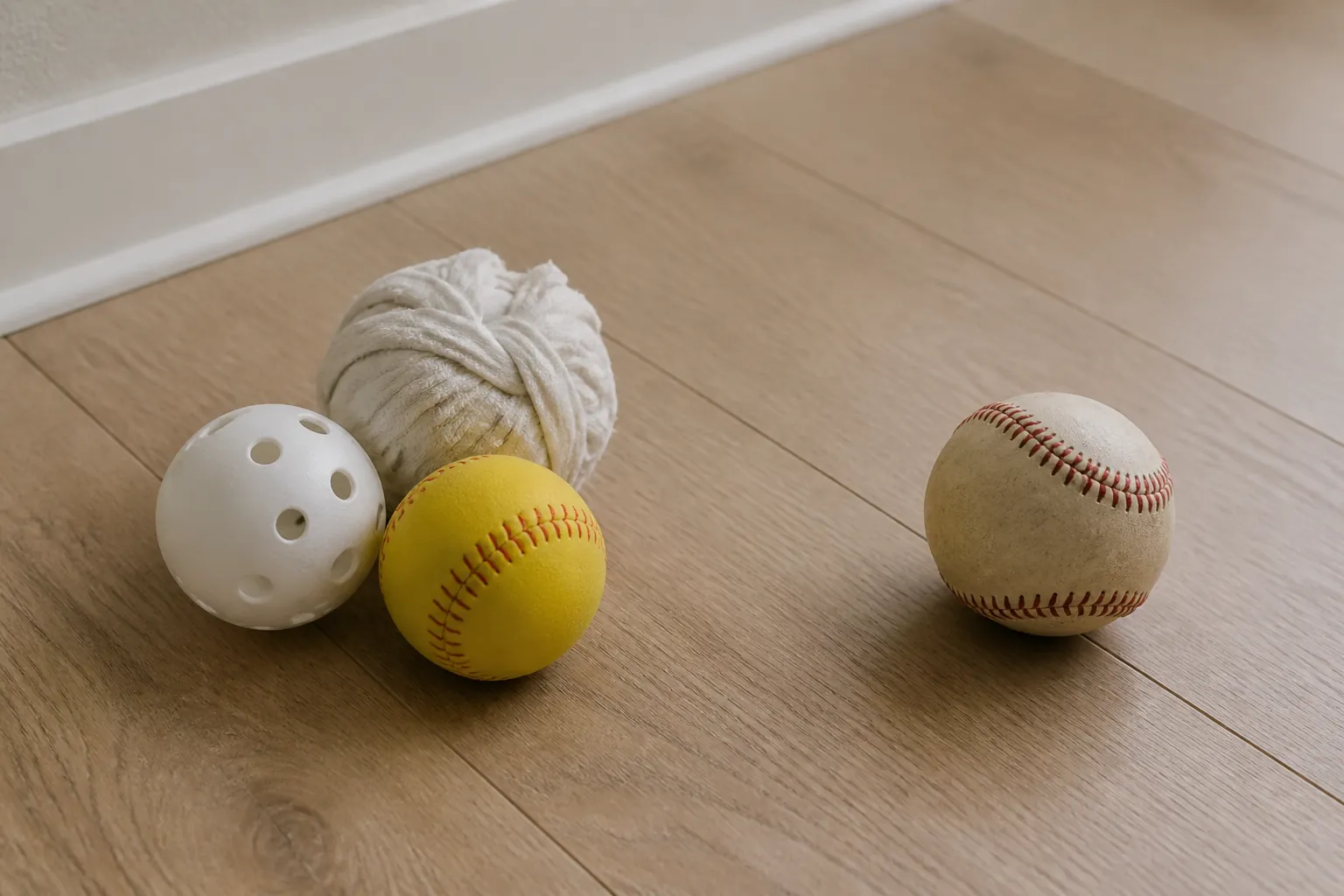
| Item | What it lets you do | Apartment noise / damage risk | Floor or wall protection | Drilling required? |
|---|---|---|---|---|
| Adjustable batting tee | Contact-point tee work, barrel control, low-volume swing reps | Low if used with wiffle, foam, or rag balls; higher if the bat hits bare floor | Place on a yoga mat, rubber mat, folded rug, or carpet square | No |
| Wiffle balls | Tee work and very short controlled flips into a backstop | Low to medium; they can still click against walls and furniture | Use a blanket, net, or curtain-like backstop behind the hitting zone | No |
| Foam balls | Quiet tee work, younger-player reps, safer misses | Low; usually the best choice when neighbors are close | Still protect the wall so the player does not start aiming at drywall | No |
| Rag balls | Dead-ball contact work, small-room hitting, soft-hand fielding feeds | Very low; the ball loses energy quickly | Good option when the backstop is close or the room is narrow | No |
| Heavy blanket or freestanding net | Backstop for tee work and soft contact | Low if it absorbs the ball instead of letting it rebound | Hang over a door, furniture edge, shower-curtain tension rod, or freestanding frame without screws | No |
| Light resistance bands | Arm care, scap work, rotational control, lower-body activation | Very low unless snapped against a wall | Anchor only where safe, or use foot/hand anchors instead of door hardware when unsure | No |
| Towel | Pitching-mechanics work without throwing a ball | Very low | Use open space and a protected visual target, not a wall strike | No |
The no-drill part matters more than people admit. A blanket hung over a door, a freestanding net, or a soft backstop wedged behind furniture may not look like a training facility, but it also does not leave anchor holes. A floor mat under the tee keeps the rubber base from walking and gives the bat a safer place to finish if the swing gets steep. That one mat can be the difference between a useful tee station and a fresh crescent mark in the floor.
What the 30-minute session actually looks like
A good apartment session is short enough to repeat and narrow enough to control. WIN Reality’s indoor routine model is useful here because it treats 30 minutes as enough time to touch hitting, defense or pitching, and athleticism without needing full-field space.[1] Little League also frames indoor training as a realistic option for young players when outdoor access is limited, which matters for parents trying to keep a 7- to 14-year-old moving without turning the room into a circus.[3]
| Time | Work | Apartment version |
|---|---|---|
| 0:00–4:00 | Warm-up | Marching, hip hinges, arm circles, band pull-aparts, easy rotational turns |
| 4:00–16:00 | Hitting skill | Tee work with wiffle, foam, or rag balls into a blanket or net |
| 16:00–23:00 | Defense or pitching mechanics | Quiet wall-ball/floor-roll fielding, or band arm care plus towel drill |
| 23:00–29:00 | Athletic development | No-jump footwork, lateral shuffles, split-stance holds, rotational band work |
| 29:00–30:00 | Reset | Balls picked up, tee moved, floor checked, backstop left as found |
That last minute is not filler. In a house, you might leave the station half-built. In an apartment, the cleanup is part of the drill design. Balls under furniture become tripping hazards, tees left in walkways get kicked, and a blanket backstop that pulls on a door hinge every night will eventually make itself known.
Tee work is the main hitting drill, not a consolation prize
If there is one baseball skill that earns its space indoors, it is controlled tee work. WIN Reality highlights tee work at multiple contact locations — including front, inside, and outside — as a key indoor hitting drill because the hitter can train contact quality without needing ball flight.[1] That is exactly what a small room needs.
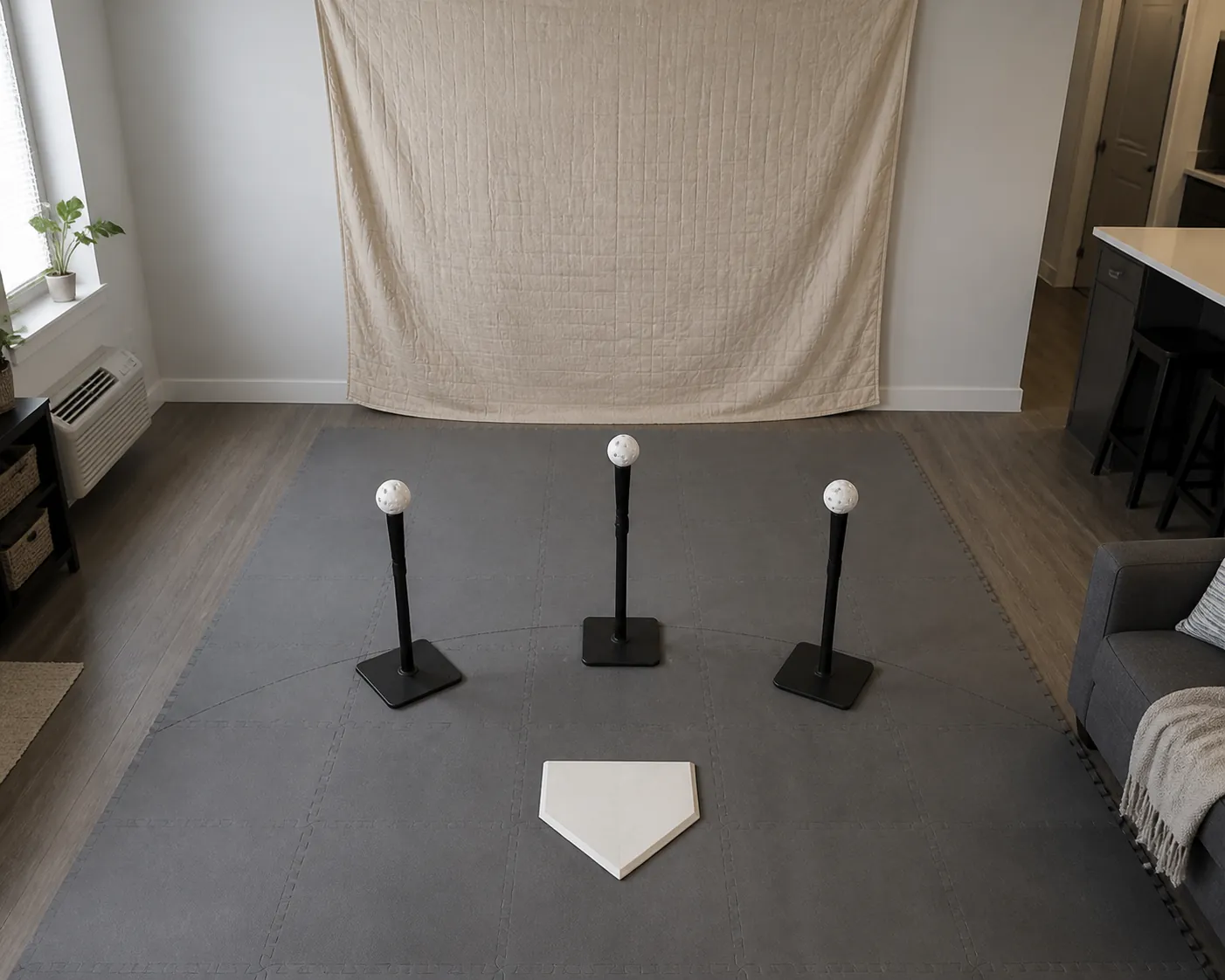
Set the tee so the hitter can swing normally without the barrel threatening a lamp, TV, ceiling fan, or wall. Then keep the ball soft and the intent specific. The goal is not to blast a ball across the room. The goal is to put the barrel in the right place at the right time.
- Front contact: place the tee slightly out front and work on finishing through the ball without lunging. This is where a hitter can feel extension, but the finish still has to stay under control.
- Inside contact: move the tee in and let the hitter learn to get the barrel there without casting. In a small room, this should be done with foam or rag balls first because pulled contact tends to be louder.
- Outside contact: move the tee deeper and away. The useful rep is a firm, quiet barrel path that stays through the opposite-field contact point, not a reach-and-slap swing.
For a youth player, I would rather see 24 focused swings with a reset between small groups than 80 rushed hacks that make the tee migrate across the floor. Use small sets: six front-contact swings, six inside, six outside, then repeat the weakest location once. If the bat starts striking the mat or the player starts chasing the ball into the backstop, stop the round. Indoor practice should teach control, not rehearse panic.
Fielding work only comes after the wall is made safe
Wall-ball fielding is useful only when the wall is protected and the ball is soft. With a foam ball or rag ball, a player can work short hops, two-hand receives, forehand funnels, backhand funnels, and clean transfers. With an official baseball, the same drill can become a dent-finding exercise. That is why the ball choice is not a minor gear preference; it decides whether the drill belongs indoors at all.[2]
The quietest version is floor-roll work. A parent or partner sits or kneels eight to ten feet away and rolls a rag ball or foam ball. The player starts in an athletic position, receives out front, funnels to the center, taps the throwing hand to the ball, and resets. No throw is needed. If the room is too narrow for a partner, roll the ball off a padded baseboard area or into a folded blanket so the return is deadened.
Middle-infield hands improve when the player learns to be early with the feet and soft with the glove. They do not improve because the apartment wall got punished for 20 minutes. If the ball is rebounding hard enough to make someone in the next room look up, switch to a softer ball or floor-rolls.
Pitching mechanics: bands and towel, not a throwing program
The apartment-safe pitching lane is narrow. Bands can support arm-care patterns such as internal and external rotation, pull-aparts, and scapular work, and they also fit rotational and lower-body activation work.[1] SIXSTAR’s at-home baseball workout guidance also supports using resistance bands and bodyweight movements as part of a home training layer.[4] That gives a player something meaningful to do without asking the room to absorb actual throws.
The towel drill belongs here because it trains extension and follow-through without releasing a ball. WIN Reality describes it as one of the safer indoor mechanics drills for that reason.[1] Hold a small towel in the throwing hand, move through the delivery under control, and let the towel travel toward a soft visual target. The target can be a taped square on a blanket or a pillow held safely by a parent at the right distance. It should not be a drywall impact drill.
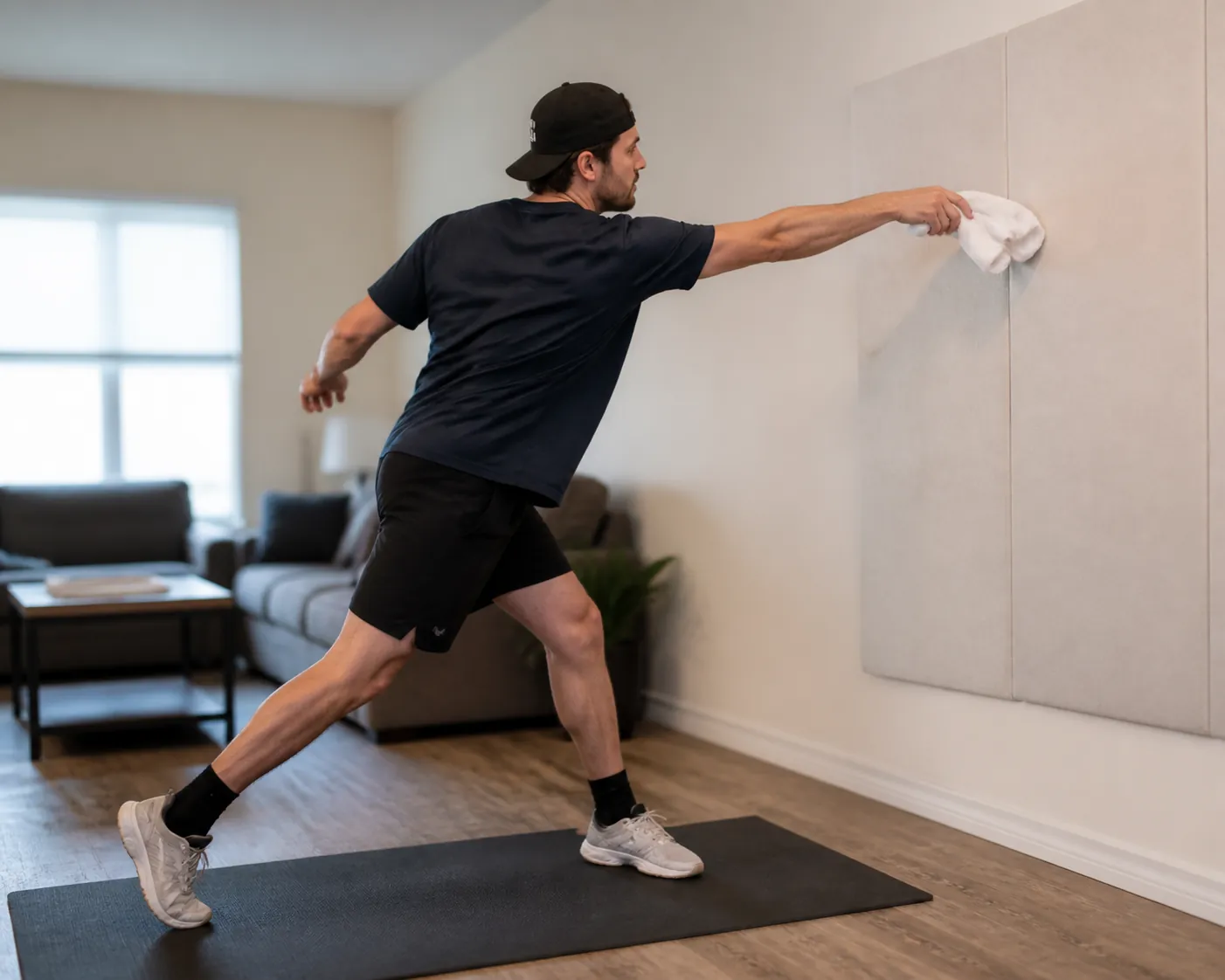
Keep the towel work modest: a few controlled reps after bands, not a full simulated bullpen. The goal is not to build pitch volume, long-toss distance, or a complete pitching calendar inside an apartment. The room is good for arm-care habits, sequencing, balance, direction, and finish. It is not a mound.
A four- to five-day weekly rotation
Running the exact same 30-minute session five times can get stale, especially for a young player. Keep the structure and rotate the emphasis. The point is to touch baseball skill often while staying below the apartment’s noise and patience limits.
| Day | Main emphasis | 30-minute split |
|---|---|---|
| Session 1 | Contact points | 4-minute warm-up; 14-minute tee work; 6-minute floor-roll fielding; 5-minute no-jump footwork; 1-minute reset |
| Session 2 | Hands and transfer | 4-minute warm-up; 8-minute tee maintenance; 12-minute rag-ball or foam-ball fielding; 5-minute band/core work; 1-minute reset |
| Session 3 | Arm care and towel mechanics | 5-minute warm-up; 8-minute tee work; 10-minute bands plus towel drill; 6-minute lower-body control; 1-minute reset |
| Session 4 | Athletic development with skill touches | 5-minute warm-up; 8-minute tee contact; 7-minute glove work; 9-minute quiet agility, shuffles, split-stance holds, and rotational band work; 1-minute reset |
| Optional Session 5 | Review day | Repeat the weakest skill from the week at lower volume and higher focus; stop before fatigue turns the reps sloppy |
For the athletic-development block, do not turn this into a jumping workout if you live above someone. Lateral steps, controlled shuffles, hip switches, split-stance holds, bear-position shoulder taps, dead bugs, and band rotations all train useful qualities without floor-thumping. If you want a separate no-equipment conditioning layer for a youth player, use the site’s small-space baseball conditioning circuit for kids as the companion piece rather than stuffing every conditioning idea into this skill session.
Players who need more footwork variety can also borrow quiet ladder-style patterns from indoor practice drills. Tape on the floor is better than a plastic ladder if the plastic rattle travels downstairs.
How to keep the drills repeatable
Repeatability is where most apartment plans either work or die. A parent should be able to set the station in two minutes, run the session, and restore the room without negotiating with furniture every night. If the setup requires moving a couch, clearing a coffee table, taping three walls, and apologizing to a neighbor, it will not last four weeks.
- Mark the tee spot with painter’s tape so the swing lane is the same every session.
- Keep the ball bucket soft-only: wiffle, foam, and rag balls. Do not mix in official baseballs indoors.
- Use a backstop that absorbs instead of rebounds. A loose heavy blanket is usually quieter than a tight hard surface.
- Put the tee on a mat, rug, or carpet square before the first swing, not after the first floor strike.
- Cap the session at 30 minutes. Good indoor reps lose value when fatigue turns them loud and careless.
- End noisy drills earlier in the evening. A drill that is acceptable at 5 p.m. can become a neighbor problem at 9 p.m.
The best small-space baseball setup feels almost boring after a week. Tee in the same place. Blanket in the same place. Bands in the same drawer. Towel on the same chair. That boring rhythm is what lets a player get real reps four to five times per week without the session becoming a production.
Where the apartment plan stops
The off-season matters, but it does not need to become a professional periodization chart in a living room. Klein and colleagues describe off-season training as important for both injury prevention and performance, and they note a 2- to 4-week post-season rest window before baseball-specific work resumes.[5] That is useful framing. It does not mean a renter needs to copy a full advanced throwing, lifting, or ramp-up plan indoors.
This plan also does not promise verified bat-speed gains from a gadget, a complete strength program, or game-ready pitching volume. Some vendors make broader performance claims around training tools, but unless the method is visible and the evidence is clear, those claims should stay in the claim pile. In an apartment, the better standard is simpler: the drill trains a real baseball skill, fits the space, stays quiet, protects the rental, and can be repeated without drama.
That still leaves plenty to do. A player can train contact points off a tee, receive ground balls with soft hands, build arm-care habits with bands, rehearse extension with a towel, and keep the lower body moving with quiet athletic work. Built around soft contact, protected surfaces, and short repeatable sessions, an apartment off-season is real baseball practice. It just has better manners.
References
- Indoor Baseball Drills You Can Do at Home, WIN Reality
- Indoor Baseball Drills & Practice In Small Areas, BaseballTips
- Three Ways to Train in the Great Indoors, Little League
- Baseball Workouts at Home - A Complete Guide, SIXSTAR
- Offseason Workout Recommendations for Baseball Players, 2021
What a small equipment investment adds
Cable Machine Alternatives That Save Space and Money
Compare the best cable machine alternatives for home gyms – from resistance bands and pulley systems to suspension trainers and compact digital units – and find the right option for your space and budget.
Small Treadmill Buying Guide: 7 Critical Specs to Check Before You Buy
A cross-category spec primer for apartment and small-space dwellers comparing walking pads, ultra-compact folding treadmills, and full-size folding treadmills. Learn the concrete thresholds for motor HP, deck length, noise, warranty, and subscription lock-in so you can compare apples to apples.
How to Practice Basketball at Home Without Noise Complaints
Learn how to run a full basketball workout in a small apartment without noise complaints. This guide covers no-dribble handling drills, wall form shooting, and silent ball options that let you train without disturbing neighbors.
How often should you repeat this?
See our recovery and rest reference for citation-anchored rest-interval guidance.
Spot something off?
Tell us if a movement, tier assumption, or duration didn't match your experience.