
Beat the Monday Blues With a 15-Minute Home Workout
Monday blues is a real early-week stress pattern — and a short, moderate morning workout is the most evidence-backed fix. Learn why it works and get a 15-minute no-equipment bodyweight routine you can do in your living room before work.
- Equipment tier required
- none
- Duration
- 15 min
- Difficulty
- beginner
- Target area
- full body
- Space footprint needed
- yoga mat space
- Noise level
- quiet (no jumping)
The Monday version of your body can feel oddly specific: jaw tight before the first meeting, shoulders already up, coffee not ready, laptop waiting, and no realistic chance you are driving to a gym before work. This 15-minute home workout is built for that moment. No shoes, no equipment, no jumping, no heroic warm-up ritual.
The goal is not to diagnose your Monday mood or pretend a quarter-hour of squats fixes work stress. It is simpler: use a moderate, repeatable morning session to raise physical energy and take the edge off early-week tension before the day starts making decisions for you.

Monday blues is real enough to plan around
“Monday blues” is not a clinical diagnosis and is not a DSM-5 condition. Medical News Today describes it as a time-linked pattern that can overlap with stress symptoms such as tense muscles, headaches, fast heartbeat, and raised blood pressure, then lift as the week moves on.[1] That boundary matters. If low mood, dread, sleep changes, or loss of interest are persistent or severe, that deserves more than a workout article.
For ordinary early-week stress, though, Monday is not just a cultural joke. Research reported by Forbes found that Monday-to-Friday employees liked their jobs less and reported more stress at the start of the week, with stressors feeling more severe on Mondays; the researchers also suggested scheduling wellness activities early in the week.[2]
There is also broader physiological context, though it should not be turned into a personal scare tactic. The Association for Psychological Science reported country-level data showing a 19% increase in the odds of sudden cardiac death from cardiovascular events on Mondays, and also reported that people anxious about Mondays showed heightened stress-system activity over months.[3] That supports a modest conclusion: Monday can be a higher-stress timing problem. It does not mean your Monday inbox is a medical emergency.
Why the fix is moderate exercise, not a motivational speech
The best evidence for this routine is not that exercise makes people feel virtuous. It is that repeated exercise has measurable effects on energy and fatigue.
A 2022 meta-analysis of 81 randomized controlled trials with 7,050 participants found that chronic exercise increased energy, with Hedges’ g = 0.415, and reduced fatigue, with g = -0.374.[4] Moderate intensity was the most dependable dose in that analysis: energy improved with g = 0.418 and fatigue decreased with g = -0.394.[4] Home-based interventions also showed a vitality effect of g = 0.569.[4]
That does not prove this exact 15-minute living-room session has been tested as a Monday protocol. It has not. The routine below is synthesized programming: quiet bodyweight movement chosen to fit the dose that the pooled evidence supports. The important word is “moderate.” The same meta-analysis did not find a significant energy effect for light-intensity exercise, and it noted possible publication bias for energy and vitality outcomes.[4] A few sleepy stretches may feel nice, but the stronger evidence sits with work that raises breathing and body temperature without turning the morning into a punishment.
A small University of Georgia study is often used to make this point sound dramatic: in 36 sedentary adults with persistent fatigue, low-intensity exercise was associated with about a 20% increase in energy and a 65% reduction in fatigue symptoms.[5] Useful, but narrow. It is one small study, not a universal promise that any person doing any movement will feel 65% better by breakfast.
The energy boost is physical before it is psychological
A short workout can feel counterintuitive when you already feel drained. Harvard Health explains the basic mechanism plainly: exercise can increase energy by improving oxygen and nutrient delivery at the cellular level, including through mitochondria, rather than simply “using up” the energy you have left.[6]
That is why the routine does not start with burpees or end with a collapse. You are looking for enough muscular work to move blood, raise breathing, and wake up large muscle groups, while still leaving enough composure to shower, answer messages, and be civil on a video call.
Why morning timing matters on Monday
The behavioral problem is not knowing that exercise helps. Most people know that. The problem is protecting a slot before Monday absorbs it.
A review by Schumacher and colleagues found that people who exercised at a consistent time trained more often than inconsistent-time exercisers: 4.8 versus 4.4 days per week, and 350 versus 285 minutes per week.[7] The same paper reported that 68% of National Weight Control Registry maintainers had temporally consistent exercise routines, and that morning plans showed higher intention-behavior concordance.[7]
That is the practical case for doing this before the workday starts. Not because 7 a.m. is morally superior. Because a protected morning repeat is harder for meetings, errands, and decision fatigue to steal.
There is some emerging trial evidence around early exercise timing, but it should be kept in its lane. A 2025 randomized controlled trial in 58 sedentary men ages 18 to 28 found that morning exercise from 6 to 8 a.m. reduced body fat by week 4, improved cholesterol and triglycerides, and advanced the sleep-wake cycle and melatonin onset compared with control.[8] That is interesting support for morning exercise, but it was male-only and narrow in age, so it should not be generalized to every apartment worker with a laptop and a stiff neck.
There is also one non-negotiable exception: do not cut sleep to perform a “healthy” 6 a.m. workout. Schumacher and colleagues note the sleep-exercise tradeoff for people whose chronotype makes early workouts costly.[7] If morning movement means turning six hours of sleep into five, move the session later and keep the same structure.
The 15-minute no-equipment Monday routine
You need about the space of a yoga mat. Barefoot is fine if your floor is safe and non-slippery. Keep every movement quiet enough that a downstairs neighbor would not know this is happening.
| Time | What to do | Intensity target |
|---|---|---|
| 0:00-2:00 | Warm-up: breathing, shoulder circles, hip hinges, easy squats | Easy |
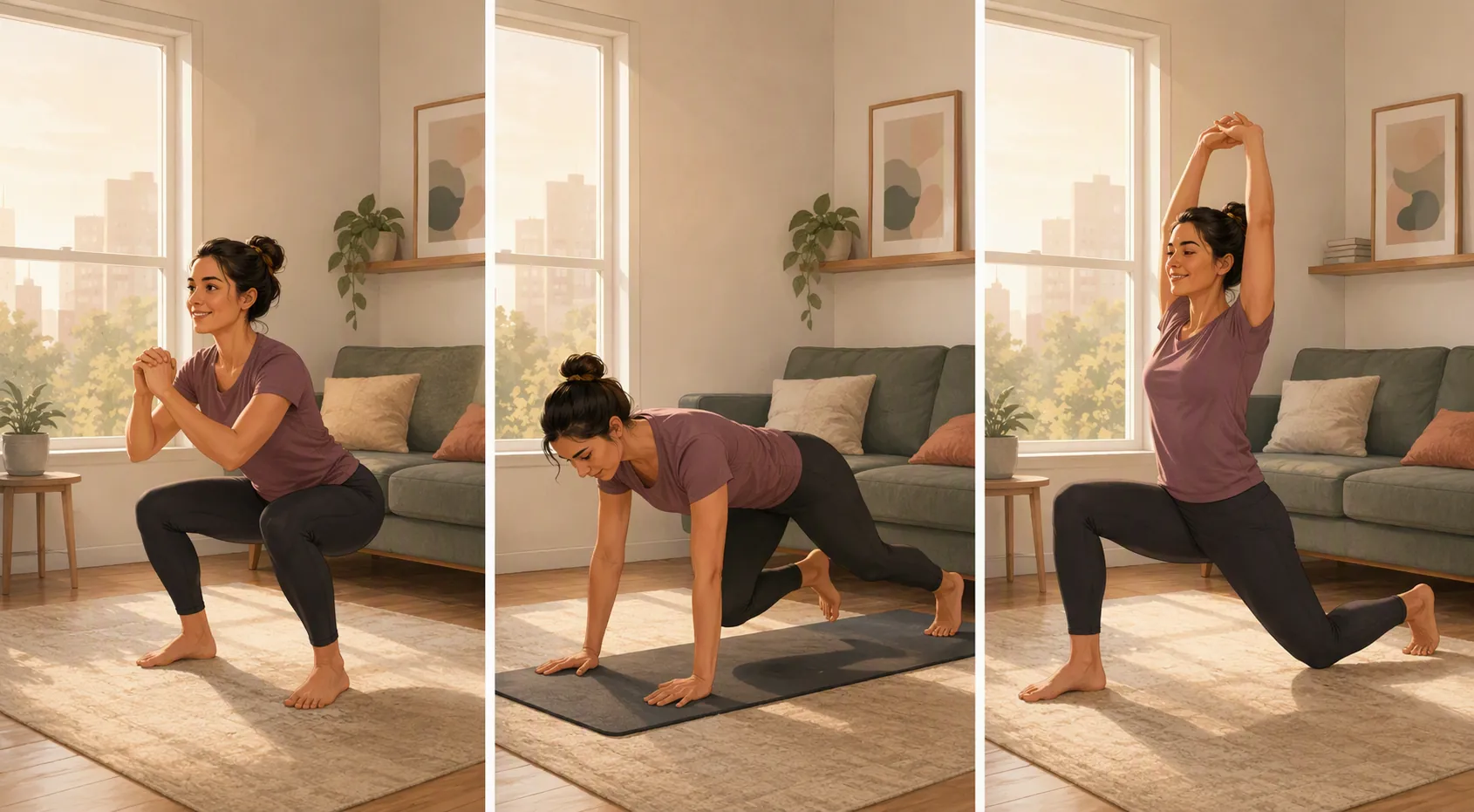
| 2:00-6:00 | Block 1: squat + reach, incline or wall push-up, reverse lunge | Moderate |
| 6:00-10:00 | Block 2: low-impact step-back plank, glute bridge, dead bug | Moderate |
| 10:00-13:00 | Block 3: quiet finisher with sit-to-stand squats, march holds, calf raises | Moderate |
| 13:00-15:00 | Cool-down: slow breathing, chest opener, hip flexor stretch | Easy |
0:00-2:00 — Warm up without negotiating
- 30 seconds: stand tall, inhale through the nose, exhale slowly, let the shoulders drop.
- 30 seconds: shoulder circles and gentle arm reaches.
- 30 seconds: hip hinges with hands on thighs, keeping the back long.
- 30 seconds: easy squats to a chair, couch edge, or comfortable depth.
This part is deliberately plain. On a low-energy Monday, a complicated warm-up becomes a chance to quit.
2:00-6:00 — Block 1: large muscles, quiet pace
Run two rounds. Work for 40 seconds, then take 20 seconds to switch.
- Squat + reach: squat to a comfortable depth, stand, reach arms overhead, lower them slowly.
- Wall or counter push-up: use a wall, desk, or countertop so the set stays smooth.
- Reverse lunge or step-back tap: step one foot back, bend slightly, return; tap only if lunges feel cranky.
Moderate means you can speak in short phrases, but you would not choose to discuss quarterly planning while doing it. If your knees dislike lunges, use alternating step-back taps and keep the torso tall.
6:00-10:00 — Block 2: core work that does not shake the floor
Run two rounds. Work for 40 seconds, then take 20 seconds to switch.
- Low-impact step-back plank: hands on a couch, bench, or sturdy chair; step one foot back, then the other, then step in.
- Glute bridge: lie on your back, feet planted, lift hips, pause, lower quietly.
- Dead bug: lie on your back, knees bent over hips, alternate lowering one heel or extending one leg.
If getting to the floor is annoying before work, keep the plank on the couch and replace bridges and dead bugs with standing good mornings and standing knee lifts. The routine survives because the setup is boring.
10:00-13:00 — Block 3: the quiet finisher
Set a 3-minute timer and move through the list at a steady pace. Do not sprint.
- 8 sit-to-stand squats from a chair or couch
- 20 slow marching steps, pausing one second with each knee lifted
- 12 calf raises with one hand lightly touching a wall
- Repeat until the timer ends
This is where breathing should be clearly elevated. If it still feels too easy, increase range of motion before speed. If it feels too hard, remove the pauses and slow down.
13:00-15:00 — Cool down enough to re-enter the morning
- 40 seconds: slow nasal inhale, long mouth exhale, hands on ribs or belly.
- 40 seconds: doorway or standing chest opener.
- 40 seconds: standing hip flexor stretch, switching sides halfway.
This cool-down is not therapy. It is a transition. You are giving your breathing and posture two minutes to stop looking like the inbox won.
How to make it fit a real Monday
Put the routine where friction is lowest. For many remote or hybrid workers, that is before the shower, before opening email, and before shoes enter the conversation.
- If you wake up stiff: keep the warm-up, shorten Block 3, and finish the full 15 minutes next Monday.
- If you live above someone: use step-backs, marches, bridges, and slow squats; skip hops, skaters, and mountain climbers.
- If your morning is wrecked: do a shorter midday reset from 5-Minute Quiet Home Workouts for Workday Energy instead of writing off the day.
- If you want more variety: use Rainy Day Home Workout Ideas for Any Budget to rotate quiet $0 and low-cost options without changing the habit slot.
Recovery can stay simple too. If the workout leaves you sore enough to avoid Wednesday, it was too much. For a fuller follow-through after harder sessions, use Your Complete Post-Workout Recovery Routine at Home.
Equipment is optional, not the entry fee. If this habit sticks and you want to upgrade the space later, start with surface and storage decisions before buying bulky gear. Home Gym Flooring on a Budget and Under $1,000 Home Gym: Where to Spend and Where to Save are better next steps than turning one good Monday into a shopping project.
Do this at 7 a.m.
- 6:55 — Put water nearby, move one chair if needed, start coffee if that helps.
- 7:00 — Start the 2-minute warm-up before checking messages.
- 7:02 — Run Block 1 at a moderate pace.
- 7:06 — Run Block 2, choosing couch-supported options if the floor is not appealing.
- 7:10 — Finish with quiet lower-body work; breathe harder, do not jump.
- 7:13 — Cool down, then start the day.
Evidence table
| Claim | Best support | Limit |
|---|---|---|
| Monday blues is a real stress-timing pattern, not a diagnosis | Medical News Today describes it as time-linked and not clinical; Pindek-related reporting finds higher early-week stress.[1][2] | No reliable prevalence figure is available from these materials. |
| Moderate exercise is the strongest energy/fatigue dose | 81-RCT meta-analysis: chronic exercise raised energy and reduced fatigue; moderate intensity had robust effects.[4] | The exact 15-minute routine here was not directly tested. |
| Home workouts can support vitality | Home-based interventions in the meta-analysis showed a vitality effect of g = 0.569.[4] | Publication bias was possible for energy/vitality outcomes. |
| Morning timing may help the habit stick | Consistent-time exercisers trained more; morning plans had higher intention-behavior concordance.[7] | Morning exercise should not replace needed sleep. |
| Early exercise has some supportive metabolic and circadian evidence | A 2025 RCT found benefits from 6-8 a.m. exercise versus control.[8] | The study included 58 sedentary men ages 18-28, limiting generalization. |
For most healthy adults, the best at-home Monday blues energy boost is not the hardest workout you can tolerate. It is the moderate one you can repeat next Monday without rearranging your life.
References
- Monday blues: Symptoms, causes, and how to cope, Medical News Today
- Are Monday Blues Real? Here’s What Research Says, Forbes, 2021
- Mondays Really Are More Stressful on the Brain and Body, Association for Psychological Science
- Chronic Exercise Increases Feelings of Energy and Decreases Feelings of Fatigue in Adults: A Systematic Review and Meta-Analysis of Randomized Controlled Trials, Frontiers in Psychology, 2022
- Low-intensity exercise reduces fatigue symptoms by 65 percent, study finds, University of Georgia
- Does exercise really boost energy levels?, Harvard Health
- Relationship of Consistency in Timing of Exercise Performance and Exercise Levels Among Successful Weight Loss Maintainers, Exercise and Sport Sciences Reviews
- Time of day-specific effect of exercise on body composition, lipid metabolism, and circadian rhythm in sedentary men, Scientific Reports, 2025
What a small equipment investment adds
We don't have a build tagged to this exact tier yet. Browse all builds.
How often should you repeat this?
See our recovery and rest reference for citation-anchored rest-interval guidance.
Spot something off?
Tell us if a movement, tier assumption, or duration didn't match your experience.