
5-Minute Quiet Home Workouts for Workday Energy
Midday energy slumps have a surprisingly strong fix: 5-minute movement breaks. These three quiet, no-equipment circuits, built from the 2026 BJSM trial evidence, swap every loud move for a silent one so you can re-energize without disturbing neighbors, roommates, or video calls.
- Equipment tier required
- none
- Duration
- 5 min
- Difficulty
- beginner
- Target area
- full body
- Space footprint needed
- small (desk area or floor patch)
- Noise level
- quiet (no jumping)
The useful version of a workday energy workout is not the one that starts with jumping jacks. It is the one you can do in socks, near a desk, with a meeting in seven minutes and someone else trying to live beneath your floor. The good news is that the strongest recent evidence for workday energy does not require loud exercise theater: it points to short, repeated five-minute movement breaks.
In a 2026 British Journal of Sports Medicine pragmatic trial, 19,342 adults completed a two-week movement-break intervention using five-minute breaks at self-selected 30-, 60-, or 120-minute frequencies. All groups improved fatigue, negative affect, and positive affect, with a dose-response pattern; the abstract identifies hourly five-minute breaks as the best balance between feasibility and effect.[1]
The realistic target is four or five breaks, not a perfect hourly streak
The trial gives the five-minute format more weight than the usual vague advice to “move more,” but it should not be inflated into something it did not prove. The full BJSM article is paywalled, so the directly verifiable details here come from the abstract: sample size, two-week design, break durations and frequencies, and the broad mood and fatigue outcomes.[1]
The more practical numbers come from TIME’s interview with lead author Keith Diaz: participants averaged only four to five movement snacks per day, yet fatigue still dropped by about 25%. Diaz also told TIME that “muscle contraction is the magic ingredient,” which matters for anyone trying to replace noisy moves with quieter ones rather than copy a routine perfectly.[2]
That is a relief, because a rigid every-hour timer can become one more notification to ignore. A better workday target is four or five five-minute breaks placed where they actually survive: after finishing a call, before opening the next document, after lunch, or when the same sentence has been reread three times. CDC guidance also supports the larger idea that activity can be split into small chunks and that some activity is better than none, even though its weekly adult target is broader than this article’s workday-energy problem.[3]
Quiet works because the point is contraction, not impact
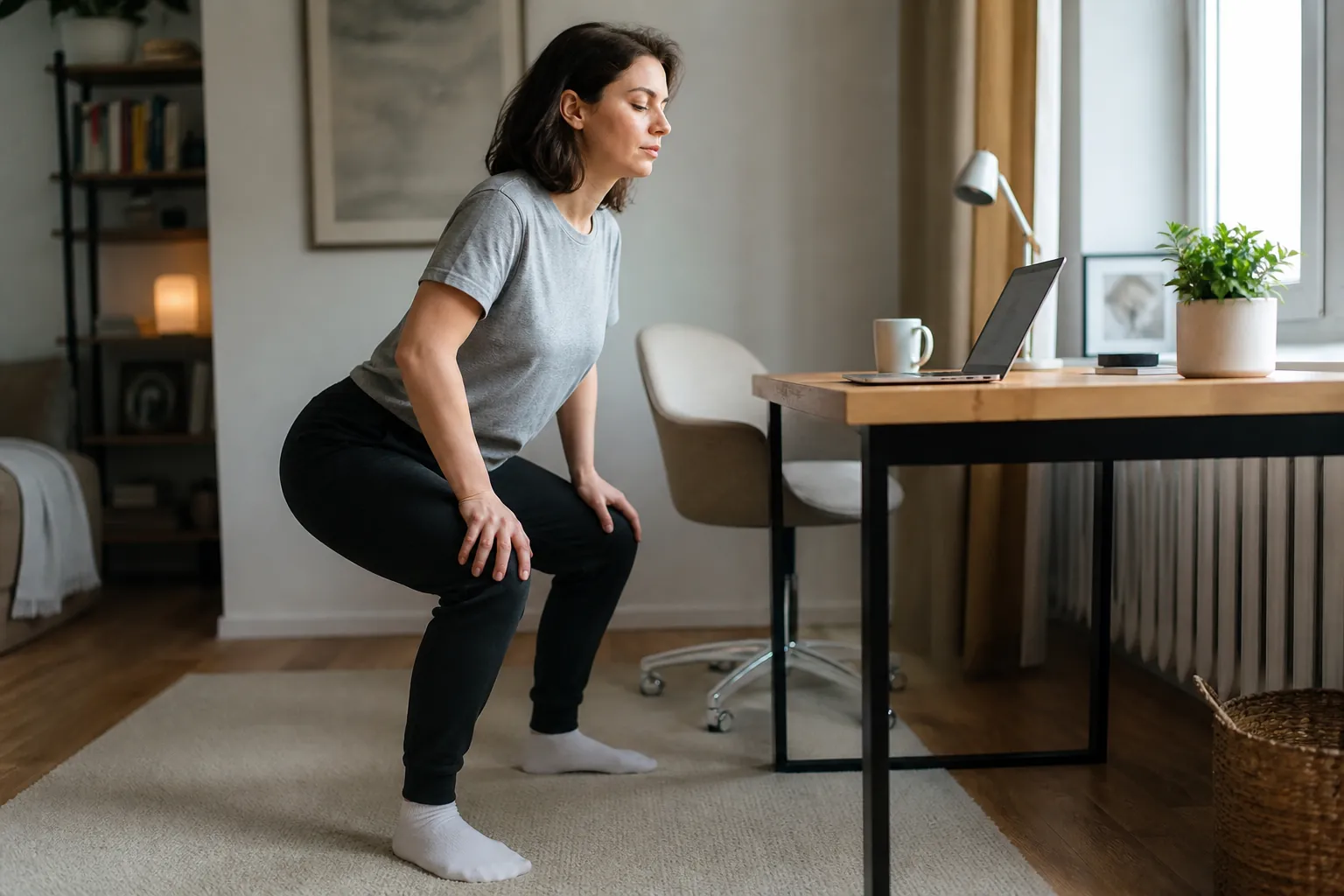
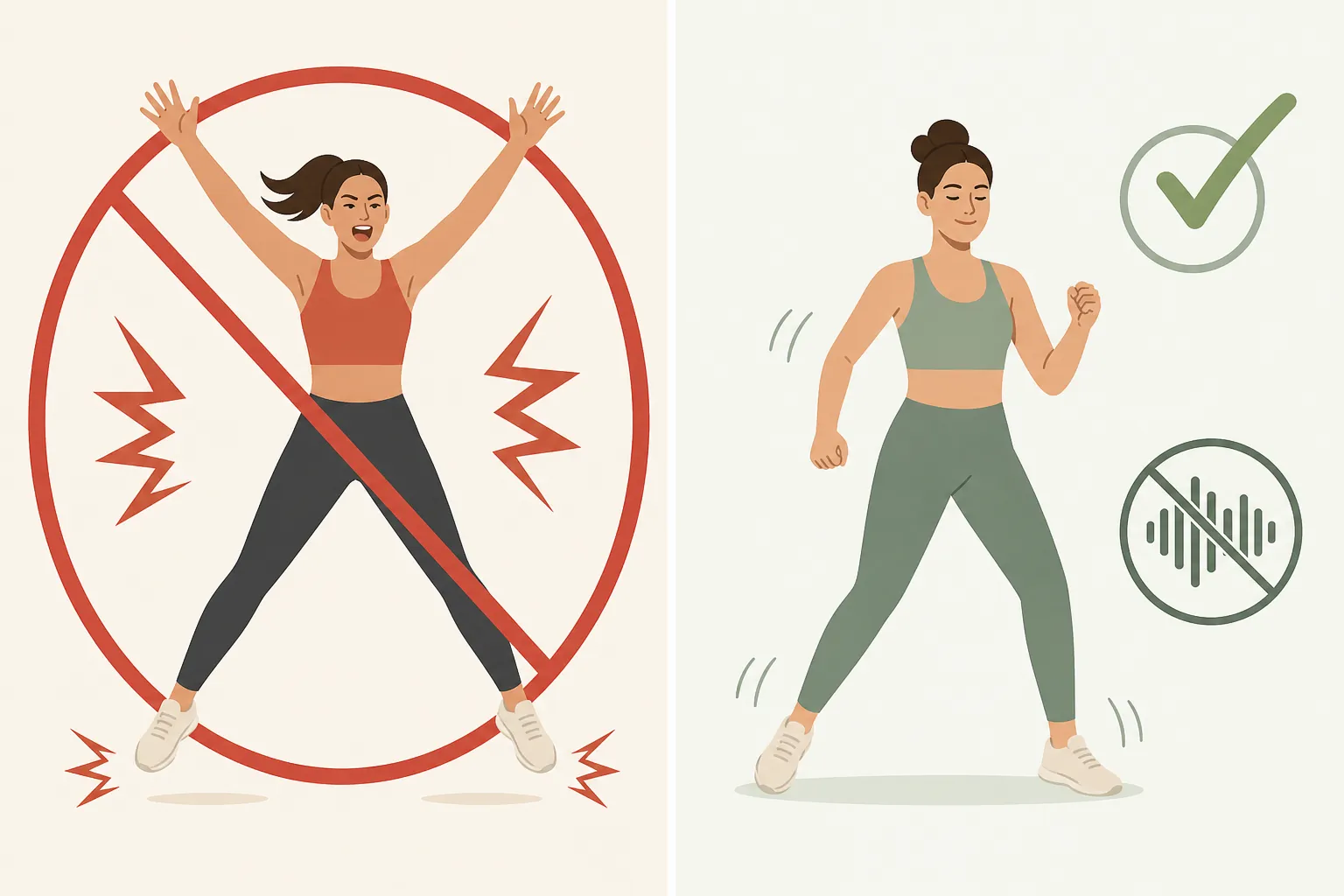
Diaz’s no-equipment example in TIME includes squats, high knees, and calf raises.[2] High knees are the problem move in an apartment: done energetically, they can turn a good idea into a ceiling complaint. The quiet adaptation is not to pretend marching is what the trial tested. It is to keep the repeated leg and hip muscle work while removing the thud.
Low-impact and apartment-workout sources are useful for naming common quiet substitutions—step jacks instead of jumping jacks, reverse lunges instead of jump lunges, controlled walk-outs instead of burpees—but those sources should be treated as movement vocabulary, not independent proof that a specific swap reproduces the BJSM outcomes.[4][5][6][7] The evidence-backed part is the five-minute, repeated movement-break pattern; the apartment-aware part is the substitution logic.
| If a routine says… | Use this quiet swap | What to keep | What to remove |
|---|---|---|---|
| High knees | Fast march in place or step jacks | Quick hip flexion, upright posture, steady breathing | Bouncing, heel strikes, floor impact |
| Jumping jacks | Step jacks | Arm swing, side-to-side rhythm, continuous movement | Both feet leaving the floor |
| Jump lunges | Reverse lunges or split-squat pulses | Thigh and glute contraction, alternating legs | Explosive switching |
| Burpees | Squat-to-walk-out, then walk hands back | Squat, core brace, controlled full-body effort | Jump back, jump up, floor slap |
| Mountain climbers | Slow mountain climbers or standing knee drives | Core tension and alternating knee movement | Fast foot taps against the floor |
The simplest quiet rule is one foot grounded whenever possible. The second is controlled lowering: the down phase of a squat, lunge, walk-out, or calf raise should look boring enough that a laptop camera would barely notice. If the floor is thin, a mat or folded towel helps more than enthusiasm. Socks can be quieter than sneakers on some floors, but only if the surface is not slippery.
Three five-minute quiet movement snacks
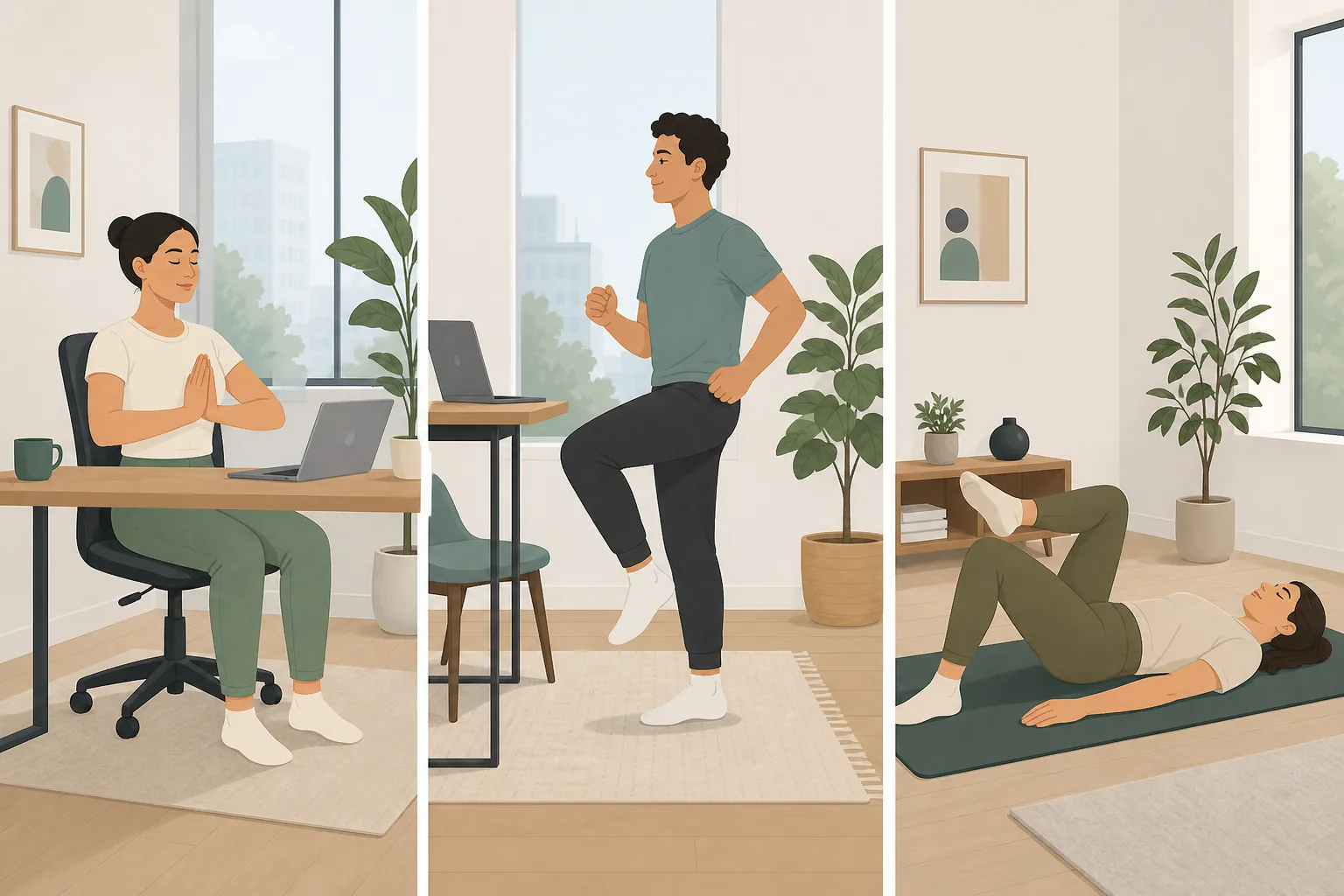
Pick the circuit that matches the room, not your fantasy version of the day. If you are on camera or sharing space, use the seated version. If you can stand beside the desk, use the standing version. If you have a safe, padded floor patch and nobody is listening for every hand placement, use the floor version.
When you have to stay almost invisible: seated circuit
This is the circuit for a shared apartment, a camera-off meeting, or the awkward ten minutes when changing into workout clothes would take longer than the workout. Cleveland Clinic describes desk-friendly isometric exercises such as glute squeezes, desk pushes, hand presses, and thigh presses, with holds in the 3- to 10-second range and sets that can be repeated at a desk.[8] Healthline also includes seated knee-to-chest movements and seated leg work among office exercises.[9]
- 0:00–1:00 — Seated glute squeezes: sit tall, squeeze both glutes for 5 seconds, release, repeat.
- 1:00–2:00 — Seated knee lifts: lift one knee a few inches, lower silently, alternate sides.
- 2:00–3:00 — Desk hand press: press palms into the desk or into each other for 5 seconds, release, repeat.
- 3:00–4:00 — Heel raises under the desk: lift heels, squeeze calves, lower slowly.
- 4:00–5:00 — Seated march: alternate lifting feet lightly, keeping the chair steady and the floor contact soft.
The seated version will not feel like a “workout” in the usual sweaty sense. That is the point. It gets muscle contraction into a dead patch of the day without creating a second problem for the person on the other side of the wall. For more on using small formats as a starter habit rather than a performance test, see this 7-minute workout habit guide.
For the normal desk break: standing circuit
This is the closest quiet cousin to the study-friendly movement snack: legs working, heart rate nudged upward, no equipment, no jumping. Do it beside the desk or at the end of a hallway. Keep the feet under control; speed comes from rhythm, not stomping.
- 0:00–1:00 — Quiet squats: feet planted, sit back, stand up, no locking out aggressively at the top.
- 1:00–2:00 — Fast march: lift knees only as high as you can without bouncing; place each foot down softly.
- 2:00–3:00 — Calf raises: rise onto the balls of the feet, pause, lower with control.
- 3:00–4:00 — Step jacks: step one foot out while arms sweep up, step back in, alternate sides.
- 4:00–5:00 — Reverse lunges or chair-supported split squats: step back quietly, bend both knees, return without pushing off hard.
If the march gets noisy, shrink it. A smaller march done for the full minute is more useful than ten dramatic seconds followed by listening for whether the downstairs neighbor noticed. If your balance is not warm yet, keep one hand on the desk or chair.
Only if the floor is safe and quiet: floor-based circuit
Floor work is not automatically apartment-friendly. Hands can slap, knees can drop, and a rushed plank can be louder than a squat. Use this circuit only on a stable patch with a mat, rug, or folded towel, and skip it if getting down and back up will make you late or irritated.
- 0:00–1:00 — Incline desk pushups or wall pushups: use the desk or wall if the floor is questionable.
- 1:00–2:00 — Squat-to-walk-out: squat, place hands down softly, walk hands forward to a plank, walk back, stand.
- 2:00–3:00 — Slow mountain climbers: from a plank, draw one knee forward at a time without tapping the foot hard.
- 3:00–4:00 — Glute bridges: lie on your back, lift hips, squeeze, lower slowly.
- 4:00–5:00 — Child’s-pose-to-plank shifts or dead bugs: choose the one that lets you breathe and stay quiet.
The floor circuit is the easiest one to overdo because it feels more like formal exercise. Keep it as a five-minute work break, not a stealth strength session that leaves you returning to a spreadsheet sweaty, annoyed, or late.
How to make the breaks happen on a real workday
The cleanest schedule is not always the one that works. If a smartwatch buzzes every hour and gets dismissed every hour, use a phone timer for the two slump windows that actually matter: late morning and after lunch. TIME’s interview notes Diaz’s point that moving after lunch can help blunt blood-sugar spikes and fend off the afternoon slump.[2] That does not require a dramatic routine; it requires standing up before the post-lunch fog fully settles.
Tether the break to a completed task rather than a perfect clock. Send the email, then do the standing circuit. End the meeting, then do the seated circuit before opening Slack. Finish lunch, then do five quiet minutes before sitting back down. If you want a broader filter for what “science-backed” can and cannot mean in short routines, this short-workout science guide is a useful companion.
- Use a mat, rug, or folded towel when hands, knees, or heels might contact the floor.
- Choose socks over sneakers only when the floor is not slippery; quiet is not worth a fall.
- Find the most stable floor patch and repeat breaks there instead of testing a creaky board every time.
- Keep one foot grounded for cardio-style moves: march, step jack, side step, reverse lunge.
- Control the lowering phase of squats, lunges, calf raises, walk-outs, and bridges.
- Scale range of motion before adding speed. Smaller and continuous beats bigger and noisy.
For beginners, the quiet swaps also double as sensible low-impact modifications; the form cues in this beginner-friendly workout guide are useful if squats, lunges, or planks need to be softened further.
A credible win is four or five five-minute breaks in a day. That is enough to take the evidence seriously without pretending your apartment is a gym, your calendar is empty, or your neighbors volunteered to participate.
References
- Evaluating movement breaks as a public health strategy to mitigate the harms of prolonged sitting, British Journal of Sports Medicine, June 16, 2026.
- A 5-Minute 'Movement Snack' Will Give You More Energy, TIME, July 14, 2026.
- Adult Activity: An Overview, CDC.
- 7 Quiet Workout Tips, SELF.
- Quiet Apartment Workout No Jumping, OgamicX.
- Quiet Cardio Workout - Low Impact Apartment Cardio Workout, Fitness Blender.
- Quiet Workout Routine: How to Exercise in an Apartment Without Jumping, STEP.CO.
- 6 Desk Exercises That Help You Get Stronger While Working, Cleveland Clinic.
- Office Exercises: 30 Exercises to Do at Your Desk, Healthline.
What a small equipment investment adds
We don't have a build tagged to this exact tier yet. Browse all builds.
How often should you repeat this?
See our recovery and rest reference for citation-anchored rest-interval guidance.
Spot something off?
Tell us if a movement, tier assumption, or duration didn't match your experience.