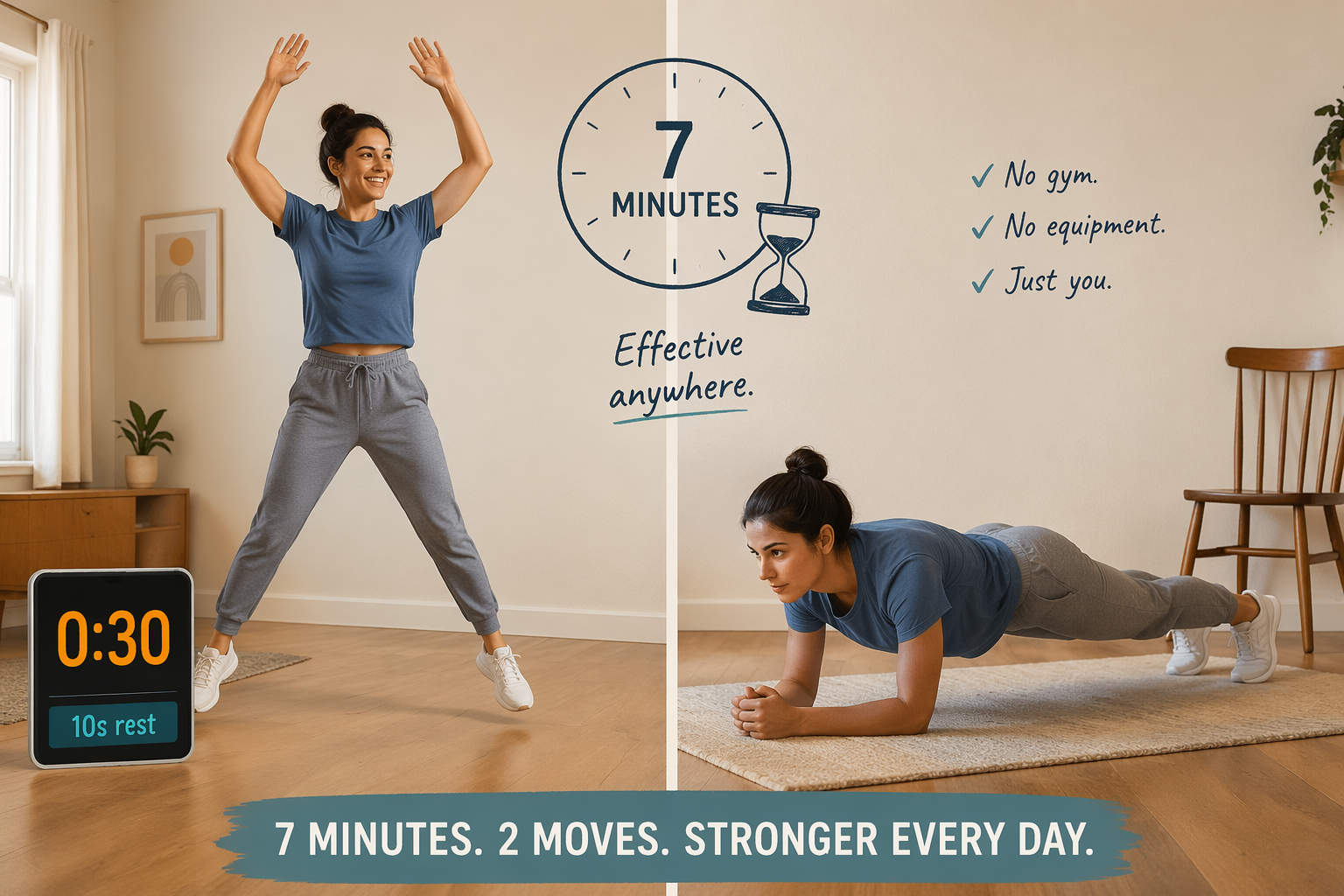
The 7-minute workout is a real bodyweight circuit, not just a cute timer trick. The original version came from Chris Jordan and Brett Klika’s 2013 article in ACSM’s Health & Fitness Journal, where the workout was presented as high-intensity circuit training using body weight, a wall, and a chair.[1] The part that usually gets lost online is just as important: the famous 7-minute round was meant to be repeated for 2–3 circuits when the goal is a meaningful training dose, not treated as a one-and-done miracle.
That does not make one round useless. If seven minutes is what you can do today, do the seven minutes. The better correction is this: use beginner versions of the movements, finish one clean circuit if that is your current level, then build toward two circuits when your form and breathing can handle it.
The workout became widely known after Gretchen Reynolds covered it in The New York Times in 2013, which helped turn a journal article into something people could picture doing in a living room.[2] That accessibility is the best thing about it. No machines, no commute, no complicated exercise library. But the simplicity only works if you know what each 30-second station is asking from your body.
Before you start: who should be cautious
This circuit is short, but it is not automatically gentle. The original ACSM article cautioned that the protocol may not be appropriate for people who are overweight or obese, detrained, previously injured, elderly, or managing comorbidities, including hypertension, especially because moves like wall sits and planks involve sustained isometric effort.[1] If that sounds like you, the safer starting point is a lower-intensity plan, medical clearance when needed, or a coached beginner program rather than trying to match the original pace on day one.
For everyone else, the rule is simple: pain, dizziness, chest pressure, or feeling faint means stop. Muscle effort is expected. Joint pain, sharp pain, or breathlessness that feels out of control is not a badge of honor.

The original 12-move order
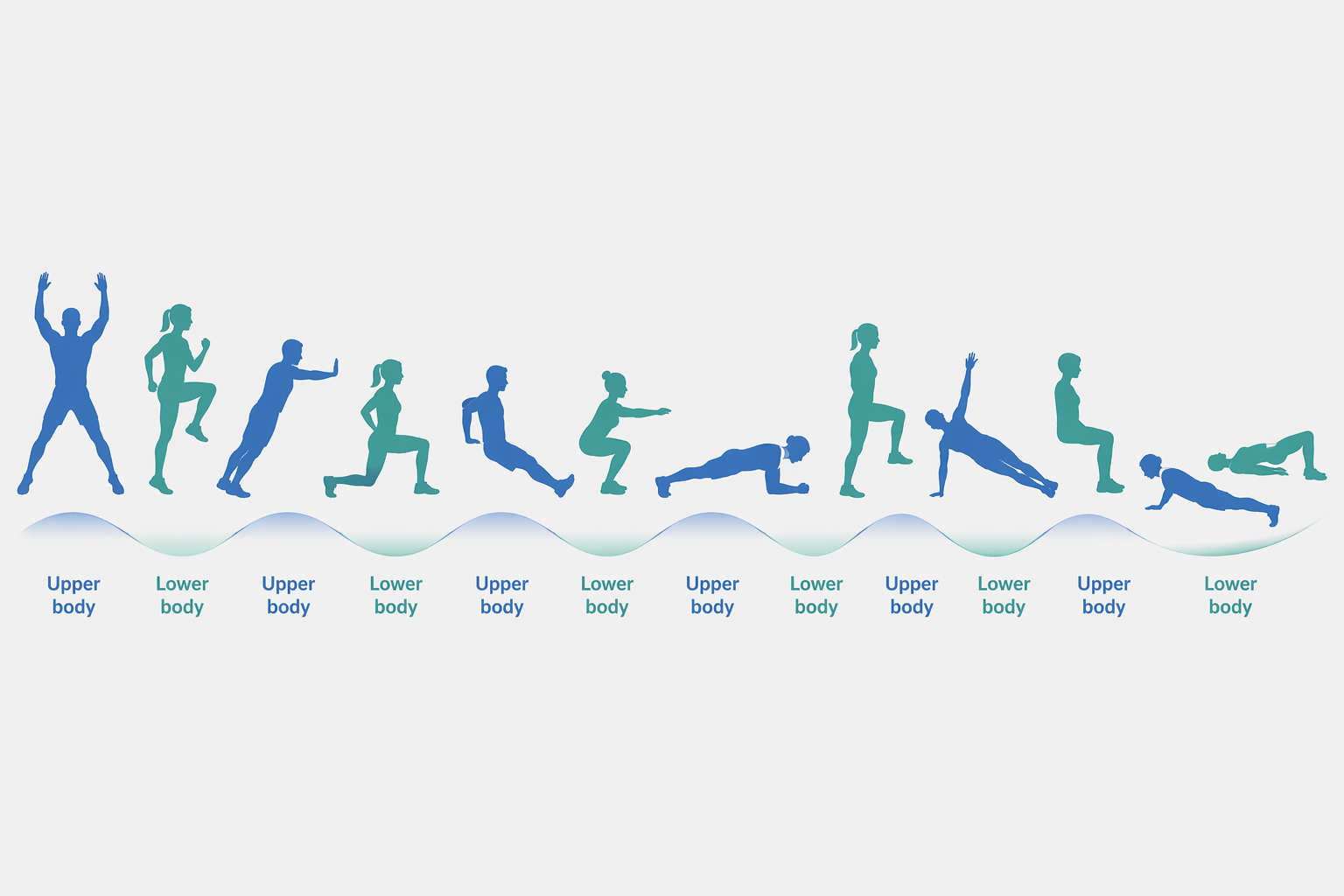
Each exercise lasts 30 seconds, followed by 10 seconds to move to the next station. The original order alternates movement demands so one area can recover while another works: total body, lower body, upper body, core, and back through again.[1] That order is not random. If you reshuffle the exercises, the workout may feel harder in the wrong places without becoming more useful.
| Order | Exercise | Main demand | Beginner version |
|---|---|---|---|
| 1 | Jumping jacks | Total body | Step-out jacks or side taps |
| 2 | Wall sit | Lower body | Higher wall sit or 20-second hold |
| 3 | Push-up | Upper body | Knee push-up or incline push-up |
| 4 | Abdominal crunch | Core | Small shoulder lift only |
| 5 | Step-up onto chair | Lower body | Lower step or alternating leg raises |
| 6 | Squat | Lower body | Shallow squat or sit-to-stand |
| 7 | Triceps dip on chair | Upper body | Small elbow bend or arm circles |
| 8 | Plank | Core | Knee plank or 20-second hold |
| 9 | High knees/running in place | Total body | Brisk marching |
| 10 | Lunge | Lower body | Reverse lunge or supported split stance |
| 11 | Push-up with rotation | Upper body/core | Regular knee push-up; skip rotation |
| 12 | Side plank | Core | Bent-knee side plank or shorter holds |
The common target is about 15–20 repetitions during each 30-second work period at roughly 8 out of 10 effort.[1] Beginners should hear that as a ceiling, not a command. A clean step-out jack beats a collapsing jumping jack. A steady knee push-up beats one full push-up followed by 25 seconds of panic.
How to do each exercise as a beginner
Set a timer for 30 seconds of work and 10 seconds of transition. Put a sturdy chair near a wall. Clear enough floor space for a plank. If you are new, choose the beginner option before the timer starts. Do not wait until the movement falls apart to “earn” the modification.
1. Jumping jacks
The first station raises your heart rate and tells you how springy your body feels today. The original version is a classic jumping jack: feet jump out as arms reach overhead, then feet jump in as arms return.
Beginner version: do step-out jacks. Step one foot out to the side while raising your arms, bring it back, then alternate sides. If overhead motion bothers your shoulders, use side taps with smaller arm swings. You should feel warm and coordinated, not like your ankles are being surprised on every landing.
2. Wall sit
Place your back against a wall, walk your feet forward, and bend your knees as if sitting into an invisible chair. The lower you go, the more your thighs work. This is where many beginners discover that “just hold still” can be surprisingly hard.
Beginner version: stay higher on the wall, with a smaller knee bend, or hold for 20 seconds and use the remaining time to stand up slowly and breathe. Keep knees roughly tracking over feet. If knee pain shows up, come out of the hold rather than sliding lower to prove a point.
3. Push-up
Push-ups are the station most likely to make a new exerciser feel defeated. That is usually a setup problem, not a character problem. A full floor push-up asks for upper-body strength, trunk stiffness, and control all at once.
Beginner version: use an incline push-up with hands on a sturdy table, counter, or chair placed safely against a wall. The higher your hands, the easier the push-up. Knee push-ups also work if you can keep a straight line from shoulders through hips to knees. Lower only as far as you can press back up without shrugging your shoulders toward your ears.
4. Abdominal crunch
Lie on your back with knees bent and feet on the floor. The crunch is small: ribs move toward pelvis, shoulders lift, then you lower with control. It is not a full sit-up.
Beginner version: keep the range tiny. Lift only your head and shoulder blades, then lower. Keep your neck long and your chin slightly tucked, as if holding a small piece of fruit under your chin. If your neck does all the work, slow down and reduce the lift.
5. Step-up onto chair
The original workout uses a chair for step-ups. This can be a good lower-body station, but it is also one of the places where home setups get sketchy. A rolling chair, soft ottoman, folding chair, or wobbly dining chair is not training equipment.
Beginner version: use a low, stable step if you have one. Step up with control, stand tall, then step down carefully and alternate legs. If you do not have a safe step, replace this station with alternating standing leg raises or a slow march. The goal is leg work, not gambling with furniture.
6. Squat
Stand with feet about hip- to shoulder-width apart. Sit your hips back and bend your knees, then stand again. The squat should feel like a controlled sit-down and stand-up, not a knee dive.
Beginner version: squat to a comfortable depth, or use a sturdy chair for sit-to-stands. Touch the chair lightly, then stand. Keep your feet planted and your chest lifted enough that you are not folding over your thighs.
7. Triceps dip on chair
Chair dips target the backs of the arms, but they can bother shoulders, especially when people slide too far forward or drop too low. This is one of the original moves where a beginner substitution is often the smarter choice.
Beginner version: if dips feel fine, keep your feet close, bend your elbows only a little, and press back up. Keep the chair stable and shoulders away from ears. If you feel shoulder pinching, skip dips and do arm circles or wall push-ups for the 30 seconds. You are still keeping the upper-body slot without forcing a cranky position.
8. Plank
A plank is a bracing exercise. Forearms or hands are on the floor, legs extend back, and the body stays long. The mistake is treating it as a contest to see how long your lower back can sag before the timer saves you.
Beginner version: drop your knees to the floor. Brace as if someone is about to poke your sides, keep your hips from sinking, and breathe. If 30 seconds is too much, hold 15–20 seconds, rest briefly, then reset.
9. High knees or running in place
This station brings the heart rate back up after the floor work. The original version is fast running in place with knees lifting high.
Beginner version: march briskly. Pump your arms, lift one knee at a time, and keep the rhythm steady. If impact feels fine, you can add a light jog. If you live above someone or your knees dislike bouncing, the march is enough.
10. Lunge
Lunges ask for single-leg strength and balance when fatigue is already building. That is why they can feel messier than squats even when the legs are strong enough.
Beginner version: use reverse lunges, stepping one foot backward and then returning to standing. Hold a wall or counter lightly if balance is the main issue. If split stance bothers your knees or feels too unstable, do alternating backward toe taps or another round of sit-to-stands.
11. Push-up with rotation
The original move adds a rotation after each push-up, turning the chest sideways and reaching one arm up. It is a lot to ask near the end of the circuit: push-up strength, core control, shoulder stability, and coordination all arrive at once.
Beginner version: skip the rotation. Do incline push-ups or knee push-ups again. If you are already struggling to keep your trunk steady, adding a twist will not make the set more productive. Earn the rotation later by making the basic push-up boring first.
12. Side plank
The final station targets the side of the trunk. In the original circuit, you hold a side plank, usually splitting time between sides. After 11 stations, even a short hold can feel like a long conversation with your obliques.
Beginner version: bend your knees and side plank from the lower knee and forearm. Hold 10–15 seconds on one side, switch, and finish on the other. Keep your shoulder stacked over your elbow and your ribs lifted away from the floor. If the position irritates your shoulder, use a dead bug or side-lying leg lift instead.

What 8 out of 10 effort should feel like
The original circuit is meant to be hard, with work intervals near 8 out of 10 effort.[1] That is a useful target for someone with training experience and a confusing one for someone whose last hard breathing came from carrying groceries upstairs.
Use these anchors instead: by the second half of a work interval, you should be breathing heavily enough that holding a full conversation would be difficult. You should still be able to control the movement and stop safely. If you are gasping, losing balance, or flinging your limbs to keep up with a timer, the exercise is too hard or too fast for today.
- Too easy: you could chat through the full 30 seconds and your form never changes.
- About right: you are working hard, breathing heavily, and glad when the timer beeps, but you can repeat the movement cleanly.
- Too hard: you cannot control the landing, brace your trunk, stand up safely, or recover enough to understand the next station.
If you want a fuller way to judge intensity without guessing, use this RPE and heart-rate guide before trying to make the circuit harder.
One circuit, two circuits, or three?
Here is the central misunderstanding: the 7-minute workout is one circuit, but the original recommendation was 2–3 circuits, which turns it into roughly 14–21 minutes of work plus transitions.[1] The internet kept the shortest unit and quietly misplaced the dose.

That matters, but it should not be used to shame someone out of starting. In an 8-week study of 96 healthy adults, both 7-minute and 14-minute groups improved push-up endurance, and strength increases were observed in men.[3] That supports a practical point: a single circuit can produce measurable improvement, especially when it replaces doing nothing.
The better question is not “Does one round count?” It counts. The better question is “What should I do next when one round stops feeling like enough?”
| Current level | What to do | Move on when |
|---|---|---|
| The workout feels chaotic | Use beginner modifications and complete one circuit at a controlled pace | You can finish without pain, dizziness, or major form breakdown |
| One circuit is hard but manageable | Repeat one circuit 2–4 times per week | You recover well and your last three stations still look controlled |
| One circuit feels clean | Add a second circuit, using the same modifications if needed | Your breathing settles enough during transitions to start the next move safely |
| Two circuits feel consistent | Consider a third circuit or a more structured plan | You want broader cardio and strength progression rather than only repeating this routine |
A second circuit should not look like a punishment round. Keep the modifications. If your first circuit uses incline push-ups, knee planks, and marching high knees, your second circuit can use the same versions. Progression is not only making exercises harder; sometimes it is doing the same good version for longer without falling apart.
Why this format can work well for beginners
The best argument for the 7-minute workout is not that it is the most complete fitness program ever built. It is that many beginners are more likely to do it than a longer session they dread. In a 2023 study, sedentary beginners reported higher enjoyment of the 7-minute workout than cycling HIIT, while the two formats produced equivalent heart-rate benefits.[4]
Enjoyment is not decoration. For beginners, it often decides whether there is a next session. A workout that feels understandable, repeatable, and short enough to fit between normal life chores can be more useful than a theoretically perfect plan that never gets a second attempt.
Medical and fitness explainers commonly present the circuit as efficient and accessible while still noting that intensity, movement quality, and personal health status matter.[5][6][7] That is the right frame. It is not magic. It is a compact circuit that rewards careful scaling.
A beginner-friendly first week
For the first week, resist the urge to test every hard version. Use the beginner column on purpose. Your job is to learn the stations, not to discover the fastest possible way to make station three ruin station eleven.
- Day 1: one circuit, all beginner modifications, stop early on any movement that causes pain.
- Day 2: rest or take an easy walk.
- Day 3: one circuit again; try to make transitions calmer and form more consistent.
- Day 4: rest or gentle mobility.
- Day 5: one circuit; if it feels controlled, add a second circuit after a longer rest.
- Days 6–7: rest, walk, or repeat one easy circuit if you recovered well.
If you want a timer, demonstrations, or coaching prompts while you learn the order, a beginner app can help, as long as it allows modifications and does not rush you into advanced versions. Start with a guide to no-equipment workout apps for beginners rather than choosing the flashiest interval timer.
When to make it harder, and when not to
Make the workout harder only after the current version is repeatable. Good signs include steady breathing recovery during the 10-second transitions, no joint pain during or after the workout, and the ability to keep push-ups, planks, squats, and lunges controlled near the end.
The cleanest progression is usually this order: first improve form, then complete one full circuit, then add a second circuit, then make selected movements harder. The Washington Post’s later interactive framing uses Gentle, Original, and Power levels, which is a helpful way to think about the path: you do not have to jump from couch to original intensity in one try.[8]
Do not make it harder on a day when sleep was poor, soreness changes your form, or the warm-up version already feels unusually heavy. Short workouts invite people to skip the body check. That is exactly when beginners end up turning a useful seven minutes into a discouraging one.
Once two circuits feel familiar and you want a plan that builds beyond repeating the same sequence, move to a structured 4-week at-home cardio progression plan. That is a better next step than endlessly chasing a harder version of every station.
References
- High-Intensity Circuit Training Using Body Weight, ACSM's Health & Fitness Journal, 2013.
- The Scientific 7-Minute Workout, The New York Times, 2013.
- Effects of 7-minute workout on health outcomes, enjoyment, and affect in sedentary adults, PMC, 2023.
- Effect of 7-minute and 14-minute high-intensity circuit training on cardiovascular fitness and body composition, PubMed.
- The 7-Minute Workout: What It Is and How To Do It, Cleveland Clinic.
- The 7-Minute Workout: Is It Effective?, Healthline.
- Pros and Cons of the 7-Minute Workout, Intermountain Health.
- The original, science-backed 7-minute workout to get fit fast, The Washington Post, 2025.


Comments
Join the discussion with an anonymous comment.