
Start with the level you can repeat for at least three weeks without your form falling apart. This full body dumbbell workout is built around three training days per week, with each muscle trained repeatedly across the week and every tier using the same basic rule: finish your prescribed sets, track how many reps you had left in reserve, then adjust the next session instead of guessing.
| Tier | Best for | Weekly schedule | Main progression rule | Typical rest |
|---|---|---|---|---|
| Tier 1: Beginner | New lifters, returning lifters, or anyone still learning stable dumbbell technique | Monday / Wednesday / Friday, or any 3 nonconsecutive days | Add load only after all sets hit the target reps with about 2 reps in reserve | 90 seconds |
| Tier 2: Intermediate | Lifters who can control basic movements and need more work without turning sessions into marathons | 3 nonconsecutive days, using paired exercises and slightly higher volume | Use either the conservative 1–2 RIR path or the aggressive 0–1 RIR path | 60–90 seconds |
| Tier 3: Advanced | Experienced dumbbell lifters who need harder variations, tempo, unilateral work, and mixed rep ranges | 3 nonconsecutive days, with supersets or short circuits | Progress load, reps, tempo, or density while keeping form clean | About 60 seconds between paired moves |
The full-body format is not the problem most people run into. Training the same muscle groups multiple times per week is a defensible setup for hypertrophy, and a 3-day dumbbell plan gives enough practice without asking a home lifter to live in the spare room. The weak point is usually what happens after week two: the same weights, the same reps, the same vague instruction to “push harder.” A 1–2 reps-in-reserve approach gives the plan a usable steering wheel instead of leaving progress to mood and caffeine.[1]
How to choose your starting tier
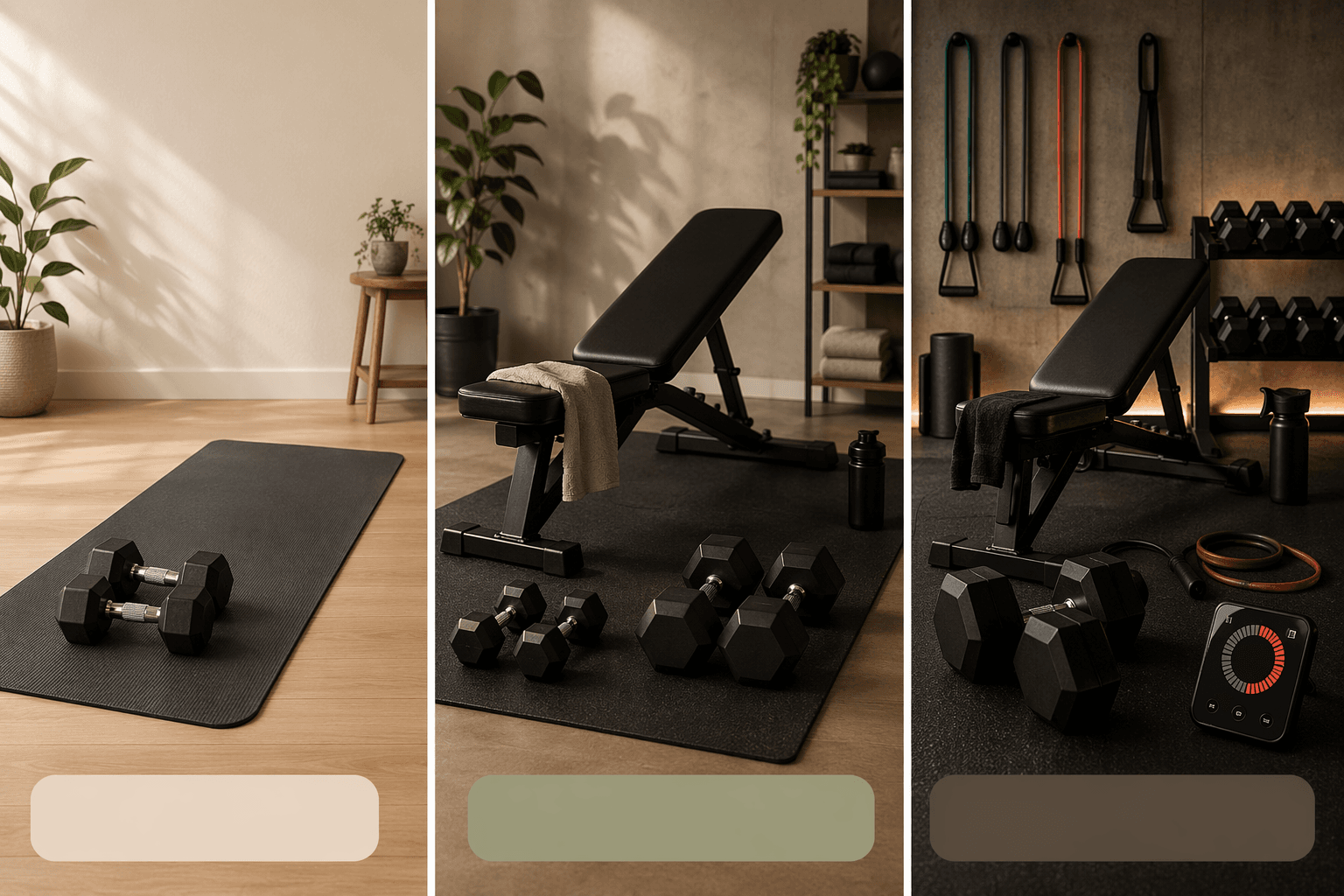
Pick the tier that matches your current execution, not your ambition. If you have never logged dumbbell sets with a consistent rep target, start at Tier 1. If you can already perform goblet squats, dumbbell presses, rows, and Romanian deadlifts without needing to relearn them every session, Tier 2 is reasonable. Tier 3 is for lifters who can make light dumbbells hard on purpose with tempo, pauses, unilateral loading, and tighter rest.
- Use Tier 1 if you are still learning where your working weights are, or if you only own one or two pairs of dumbbells.
- Use Tier 2 if 3 sets of 10 on the basic lifts no longer creates a clear training stimulus, but you are not ready to turn every set into a grind.
- Use Tier 3 if your dumbbells are no longer heavy enough for straight sets alone and you need harder exercise variations, slower reps, and denser pairings.
If you are between tiers, start lower for two weeks. A slightly easy first week is useful data. A too-hard first week usually just teaches you that the plan was badly chosen.
Tier 1: beginner 3-day full body dumbbell workout
Tier 1 keeps the exercise list short because beginners do not need novelty. They need repeatable reps, stable positions, and a clear rule for when to make the dumbbells heavier. Each workout uses the same main pattern: squat, press, row, hinge, and trunk work.
| Exercise | Sets x reps | RIR target | Rest | Notes |
|---|---|---|---|---|
| Goblet squat | 3 x 10 | 2 RIR | 90 sec | Hold one dumbbell at chest height; stop the set before your torso starts collapsing forward. |
| Dumbbell bench press or floor press | 3 x 10 | 2 RIR | 90 sec | Use a bench if available; use the floor press if you train without one. |
| Bent-over dumbbell row | 3 x 10 | 2 RIR | 90 sec | Row both dumbbells together, or use one arm at a time if your lower back gets tired first. |
| Dumbbell Romanian deadlift | 3 x 10 | 2 RIR | 90 sec | Hinge at the hips; the set ends when your back position changes, not when your grip gives out. |
| Plank | 3 x 20–45 sec | Stop before form breaks | 60 sec | Add time until 45 seconds is solid, then progress to a harder plank variation. |
Run this workout three times per week on nonconsecutive days. The movements repeat because the first job is skill acquisition. Changing exercises every session feels more interesting, but it also makes it harder to know whether you are getting stronger or just doing a different task.
Tier 1 progression rule
Use the conservative path. When you can complete all 3 sets of 10 with about 2 reps still in reserve on every set, increase the dumbbell load at the next session. If your dumbbells jump sharply in weight, keep the same load and add reps first, working toward 3 sets of 12 before increasing weight.
| What happened today | What to do next time |
|---|---|
| You got 10, 10, 10 and each set felt like 2 RIR | Increase load next time, or move to 3 x 8 with the heavier pair if the jump is large. |
| You got 10, 9, 8 | Keep the same load until all three sets reach the target. |
| You hit 10s, but the last reps were ugly | Do not increase load. Repeat the weight and clean up the reps. |
| You could have done many more than 2 extra reps | Increase load sooner, or slow the lowering phase if heavier dumbbells are unavailable. |
This is also the point where many beginners make their first bad trade: they add weight because the calendar says week three, not because the sets say they are ready. The logbook gets the vote. If the reps and RIR are not there yet, hold steady.
When to move from Tier 1 to Tier 2
Move to Tier 2 when you can complete the Tier 1 workout for several weeks with stable technique and the main lifts no longer feel challenging enough at practical dumbbell loads. You do not need to “graduate” because you are bored. You move up because the current tier has stopped giving you enough productive work.
Tier 2: intermediate 3-day full body dumbbell workout
Tier 2 adds unilateral leg work, overhead pressing, pullovers, carries, and paired exercises. This is where the plan starts saving time without pretending fatigue is free. Pairing a press with a row or a squat pattern with a hinge lets you get more total work done, but the RIR target still matters. Supersets are not an excuse to turn every lift into a conditioning test.
| Day | Exercise pair or movement | Sets x reps | RIR target | Rest |
|---|---|---|---|---|
| Day 1 | A1. Dumbbell bench press or floor press | 3–4 x 8–12 | 1–2 RIR | 60–90 sec after A2 |
| Day 1 | A2. One-arm dumbbell row | 3–4 x 8–12 each side | 1–2 RIR | 60–90 sec after A2 |
| Day 1 | B1. Goblet squat | 3 x 8–12 | 1–2 RIR | 60–90 sec after B2 |
| Day 1 | B2. Dumbbell Romanian deadlift | 3 x 8–12 | 1–2 RIR | 60–90 sec after B2 |
| Day 1 | Farmer carry | 3 carries | Stop before grip fails | 60 sec |
| Day 2 | A1. Single-arm overhead press | 3–4 x 8–12 each side | 1–2 RIR | 60–90 sec after A2 |
| Day 2 | A2. Dumbbell pullover | 3–4 x 10–12 | 1–2 RIR | 60–90 sec after A2 |
| Day 2 | B1. Split squat | 3 x 8–12 each side | 1–2 RIR | 60–90 sec after B2 |
| Day 2 | B2. Dumbbell hip hinge or RDL | 3 x 10–12 | 1–2 RIR | 60–90 sec after B2 |
| Day 2 | Side plank | 3 x 20–40 sec each side | Stop before form breaks | 45–60 sec |
| Day 3 | A1. Incline dumbbell press, bench press, or floor press | 3–4 x 8–12 | 1–2 RIR | 60–90 sec after A2 |
| Day 3 | A2. Chest-supported row or bent-over row | 3–4 x 8–12 | 1–2 RIR | 60–90 sec after A2 |
| Day 3 | B1. Front-foot-elevated split squat or goblet squat | 3 x 8–12 each side | 1–2 RIR | 60–90 sec after B2 |
| Day 3 | B2. Dumbbell Romanian deadlift | 3 x 8–12 | 1–2 RIR | 60–90 sec after B2 |
| Day 3 | Farmer carry or suitcase carry | 3 carries | Stop before posture breaks | 60 sec |
The rest periods here sit in the middle because the goal is still muscle and strength development, not simply getting sweaty. If shortening rest makes your rows turn into half-reps or your split squats lose depth, the rest period is too short for that exercise.
The two overload paths
Tier 2 is where you choose how assertively to progress. The conservative path remains the default for most home lifters because it gives you cleaner feedback and fewer recovery surprises. The aggressive path can work, but only if you can judge proximity to failure honestly and accept that later sets may drop.
| Path | Who should use it | How it works | Example |
|---|---|---|---|
| Conservative | Beginners moving into intermediate work, cautious improvers, anyone training without a spotter | Stay at 1–2 RIR. Add weight only when all sets land at the top of the rep range with the target RIR. | Bench press: 12, 12, 12 at 1–2 RIR → increase load next time. |
| Aggressive | Intermediates with reliable technique and recovery | Push early sets to 0–1 RIR, then accept some rep drop-off while keeping form strict. | One-arm row: 12, 10, 9 with the first set near failure → keep load until the later sets climb. |
For most exercises, use a double-progression range: work from 8 reps toward 12 reps before adding load. If you need a more detailed progression method for awkward dumbbell jumps, use the deeper full-body dumbbell workout progression framework.
When to move from Tier 2 to Tier 3
Move to Tier 3 when the Tier 2 structure is no longer enough even after you have used heavier dumbbells, higher reps within the target range, stricter tempo, and clean supersets. Tier 3 is not just “more exercises.” It is a way to make the same equipment demanding again.
Tier 3: advanced 3-day full body dumbbell workout
Advanced dumbbell training has to solve a different problem: the weights may not be heavy enough to keep straight sets productive forever. Dumbbells can still create mechanical overload with heavier lower-rep work and metabolic overload with moderate loads taken through higher-rep fatigue, which is why this tier uses both across the week.[2]
| Day | Focus | Workout |
|---|---|---|
| Day 1 | Strength-biased full body | A1. Dumbbell front squat or heavy goblet squat: 4 x 5–8; A2. One-arm row: 4 x 5–8 each side; B1. Dumbbell floor press or bench press: 4 x 5–8; B2. Dumbbell RDL: 4 x 6–8; Carry: 3 hard carries |
| Day 2 | Tempo and unilateral control | A1. Front-foot-elevated split squat with 3-sec eccentric: 3–4 x 8–10 each side; A2. Single-arm overhead press with pause: 3–4 x 8–10 each side; B1. Single-leg RDL: 3–4 x 8–10 each side; B2. Pullover or row variation: 3–4 x 10–12; Core: side plank or dead bug variation |
| Day 3 | Density and hypertrophy | A1. Dumbbell thruster: 3–4 x 10–15; A2. Renegade row: 3–4 x 8–12 each side; B1. Reverse lunge: 3–4 x 10–15 each side; B2. Dumbbell floor press: 3–4 x 10–15; Finisher: farmer carry or suitcase carry |
Keep most Tier 3 work around 1–2 RIR unless a movement is safe to push harder. A renegade row done near total failure tends to become a twisting contest. A farmer carry taken close to grip failure is usually more tolerable. The exercise decides how aggressive you can be.
The 2024 European Journal of Sport Science study covered by Men’s Health UK found that full-body training reduced whole-body fat mass more than split training in a small sample of 23 experienced male lifters, and reported up to 7.5 times less lower-body DOMS.[3] That is useful, but narrow. It does not prove every home lifter will lose more fat on this plan. It does support a more modest point: distributing work across the week can be a sensible way to train hard without burying one body part in a single session.
How to progress week by week
Progression does not need to be dramatic. It needs to be legible. At the end of each set, write down the weight, reps, and estimated RIR. That gives you the next adjustment.
| If your log shows | Your next adjustment |
|---|---|
| All sets hit the top of the rep range with the target RIR | Increase weight next session. |
| You hit the target reps but had 3 or more reps in reserve | Increase weight, slow the eccentric, or choose a harder variation. |
| You missed the lower end of the rep range | Keep the weight the same or reduce it slightly. |
| Your first set is strong but later sets collapse | Add rest, reduce load, or stop using the aggressive path for that lift. |
| Your form breaks before the target muscle is challenged | Change the variation or reduce load until the limiting factor matches the exercise. |
If you own fixed dumbbells with large jumps, do not force load increases every time you earn them. Add reps, add a pause, slow the lowering phase, or move from a bilateral version to a unilateral version. For more options with limited equipment, the full body dumbbell progressive overload system is the better next stop.
What to do when the workout stalls
A stall is not a reason to throw away the program. It is a reason to ask which part stopped moving. Load, reps, exercise difficulty, rest, and recovery are separate levers. Pull the smallest one that solves the problem.
If every lift feels worse for a week
Deload. Keep the same three training days, but reduce total volume by about 40–50% or reduce intensity by about 10–20% for one week. That can mean doing 2 sets instead of 4, using lighter dumbbells, or stopping farther from failure. Do not turn the deload into a new secret hard week.
If one exercise stops progressing
Change the variation before changing the whole program. A goblet squat that has outgrown your heaviest dumbbell can become a front-foot-elevated split squat. A floor press that stops moving can use a pause at the bottom. A bent-over row limited by your lower back can become a chest-supported row if you have a bench or an incline surface.
If you do not have a bench
Use floor presses instead of bench presses, one-arm rows with your free hand braced on a chair or thigh, and pullovers only if you can perform them safely from the floor. A bench is useful; it is not permission to skip the plan. If your setup is permanently bench-free, use the dedicated no-bench full-body dumbbell workout for substitutions that are built around that constraint from the start.
If the workouts are too easy but you cannot buy heavier dumbbells
- Slow the eccentric to about 3 seconds on squats, presses, rows, and RDLs.
- Add a one-second pause in the hardest stable position.
- Use unilateral versions: split squat instead of goblet squat, single-leg RDL instead of two-leg RDL, single-arm press instead of two-arm press.
- Shorten rest slightly, but only if the target muscles still do the work.
- Move from Tier 1 to Tier 2, or from Tier 2 to Tier 3, only when the current tier is genuinely underloading you.
If you want a stricter calendar
Some beginners do better with a fixed week-by-week schedule before they start making their own progression calls. If that is you, run an 8-week full body dumbbell workout for beginners first, then return to this tiered system once you are ready to steer by reps and RIR.
Keep the system, change the dose
The exercises can change over time, but the decision process should stay boringly consistent: train three full-body days, work inside the tier that matches your ability, record reps and RIR, progress only when the set data supports it, and deload when fatigue stops being local and starts showing up everywhere.
Once you have run the system long enough to know whether you care more about strength, hypertrophy, or fat loss, you can specialize with a goal-specific full body dumbbell workout for strength, hypertrophy, or fat loss. Until then, the job is simpler: choose the right tier, make the next session slightly more productive when you have earned it, and stop replacing the plan every time the dumbbells stop feeling new.
References
- The 3-Day Full-Body Dumbbell Workout — Bony to Beastly — https://bonytobeastly.com/3-day-full-body-dumbbell-workout/
- 5 Benefits of Dumbbell Training — ACE Fitness — https://www.acefitness.org/resources/pros/expert-articles/5675/5-benefits-of-dumbbell-training/
- Full-Body Splits Could Be Better for Fat Loss Than Split Training, According to New Study — Men’s Health UK — https://www.menshealth.com/uk/building-muscle/train-smarter/a65077401/full-body-splits-fat-loss/


Comments
Join the discussion with an anonymous comment.