
The Problem Isn't Home Cardio — It's How You're Doing It
You started with good intentions. A mat on the floor, a twenty-minute video, maybe a brisk walk in place while the kettle boiled. But after a few weeks the numbers on the scale had barely moved, the watch told you that you had burned some embarrassingly low number of calories, and somewhere around week four you quietly stopped. Not because home cardio is ineffective, but because the way most people approach it — grab a session when you remember, trust whatever your wrist says, and treat intensity like a moral virtue — is almost designed to fail.
I have watched this pattern repeat in dozens of training logs. The real problem is not the modality. It is the absence of structure, the reliance on unreliable metrics, and the failure to combine cardio with strength work. The research is surprisingly clear on what works, and it does not require a gym membership or a Peloton.
What the Evidence Actually Says About Volume, Intensity, and Calorie Counters
Let's get the foundation down first. A 2024 analysis in JAMA Network Open concluded that aerobic exercise at 150 minutes or more per week is associated with clinically important reductions in waist circumference and measures of body fat. That is not a niche finding. It is a broad meta-analytic statement about aerobic exercise regardless of setting — gym, home, outdoors. The volume is the active ingredient, not the equipment.
Aerobic exercise at 150+ minutes per week is associated with clinically important reductions in waist circumference and measures of body fat.
One hundred fifty minutes is about twenty-two minutes per day. Most people can fit that into a morning before the shower. The catch is that volume alone is not enough — you also need to pay attention to how hard you work, and you need to avoid the trap that makes most people quit: trusting the numbers on your wrist.
According to Henry Ford Health, steady-state cardio burns roughly 10 to 12 calories per minute. That sounds like useful information. But that number is an average over a wide range of body weights, fitness levels, and movement forms. Your actual burn on a given day depends on variables no watch can measure accurately. Most consumer wearables are off by 20–40% for calorie estimation, as we covered in our Fitbit accuracy analysis. If you are trying to structure your week around the watch's readout, you are building on sand.
There is a popular belief that HIIT is superior for fat loss because it 'torches calories' and boosts metabolism for hours. The Harvard Nutrition Source reviewed a meta-analysis of controlled trials in overweight and obese adults and found something more nuanced. Both HIIT and moderate-intensity continuous training (MICT) produced similar improvements in body composition — reductions in fat mass and waist circumference. The difference was time: HIIT required about 40% less time to achieve those results.
The time spent on HIIT programs was 40% less than with MICT to achieve similar body composition improvements.
The caveat matters. The original trial controlled for total energy expenditure — the HIIT group did less work in total but at higher intensity. At home without a metabolic cart, you cannot guarantee that your HIIT session and your steady-state session burn the same number of calories. The time advantage is real, but it assumes you are actually working at an intensity that matches the study protocol. If you treat HIIT as a light jog with bursts of slightly faster jogging, you lose the benefit. For readers who want a detailed HIIT setup, we have a science-backed HIIT guide that covers the exact intervals and progression.
The practical upshot: HIIT is not superior. It is time-efficient. That is an important difference. Use it when you are short on time, but do not abandon steady-state completely — volume still matters for total calorie expenditure and for recovery between harder sessions.
Why Home Cardio Alone Isn't Enough—The Strongest Evidence Points to Combining with Strength
If you do only cardio, you are leaving results on the table. The strongest evidence comes from a 2022 network meta-analysis in Circulation: Cardiovascular Quality and Outcomes that pooled 81 randomized controlled trials with 4,331 participants. The headline finding: combined training (aerobic plus resistance) was the most effective modality for improving cardiometabolic health. The numbers are concrete enough to remember:
| Measure | Change (combined vs. no exercise) |
|---|---|
| Body mass | –2.57 kg (95% CI: –3.78 to –1.36) |
| Body fat percentage | –2.76% (95% CI: –5.42 to –0.09) |
| Waist circumference (hybrid training) | –8.30 cm (95% CI: –13.27 to –3.33) |
Strength training also boosts resting metabolism through a phenomenon called excess post-exercise oxygen consumption (EPOC). Cleveland Clinic notes that high-intensity strength workouts can keep EPOC elevated for up to 48 hours, and over time, increases in muscle mass raise the body's overall daily calorie burn at rest. You do not need to become a bodybuilder — two resistance sessions per week of 20–30 minutes are enough. For those who prefer guided programs, we compare the best strength training apps for home gym users.
A Practical Weekly Schedule: Three Steady-State, Two HIIT, Two Strength
Here is a template that operationalizes the evidence. It assumes you have about 30–40 minutes most days and that you can fit in seven sessions per week. Adjust down if that is too much — the key is consistency, not perfection.
- 3 moderate steady-state sessions: 30 minutes each at RPE 3–4 (on a 1–10 scale, this is a pace where you can hold a conversation but feel your breath deepen). These can be walking, jogging in place, marching, cycling on a cheap stationary bike — whatever keeps you moving.
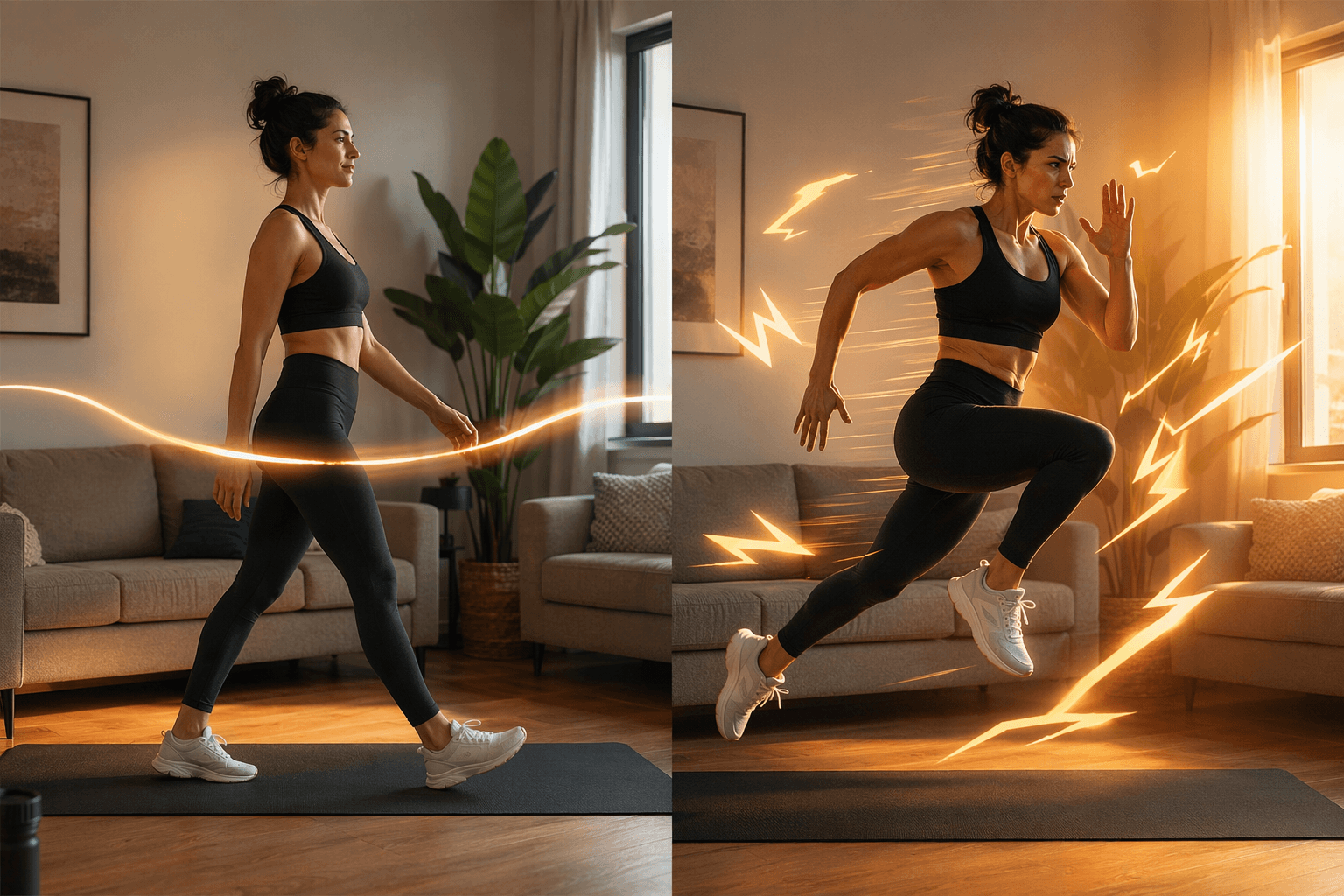
- 2 HIIT sessions: 20 minutes each at RPE 7–8 (you can say a few words but not a full sentence). Use intervals like 30 seconds of high-knee runs or burpees followed by 60 seconds of easy movement. The 40% time savings from the Harvard meta-analysis justifies the shorter duration.
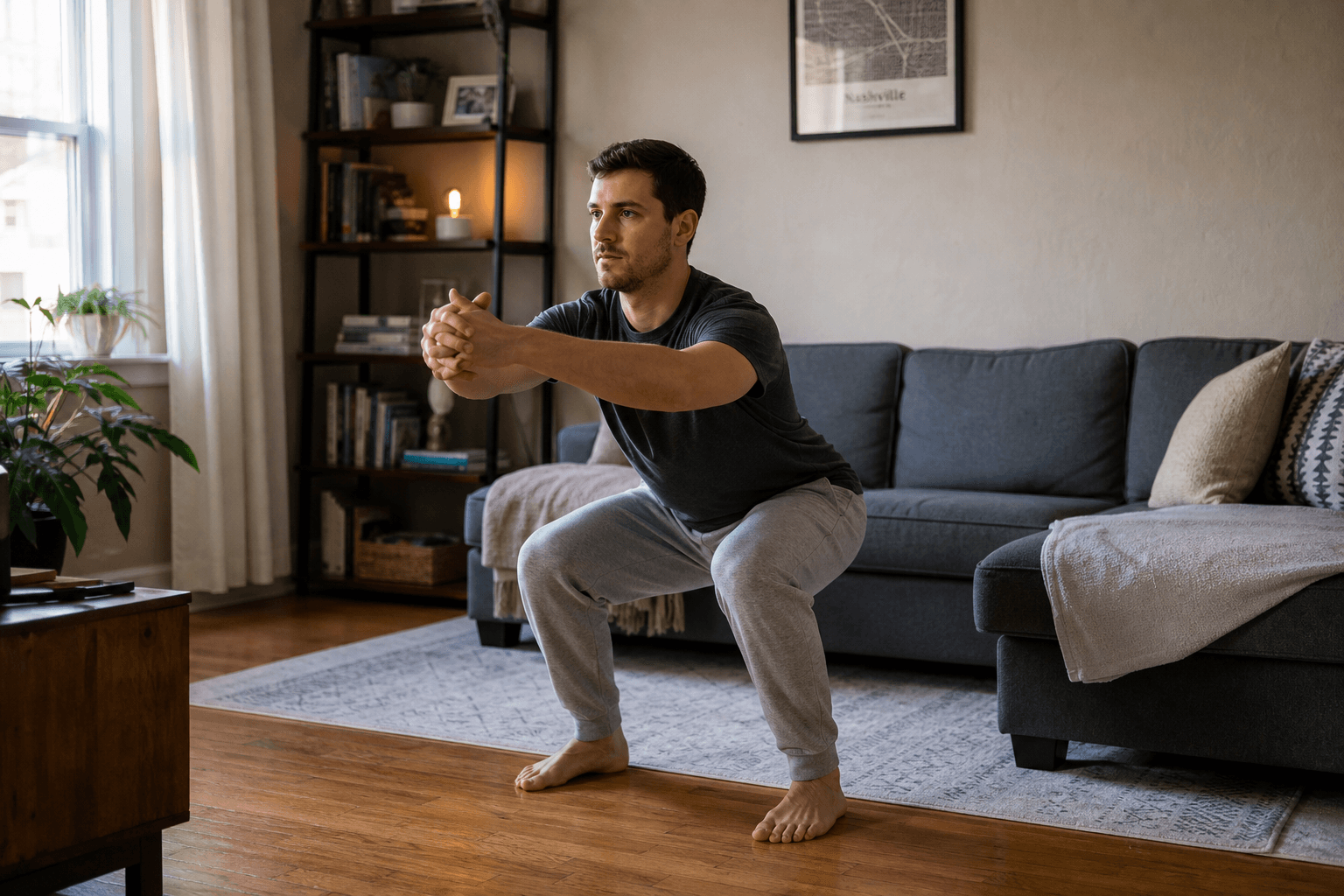
- 2 strength sessions: 20–30 minutes of full-body resistance work (bodyweight squats, push-ups, rows if you have bands, lunges, planks). Keep the rest short to maintain some cardiovascular demand.
| Day | Session Type | Duration | RPE |
|---|---|---|---|
| Monday | Steady-state | 30 min | 3–4 |
| Tuesday | HIIT | 20 min | 7–8 |
| Wednesday | Strength | 25 min | N/A |
| Thursday | Steady-state | 30 min | 3–4 |
| Friday | HIIT | 20 min | 7–8 |
| Saturday | Strength | 25 min | N/A |
| Sunday | Steady-state | 30 min | 3–4 |
RPE (rating of perceived exertion) is deliberately chosen over heart rate zones because you do not need a chest strap or a smartwatch to gauge it. The American Heart Association's target heart rate zones are a useful reference, but for most people, RPE works just as well and removes the temptation to stare at a number.
How to Track Progress Without a Scale—and Avoid the Mistakes That Undo Results
The scale is a crude tool. Water weight, glycogen stores, time of day, and hormonal cycles can swing your weight by two or three kilograms in a single day. The following metrics tell you more about what is actually changing.
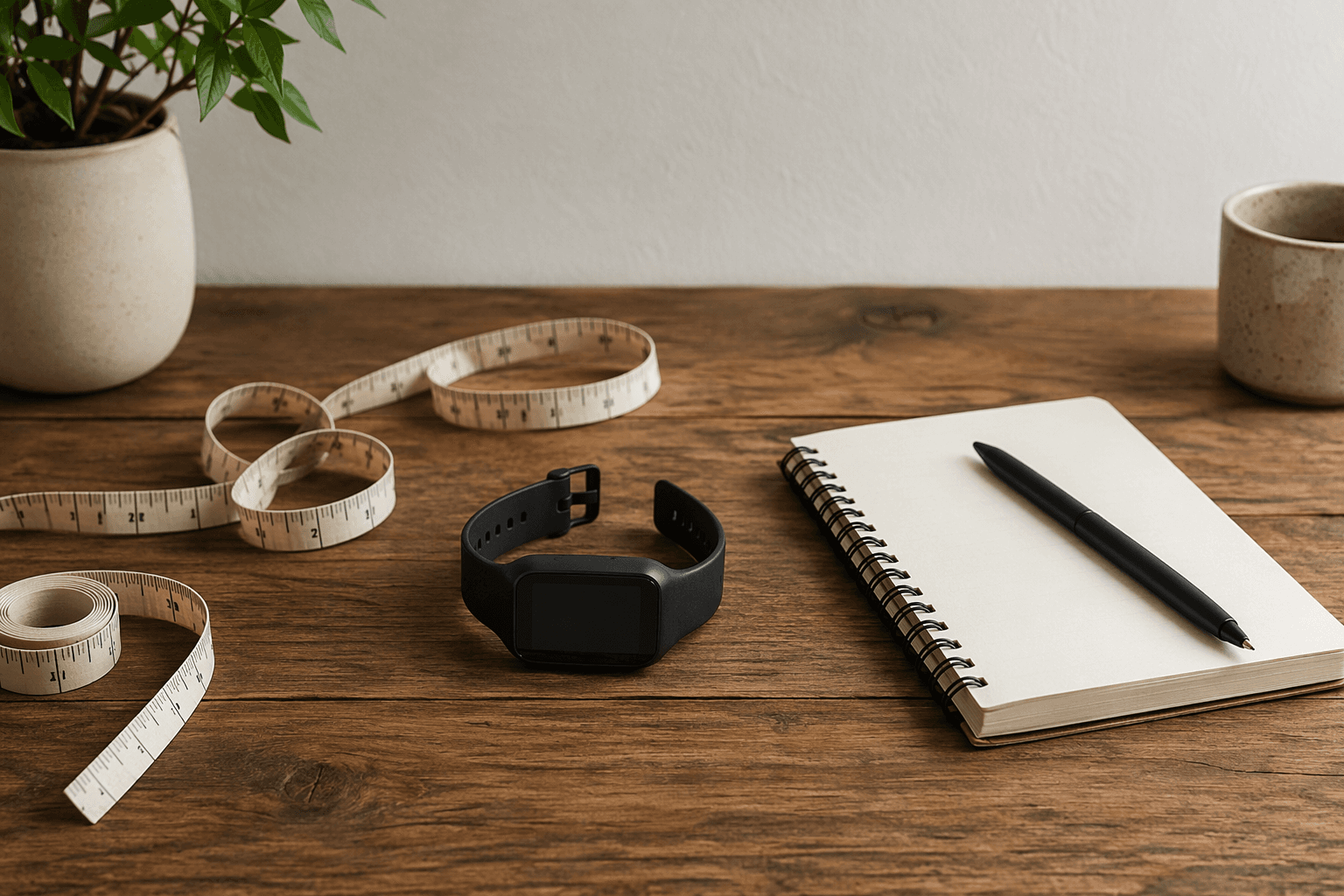
- Waist circumference: Use a cloth tape measure (like the one in the image below). Measure across the narrowest part of your torso once a week, same time of day, after exhaling. A reduction of even 1 cm is a real sign of fat loss.
- Workout performance: Can you hold the steady-state pace longer? Can you complete one more burpee in the HIIT intervals? Progressive improvement in capacity is a stronger signal of progress than any static measurement.
- Resting heart rate: If you use a tracker, a downward trend in resting heart rate over weeks indicates improved cardiovascular fitness. We have a guide to choosing heart rate trackers if you need help picking one.
Common Mistakes That Undo Results
- Over-relying on estimated calorie burn from wearables. As mentioned, the error margins are large. If you eat back the calories your watch says you burned, you may be overeating. Our deep dive into Fitbit accuracy shows just how unreliable those estimates can be.
- Skipping strength work because you think cardio alone will do the job. The AHA data above makes it clear: combined training wins.
- Not progressing intensity. If you do the same steady-state pace week after week, your body adapts and the calorie burn per minute drifts down. Increase RPE slightly every few weeks, or add a minute to the session, or introduce new movements.
Comments
Join the discussion with an anonymous comment.