If you are starting from scratch in a living room, it is reasonable to wonder whether you are asking for too much. Losing fat is already supposed to be hard. Building muscle is supposed to be hard. Trying to do both at the same time, without a gym, can sound like something reserved for people who already know what they are doing.
That doubt is common, but the assumption behind it is backwards. For body recomposition at home, beginners are not the least qualified group. They are often the best candidates. A 2020 review in the NSCA Strength and Conditioning Journal identified untrained beginners, detrained people returning after a break, and people with higher body fat starting structured resistance training as the populations with the strongest body recomposition signal, with beginners sitting at the top of that practical list [1].
Body recomposition just means gaining muscle while losing fat. Bulking means eating in a surplus to prioritize muscle gain. Cutting means eating in a deficit to prioritize fat loss. Those terms are useful later, but they can make the first decision feel more complicated than it needs to be. A beginner does not have to choose an advanced physique cycle before doing a proper push-up, squat, hinge, or row variation consistently.

Why the Beginner Body Responds So Strongly
The beginner advantage is not motivational fluff. It comes from novelty. If your muscles have not been asked to produce force through a structured resistance routine, even simple exercises can create a strong training signal. Squats, push-ups, lunges, hip hinges, rows with a band or towel setup, and loaded carries with household objects can all become meaningful stress when they are progressed instead of repeated casually.
That is why beginners should not read “advanced lifters struggle to recomp” as “recomp is unrealistic.” Advanced lifters have already harvested much of the easy adaptation. They need more precise training loads, tighter nutrition, and longer timelines because their bodies are no longer surprised by resistance training. A beginner is in a different biological situation.
The energy side is also less dramatic than people assume. Building muscle tissue is energetically costly, but not in the way “you must bulk first” advice often implies. Wolf's cited estimate places the cost of building muscle at about 3 to 4.6 calories per gram [2]. That does not mean muscle appears for free. It means the body does not necessarily need a large calorie surplus to support early muscle gain, especially when stored body fat is available and the training signal is new enough.
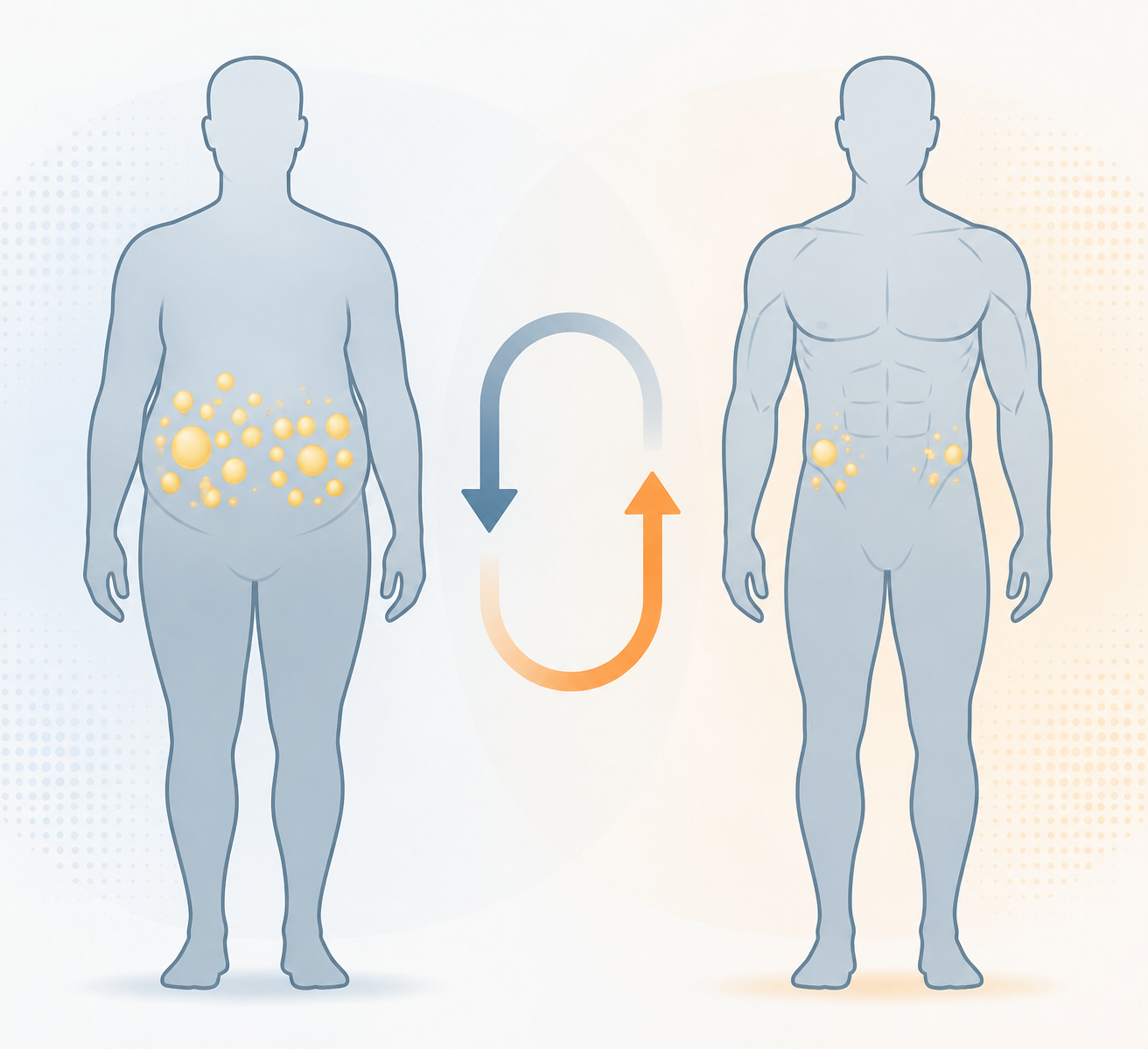
This is the part that makes recomposition click for many beginners: fat loss and muscle gain are not competing goals in the same way they are for a lean, highly trained lifter chasing small improvements. A beginner with stored energy, adequate protein, and a real resistance routine can use fat as part of the energy supply while the body builds the muscle it now has a reason to build.
This Has Been Observed in Sedentary Adults
The point is not that every beginner gets the same result. It is that the pattern has been observed in people who look much more like new exercisers than like fitness influencers. Ribeiro et al. reported that sedentary adults starting structured resistance training gained fat-free mass while also losing fat, with men gaining 1.15 kg of fat-free mass and women gaining 0.94 kg [3].
Those are not transformation-poster numbers, and that is exactly why they are useful. They show a realistic direction of change: tissue that contributes to strength and shape going up, fat mass going down, without requiring the person to begin as an athlete. A beginner training at home should not turn that into a guarantee, but it is more than enough evidence to stop treating recomposition as a fantasy.
Home Training Counts When It Is Actually Progressive
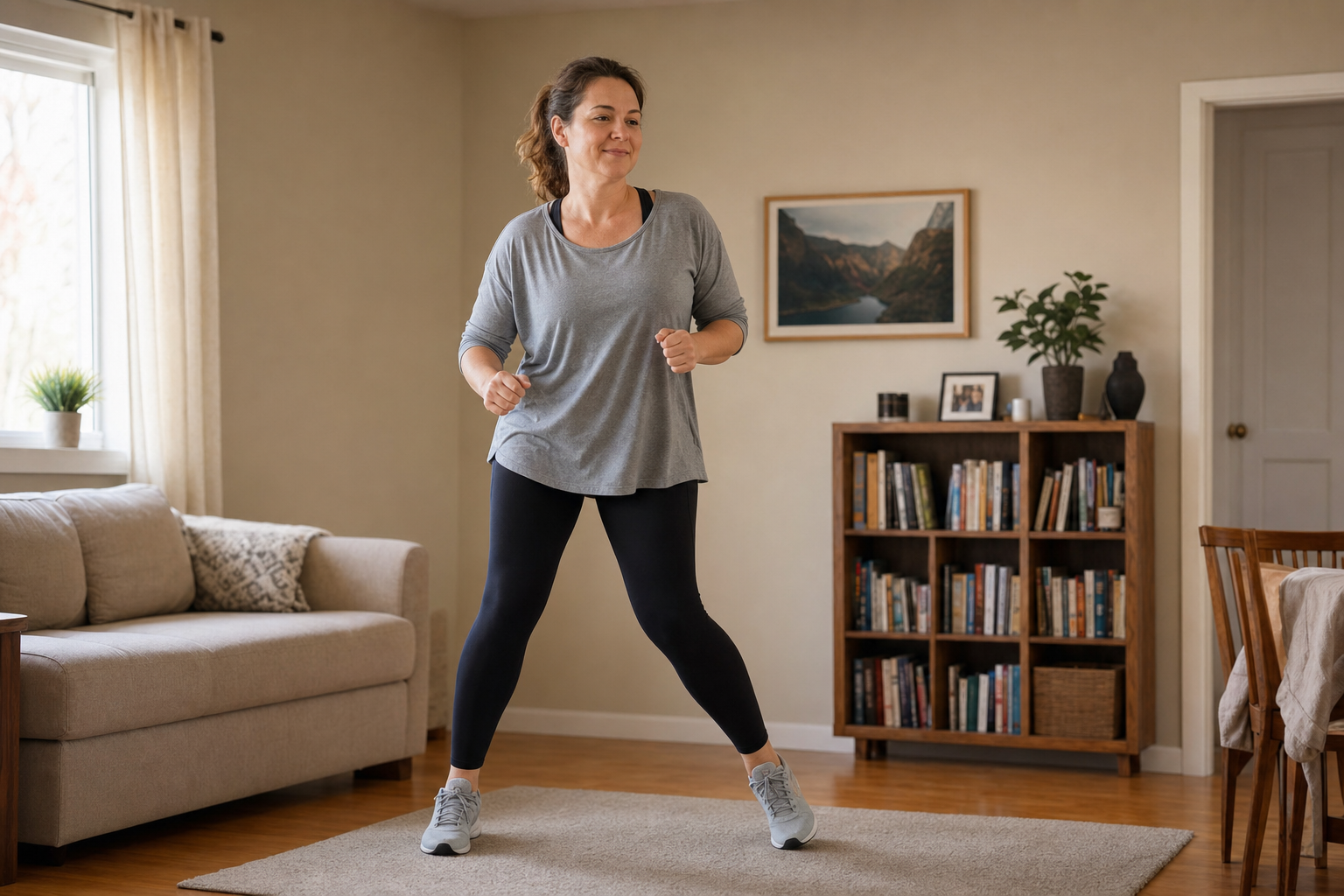
The gym is convenient because it makes progression obvious. Add weight to the machine. Move the pin. Load the bar. That convenience is real, but it is not the same as a requirement. Home training can create enough resistance for beginners if the exercises become harder over time instead of staying at the same comfortable level.
A bodyweight squat that never changes will eventually stop being a muscle-building stimulus. A bodyweight squat that becomes slower, deeper, higher-rep, split-stance, paused, loaded with a backpack, or replaced by a more difficult single-leg progression is a different story. The same principle applies to push-ups, rows, bridges, hinges, planks, and lunges.
| Home exercise pattern | Beginner progression example |
|---|---|
| Squat | Chair squat to full squat to paused squat to backpack squat |
| Push | Wall push-up to incline push-up to floor push-up to slow-tempo push-up |
| Hinge | Glute bridge to single-leg bridge to hip hinge with backpack load |
| Pull | Band row, towel row setup, or sturdy-table row progressed by reps and control |
| Core | Dead bug to plank to longer lever plank variations |
The available review evidence supports the same practical boundary: bodyweight resistance training can produce comparable hypertrophy outcomes to barbell training when the major conditions are present, including progressive overload, sufficient weekly volume, adequate protein, and training close enough to failure [1]. That last phrase matters. Stopping every set when it starts to feel mildly unpleasant is not the same as giving the muscle a reason to adapt.
The Conditions That Make Recomposition More Likely
A beginner does not need a perfect routine, a food scale, and a supplement shelf to begin. The floor is lower than that. But there are a few conditions that separate a recomposition-friendly home plan from random exercise.
- Train several times per week. The exact split matters less than repeating resistance work often enough for the body to practice and adapt.
- Progress the exercises. Add reps, sets, range of motion, tempo control, load, or harder variations over time.
- Do enough total work. The evidence identifies roughly 15 to 20 or more sets per muscle group per week as a useful hypertrophy condition when comparing bodyweight and barbell outcomes [1].
- Get close enough to failure. Most working sets should end with effort still controlled, but not with half the set left unused.
- Keep protein consistent. Protein does not replace training, but it gives the body material to repair and build muscle.
- Avoid aggressive dieting. A modest deficit is much friendlier to recomposition than a crash diet that makes training performance collapse.
The calorie point deserves special restraint. Some beginners hear “lose fat” and immediately slash food intake. That can reduce scale weight, but it can also make workouts weaker, recovery worse, and muscle gain less likely. A modest deficit gives the body a reason to draw from stored fat without treating training like an emergency it cannot recover from.
This is also why daily scale weight can be misleading during recomposition. If fat mass is decreasing while lean mass is increasing, the scale may move slowly, pause, or fluctuate. Strength improvements, waist measurements, progress photos, how clothes fit, and exercise performance often tell the story earlier than body weight does.
What a Simple Starting Path Looks Like
The next step does not have to be a full physique plan. It can be a simple structure that gives your beginner advantage somewhere to go.
- Pick a beginner strength plan you can repeat for several weeks.
- Train three or more times per week if your schedule allows.
- Use exercise variations that feel challenging in the target rep range.
- Write down reps, sets, and variations so progression is visible.
- Keep protein present at meals instead of treating it as an occasional add-on.
- Measure progress with strength, measurements, and consistency, not only body weight.
If you want the training side already laid out, the 8-Week No-Equipment Strength Plan for Beginners is the natural place to start. It gives the beginner advantage the one thing it needs most: repeated, progressive resistance work.
For lower-body progression specifically, the home leg workout progression guide shows how bodyweight movements can become harder without turning the living room into a gym.
The Window Is Real, but It Does Not Stay Wide Forever
The beginner phase is useful because the body is highly responsive. It is not permanent. The strongest beginner recomposition window is roughly 3 to 6 months before progress usually requires more deliberate specialization [1]. That does not mean results stop after that period. It means the easy overlap between fat loss and muscle gain becomes less automatic.
After that window narrows, some people will benefit from adding dumbbells or bands, changing rep ranges, increasing weekly volume, tightening nutrition, or choosing a clearer emphasis on muscle gain or fat loss for a while. Those are later decisions. They do not need to block the first one.
A beginner pursuing body recomposition at home is not being naive. The evidence supports the idea, the biology makes sense, and the required setup can be ordinary. What cannot be skipped is structure: progressive resistance, enough effort, enough protein, and a diet that supports training instead of punishing it. Start while the beginner advantage is still fresh enough to matter.
References
- Body Recomposition: Can Trained Individuals Build Muscle and Lose Fat at the Same Time? Strength and Conditioning Journal, 2020. https://journals.lww.com/nsca-scj/Fulltext/2020/10000/Body_Recomposition__Can_Trained_Individuals_Build.3.aspx
- Wolf estimate of the energetic cost of building muscle, cited by BodySpec, 2023.
- Ribeiro et al. sedentary adult resistance training data, cited by FitCraft, 2025.

Comments
Join the discussion with an anonymous comment.