
What Celebrities Actually Do at Home for Weight Loss
This article cuts through clickbait to reveal that celebrity weight loss home workouts are not secret — they rely on simple bodyweight moves, short frequent sessions, and consistency, which anyone can replicate with minimal space and under $100.
- Equipment tier required
- $0-100
- Duration
- 30 min
- Difficulty
- beginner
- Target area
- full body
- Space footprint needed
- mat-sized space
- Noise level
- low
The celebrity weight loss home workout “secret” is usually not a secret exercise. In the better-documented routines, the reveal is much less exotic: a pull-up bar, resistance bands, Pilates-style sessions, short circuits, running, and enough repetition across the week for the work to count.
Jamie Foxx has been reported using a bedroom pull-up bar and bodyweight work. Tom Brady’s at-home training has been reported around resistance bands. Rihanna’s reported routine has included 5k runs and 30-minute Pilates three to five times per week. Dakota Johnson’s reported “Madame Web” prep used 20- to 45-minute Sculpt Society sessions with light dumbbells, sliders, bodyweight moves, and simple substitutions like a paper plate, sock, or hand towel for sliding work.[1][2][3]
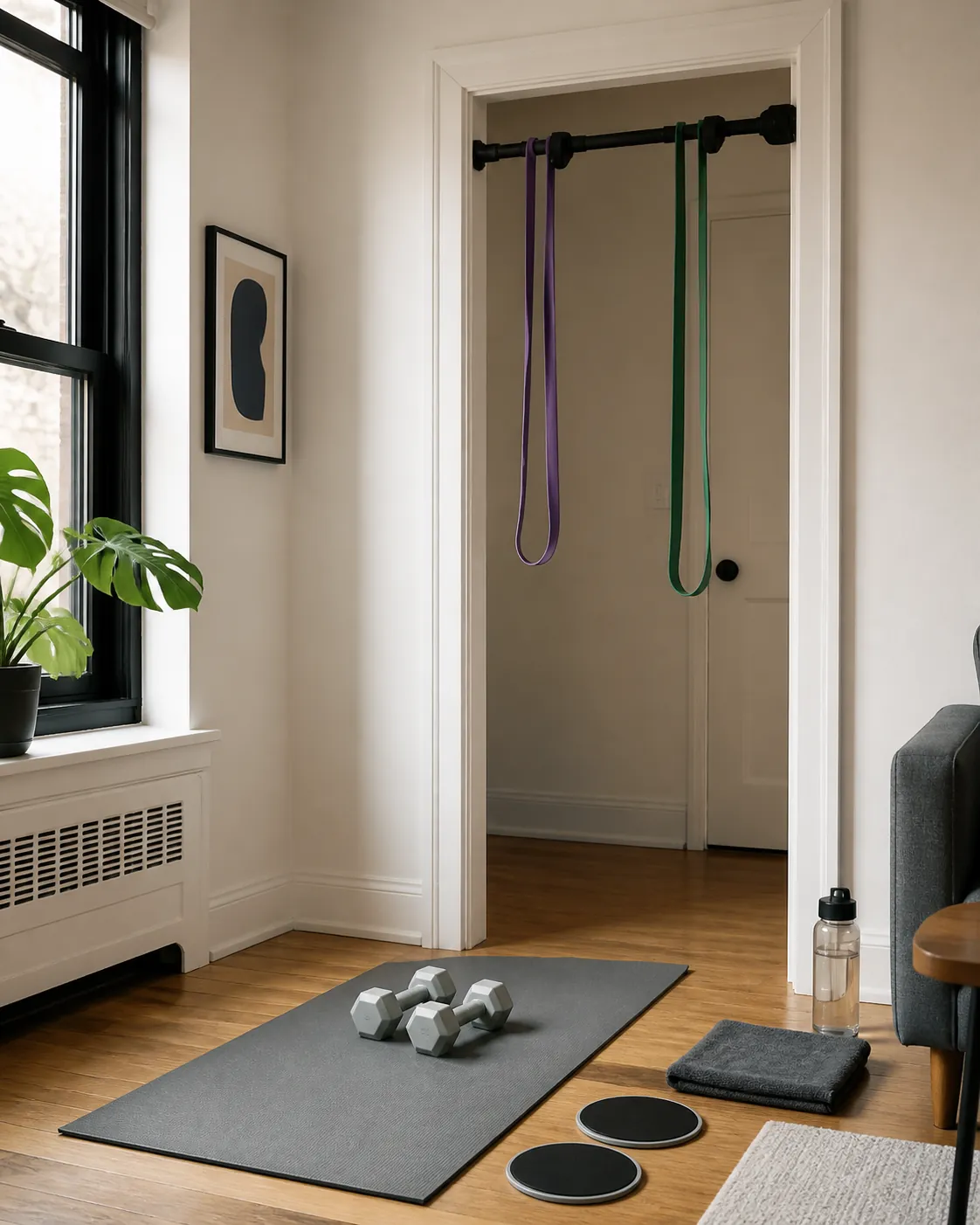
Those names make the routines clickable. The structure is what makes them useful. None of those examples requires a private gym to understand. The repeatable pattern is bodyweight strength, low-cost resistance, some cardio or cardio-like intervals, and short sessions done often enough that they stop feeling like an event.
The Famous Part Is Not the Useful Part
A celebrity routine can be “home-compatible” in two very different ways. One version means the person has a home gym, a trainer, a reformer, and enough space to film a small commercial. The other version means the workout still works when you remove the celebrity surroundings and keep only the movement pattern.
Foxx’s reported pull-up-bar and bodyweight setup belongs in the second category because the equipment is ordinary and the movements are scalable. Brady’s band-heavy TB12-style work is also easy to translate, even if the brand around it is not the point. Rihanna’s reported mix is less “secret celebrity method” than a familiar pairing: aerobic work plus Pilates. Johnson’s example is especially useful because the props are almost aggressively normal: sliders can be replaced with a sock, towel, or paper plate, depending on the floor.[1][2][3]
That is the first filter for any celebrity weight loss home workout claim: if the routine collapses without the trainer, the machine, or the house, it is not a home plan. It is a lifestyle photo with exercises attached.
| Reported celebrity example | What matters after removing the fame | Budget translation |
|---|---|---|
| Jamie Foxx: pull-up bar and bodyweight work | Upper-body pulling plus pushups, squats, lunges, and core work | $0 for bodyweight only; about pull-up-bar money if your doorway and lease allow it |
| Tom Brady: resistance-band work | Joint-friendly resistance that can be made easier or harder by changing band tension | One or two bands instead of a machine stack |
| Rihanna: 5k runs plus 30-minute Pilates three to five times weekly | Cardio volume plus controlled strength and mobility | Walking, jogging, stairs, mat Pilates, or low-impact intervals |
| Dakota Johnson: 20- to 45-minute Sculpt Society sessions | Short sessions using light load, sliders, bodyweight, and repetition | Light dumbbells optional; towel, sock, or paper plate can replace sliders |
The Dose Is Where the Clickbait Usually Gets Quiet
The move list is the easy part. The weekly dose is the part that decides whether the plan is just a sweat break or a serious weight-management tool.
The CDC’s baseline adult activity target is at least 150 minutes a week of moderate-intensity aerobic activity, with muscle-strengthening work on two or more days. The same CDC page is also blunt about the weight-loss caveat: physical activity helps with weight control, but most weight loss comes from reducing calories.[4]
That caveat matters because home workouts are often sold as if the correct circuit can outrun the rest of the day. It usually cannot. A 30-minute session can be valuable for fitness, mood, strength, and maintenance, but if food intake rises enough to erase the energy gap, the scale may not move much. That is not a failure of bodyweight training. It is the math that most glossy routines prefer to skip.
For clinically significant weight loss, the American College of Sports Medicine threshold commonly cited in obesity-medicine guidance is higher than the basic health floor: more than 225 minutes per week of physical activity. The Obesity Medicine Association also summarizes older adherence-by-volume data from Jakicic and colleagues showing that people assigned higher weekly exercise targets lost more weight when they actually reached those higher volumes.[5]
That does not mean everyone must start at 225 minutes on Monday. It means the celebrity examples make more sense when viewed as repeated sessions rather than isolated moves. Rihanna’s reported three to five 30-minute Pilates sessions plus runs is not magic because Pilates is magic; it is meaningful because repeated 30-minute blocks can add up. Johnson’s 20- to 45-minute sessions are not interesting because sliders are special; they are interesting because the time frame is short enough to repeat and long enough to matter when stacked across a week.[2][3]
The research is not promising movie-poster outcomes from apartment workouts. Bellicha and colleagues reviewed 12 systematic reviews covering 149 studies on adults with overweight or obesity and found that aerobic training and resistance training produced modest average weight-loss effects, roughly in the range of 1.5 to 3.5 kg depending on the exercise mode and comparison. The same overview found high-intensity interval training and moderate-intensity continuous training produced similar weight and fat-loss results when energy expenditure was comparable.[6]
That last point is useful for normal people because it removes a lot of theater. You do not have to turn every session into a punishment scene. Hard intervals can work. Steady work can work. The common requirement is enough total work, repeated consistently, with resistance training included so weight loss does not become a sloppy loss of strength and muscle.
A $0–$100 Version of the Same Pattern
The copyable version does not start with a celebrity’s exact routine. It starts with the job each part of the routine is doing.
- Cardio volume: brisk walking, jogging, stairs, low-impact intervals, cycling, or follow-along dance cardio.
- Resistance work: squats, lunges, pushups, rows, band presses, band pulls, hinges, carries, and core work.
- Low-friction setup: a mat-sized space, a timer, and movements that do not require rearranging the room.
- Progression: more weekly minutes, more controlled reps, slightly harder variations, or stronger bands before buying bigger gear.
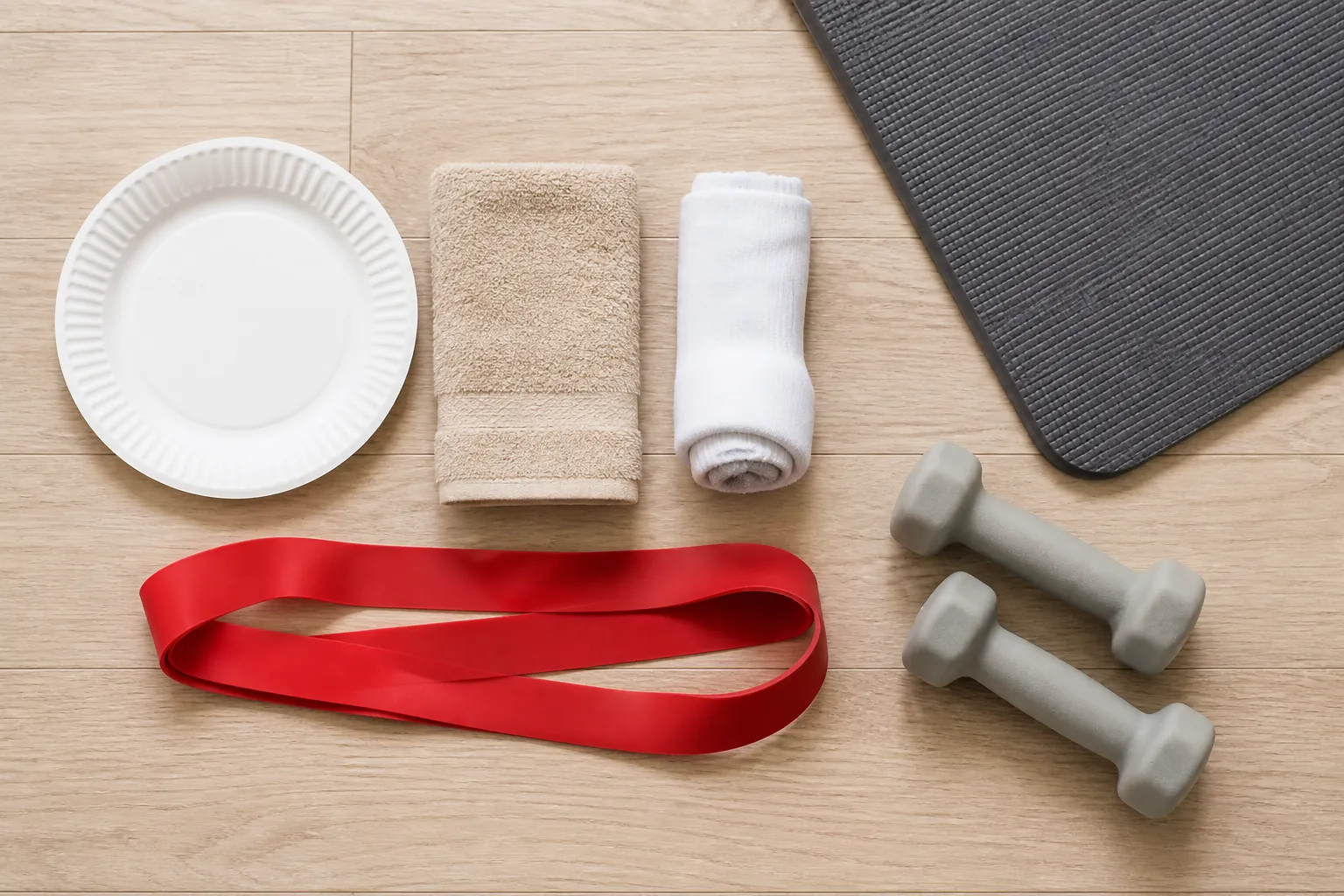
For $0, the plan can already cover a lot: squats, reverse lunges, incline pushups against a counter, glute bridges, dead bugs, mountain climbers, step-ups if you have a safe step, and brisk outdoor walks. If noise is an issue, the cardio can be low-impact. A no-jump routine is less dramatic on video, but it is easier to repeat in an apartment without becoming the upstairs neighbor everyone hates.
For a small budget, bands are usually the first useful buy because they make rows, presses, pulldowns, hinges, and anti-rotation work easier to load. Light dumbbells help, but they are not mandatory at the beginning. Sliders are optional because Johnson’s trainer, Megan Roup, specifically noted household substitutions such as a paper plate, sock, or hand towel for sliding movements.[3]
A doorway pull-up bar is more conditional. It is a good tool if the frame is suitable, the bar is installed correctly, and your lease or household rules allow it. It is not a moral upgrade over bands. If the doorway is questionable, band rows and towel rows around a secure anchor are the more sensible choice.
For a familiar comparison, see this no-secret Arnold home workout and this two-tool Hemsworth-style kit: the useful question is not whether the setup looks impressive. It is whether the setup lets you repeat enough quality work.
One Weekly Template That Actually Resembles the Evidence
A beginner does not need to jump straight to the upper end of the weight-loss range. A practical plan can build from the CDC floor toward the larger weekly volume associated with more meaningful weight loss, while keeping resistance work in the week.[4][5]
| Day | Session | What it copies from the celebrity pattern |
|---|---|---|
| Monday | 30 minutes brisk walking or low-impact cardio | Rihanna-style aerobic volume without needing a treadmill |
| Tuesday | 25–35 minutes full-body strength with bodyweight and bands | Foxx and Brady-style minimal-equipment resistance |
| Wednesday | 20–30 minutes Pilates-style core, glutes, and mobility | Johnson-style short mat session with sliders or towel work |
| Thursday | 30 minutes brisk walking, jogging, cycling, or stairs | Simple repeatable cardio volume |
| Friday | 25–35 minutes full-body strength | Second weekly muscle-strengthening session |
| Saturday | 30–45 minutes easy cardio or mixed low-impact intervals | Extra weekly minutes without making every session intense |
| Sunday | Rest or light walking | Recovery so the next week can happen |
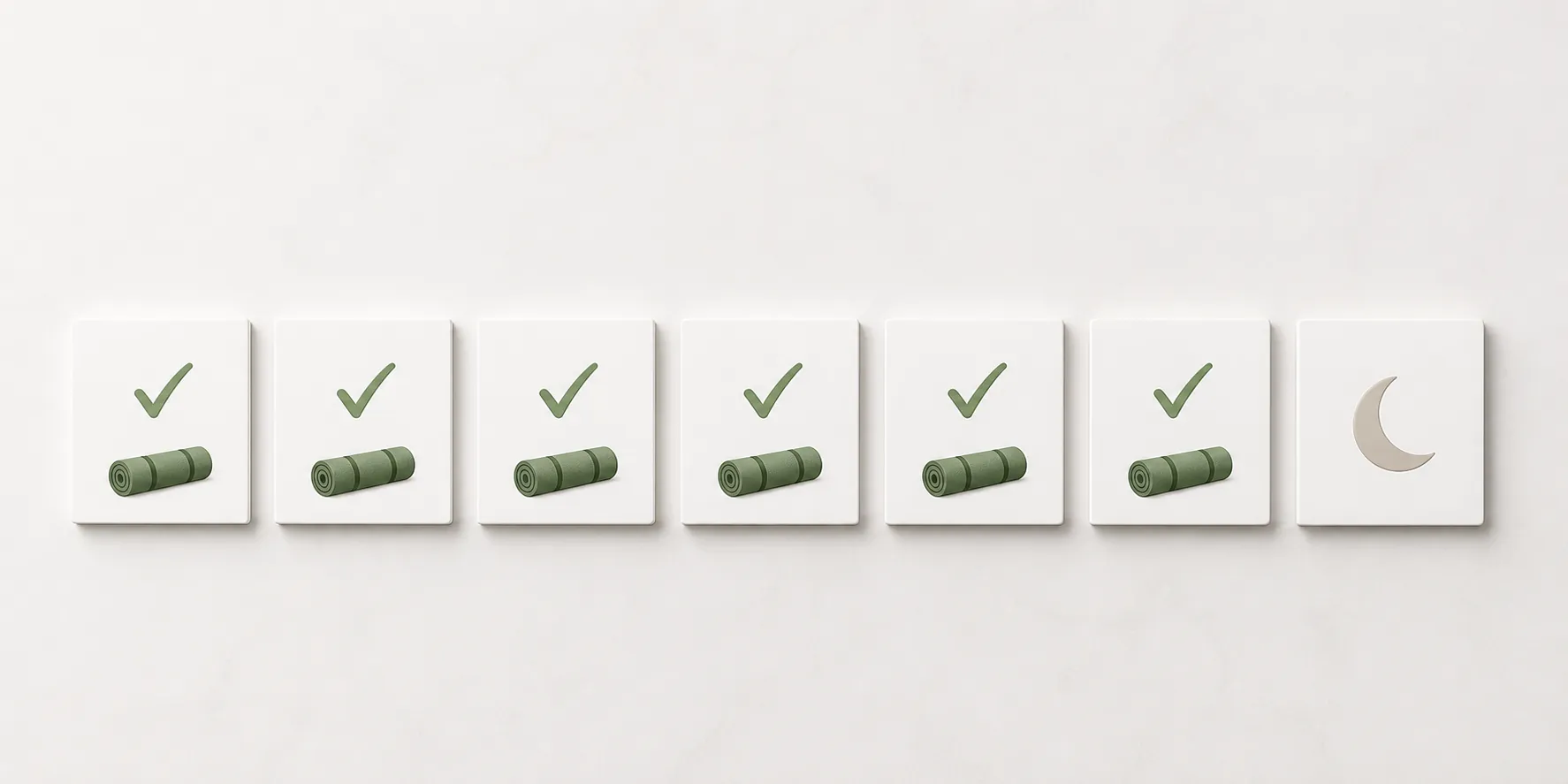
That week lands around the health-guideline neighborhood first. To move closer to the higher exercise dose often discussed for weight loss, the least heroic adjustment is not a new secret circuit. It is adding 10 to 15 minutes to several sessions, extending Saturday, or adding short walks after meals when the schedule allows. The boring upgrade is the honest one.
How the Strength Days Can Look
Use a timer instead of chasing a perfect celebrity rep scheme. For example, a hypothetical 30-minute strength day could run as five minutes of warmup, 20 minutes of alternating lower-body, upper-body, and core movements, then five minutes of easy cooldown. The exercises can rotate without changing the purpose.
- Lower body: squat, reverse lunge, glute bridge, hip hinge, step-up.
- Push: wall pushup, incline pushup, floor pushup, band chest press.
- Pull: band row, band pulldown, assisted pull-up, slow negative pull-up if appropriate.
- Core and control: dead bug, plank, side plank, slider mountain climber, slow bear crawl.
The substitution is not a downgrade. A band row is doing the pulling job when a pull-up is not available. A towel slider is doing the instability and friction job when plastic sliders are not available. A brisk walk is doing the aerobic-volume job when a 5k run is not appropriate yet.
How to Progress Without Buying a New Personality
Progression can be plain. Add five weekly minutes. Add one more round. Slow the lowering phase of a pushup. Use a stronger band. Turn a 20-minute mat session into 30 minutes. Add a second walk on one day. These changes are dull to advertise because they do not sound like access. They are also the changes that make the routine become a routine.
Intensity still matters, but it does not need to dominate every session. Bellicha and colleagues’ overview found no clear weight-loss advantage of HIIT over moderate continuous training when the energy work was comparable, which is a useful correction to the idea that only brutal workouts count.[6]
What This Can and Cannot Promise
The celebrity examples prove copyability, not guaranteed outcomes. They show that famous people, at least in these reported routines, often use the same categories of training available to everyone else: bodyweight strength, bands, Pilates-style control, running or other cardio, and short repeatable sessions. They do not prove that copying one celebrity’s week will produce that celebrity’s body.
The research is similarly useful when kept in its lane. Exercise training in structured studies can produce modest average weight loss, and higher weekly activity volumes are associated with better weight-loss and maintenance targets. But the CDC’s calorie point still sits in the middle of the room: for losing weight, food intake usually does most of the heavy lifting, while physical activity is especially important for health and for keeping weight off.[4][5][6]
So the honest answer to celebrity weight loss home workout secrets is smaller and more useful than the phrase suggests. There is no hidden move. There is a reproducible structure: short sessions, repeated often; enough weekly volume to matter; resistance work to protect strength; cardio that fits your joints and space; and a food environment that supports the goal instead of canceling the work.
If you wanted a magic celebrity trick, this is disappointing. If you wanted something you can run in a small room with $0–$100 of gear, it is better than a secret.
References
- Celebrities who use bodyweight workouts to stay in shape, Business Insider, 2021.
- 40 celebrity workouts, Women’s Health UK.
- Dakota Johnson’s ‘Madame Web’ workout, TODAY.
- Physical Activity and Your Weight and Health, Centers for Disease Control and Prevention.
- How Much Physical Activity is Needed for Weight Loss, Weight Loss Maintenance and Weight Gain Prevention?, Obesity Medicine Association.
- Effect of exercise training on weight loss, body composition changes, and weight maintenance in adults with overweight or obesity: An overview of 12 systematic reviews and 149 studies, Obesity Reviews, 2021.
What a small equipment investment adds
Cable Machine Alternatives That Save Space and Money
Compare the best cable machine alternatives for home gyms – from resistance bands and pulley systems to suspension trainers and compact digital units – and find the right option for your space and budget.
Small Treadmill Buying Guide: 7 Critical Specs to Check Before You Buy
A cross-category spec primer for apartment and small-space dwellers comparing walking pads, ultra-compact folding treadmills, and full-size folding treadmills. Learn the concrete thresholds for motor HP, deck length, noise, warranty, and subscription lock-in so you can compare apples to apples.
How to Practice Basketball at Home Without Noise Complaints
Learn how to run a full basketball workout in a small apartment without noise complaints. This guide covers no-dribble handling drills, wall form shooting, and silent ball options that let you train without disturbing neighbors.
How often should you repeat this?
See our recovery and rest reference for citation-anchored rest-interval guidance.
Spot something off?
Tell us if a movement, tier assumption, or duration didn't match your experience.