
Chris Hemsworth's Extraction 3 Home Workout Needs 2 Tools
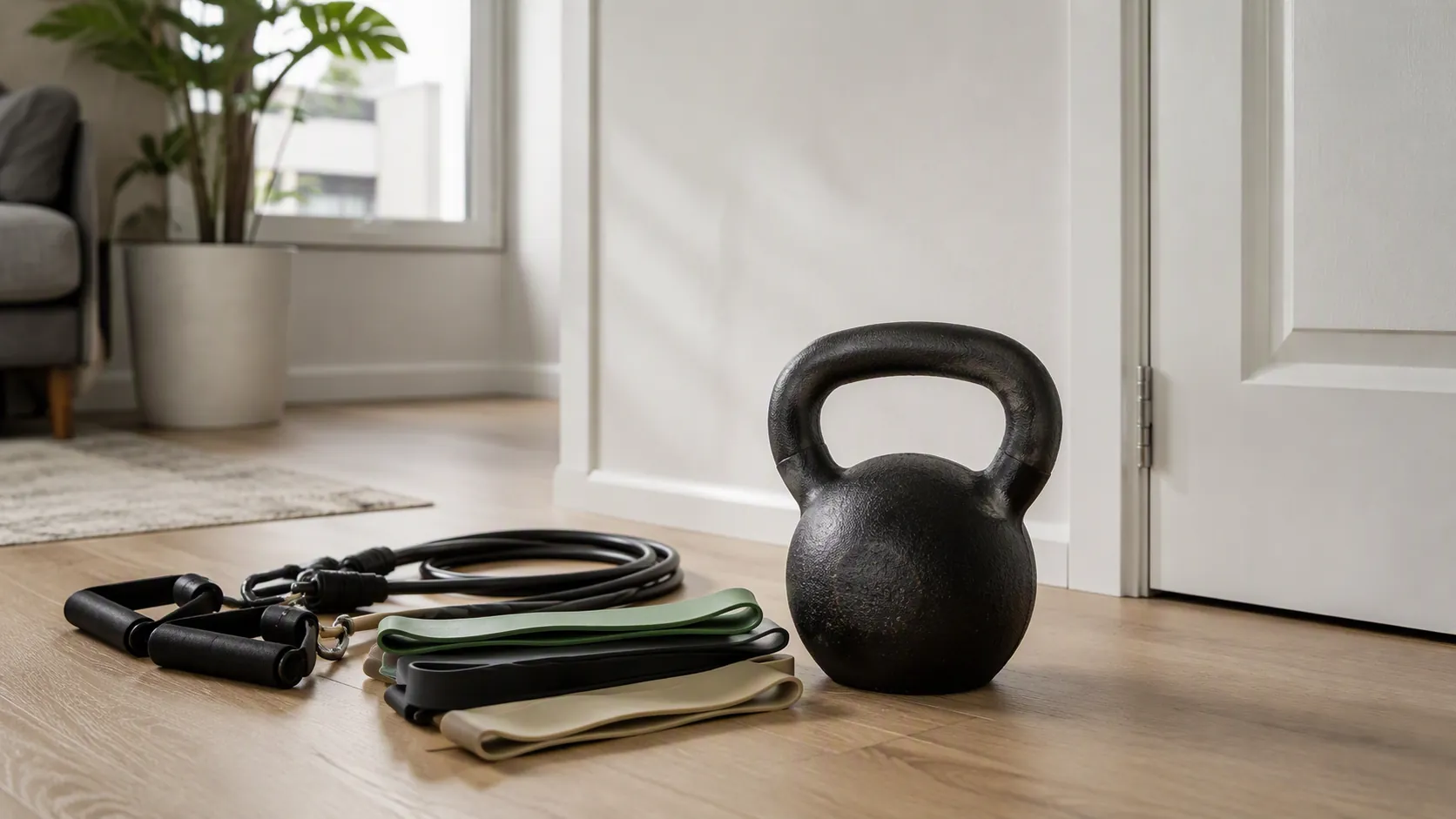
The entire kit behind Chris Hemsworth's Extraction 3 home workout is one kettlebell and a set of resistance bands. Here's what that two-piece setup costs, whether it fits an apartment's space, noise, and floor-protection constraints, and why it belongs in the $0–100 home-gym tier.
- Equipment tier required
- $0-100
- Duration
- 30 min
- Difficulty
- beginner
- Target area
- full body
- Space footprint needed
- small
- Noise level
- low
The useful part of Chris Hemsworth’s Extraction 3 home workout is not the body-transformation language. It is the kit list. In the July 2026 session covered by Men’s Health UK, the whole setup is framed as “17 exercises, 2 bits of kit”: one kettlebell and resistance bands.[1] Men’s Journal’s coverage lands in the same place, treating the session as a full-body workout built around those two tools rather than a room full of machines.[2]
That is the part worth stealing. Not Hemsworth’s schedule, not his job, not his film-prep support system, and definitely not the promise that a renter with one bell will become Tyler Rake. The replicable thing is smaller and more useful: a first home-strength kit can be one kettlebell plus a set of bands, and it can still train legs, shoulders, back, arms, and core.
The buying question: does this actually fit the $0–100 tier?
There is no official “Extraction 3 home kit” price in the available reporting. That matters. A clean two-tool setup can be cheap, but the exact cart depends on the kettlebell weight, band type, shipping, sales, and whether the buyer already owns a mat or safe anchor point.
For FitAtHome tiering, the honest test is simple: price the kettlebell and band set you would actually use today, from current retailers, and keep the required training kit inside the $0–100 tier before you start adding nice-to-have accessories. If the kettlebell alone eats most of the budget, the answer is not to buy a decorative band bundle; it is to choose a usable bell first and a plain resistance-band set second.
| Item | What it has to do | Budget judgment |
|---|---|---|
| One kettlebell | Load squats, hinges, carries, rows, presses, deadlifts, swings if appropriate | This is the main cost. Buy a weight you can control quietly, not the heaviest one that looks impressive. |
| Resistance bands | Add pulling, pressing, arm, shoulder, core, and top-range tension options | A basic set is enough. Handles and door anchors are useful only if they match your space. |
| Floor protection | Reduce dent, chip, and deposit risk when the bell is set down | Not always part of the kit price, but renters should treat it as part of the real cost if they train over wood, tile, or thin carpet. |
That puts the Hemsworth-style two-tool build in the same practical lane as the first tier in our small apartment home gym tour: low cost first, small footprint second, and no tolerance for gear that makes a rental harder to live in.
Why this two-tool pairing works
A kettlebell is blunt in a good way. It gives you a real external load for goblet squats, Romanian deadlifts, deadlifts from the floor, loaded carries, rows, presses, and hinge patterns. It also gives the workout a fixed point of truth: the weight is the weight. If you cannot control it, the room will tell you quickly.
Bands solve a different problem. They are light to store, easy to scale, and useful in movement angles where one kettlebell becomes awkward. More importantly, elastic resistance rises as the band stretches, so it can add meaningful tension near the top of certain ranges, where a free weight’s leverage may feel easier or less direct.
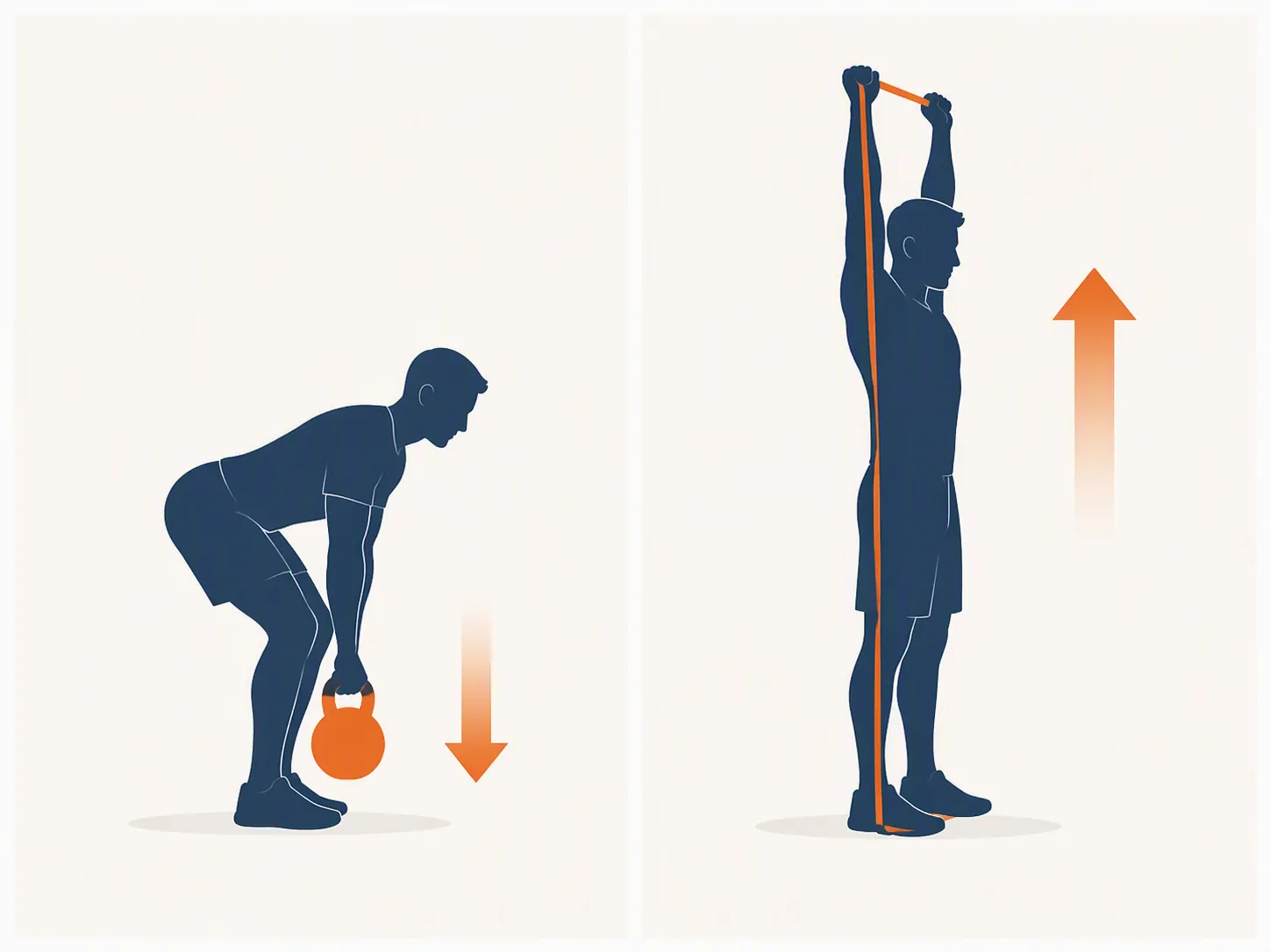
That is the mechanical reason the pairing feels more complete than either tool alone. The bell is better for simple loaded lower-body work and carries. The band is better for cheap horizontal pulling, shoulder work, arm work, assisted or resisted core patterns, and positions where you want tension without adding another metal object to the apartment.
There is also research support for taking elastic resistance seriously. A 2019 SAGE Open Medicine systematic review and meta-analysis by Lopes and colleagues found that elastic-resistance training can produce strength gains comparable to conventional resistance training in the studies analyzed.[3] That does not mean a band is secretly a barbell. It means bands are not just warmup toys when they are loaded and progressed intelligently.
The routine proves coverage, not magic
The Men’s Health UK framing is useful because it shows the constraint: 17 exercises, two tools.[1] Men’s Journal’s write-up also emphasizes that the session reaches across the body rather than sitting in one narrow muscle group.[2] That is enough for the buying decision. The point is not to rebuild every move from the clip here; that turns the equipment lesson into another celebrity circuit recap.
For a home buyer, the better question is whether the tools unlock the movement patterns you will need next week, after the clip has stopped being interesting.
- Squat pattern: goblet squats, split squats, band-resisted variations.
- Hinge pattern: kettlebell deadlifts, Romanian deadlifts, hip hinges, swings only if technique and space are appropriate.
- Push pattern: kettlebell floor presses or overhead presses; band presses if you have a safe anchor.
- Pull pattern: kettlebell rows, band rows, pull-aparts, pulldown-style work if anchored safely.
- Carry and core: suitcase carries, rack holds, anti-rotation band work, loaded marches.
That is a real foundation. It is also still a foundation. A single kettlebell gives one main load, so progression eventually depends on reps, tempo, range of motion, unilateral work, shorter rest, or buying the next bell. Bands vary by length, angle, and how far they are stretched, so they require more setup attention than a plate-loaded machine. Minimal gear is clean; it is not frictionless.
Apartment fit: storage, anchors, noise, and floors
This kit wins on storage before it wins on anything cinematic. One kettlebell can live under a desk, beside a couch, in a closet corner, or on a low shelf that can handle the weight. Bands disappear into a drawer or pouch. Compared with benches, racks, adjustable dumbbell stands, or cardio machines, there is almost nothing to assemble and almost nothing to explain when guests come over.
The narrow-apartment issue is not only square footage. It is whether the tool has to swing, scrape, roll, or lean somewhere stupid after the workout. A cast-iron bell with a stable base is easier to park than a pile of loose plates. Bands need even less storage, but they do need inspection: cuts, cracking, or stretched-out spots are not charming signs of use.
For more on what actually fits in tight rooms, the storage testing in our narrow-apartment home gym storage guide is the better comparison than a polished studio shot.
No-drill band setup
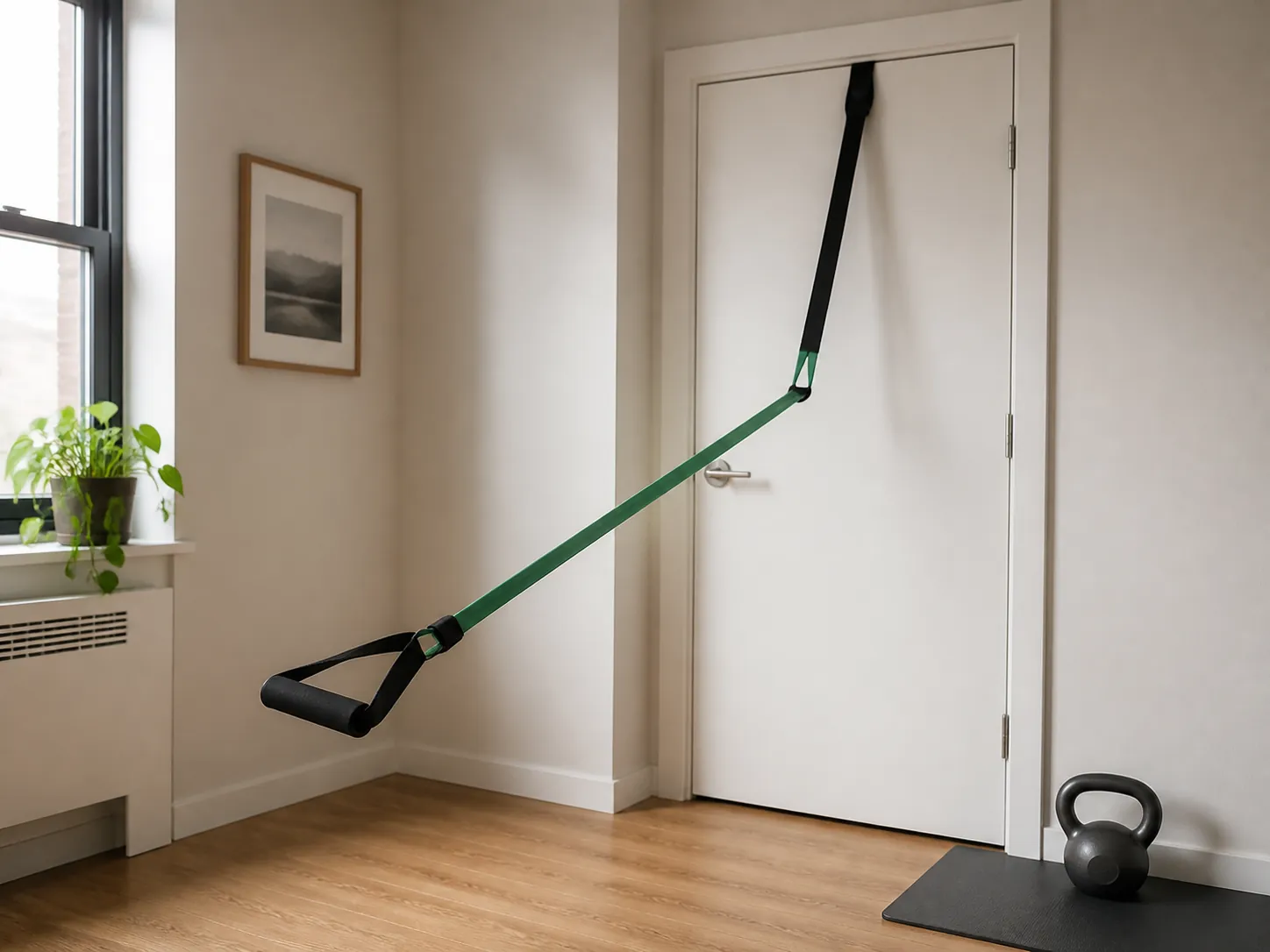
Bands are only rental-friendly if the anchor is rental-friendly. A door anchor can work, but only when the door closes securely, opens away from you for the direction of pull, and does not have fragile trim taking the load. A loop around a heavy fixed object can also work, but “fixed” has to mean fixed, not a wobbly table leg or a radiator you do not own.
If the band set requires a wall mount to become useful, it is no longer the same $0–100 renter build. Drilling changes the permission question, the repair question, and the deposit question. For most apartments, the better first purchase is a band set that can be used around the body, under the feet, around a closed door with a proper anchor, or around an already-safe structure.
Noise behavior
A kettlebell can be quiet if you train like someone lives downstairs. The noise problem usually comes from setting it down too fast, dragging it across hard flooring, clipping furniture, or turning every hinge into a drop. Bands are nearly silent unless an anchor slips, a handle snaps back, or the door hardware complains.
Under FitAtHome’s apartment logic, this is why the kit belongs near the top of the first-buy list. It can support strength work without repeated impacts, motors, jump landings, or a rack that transfers vibration through the floor. The catch is behavioral: swings, cleans, and snatches demand more control and more clearance than deadlifts, rows, presses, carries, and squats.
Floor and deposit risk
The floor does not care that the kit is minimalist. A kettlebell concentrated on one small base can dent soft wood, chip tile, or leave marks if it is stored directly on a vulnerable surface. The fix is boring and worth it: put the bell on a small protective mat, avoid dropping it, and do not store it where a half-asleep foot will kick it into a baseboard.
Bands carry a different risk. They can scuff paint, stress door seals, or snap back if anchored carelessly. None of that makes them unsuitable for apartments. It just means the cheapest possible version of the kit is not always the cheapest real version if you end up repairing trim.
What to buy first
Start with the kettlebell if you can only buy one item today. It gives the clearest strength signal and the most straightforward lower-body loading. Choose a weight you can deadlift, goblet squat, row, and carry with control. If you cannot set it down quietly for repeated reps, it is too heavy for the room even if your ego likes the number.
Add bands next. A compact set gives you rows, pull-aparts, presses, curls, triceps work, anti-rotation holds, lateral walks, assisted mobility, and extra tension layered onto kettlebell patterns. If you train in a rental, prioritize bands that work without permanent hardware.
| Buyer situation | Best first move |
|---|---|
| You have no equipment | Buy one controllable kettlebell, then a simple resistance-band set. |
| You already own a light dumbbell or kettlebell | Add bands first to expand pulling, shoulder, and core options. |
| You live above neighbors | Favor controlled deadlifts, squats, rows, presses, carries, and band work before ballistic kettlebell moves. |
| You cannot anchor bands safely | Use foot-anchored and body-anchored band drills, or delay anchor-dependent exercises. |
| Your floor is vulnerable | Budget for a small mat before chasing a heavier bell. |
The same two-tool kit also travels well across non-celebrity programming. It fits budget-phase training like our boxing training by budget model, band-friendly skill and conditioning work like the tennis home training routine, and lower-clutter strength maintenance like the muscle maintenance after 50 home routine. That matters more than whether it resembles one film-prep clip for one week.
The clean verdict
At current budget-retailer pricing, a basic version of one kettlebell plus resistance bands is a tier-one $0–100 recommendation for small-space home strength. The Men’s Health UK and Men’s Journal coverage of Hemsworth’s Extraction 3 session makes that visible because the setup is stripped down enough to audit: two tools, full-body coverage, no rack, no bench, no cable tower.[1][2]
Buy it for usable strength, quiet training, low storage demand, and a realistic first build. Do not buy it because a celebrity physique has been flattened into a shopping list. The body is not the product. The replicable part is the kit.
References
- Chris Hemsworth, 42, Shares His Extraction 3 Workout for Full-Body Muscle – 17 Exercises, 2 Bits of Kit — Men’s Health UK
- How Chris Hemsworth Is Getting Shredded for Extraction 3 with Just a Kettlebell and Resistance Bands — Men’s Journal
- Effects of training with elastic resistance versus conventional resistance on muscular strength — SAGE Open Medicine, 2019
What a small equipment investment adds
Cable Machine Alternatives That Save Space and Money
Compare the best cable machine alternatives for home gyms – from resistance bands and pulley systems to suspension trainers and compact digital units – and find the right option for your space and budget.
Small Treadmill Buying Guide: 7 Critical Specs to Check Before You Buy
A cross-category spec primer for apartment and small-space dwellers comparing walking pads, ultra-compact folding treadmills, and full-size folding treadmills. Learn the concrete thresholds for motor HP, deck length, noise, warranty, and subscription lock-in so you can compare apples to apples.
How to Practice Basketball at Home Without Noise Complaints
Learn how to run a full basketball workout in a small apartment without noise complaints. This guide covers no-dribble handling drills, wall form shooting, and silent ball options that let you train without disturbing neighbors.
How often should you repeat this?
See our recovery and rest reference for citation-anchored rest-interval guidance.
Spot something off?
Tell us if a movement, tier assumption, or duration didn't match your experience.