
Tour a Small Apartment Home Gym at $100, $300, and $800
Three real apartment gym setups at $100, $300, and $800 with itemized costs, measured decibel ratings, floor-protection methods, and honest notes on what each tier can and cannot do — so you can choose the right entry point without risking your deposit or your neighbor's patience.
- Budget tier
- $0-100, $100-300, $300-800
- Space type
- apartment
- Total cost
- $100, $300, $800
- Floor protection required
- ✓
- Best for
- renter, small apartment, tight budget
- Last tested
Items included: Resistance bands, door anchor, yoga mat, sliders, adjustable dumbbells, folding bench, rubber tiles, rug pad, magnetic bike, walking pad, pull-up tower
A small apartment home gym tour is only useful if it shows the part that usually gets cropped out: where the gear sits after training, what touches the floor, and how much noise reaches the room before coffee is even made. These three setups are built around that reality. The $100 version fits in a drawer and stays under 30 dB in the AnyRoomGym decibel framework; the $300 version turns one 6x6 ft corner into a strength station at a source-derived 35-45 dB for controlled dumbbell work; the $800 version adds quiet cardio and pull-ups, but only when the room can spare the footprint and ceiling clearance.[1]
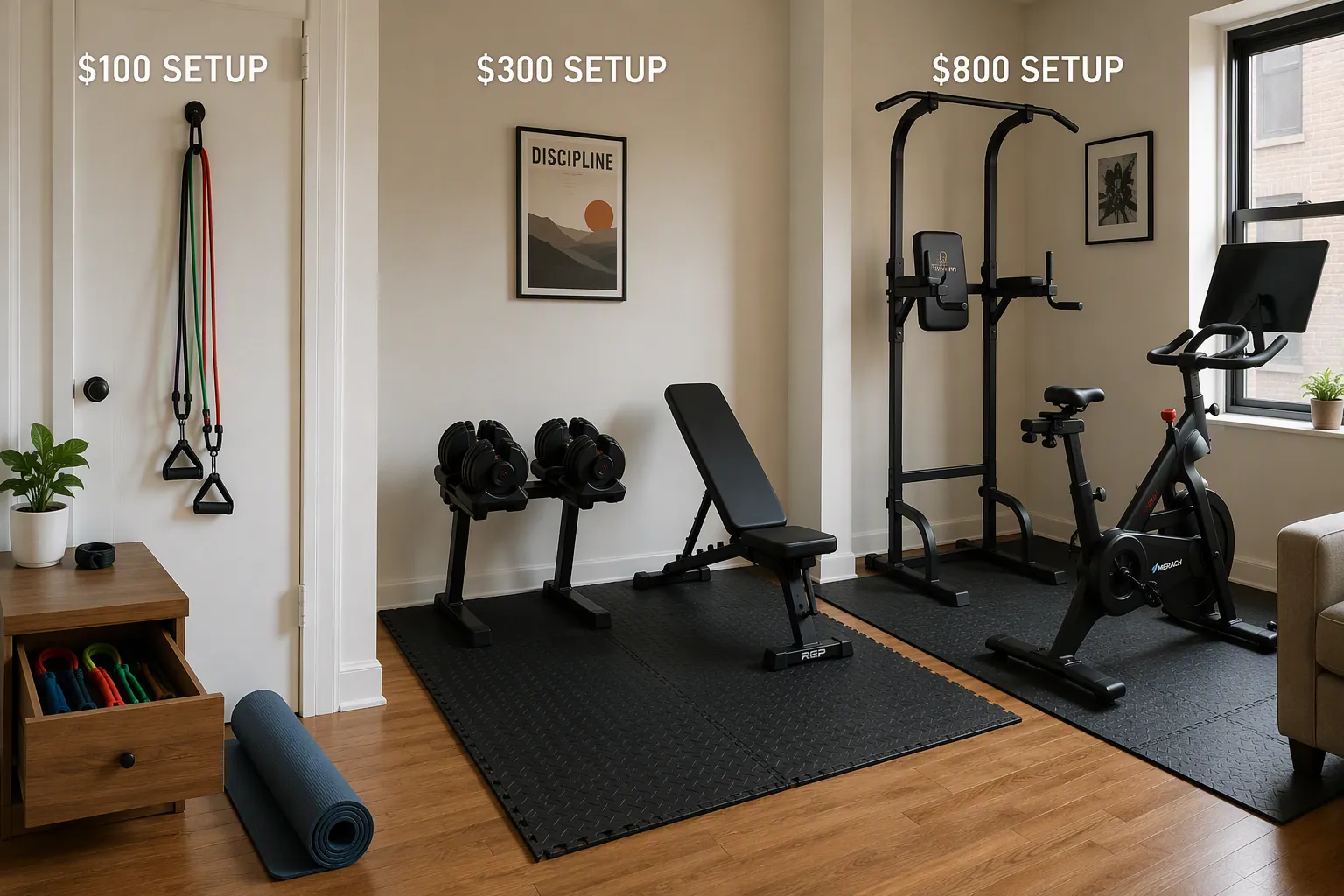
| Tour | Approx. Cost | Working Footprint | Source-Derived Noise Range | Floor Protection | Teardown / Storage Plan | Best For |
|---|---|---|---|---|---|---|
| $100 drawer gym | $100 | Mat-length floor space during use; drawer or closet shelf after | Under 30 dB | Yoga mat; no loaded weights | Roll mat, unclip door anchor, store bands and sliders in a drawer | Quiet training, mobility, travel-style resistance work |
| $300 corner strength gym | $300 | 6x6 ft rubber-tile zone | 35-45 dB for controlled dumbbell work | 10-15mm rubber tiles over rug pad, no glue | Bench folds; dumbbells and accessories move to cart or under-bed zone | Apartment strength training without permanent changes |
| $800 cardio-plus corner | $800 | Dedicated corner plus bike or walking pad clearance | Magnetic bike under 30 dB; walking pad 45-55 dB peak | Rubber-tile zone under cardio and pull-up tower contact points | Cart plus fixed corner; tower disassembly depends on model | Quiet cardio, pull-ups, and a more complete routine if space allows |
The decibel ranges here should be read as directional, not lab-certified. AnyRoomGym presents them as estimated apartment-gym measurements, and they are useful because they compare common equipment under the same framework, not because they settle every building’s acoustics. FitnessVolt’s renter-safe framing is similar: a setup that comes apart in under 30 minutes with no permanent damage is a practical threshold, not a law of physics.[1][2]
The $100 Tour: A Drawer Gym That Does Not Pick a Fight With the Building
| Item | Role in the Setup | Storage |
|---|---|---|
| Resistance bands | Rows, presses, curls, pull-aparts, assisted mobility | Drawer or pouch |
| Door anchor | Turns a closed door into a high, mid, or low band station | Band pouch |
| Yoga mat | Floor work, kneeling exercises, light impact protection | Rolled beside closet or under bed |
| Sliders | Hamstring curls, mountain climbers, plank variations, lunges | Drawer |
This is the setup for the renter who trains before the rest of the apartment wakes up. Nothing clanks. Nothing needs to be dropped. Nothing has to stay out because it is too annoying to put away. Bands and sliders sit in a drawer, the mat rolls into a closet edge or under a bed, and the door anchor only exists during the workout.
In use, the room barely changes. The mat goes down where there is already walking space. The door anchor goes over the hinge side or top of a solid door according to the anchor’s instructions. The bands handle rows, presses, pulldowns, curls, lateral walks, and mobility work. Sliders add enough friction to make core and hamstring work feel serious without adding impact. AnyRoomGym’s framework places bands and sliders under 30 dB, roughly the quietest range in these tours.[1]
The floor-protection story is simple because there is very little load. A mat protects the finish from sweat and sliding contact. It does not turn the apartment into a weight room, and it does not need to. The whole point is reversibility: when the workout ends, the floor is just the floor again.
The tradeoff is progressive loading. Bands can be made harder, but they do not replace a stable dumbbell path for presses, split squats, rows, and carries. This tier is excellent when silence, storage, and deposit safety are the hard constraints. It is less satisfying if the real goal is to build a strength routine that feels close to a small weight room.
The $300 Tour: One 6x6 ft Corner That Actually Trains Like a Gym
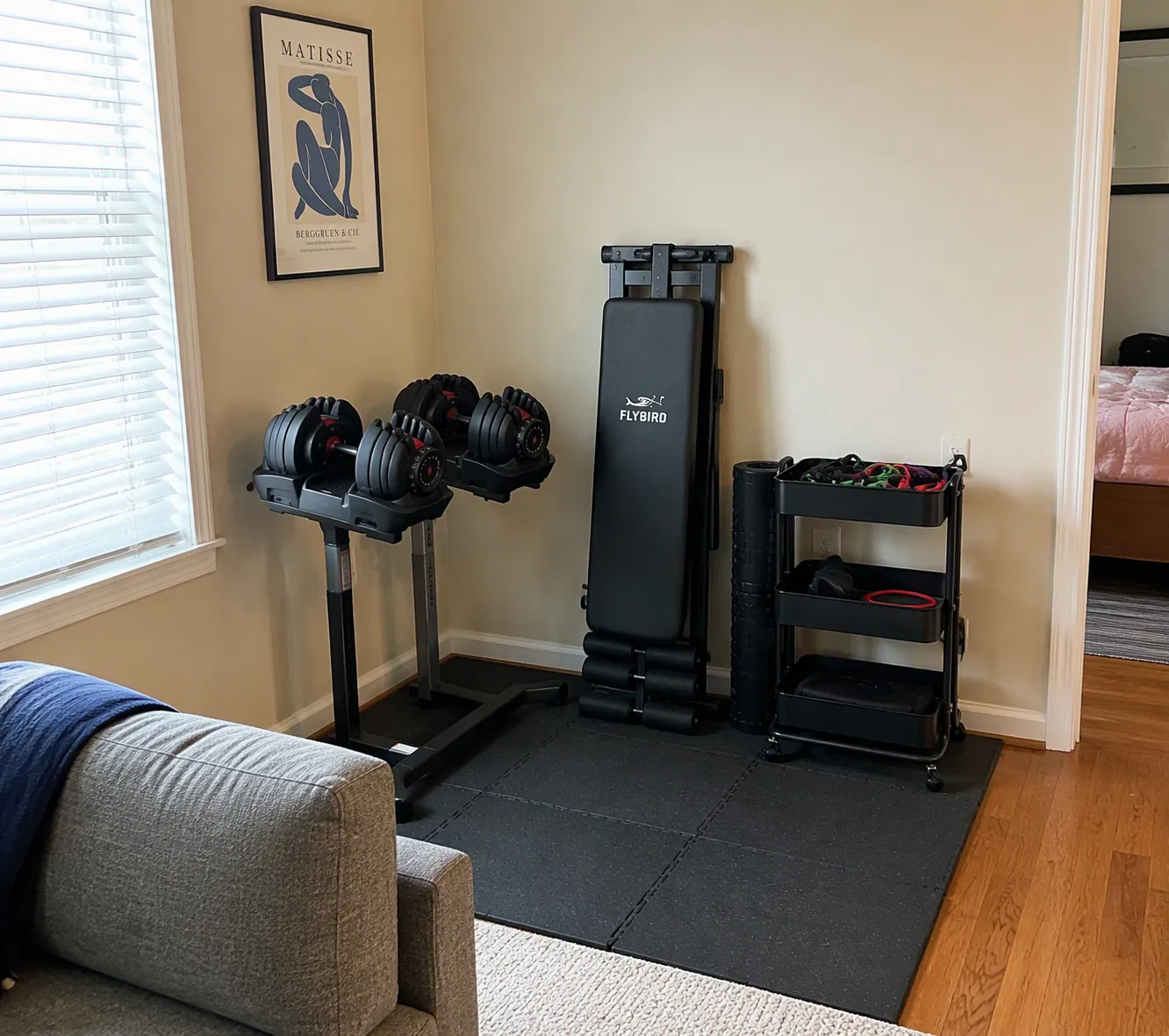
This is the tier where the apartment starts to feel like it has a real training corner, not just a clever drawer. The working zone is a 6x6 ft patch of rubber tiles over a rug pad. Adjustable dumbbells live on a small stand or against the wall. A folding bench opens only when needed, then disappears flat enough to lean behind a door, slide beside a wardrobe, or park under a bed if the frame allows it.
| Item | Approx. Role | Why It Belongs in the $300 Corner |
|---|---|---|
| Adjustable dumbbells | Main loading tool | Replaces several pairs without spreading metal across the room |
| Folding bench | Presses, rows, seated work, step-supported movements | Adds exercise range without becoming permanent furniture |
| 6x6 ft rubber-tile zone | Training surface and impact buffer | Defines the gym corner and protects the floor |
| Rug pad under tiles | Extra isolation layer | Keeps the setup removable and avoids glue or trim |
| Small cart or under-bed bin | Accessory storage | Stops collars, bands, gloves, and towels from migrating into the hallway |
The reason this tier earns the most space is not that it is glamorous. It is the best exchange between training return and apartment friction. Controlled dumbbell work sits in the 35-45 dB range in the source framework, and FitnessVolt’s renter-friendly standard treats no-damage setups that can be removed in under 30 minutes as a practical benchmark for reversibility.[1][2]
The tiles matter before the dumbbells do. A 6x6 ft square is large enough for a bench, standing lifts, split squats, rows, curls, and careful carries without forcing every rep into a strip of hallway. The better renter-safe method is 10-15mm rubber tiles over a rug pad, with no glue, no taped perimeter that leaves residue, and no cut trim pressed into baseboards. AnyRoomGym attributes a 16-23 dB impact-noise reduction to 10-15mm rubber flooring; that figure should be treated as source-derived rather than independently verified, but it is still the clearest reason this setup can be more neighbor-aware than bare-floor dumbbell work.[1]
The rug pad is not there to make the setup look finished. It gives the tile layer a little more decoupling from the floor and keeps the system removable. That matters on move-out day, when a renter does not want to explain adhesive marks, compressed carpet edges, or mystery scuffs under a bench foot. For a deeper floor build, the natural next read is the apartment floor guide on how to soundproof your apartment home gym floor.
How the Corner Works During a Normal Session
A good $300 corner has a rhythm. Pull the bench out. Set it flat or incline if the model allows. Bring the dumbbells onto the tiles before the set starts. Lift under control. Set the weights down with both hands, not with the little end-of-set drop that sounds harmless upstairs and rude downstairs.
That one behavior separates a workable apartment gym from a complaint waiting to happen. The flooring reduces impact, but it should not be asked to forgive deadlift habits. Dumbbell floor presses, bench presses, one-arm rows, goblet squats, Romanian deadlifts performed lightly and controlled, split squats, lateral raises, curls, overhead presses where ceiling height allows, and suitcase carries inside the tile zone are all realistic. Heavy deadlifts, Olympic lifts, plyometrics, and any lift that depends on dropping weight are not apartment-friendly in this setup.
Storage discipline is part of the build, not an afterthought. If the bench blocks a closet, it will be moved angrily. If the dumbbells sit where shoes need to go, they will migrate. If collars, bands, and towels have no home, the corner stops looking intentional within a week. A small rolling cart or under-bed bin is enough; the standard is simply that every loose item has somewhere to go without rearranging the apartment.
This is also the tier where product choice starts to matter. A folding bench that technically folds but remains too thick to store cleanly is not a compact bench in practice. Adjustable dumbbells that require slow plate changes may be fine for straight sets and annoying for circuits. If you want a product-level comparison after seeing the room layout, use the companion compact home gym equipment guide for apartments rather than turning this tour into a shopping list.
The $800 Tour: Better Cardio, More Capability, More Conditions
The $800 setup is not automatically the best apartment gym. It is the version for a renter who has already solved the corner problem and wants something the $300 tier does not provide: quiet cardio, pull-ups, or both. The same flooring logic still applies, but now the room has to answer harder questions about clearance, storage, and whether a machine can remain in place without taking over daily life.
| Upgrade | Source-Derived Noise / Space Constraint | Apartment Verdict |
|---|---|---|
| Magnetic exercise bike | Under 30 dB | The quietest cardio choice among these options and easier to justify than a walking pad when neighbors are close |
| Walking pad | 45-55 dB peak | Possible in some apartments, but noticeably more conditional than a bike |
| Freestanding pull-up tower | Needs 18-24 in ceiling clearance above the top bar | Only works if the room has enough overhead space and a permanent corner to spare |
| Treadmill | 60-70 dB | Excluded from these apartment tours |
A magnetic bike is the cleanest cardio addition because the noise stays under 30 dB in the source framework, which puts it closer to the $100 band setup than to a treadmill problem.[1] It still needs a mat or tile contact zone, partly for floor protection and partly because sweat and small machine movements are not kind to rental flooring over time.
A walking pad is more tempting than it is simple. The 45-55 dB peak range is not outrageous, but it is no longer the almost invisible sound profile of bands or a magnetic bike.[1] The user also has to store the machine, manage cord placement, and avoid placing repetitive footfall directly over a neighbor’s ceiling fan, bedroom, or work area if the apartment layout makes that obvious.
The pull-up tower is the upgrade most likely to be misjudged from a product photo. It is freestanding, so it avoids drilling into a wall or doorframe, but it does not avoid physics. The setup needs 18-24 inches of ceiling clearance above the top bar, and that clearance has to exist while a person’s head moves over the bar, not just while the tower stands empty.[1] In a room with low ceilings, a tower becomes expensive clothing storage with handles.
This tier can be excellent when the apartment has a dedicated corner. Bike on tiles, dumbbells beside it, bench folded flat, accessories in a cart, tower only if ceiling height checks out. It becomes a bad apartment gym when every session begins by dragging a machine around furniture or negotiating with a closet door.
What the Flooring Has to Do
The floor system has three jobs: reduce impact noise, protect the rental surface, and come apart cleanly. The most convincing method for these setups is not a permanent platform. It is a removable layer: rug pad first, then 10-15mm rubber tiles, sized to the work zone. AnyRoomGym’s 16-23 dB impact-noise reduction claim for 10-15mm rubber flooring is useful enough to guide the setup, as long as it is not treated as a universal promise for every building.[1]
A renter should be suspicious of anything that needs glue, screws, wall anchors, or a custom edge that traps the room into one layout. The better test is dull and effective: can the whole surface be lifted, vacuumed under, moved to another corner, and removed before a lease inspection without leaving a story behind?
- Use a rubber-tile zone only where training actually happens instead of covering the whole room.
- Put a rug pad under the tiles for a removable buffer between rubber and rental flooring.
- Keep dumbbell changes and set-downs inside the tile boundary.
- Avoid adhesive, nailed trim, or anything that changes the baseboards.
- Treat heavy drops as excluded, not as a flooring challenge to solve.
This is why treadmills do not appear in any of the tours. AnyRoomGym places treadmills at 60-70 dB, which is a different neighbor conversation than a magnetic bike or controlled dumbbell work.[1] In a detached garage, maybe. In a rental apartment, no.
Which Tour Should You Copy?
Start with the $100 drawer gym if silence, reversibility, and storage are the non-negotiables. It is the easiest setup to live with, the easiest to hide, and the least likely to create a deposit or neighbor problem. Its limitation is not effort; it is loading.
Choose the $300 corner if the real goal is strength training in an apartment. Adjustable dumbbells, a folding bench, and a 6x6 ft removable tile zone cover the most useful work for the least permanent disruption. This is the setup most renters should study before buying more equipment.
Move to the $800 version only when cardio or pull-ups are worth the extra footprint. A magnetic bike makes more apartment sense than a walking pad when noise is the deciding factor. A pull-up tower makes sense only after measuring ceiling clearance above the bar, not after admiring the product photo.
None of these tours does everything. That is the relief in them. A small apartment gym works when quiet, floor-safe, storable gear outranks equipment volume.
References
Some links on this page are affiliate links — they may earn us a commission at no extra cost to you. Our tier and tests are decided before we ever check which links pay; see our full affiliate disclosure.
Spot something off?
Noise and floor-damage claims carry real deposit-risk consequences if we get them wrong — tell us if your experience with this build didn't match what's above.