
Build a Tennis Home Training Routine That Fits Your Equipment and Space
A tiered weekly training plan for recreational tennis players that builds foot speed, rotational power, and endurance in a small apartment corner, using bodyweight, resistance bands, or basic dumbbells — no full gym required.
What this routine assumes
Equipment required: bodyweight, resistance bands, dumbbells
This routine assumes gear from the 0-150 tier.
The routine
- Duration
- 20-45 min
- Difficulty
- Beginner
- Space needed
- 3m x 4m
- Noise level
- Low
Here is the tennis home training routine I would actually use in a spare-room corner: 2–3 off-court sessions per week, 20–45 minutes each, in roughly 3m x 4m of space, with the exercises swapped according to what you own. Tennis Nation uses that 2–3 session, 20–45 minute range for recreational circuit work, while Tennis Fitness sets 3m x 4m as the minimum home-training footprint for its program.[1][2]
| Day | Session | Time | Main job | Equipment tier |
|---|---|---|---|---|
| Day 1 | Strength + rotational power | 30–45 min | Leg drive, trunk control, shoulder-friendly pushing and pulling | Bodyweight, band, or dumbbells |
| Day 2 | Footwork + conditioning | 20–35 min | Split-step timing, first step, recovery steps, repeat efforts | No equipment needed; jump rope optional |
| Day 3 | Recovery + prehab | 20–30 min | Shoulders, hips, calves, ankles, easy mobility | Bodyweight or band |
This is a synthesis of tennis fitness sources, not a lab-tested week-by-week program. The point is to keep the weekly jobs consistent: one day that makes your legs and trunk stronger, one day that makes your feet sharper, and one day that keeps the usual tennis trouble spots from getting ignored.
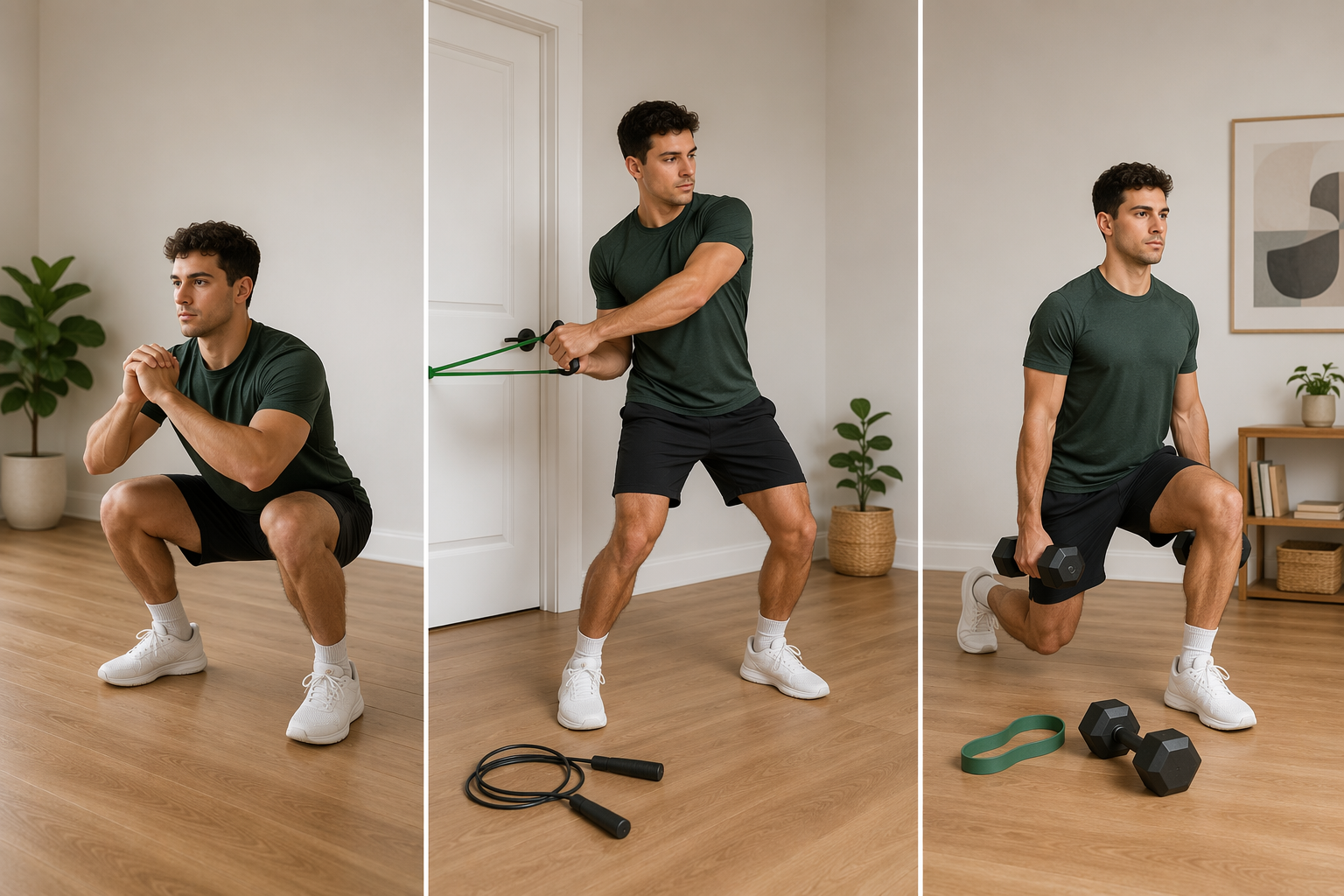
Choose the Tier You Already Have
Do not wait for the perfect setup. A $0 version is not fake training. Bands make the rotational and shoulder work cleaner. Dumbbells make lower-body strength easier to load. But the routine only works if it fits the week you actually live in.
| Tier | Use this if | What it does well | Main limit |
|---|---|---|---|
| $0 bodyweight | You have floor space and no gear | Single-leg strength, trunk stiffness, basic footwork, conditioning | Harder to load strength over time |
| Approx. $0–50 band + jump rope | You own or can add a loop band, long band, or rope | Rotational pulls, shoulder prehab, hip activation, rhythm work | Door anchors and band angles need attention |
| Approx. $50–150 dumbbells + band | You have one or two basic dumbbells and a band | Loaded legs, rows, carries, lunges with rotation | Weight jumps may be uneven or too light later |
If you do decide to add gear later, avoid turning a small room into an obstacle course. The mistakes are usually predictable: buying bulky equipment first, ignoring storage, and leaving no room to move. For that, use a compact setup guide like 7 Mistakes People Make When Building a Compact Home Gym before you spend money.
Session 1: Strength and Rotational Power
This is the session that helps when you are pulled wide, recover late, and still need to hit something heavier than a guided arm swing. Keep the work controlled. Rest enough that the final reps still look athletic.
| Block | $0 bodyweight | Band tier | Dumbbell + band tier |
|---|---|---|---|
| Warm-up, 5–7 min | March, hip circles, inchworm, lateral shuffle in place | Same + light band pull-aparts | Same + light goblet squat patterning |
| Lower-body strength, 3 rounds | Split squat 8–10/side; squat 12–15 | Split squat 8–10/side; banded lateral walk 10/side | Goblet squat 8–10; reverse lunge 8/side |
| Push/pull, 3 rounds | Push-up 6–12; prone Y-T raise 8 each | Push-up 6–12; band row 10–15 | Dumbbell row 8–12/side; dumbbell floor press 8–12 |
| Rotation, 3 rounds | Dead bug with reach 8/side; slow shadow forehand 6/side | Band forehand pull 8–10/side; band backhand pull 8–10/side | Lunge with rotation 6–8/side; band anti-rotation hold 15–20 sec/side |
| Carry or core finisher, 2–3 rounds | Side plank 20–40 sec/side | Tall-kneeling band anti-rotation press 8–10/side | Farmer carry in place or around room 30–45 sec |
The exercise choices are not random gym leftovers. PureGym’s tennis strength recommendations include lunges, squats, planks, glute bridges, push-ups, split squats, goblet squats, dumbbell rows, dumbbell press variations, lunges with rotation, and farmer carries.[3] Verywell Fit also emphasizes compound strength work for tennis conditioning, while Planet Fitness lists lower-body and core strength exercises that overlap with the same job: legs that can push, brace, and repeat.[4][5]
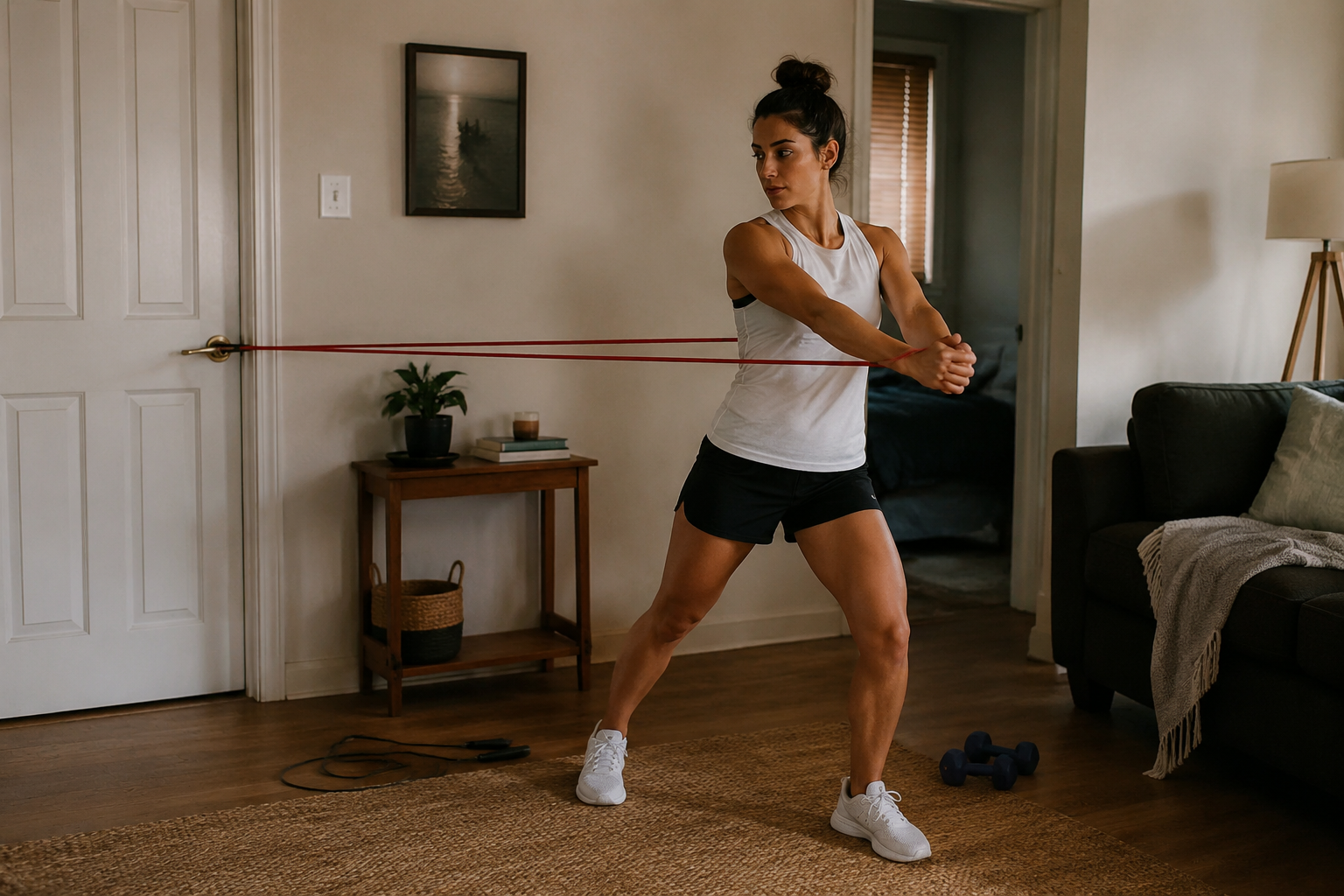
The band tier earns its keep on rotation. Tennis Fitness demonstrates band work that copies forehand and backhand rotational patterns through a fuller range of motion, which is much closer to tennis than doing another set of generic crunches beside the couch.[2] Road to 4.5 Tennis also uses band rows and external rotation in its tennis workout and prehab programming.[6]
How the Rotation Should Feel
Anchor the band around chest height if the anchor is secure. Stand sideways to it. Start with your outside foot lightly loaded, ribs down, and both hands on the band. Turn through the hips and trunk, then let the arms follow. If the band makes you twist your lower back while your feet stay dead, lighten the resistance.
For bodyweight training, the shadow swing is not theater. Treat it as a slow rehearsal of the sequence you want under pressure: split, turn, load, swing, recover. Six good reps are more useful than twenty lazy ones where the knees never bend.
Session 2: Footwork in a 3m x 4m Space
Small-space footwork is not about pretending your living room is a baseline. It is about training the pieces that show up before and after the stroke: split-step timing, first push, deceleration, spacing, and recovery.
| Drill | How to do it | Work |
|---|---|---|
| Split-step callout | Bounce into a split step, then move one step left, right, forward, or back on a verbal cue or timer beep | 6 rounds of 20 sec, 40 sec rest |
| X-pattern recovery | Mark center and four corners with tape, socks, or cone dots; move center-corner-center with tennis recovery steps | 4–6 rounds of 30 sec |
| Ladder-style quick feet | Use floor lines or imaginary boxes; move in-in-out-out, lateral in-in-out-out, then crossover steps | 3 patterns, 2 rounds each |
| Shadow wide ball | Split, push to the side, load outside leg, shadow forehand or backhand, recover to center | 3 rounds of 5 reps/side |
| Optional rope rhythm | Jump rope easy, staying quiet and relaxed | 5 rounds of 30 sec, 30 sec rest |
UTR Sports describes pattern-based drills such as shadow patterns, X-pattern cone work, and ladder-style movements for split-step timing, first-step explosiveness, and recovery speed.[7] Functional Tennis lists zero-equipment agility drills including Spider, Lateral Sprint, Star, Mirror, and Zig Zag drills, and says these are used by coaches training top-100 juniors.[8]
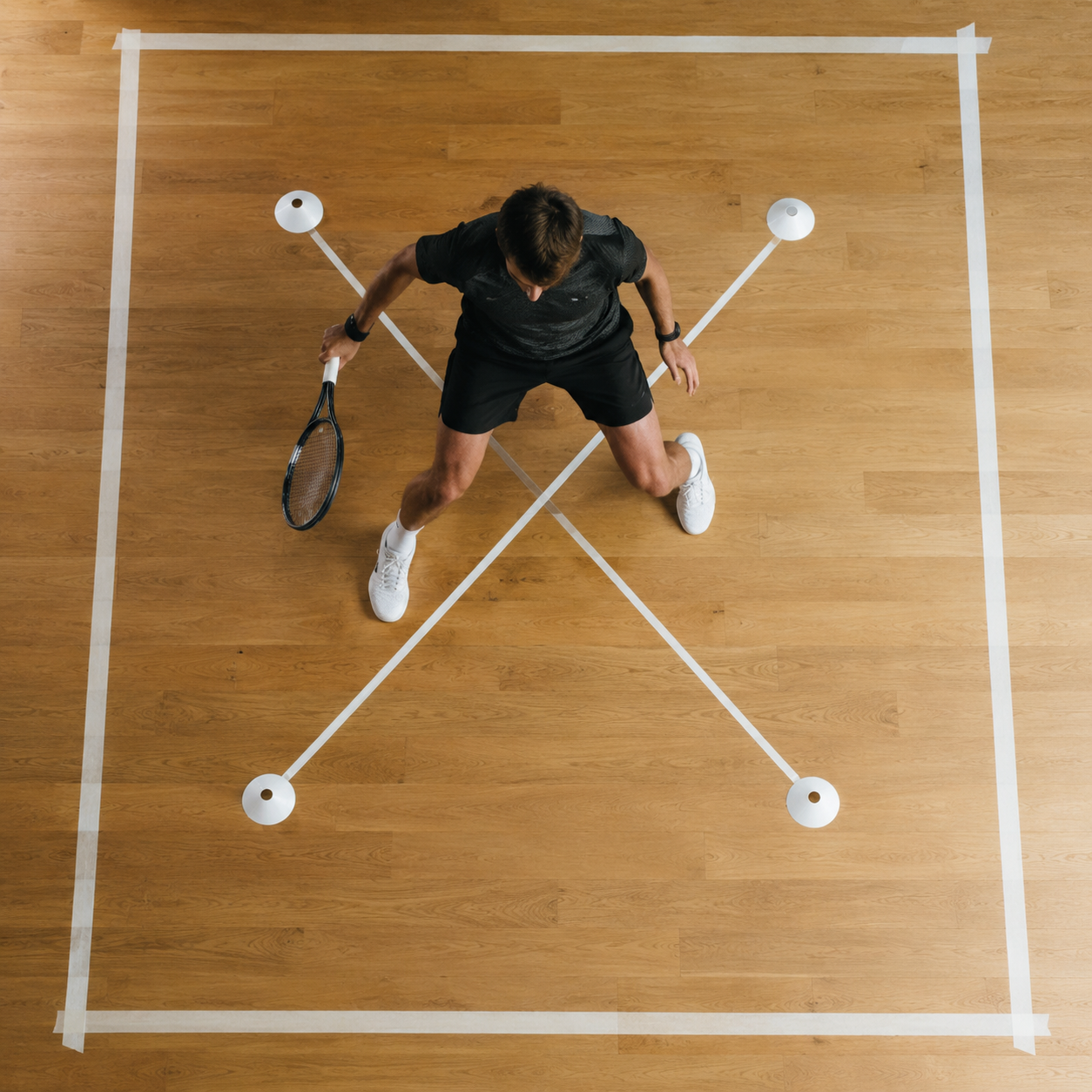
If you are newer to footwork drills, start slower than your ego wants. A useful rep has three parts: you split before you move, you arrive balanced enough to swing, and you recover without standing tall. If one of those disappears, the drill has turned into cardio.
A Simple X-Pattern Setup
- Put one marker in the middle of your space.
- Put four markers around it: front left, front right, back left, back right.
- Start at center, split step, move to one marker, shadow a compact stroke or volley, then recover to center.
- Change the order every round so you do not memorize the pattern too comfortably.
The space stays small, but the tennis demand is real: push, brake, hit, recover, repeat. That is the sequence that tends to fall apart late in a second set.
Session 3: Recovery, Shoulders, Hips, and Calves
This day should feel like maintenance, not punishment. If you play a lot, this may be the session that keeps the rest of the plan from becoming another source of soreness.
| Exercise | Bodyweight version | Band version | Dose |
|---|---|---|---|
| Shoulder external rotation | Side-lying rotation without load, slow | Elbow at side, rotate hand outward against light band | 2–3 sets of 10–15/side |
| Shoulder internal rotation | Isometric palm press into wall | Elbow at side, rotate hand inward against light band | 2 sets of 10–15/side |
| Monster walk | Mini-squat lateral steps without band | Band above knees or at ankles | 2–3 sets of 8–12 steps/side |
| Calf raise | Two-leg or single-leg calf raise | Same, holding band or wall for balance | 2–3 sets of 10–15 |
| Ankle mobility | Knee-to-wall rocks | Same | 1–2 min/side |
| Hip bridge | Glute bridge or single-leg bridge | Band above knees | 2–3 sets of 10–12 |
On Running’s strength coach Gabriel Echevarria recommends a shoulder “housekeeping routine” with internal and external rotation before sessions, and also notes that bodyweight circuits with tennis-specific movement patterns can build functional strength.[9] Road to 4.5 Tennis prescribes prehab work including monster walks, external rotation, calf strengthening, and ankle mobility three times per week.[6]
If band technique still feels awkward, a general beginner guide like this resistance band workout guide can help with setup and tension control. The tennis version stays lighter and cleaner than a general muscle-building band workout.
How to Fit It Around Actual Tennis
The routine should support court time, not compete with it. If you play one match a week, you can usually handle all three sessions. If you play three or four times a week, two short sessions may be plenty.
| Your tennis week | Best home-training setup | What to avoid |
|---|---|---|
| 1 court day | Strength day, footwork day, recovery day | Turning the footwork day into a max-effort HIIT session |
| 2 court days | Strength day plus recovery/prehab day; add short footwork if legs feel good | Heavy lunges the day before a match |
| 3 court days | One 30–40 min strength session and one 20 min prehab session | Trying to force three hard off-court workouts |
| 4 court days | One short strength maintenance session or two very light prehab sessions | Adding fatigue just to complete the plan |
A clean week might look like this: Monday strength, Tuesday hit, Wednesday recovery, Thursday hit, Saturday footwork, Sunday match. Another clean week might be Tuesday match, Thursday strength, Saturday hit, Sunday prehab. The order matters less than the rule: do not put your hardest leg session right before the tennis session you care about most.
Progress Without Turning the Room Into a Gym
Run the same plan for three to four weeks before changing it. Recreational players often rotate exercises too quickly and then wonder why nothing feels different on court. You want enough repetition to notice whether you are pushing off faster, staying lower, and recovering sooner after wide balls.
- Week 1: learn the movements and stop every set with clean reps left.
- Week 2: add one set to the main strength block or one round to the footwork block.
- Week 3: make one exercise harder by slowing the lowering phase, adding band tension, or using dumbbells.
- Week 4: keep the volume steady and track whether the tennis feels better, not whether the workout feels more dramatic.
Good progression in this routine is boring in the right way. Add a rep, add a set, use a slightly stronger band, hold the side plank longer, or make the X-pattern sharper. You do not need broad jumps in an apartment or a sled you cannot store.
If the dumbbell tier starts to make sense, keep the upgrade small and practical. Adjustable dumbbells, a reliable band, and open floor space beat a crowded room full of equipment you step around. For a broader buying plan, see How to Build a Home Gym Under $500 in a Small Space.
The 20-Minute Version for Busy Weeks
Some weeks do not deserve a heroic plan. Use this when work runs late, court time is high, or your legs are still carrying the last match.
| Minute | Do this |
|---|---|
| 0–4 | Warm up: march, hip circles, lateral shuffle, light shoulder rotation |
| 4–10 | Strength pair: split squat 8/side + push-up or band row 10–12; repeat |
| 10–15 | Footwork: split-step callout or X-pattern recovery, 5 rounds of 20 sec |
| 15–18 | Rotation: shadow swings, band forehand/backhand pulls, or lunge with rotation |
| 18–20 | Shoulders and calves: external rotation + calf raises |
That is enough to keep the habit alive. If you want a non-tennis cross-training day with bands and small-space equipment, this resistance-band and kettlebell home workout can sit in the week, but do not add it on top of heavy tennis unless recovery is already good.
What to Track on Court
Track the things you can actually feel in a club match. Are you split-stepping more often before the opponent hits? Are you getting a cleaner first push to the wide forehand? Are you still using your legs late in the second set, or are you arming the ball again? Are your shoulder warm-ups making the first service game feel less abrupt?
A small-space tennis home training routine cannot replace coaching, hitting volume, or medical rehab. It can give you repeatable work for foot speed, rotational control, shoulder durability, and late-match legs without needing a full gym. Choose the tier you already have, schedule the next week, and give it a few weeks before deciding whether the first step and the last two games feel different.
References
- Tennis Fitness Circuit Workouts: 4 Complete Routines, Tennis Nation
- Tennis Fitness Workout for Home, Tennis Fitness
- The Best Gym Exercises for Tennis Players, PureGym
- Tennis Strength Training and Conditioning Program, Verywell Fit
- 9 Best Strength Exercises for Tennis Players, Planet Fitness
- Tennis Workouts & Fitness Training, Road to 4.5 Tennis
- Tennis Footwork Drills, UTR Sports
- 5 Agility & Footwork Drills for Tennis Players That Need No Equipment, Functional Tennis
- 12 tennis workouts for different skill levels, On Running
Missing the equipment, or need to rest?
- How to Build a Better Tennis Forehand at Home in 15 Minutes
- Soccer Conditioning Workout for Your Apartment (No Equipment)
- Build a Golf Workout Routine for Home on Any Budget
Sore or unsure how much rest you need? Read Recovery & Rest— this routine doesn’t cover injury-specific advice.
Comments
Join the discussion with an anonymous comment.