Soccer Conditioning Workout for Your Apartment (No Equipment)
A bodyweight-only soccer conditioning routine designed for apartment spaces. Maintain match fitness with HIIT, plyometrics, and core work — no equipment needed, takes just 20-30 minutes.
What this routine assumes
Equipment required: None
This routine assumes gear from the $0 tier.
The routine
- Duration
- 25 min
- Difficulty
- intermediate
- Space needed
- 6x6 ft
- Noise level
- Moderate
You can get a useful soccer session done in an apartment if the workout respects the limits of the room: no cones, no weights, no hallway sprints, and no pretending your downstairs neighbor wants to hear jump lunges for 20 minutes. The point of this soccer home workout routine is narrower and more honest: keep the legs explosive, the trunk stiff, the single-leg control sharp, and the conditioning close enough to game demands that you are not starting from zero when you get back on a field.
| Training Contract | Details |
|---|---|
| Category | workout-routines |
| Equipment | None |
| Budget tier | $0 |
| Duration | 20-30 minutes |
| Space | About 6x6 ft of clear floor |
| Noise level | Moderate with jumps; quiet with the low-impact substitutions |
| Best use | Match-fitness maintenance when you cannot access a field or gym |
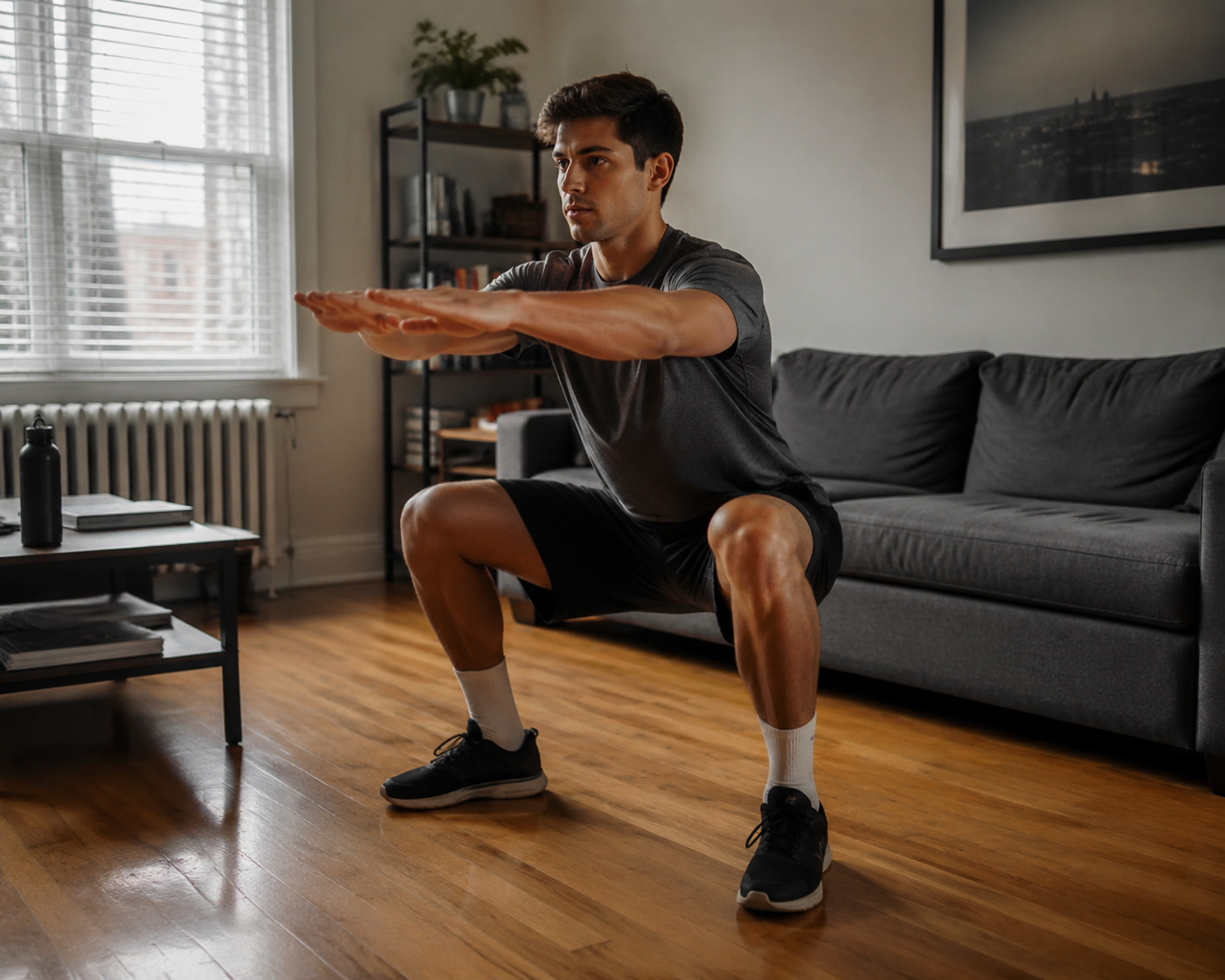
Clear the floor first. Push the coffee table aside, check the ceiling if you plan to jump, and give yourself enough room to lunge forward, step back, plank, and run in place without clipping furniture. If you live above someone, use the quiet track from the start instead of waiting until the first loud landing.
The Full Apartment Session
Use this flow exactly the first time. Once you know the movements, the whole session runs cleanly: warm up, hit a short power block, slow down for single-leg control, push the conditioning, finish with core, then cool down.
| Block | Time | Work |
|---|---|---|
| Warm-up | 4-5 minutes | Dynamic movement prep |
| Power | 4-6 minutes | Jump squats or quiet squat-to-calf-raise |
| Single-leg/control | 6-8 minutes | Reverse lunges, lateral lunges, single-leg hinge reaches |
| HIIT conditioning | 8 minutes | 40 seconds work / 20 seconds rest |
| Core finisher | 3-4 minutes | Plank, side plank, dead bug |
| Cool-down | 2-3 minutes | Breathing, hips, calves, quads |
The conditioning block uses a 40-second work and 20-second rest structure adapted from TraceUp Academy’s indoor HIIT example for soccer players. That source is useful as a timing template, not proof that this exact apartment routine has been tested as a multi-week program.[1]
Warm-up: 4-5 Minutes
Do not skip this and then blame the workout for feeling stiff. Under Armour’s offseason soccer guide uses dynamic movement prep in its warm-up logic, which fits this setting better than long static stretching before you ask your legs to jump, brace, and change direction.[2]
- March in place with arm drive — 45 seconds. Start easy, then build the rhythm.
- Hip circles and leg swings — 30 seconds per side. Hold a wall if balance is the limiting factor.
- Bodyweight squats — 10 reps. Keep the feet quiet and the knees tracking over the toes.
- Alternating reverse lunges — 8 reps per side. Step back under control, then drive through the front foot.
- Low pogo bounce or calf raise — 30 seconds. Use calf raises if bouncing is too loud.
Power Block: 4-6 Minutes
Soccer power is not only about jumping high. It is the ability to load quickly, extend hard, land safely, and repeat the action without your knees folding inward. Mass General Brigham’s soccer strength guidance emphasizes plyometrics alongside fundamental movement patterns and core stabilization, with strength work recommended 2-3 times per week.[3]
Do 3 rounds. Rest 30-45 seconds between rounds.
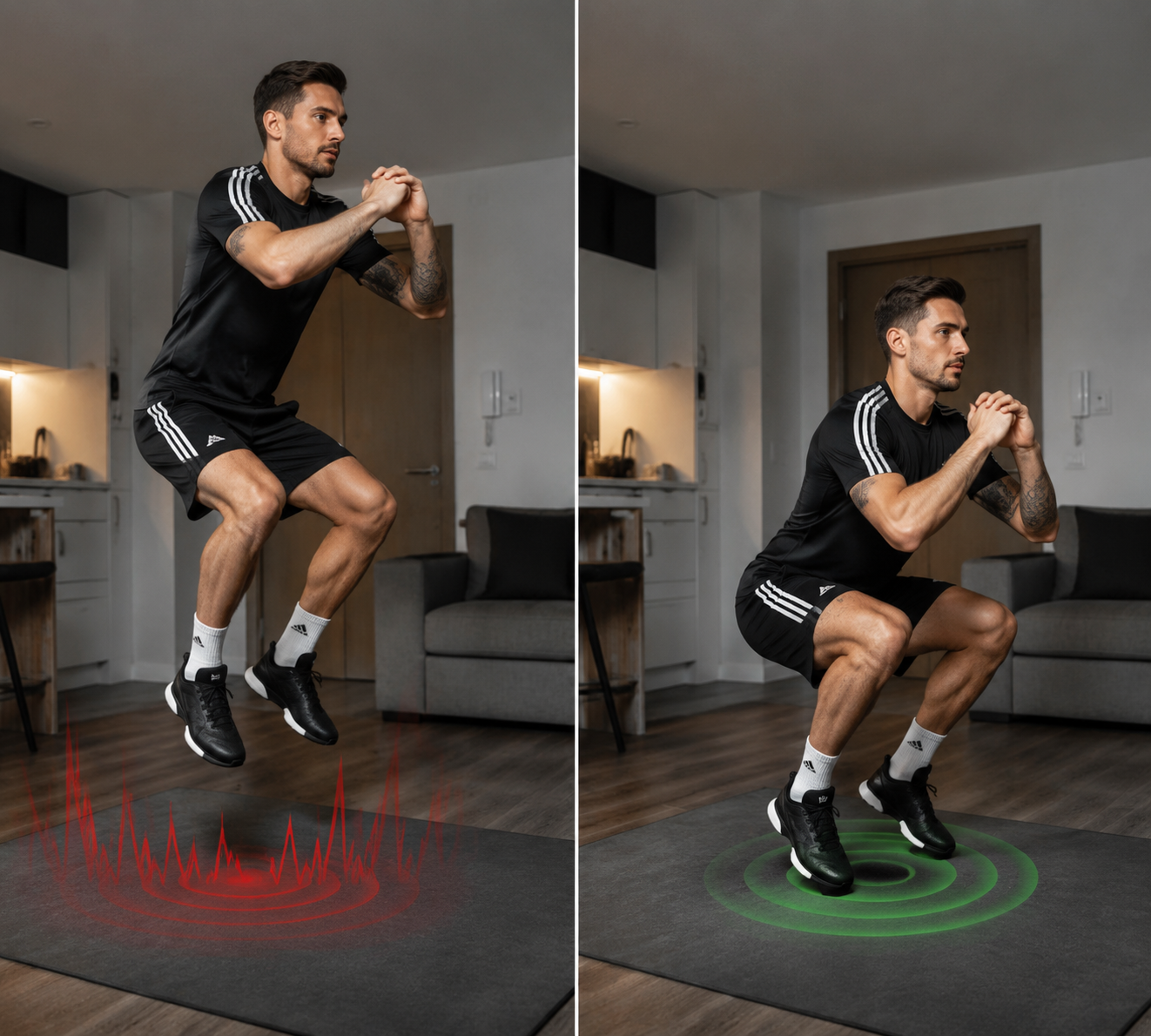
- Jump squat — 8-10 reps. Sit into a squat, jump straight up, land softly, reset for one beat, then repeat.
- Split-squat pulse — 8 reps per side. Hold a lunge stance, lower two inches, rise two inches, then stand tall after the final rep.
- Standing broad-load without travel — 6 reps. Hinge the hips back, swing the arms, rise fast onto the toes, and stop before leaving the floor if space is tight.
BlazePod includes jump squats, lunges, and core work among its soccer exercise selections, including a jump-squat example of 3 sets of 15 reps.[4] In an apartment, fewer cleaner reps usually beat chasing that higher count while landing heavy.
Single-leg and Control Block: 6-8 Minutes
Outside backs, wingers, midfielders, center backs under pressure — everyone eventually has to plant one foot, absorb contact, and still make the next action. This block is slower than the power work on purpose. If you rush it, you turn useful control work into sloppy cardio.
Do 2 rounds. Move steadily and rest only as needed between exercises.
- Reverse lunge — 10 reps per side. Step back softly, keep most of the pressure through the front foot, and stand up without pushing off the back toes.
- Lateral lunge — 8 reps per side. Sit the hips toward one side while the opposite leg stays long; return by pushing the floor away.
- Single-leg hinge reach — 6-8 reps per side. Balance on one leg, hinge forward, reach both hands toward the floor, then stand tall.
- Wall drive hold — 20 seconds per side. Hands on the wall, one knee up, standing leg strong, ribs down, glute tight.
The wall drive hold looks simple until you do it honestly. It teaches the same shape you need when accelerating: one knee punched up, one foot driving down, trunk braced instead of leaking backward.
HIIT Conditioning Block: 8 Minutes
Set a timer for 8 rounds: 40 seconds of work, 20 seconds of rest. Work hard, but not like the last minute of extra time. The first round should feel controlled enough that the fifth round is still athletic.
| Round | Exercise | Soccer Emphasis |
|---|---|---|
| 1 | High knees or fast march | Running rhythm and arm drive |
| 2 | Skater step or skater hop | Lateral push-off and landing control |
| 3 | Squat thrust walk-out or burpee without push-up | Full-body bracing under fatigue |
| 4 | Quick feet in place | Short contacts and reaction posture |
| 5 | High knees or fast march | Repeat sprint-style effort |
| 6 | Skater step or skater hop | Side-to-side control |
| 7 | Mountain climber slow-fast mix | Hip drive and trunk stiffness |
| 8 | Quick feet in place | Finish with clean speed, not noise |
For quick feet, stay low enough that you could defend a dribbler. The mistake is standing upright and tapping the floor as fast as possible. Keep the hips back, chest angled slightly forward, arms active, and feet under you.
Core Finisher: 3-4 Minutes
Core work for soccer is mostly about resisting movement. You are bracing when you shield, when you land, when you cut, and when someone leans into you. Mass General Brigham specifically names core stabilization as one of the strength categories soccer players should train.[3]
- Forearm plank — 30-40 seconds. Squeeze glutes, pull ribs down, breathe without letting the low back sag.
- Side plank — 20-30 seconds per side. Stack the feet or stagger them if needed.
- Dead bug — 8 reps per side. Move slowly enough that your back position does not change.
Cool-down: 2-3 Minutes
Walk around the room until your breathing settles. Then spend a short stretch on the hip flexors, calves, and quads. This does not need to become a separate mobility class; just give your legs a clear off-ramp before you sit back down.
Quiet-floor Substitutions That Still Train Hard
Low impact does not have to mean easy. It means you remove the airborne part and make the muscles do the work through control, range, tempo, and intent. If every landing sounds like a dropped boot, switch immediately.
| Loud Version | Quiet Swap | How to Keep It Intense |
|---|---|---|
| Jump squat | Squat to calf raise | Lower for 3 seconds, drive up fast, squeeze the calves at the top |
| Jumping lunge | Reverse lunge | Pause at the bottom, stand up hard through the front leg |
| High knees | Fast march | Keep the arms sharp and bring each knee to hip height |
| Skater hop | Skater step | Reach the trailing leg behind without letting the front knee cave in |
| Burpee | Squat thrust walk-out | Step back to plank, brace, step in, stand fast |
| Pogo jumps | Calf raise pulses | Use continuous tension and avoid bouncing through the ankles |
The main tradeoff is simple: when you remove impact, add control. Slow eccentrics, pauses, and sharper intent on the way up keep the session demanding without shaking the floor. A quiet reverse lunge with a real pause can be more useful than a loud jumping lunge that collapses at the knee.
For the HIIT block, quiet does not mean drifting. During a fast march, drive the elbows back and keep the stance tall. During skater steps, push sideways instead of just stepping side to side. During walk-outs, brace the plank like someone is about to shoulder you off the ball.
How Hard This Should Feel
Start at seven out of ten effort, not ten. A useful apartment session should leave you breathing hard and moving better, not stumbling through ugly reps because the timer bullied you. If your knees cave in on lunges, your plank sags, or every rest period becomes a rescue mission, reduce the range or take another 20 seconds.
Beginners should run one round of each block for the first week and keep the HIIT section to 4-6 rounds. More experienced players can use the full session and add a third round to the single-leg block when recovery is good. The goal is repeatable work, because soccer fitness depends on producing again after partial recovery.
Weekly Use
Use this routine 2-3 times per week when you are away from field training. That frequency lines up with Mass General Brigham’s recommendation that soccer players strength train 2-3 times weekly.[3] Svetness also suggests 3-4 weekly home sessions for soccer players, which can work if your legs are recovering and you are not stacking hard sessions on top of practices or matches.[5]
A practical week could look like this: one full session early in the week, one quiet version midweek, and one shorter conditioning-focused version if you are not playing on the weekend. If you have a Sunday league match, do not turn Saturday night into a punishment circuit. Keep it light or skip it.
This is not a full replacement for field work. It will not train long sprints, ball striking, scanning, defending space, or the awkward timing of real opponents. It is a $0 apartment routine for keeping useful qualities alive: explosive legs, single-leg control, trunk stiffness, repeated high-intensity effort, and enough conditioning that the first game back does not feel like a shock.
References
Missing the equipment, or need to rest?
- Build a Tennis Home Training Routine That Fits Your Equipment and Space
- Luis de la Fuente's Bicep Workout You Can Do at Home
- Caitlin Clark's Home Workout Drills Without a Full Court
Sore or unsure how much rest you need? Read Recovery & Rest— this routine doesn’t cover injury-specific advice.
Comments
Join the discussion with an anonymous comment.