
What Boxing Training Can You Afford at Home?
This tiered guide breaks down boxing training at home into three clear budget levels — $0, under $100, and under $300 — with specific workout plans matched to each tier. Start with bodyweight shadowboxing today and upgrade gear only when you outgrow it.
- Equipment tier required
- none
- Duration
- 30 min
- Difficulty
- beginner
- Target area
- full body
| Budget tier | What it unlocks | A realistic session | Weekly use | Upgrade when |
|---|---|---|---|---|
| $0 | Bodyweight shadowboxing, footwork, defense, and conditioning. A controlled 30-minute FightCamp bodyweight boxing workout averaged 482 calories, 2,836 punches, a sustained 145 bpm heart rate, and a 180 bpm max heart rate among existing users ages 30–39 [1]. | Warm up, shadowbox in rounds, add footwork and defensive moves, finish with bodyweight conditioning. | 2–4 short sessions per week, depending on recovery and other training. | You are consistent, combinations feel automatic, and you want impact feedback or power pacing. |
| Under $100 | More structure: wraps, light gloves, a jump rope, a timer, floor markers, or a simple mirror/camera setup. None of it is mandatory, but it makes training easier to repeat. | Rope or footwork warm-up, gloved shadowboxing, combination rounds, conditioning intervals. | 2–4 sessions per week, often alternating harder conditioning days with lighter technique days. | You want to hit something, have enough room, and can handle the noise, storage, and floor concerns. |
| Under $300 | A functional bag-oriented setup if current prices, shipping, space, and mounting options cooperate. BoxingInsider’s home-gym guide is useful for thinking in staged budget ranges, but exact 2026 costs vary and shipping can change the math [2]. | Shadowbox first, then work the bag in controlled rounds, then finish with conditioning or mobility. | 1–3 bag sessions per week, with recovery space around hard rounds. | Upgrade beyond this only for a specific limitation: coaching, better mounting, more durable gear, or sport-specific progression. |
The useful question is not “what does a complete home boxing gym include?” It is “what can I train this week without buying a heavy object I may hate moving later?” Boxing training at home changes meaningfully at each tier: $0 gives you rhythm and conditioning, under $100 gives you repeatable structure, and under $300 is where a bag can change the feel of the workout.
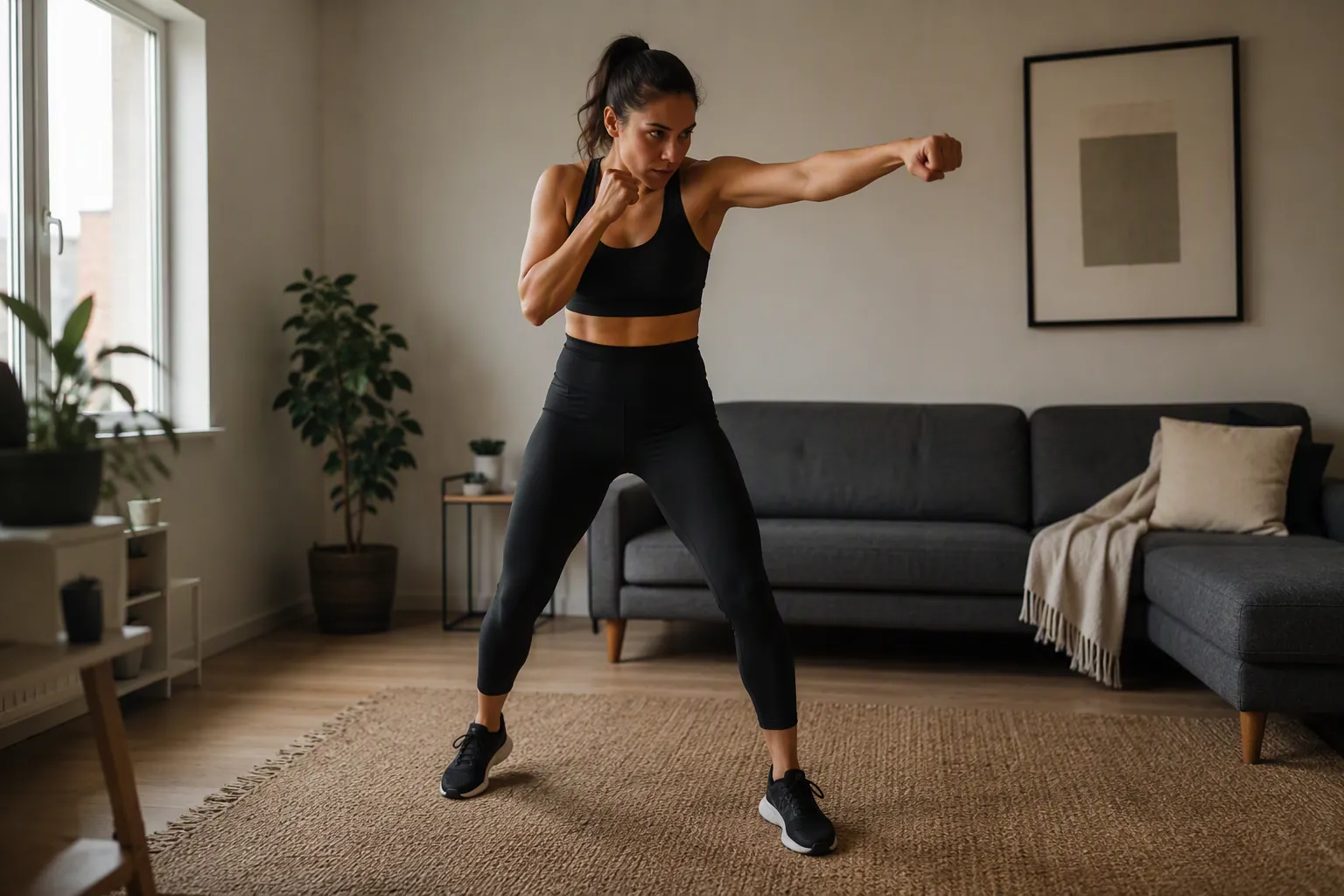
The $0 tier: shadowboxing is not a placeholder workout
The $0 tier is where people are most often made to feel underprepared. That is backwards. If you have enough room to stand, step forward and back, pivot a little, and extend your arms without clipping a lamp, you can train boxing patterns, footwork, breathing, balance, and conditioning today.
The strongest evidence here is not that every beginner will torch hundreds of calories immediately. The FightCamp case study used 14 existing FightCamp users ages 30–39 in a controlled 8-round, 30-minute workout with heart-rate monitors; they averaged 482 calories burned, 2,836 punches thrown, a sustained heart rate of 145 bpm, and a max heart rate of 180 bpm [1]. That is not a universal promise for a first session in a spare bedroom. It does show that bodyweight-only boxing can reach legitimate HIIT-level intensity when the rounds are structured and the athlete works hard.
A second, lighter datapoint points the same direction: Legends Boxing says shadowboxing alone can burn more than 200 calories in 30 minutes [3]. Because that comes from a commercial boxing source, treat it as a broad training claim rather than a precise personal forecast. The practical takeaway is still useful: no bag does not mean no workout.
What the workout feels like
Shadowboxing feels easy only when it is loose arm-swinging. Once you hold a stance, keep your guard up, rotate through the hips, bring punches back to your face, move after combinations, and work on a round clock, the work shifts into your legs and lungs quickly. FightCamp’s beginner guide emphasizes stance, basic punch mechanics, and simple combinations as the starting point for boxing at home [4]. That is enough for a real first month.
The tradeoff is clear: the air will not tell you whether your punch landed cleanly, and it will not teach you how impact travels through the wrist, shoulder, and feet. You have to create difficulty through pace, precision, movement, and conditioning instead of pretending shadowboxing is the same as bag work.
A $0 session you can actually repeat
- Warm up with light bouncing, shoulder circles, hip hinges, easy squats, and slow stance switches.
- Set your stance: feet staggered, knees soft, chin down, hands up, elbows close enough that your ribs are not abandoned.
- Round 1: jab only. Step in, jab, step out. Reset your guard every time.
- Round 2: jab-cross. Add hip rotation, then move after every combination.
- Round 3: jab-cross-slip-cross. Keep the slip small; do not turn it into a waist-bending dance move.
- Round 4: freestyle combinations using only punches you can bring back cleanly.
- Round 5: footwork only. Step forward, back, left, right, then pivot without crossing your feet.
- Finish with bodyweight conditioning: squats to guard, mountain climbers, plank shoulder taps, or fast-feet intervals.
If you want a fully guided version instead of building the rounds yourself, use this no-equipment boxing workout at home. If your punches are fine but your feet keep tangling, spend time with these home boxing footwork drills before adding more combinations.
How to make the $0 tier harder without making it sloppy
- Use a round timer instead of stopping when you feel bored.
- Add a defensive move after every combination: slip, roll, step out, or pivot.
- Keep your stance lower for selected rounds, but do not let your knees collapse inward.
- Film one round from the front and one from the side. Watch whether your hands return to guard.
- Alternate fast rounds with technical rounds so every session does not become frantic arm cardio.
- Put a small object on the floor as a center marker and move around it instead of drifting across the room.
The right time to leave the $0 tier is not the moment an ad shows you gloves. It is when you have used the free version enough to know what is missing. If the missing piece is rhythm, conditioning, or coordination, stay here. If the missing piece is feedback from contact, then the next tiers begin to make sense.
Under $100: small gear that adds structure, not a new identity
The under-$100 tier is a bridge. It should not turn into a pretend home gym assembled from five “essential” accessories. The best small purchases make the workout easier to repeat: hand wraps, light gloves, a jump rope, a visible timer, floor tape, or a cheap mirror/camera angle. Current prices vary, so the point is not to buy a fixed list. The point is to add one or two tools that solve an actual training problem.
| Problem in the $0 tier | Small upgrade that can help | What it changes |
|---|---|---|
| You drift through rounds without intensity. | Round timer or interval app. | The clock decides when the round ends, not your mood. |
| Your shoulders fatigue before your lungs do. | Light gloves for shadowboxing. | More shoulder endurance and a more realistic guard demand. |
| Your feet are slow or noisy. | Jump rope or floor markers. | Better rhythm, lighter steps, and clearer boundaries in a small room. |
| You cannot see technical errors. | Mirror, phone tripod, or simple camera angle. | Immediate feedback on stance, guard, and punch return. |
| You plan to hit a bag later. | Hand wraps and gloves. | A foundation for impact work when you actually have something appropriate to hit. |
For a renter or small-apartment trainee, this tier is often the sweet spot for several weeks. A jump rope may need hallway, garage, or outdoor space, but a timer, wraps, gloves, and floor markers can live in a drawer. The workout still depends on your body, not on furniture rearrangement.
A minimal-gear session
- Warm up with jump rope, marching footwork, or light shadowboxing.
- Wrap your hands or put on light gloves if they help you stay disciplined with your guard.
- Do one technical round with only the jab and footwork.
- Do two combination rounds: jab-cross, jab-cross-hook, and jab-cross-slip-cross.
- Do one defense round: slip, roll, step out, pivot, reset.
- Do one conditioning round alternating fast punches with squats, plank work, or fast feet.
- Cool down by replaying one combination slowly until it looks cleaner than it did at the start.
What you still do not get is impact. Gloves in the air are not the same as hitting a heavy bag. They can make your shoulders work harder and help your hands feel organized, but they will not teach distance against a target or how to manage recoil. That matters because it keeps this tier honest: it is better shadowboxing, not bag training.
Under $300: when a bag setup becomes the workout
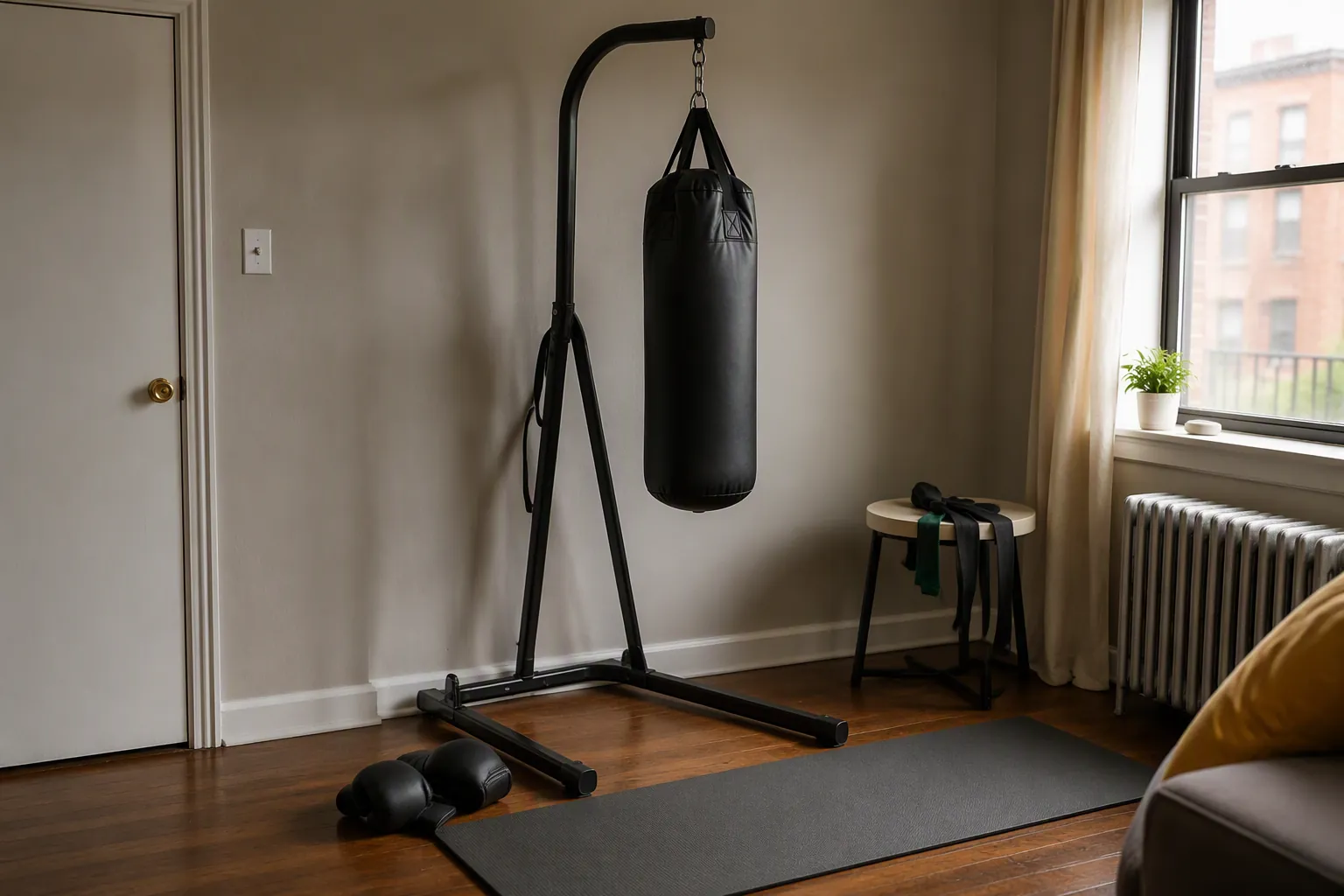
The under-$300 tier is where boxing training at home stops being mostly self-generated and starts giving you contact feedback. It is also where mistakes get expensive and annoying. A bag takes space, makes noise, may require a stand or mount, and can become the thing you resent every time you vacuum or move apartments.
For home users, Heavy Bag Pro recommends a 70–100 lb heavy bag as the optimal range [6]. That recommendation is useful because very light bags can swing wildly, while heavier setups demand more from the stand, floor, and room. It does not mean every renter should buy the heaviest bag they can afford. The bag, mount, flooring, ceiling height, neighbors, and storage all belong in the same decision.
There are budget examples showing that a functional setup can be built without luxury-gym money, but they need to be read carefully in 2026. Commando Boxing published a DIY heavy bag stand build described at about $150 in materials, which is useful as proof of concept rather than a current-price guarantee because the article is from 2018 and material costs have changed [7]. BoxingInsider’s staged home-gym framing is similarly helpful for thinking in budget levels, not for assuming a checkout total before shipping and regional price differences [2].
If you are trying to imagine what a compact apartment build can look like at different budgets, this small apartment home gym tour is a better next stop than a random shopping haul. Space is part of the cost.
What a bag changes
- Distance becomes real. You learn whether you are too close, reaching, or smothering your punches.
- Power has a cost. If you punch hard without balance, the bag exposes it quickly.
- Your wrists and shoulders need more respect. Wraps, glove fit, and gradual intensity matter more once there is impact.
- Rounds feel less abstract. The bag gives you a target, a rhythm, and a reason to reset your feet.
- Noise and vibration become training variables. In an apartment, they can matter as much as the workout itself.
A first bag-oriented session
- Warm up away from the bag. Use light footwork, shoulder mobility, and easy shadowboxing before throwing anything hard.
- Shadowbox one round with the same punches you plan to put on the bag.
- Bag round 1: jab only. Touch the bag, reset your feet, and keep the bag from turning into a shove.
- Bag round 2: jab-cross. Work at a moderate pace and bring both hands back to guard.
- Bag round 3: one simple combination, then step out. Do not stand in front of the bag admiring the shot.
- Bag round 4: controlled power. Pick a few moments to hit harder rather than trying to blast the whole round.
- Finish with core work, easy shadowboxing, or mobility instead of adding junk volume with tired wrists.
A bag does not erase the need for shadowboxing. In a good home session, shadowboxing prepares the movement, the bag tests it, and the cooldown cleans it up. If every round becomes a contest to make the bag swing, the setup is training your ego more than your boxing.
How often to train at each tier
Weekly planning does not need to become athlete cosplay, but it does need recovery. Boxing Science describes a concurrent training structure with 2 strength sessions plus 2–3 HIIT sessions per week and notes a 6-hour recovery rule when combining sessions [5]. For a home trainee, the useful part is simple: do not stack hard boxing, hard strength, and hard conditioning every day just because the workouts are short.
| Tier | Good weekly rhythm | What to avoid |
|---|---|---|
| $0 | Two technique-and-conditioning sessions plus optional light footwork practice. | Turning every session into frantic punching with no stance, guard, or recovery. |
| Under $100 | Two harder interval sessions and one lighter skill session using timer, gloves, rope, or video feedback. | Buying accessories to compensate for not repeating the basics. |
| Under $300 | One or two bag sessions, one shadowboxing or footwork session, and recovery space around harder rounds. | Hitting hard on tired wrists or training late in a way that creates neighbor problems. |
If body changes are part of why you are starting, pair the weekly rhythm with realistic expectations. This 12-week boxing-at-home timeline is a better companion than assuming one brutal first week will tell you what the training can do.
Choose the tier that removes today’s obstacle
If the obstacle is motivation, start with $0 and make the session short enough that you will actually do it. If the obstacle is structure, spend a little on timing, feedback, or light gear. If the obstacle is lack of contact and you have the space, noise tolerance, and storage, then a bag setup can be worth planning.
The most common bad purchase is not the wrong glove color or the wrong accessory. It is buying for the version of yourself who trains five days a week before proving that the current version will train twice. Start at the tier you can sustain, use the matching workout until it becomes limiting, and upgrade for a specific reason. $0 is legitimate. Under $100 adds structure. Under $300 changes the workout style. None of those tiers needs the next one to be real.
References
- Calories Burned Boxing — FightCamp Case Study — FightCamp
- How to Build a Home Gym That's Actually Worth Training In — BoxingInsider
- Get Lean and Strong: The No-Equipment Boxing Workout — Legends Boxing
- The BEGINNER'S Guide To Boxing At Home — FightCamp
- PLANNING YOUR TRAINING WEEK — Boxing Science
- Which Equipment Do You Need for Home Boxing Training? — Heavy Bag Pro
- The Home Made Boxing Gym Guide — Commando Boxing — 2018
What a small equipment investment adds
We don't have a build tagged to this exact tier yet. Browse all builds.
How often should you repeat this?
See our recovery and rest reference for citation-anchored rest-interval guidance.
Spot something off?
Tell us if a movement, tier assumption, or duration didn't match your experience.