
How to Do a Boxing Workout at Home with No Equipment
This 20-minute no-equipment boxing workout gives beginners a structured, round-by-round routine that fits in a living room. By alternating shadowboxing combinations with bodyweight conditioning, it delivers genuine HIIT-level effort without needing a bag or gloves.
- Equipment tier required
- none
- Duration
- 20 min
- Difficulty
- beginner
- Target area
- full body
- Noise level
- low
You can do a real boxing workout at home for beginners with a timer, a few square feet of floor, and no equipment. This one lasts 20 minutes: 2 minutes to warm up, four 3-minute work rounds, three 1-minute rests, and 3 minutes to cool down. The work alternates shadowboxing with quiet bodyweight conditioning, so you are not just waving your arms until the timer ends.
Set a round timer if you have one, or use a regular phone timer. Move anything ankle-height out of the way, face a wall or window instead of a mirror if watching yourself makes you overthink, and start at a pace that lets you finish all four rounds. If you are still deciding whether boxing is the right first home workout for you, the Home Fitness Decision Guide is a better starting point. If you came here to press start, keep reading.
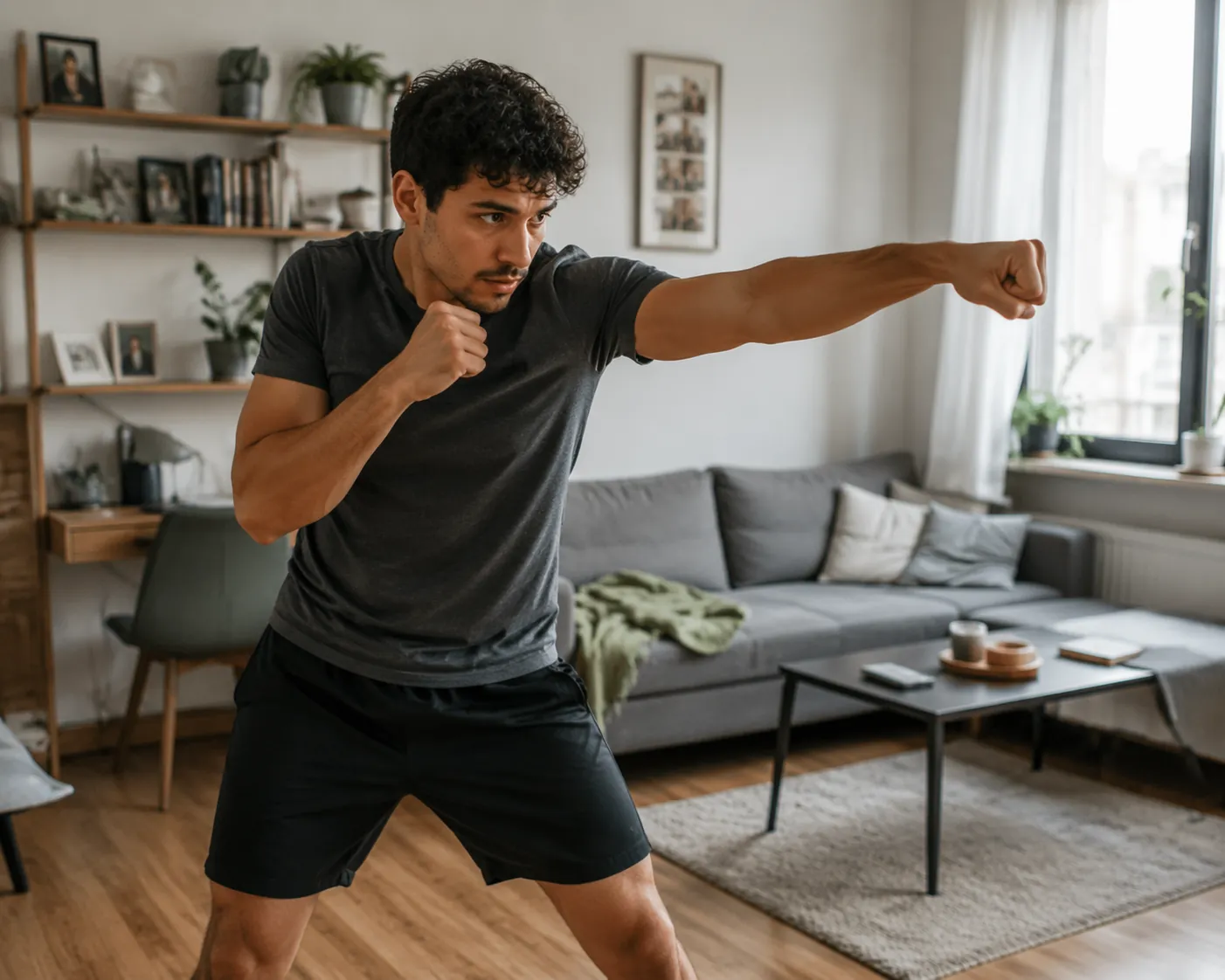
The 20-Minute No-Equipment Boxing Workout
The workout uses boxing's familiar 3-minute work round and 1-minute rest pattern, a structure also used in no-equipment shadowboxing routines.[1] The point of the format is simple: long enough to make your breathing climb, short enough that a beginner can stay organized.
| Time | Segment | What to do | Effort |
|---|---|---|---|
| 0:00-2:00 | Warm-up | March in place, shoulder rolls, hip circles, easy step-touches, gentle arm swings | Easy |
| 2:00-5:00 | Round 1: Shadowboxing basics | Boxer stance, guard up, jab-cross, reset; add light slips in the final minute | Moderate |
| 5:00-6:00 | Rest | Walk around, shake out arms, breathe through the nose if possible | Recovery |
| 6:00-9:00 | Round 2: Quiet conditioning | 20 seconds squats, 20 seconds incline or wall push-ups, 20 seconds marching knees; repeat 3 times | Moderate-hard |
| 9:00-10:00 | Rest | Sip water if needed; get back into stance before the next bell | Recovery |
| 10:00-13:00 | Round 3: Shadowboxing combinations | Jab-cross, jab-cross-hook, jab-cross-reset; move forward and back in small steps | Hard but controlled |
| 13:00-14:00 | Rest | Slow walk, relax shoulders, check that your feet are not lined up like a tightrope | Recovery |
| 14:00-17:00 | Round 4: Boxing conditioning finisher | 30 seconds fast straight punches, 30 seconds reverse lunges or step-backs, 30 seconds squat-to-reach; repeat twice | Hard |
| 17:00-20:00 | Cool-down | Slow march, chest opener, calf stretch, easy side bends, deep breathing | Easy |
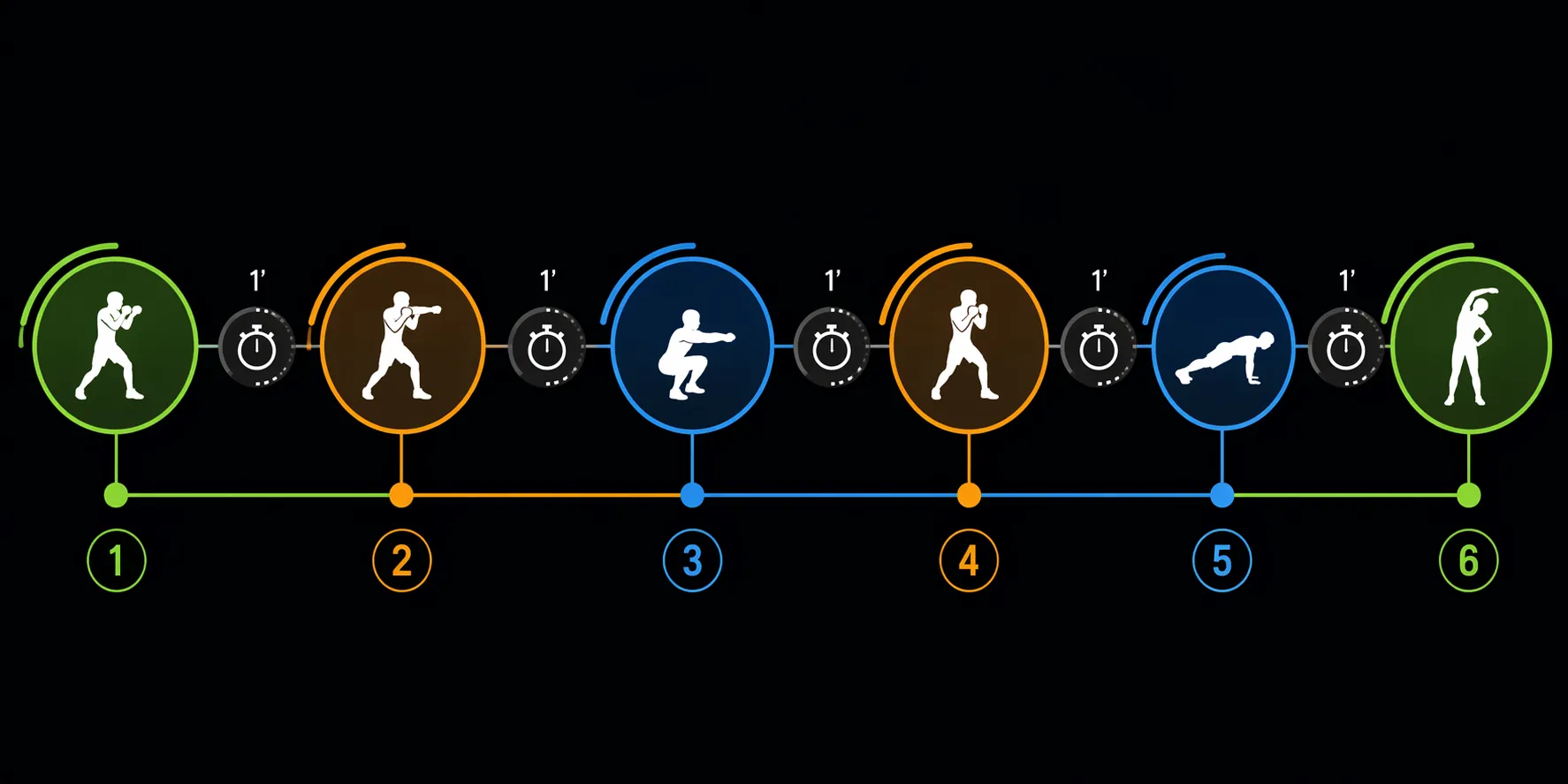
Once this 20-minute routine feels comfortable, the tiered weekly home boxing plan gives you a full week's schedule instead of asking you to invent a new workout every time.
Before Round 1: Set Your Stance So the Punches Make Sense
For a beginner, stance matters more than speed. Stand with your feet about shoulder-width apart. If you are right-handed, step your right foot back; if you are left-handed, step your left foot back. Your front toe points mostly forward. Your back foot turns out slightly. Bend your knees enough that you can bounce without your heels slapping the floor.
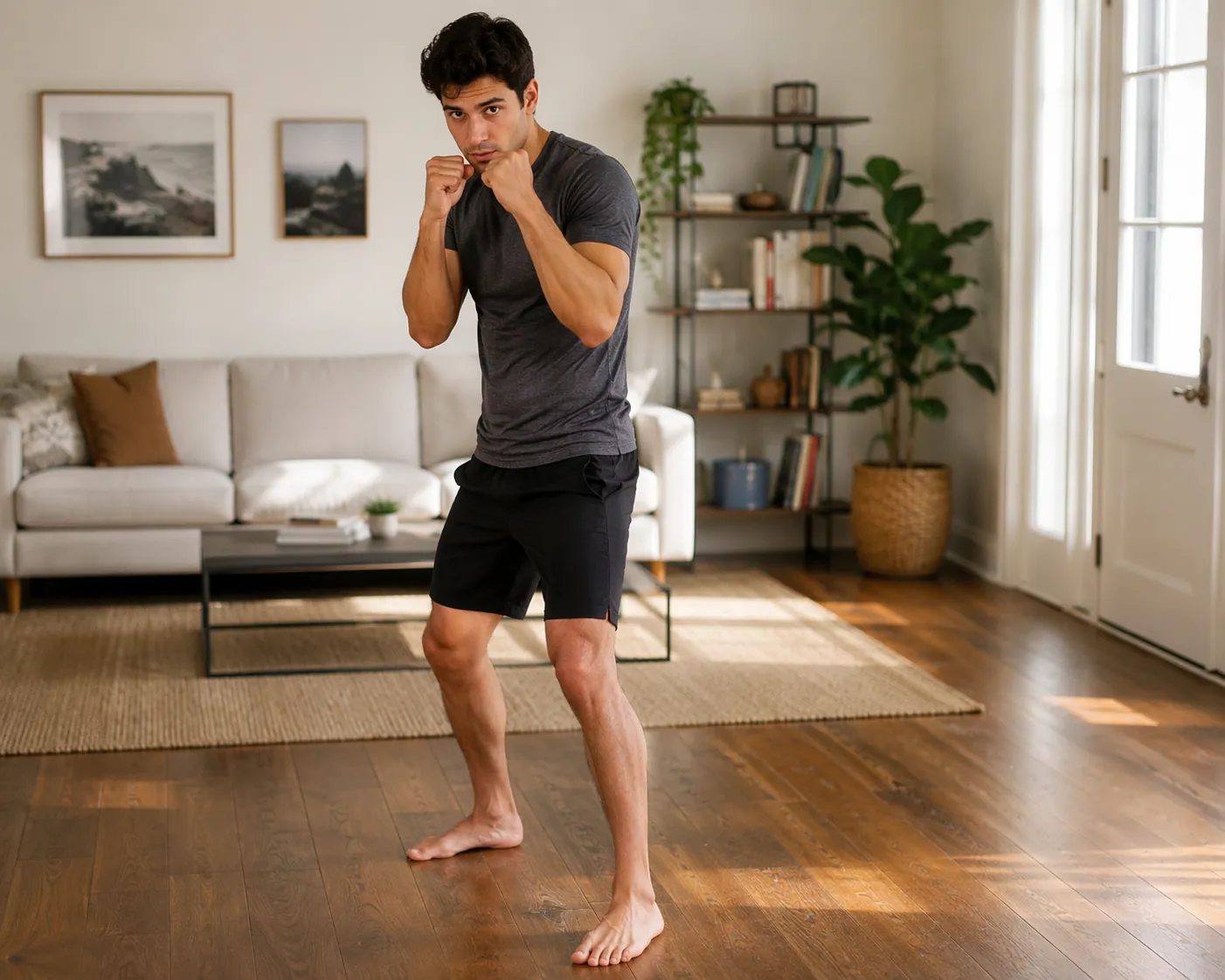
The common beginner error is making the stance too narrow, with one foot directly behind the other. Fran Sands of MyBoxingCoach calls this "losing the line," and places it first in his list of beginner mistakes.[2] It feels tidy for two seconds, then every punch pulls you off balance. Keep your feet on two separate rails, not one tightrope.
- Guard: hands near cheekbones, elbows close enough that your ribs do not feel abandoned.
- Chin: slightly down, eyes forward, neck relaxed.
- Weight: balanced between both feet, not parked on the front leg.
- Floor noise: step softly, lift the heel before you pivot, and avoid jumping if you share floors.
For deeper practice, these apartment-friendly boxing footwork drills build the stance, step, and reset pattern without needing a bag.
The Punches You Need for This Workout
You only need three punches today: jab, cross, and hook. Do not try to make them look violent. Try to make them return home. A punch that snaps back to guard is more useful than a wild punch that leaves your chin uncovered and your shoulder cranky.
Jab
The jab is the front-hand punch. From your guard, send the front fist straight out at nose height, then bring it straight back. Keep the other hand at your face. The front shoulder can rise a little to protect your jaw, but do not shrug both shoulders to your ears.
Cross
The cross is the back-hand punch. Turn the back hip and back heel as the rear fist travels forward. Think of the floor starting the punch, not your neck. If the back heel stays glued down, the shoulder usually does too much work.
Hook
The hook is a short bent-arm punch. Keep the elbow roughly level with the fist, turn through the front foot and hip, and stop the punch in front of your body instead of swinging it behind you. For this workout, a small hook is enough.
If a combination gets messy, strip it back to jab-cross. The timer is already doing enough work for you. Your job is to keep a stable base, breathe, and return to guard.
How Each Round Should Feel
Round 1 should feel like learning while moving. You are not chasing exhaustion yet. Use the first minute for single jabs, the second for jab-cross, and the third for jab-cross with a small slip after the cross. A slip is just a tiny bend through the knees and ribs, as if your head moved off the center line. It is not a dramatic side bend.
Round 2 is where the workout starts to feel like conditioning. Squats wake up the legs, wall or incline push-ups keep the upper body working without demanding floor space, and marching knees raise the heart rate without the thud of high knees. If you live above someone, choose reverse lunges or step-backs over jump lunges every time.
Round 3 asks for cleaner boxing, not more chaos. Use jab-cross for 30 seconds, jab-cross-hook for 30 seconds, then spend 30 seconds stepping forward and back while throwing only the jab. Repeat that twice. The forward-back step should be small: front foot moves first when you go forward, back foot moves first when you go backward. Do not let your feet click together.
Round 4 is the hard round. The fast straight punches should come from a stable stance, with small exhales on each punch. During the reverse lunges or step-backs, keep the torso tall. During the squat-to-reach, stand up fully and reach overhead instead of jumping. You should be breathing hard by the end, but you should not feel like your knees, shoulders, or downstairs neighbor paid the price.
Does No-Equipment Shadowboxing Count as HIIT?
It can, if you actually work during the rounds. In a 2015 pilot randomized controlled trial, Cheema and colleagues found that adults with abdominal obesity doing boxing-style HIIT trained at 86-89% of age-predicted maximum heart rate, compared with 64-77% during brisk walking.[3] That is the useful part of the study for this workout: boxing-style intervals can produce genuinely high cardiovascular intensity.
The caveat matters. That study used supervised group boxing with bags and focus mitts, not a beginner alone in a living room.[3] A bag gives feedback and resistance. A coach changes how hard people work. So the finding should not be treated as proof that every solo shadowboxing session reaches the same heart-rate range. It does support the basic idea that round-based boxing work has the structure to become high intensity.
For this workout, use a practical intensity check. During the last minute of Rounds 3 and 4, you should only be able to speak in short phrases. During the 1-minute rests, your breathing should come down enough that you can start the next round without panic. If you can chat through the hard rounds, punch sharper or move your feet more. If you cannot recover during the rests, slow the next round down.
Short workouts can still be useful when the work periods are focused; if you want the broader beginner case for the 20-minute format, FitAtHome's 20-minute home workout guide covers that more generally.
A Careful Note on Calories
ACE-sponsored research estimated cardio kickboxing at 350-450 calories per hour at a sustained pace.[4] That is a reasonable anchor for the energy cost of boxing-style cardio, but it is not a personalized promise for this 20-minute living-room session. Your body size, pace, range of motion, conditioning level, and how seriously you move during the rests all change the result.
There is no direct scientific measurement here for solo, no-equipment beginner shadowboxing. A small FightCamp case study reported an average of 482 calories in a 30-minute session among 14 participants ages 30-39, with males averaging 595 calories and females 369 calories, but that was a brand case study, not an independent controlled trial.[5] It is useful as a real-world comparison point, not as the number to chase.
Make It Easier, Harder, or Quieter
The cleanest way to adjust this workout is to change impact and pace before changing the whole structure. Keep the 3-minute rounds and 1-minute rests; modify what happens inside them.
| If this happens | Change this |
|---|---|
| Your shoulders burn before your breathing rises | Punch at 70% speed, relax your grip, and bring the hands back to guard without clenching. |
| Your knees dislike lunges | Use step-backs, sit-to-stand squats from a chair, or marching knees. |
| You are making too much floor noise | Remove hops, keep the heels soft, and use squat-to-reach instead of jump squats. |
| You feel lost during combinations | Use only jab-cross for the whole round and add movement later. |
| The workout feels too easy | Add more footwork during shadowboxing and make the conditioning intervals continuous. |
For safety, proper form matters more than pretending you are in a gym. Cleveland Clinic physical therapist Jim Edwards points to hand wrapping and proper form as primary injury-prevention tools in boxing.[6] Since this routine has no bag and no gloves, the form piece is the one you control today: do not lock the elbows, do not throw full-power air punches, and stop if a joint feels sharp rather than tired.
How to Progress After the First Workout
Repeat this exact session two or three times before changing it. The first pass is mostly coordination. The second is where the rests start to feel shorter. The third tells you whether the structure fits your space, joints, and schedule.
Cleveland Clinic notes that two to three boxing workouts per week can help contribute to the 150-minute moderate-exercise guideline.[6] For a beginner, that does not mean every session has to be brutal. A sensible week might include this 20-minute boxing workout twice, one easier walk or mobility session, and one short strength workout.
- Stay with this workout if you are still learning stance, guard, and jab-cross.
- Move into the weekly boxing plan when you can finish all four rounds without losing track of your feet.
- Add dedicated footwork practice if your punches feel fine but your balance falls apart.
- Consider equipment later if you want impact feedback, bag work, or app-led coaching.
If you eventually want a bag-based system, read the FitAtHome FightCamp review before assuming equipment automatically solves the apartment problem. If you want another no-equipment fighter-style option, the zero-equipment UFC-style workout sits in the same general lane.
For now, the next decision is simple: repeat this 20-minute routine two or three times this week. If the rounds make you breathe hard, your feet stay organized, and your joints feel normal the next day, no-equipment shadowboxing is doing its job.
References
- No Equipment Boxing Workout, Boxing Insider
- Boxing For Beginners: Top 10 Mistakes To Avoid, MyBoxingCoach
- The Feasibility and Effectiveness of High-Intensity Boxing Training versus Brisk Walking in Adults with Abdominal Obesity: A Pilot Study, PMC, 2015
- ACE Research Team Counts Calories, Confirms Benefits of Cardio Kickboxing, American Council on Exercise
- How Many Calories Do You Burn Boxing? A FightCamp Case Study, FightCamp
- Benefits of Boxing, Cleveland Clinic
What a small equipment investment adds
We don't have a build tagged to this exact tier yet. Browse all builds.
How often should you repeat this?
See our recovery and rest reference for citation-anchored rest-interval guidance.
Spot something off?
Tell us if a movement, tier assumption, or duration didn't match your experience.