
Train Like a UFC Fighter at Home with Zero Equipment
Discover how to build fight-ready conditioning using only bodyweight exercises, inspired by elite UFC fighters and proven training methods. This no-equipment approach delivers strength, power, and endurance without a gym.
- Equipment tier required
- none
- Duration
- 24 min
- Difficulty
- intermediate
- Target area
- full body
- Space footprint needed
- small
- Noise level
- low
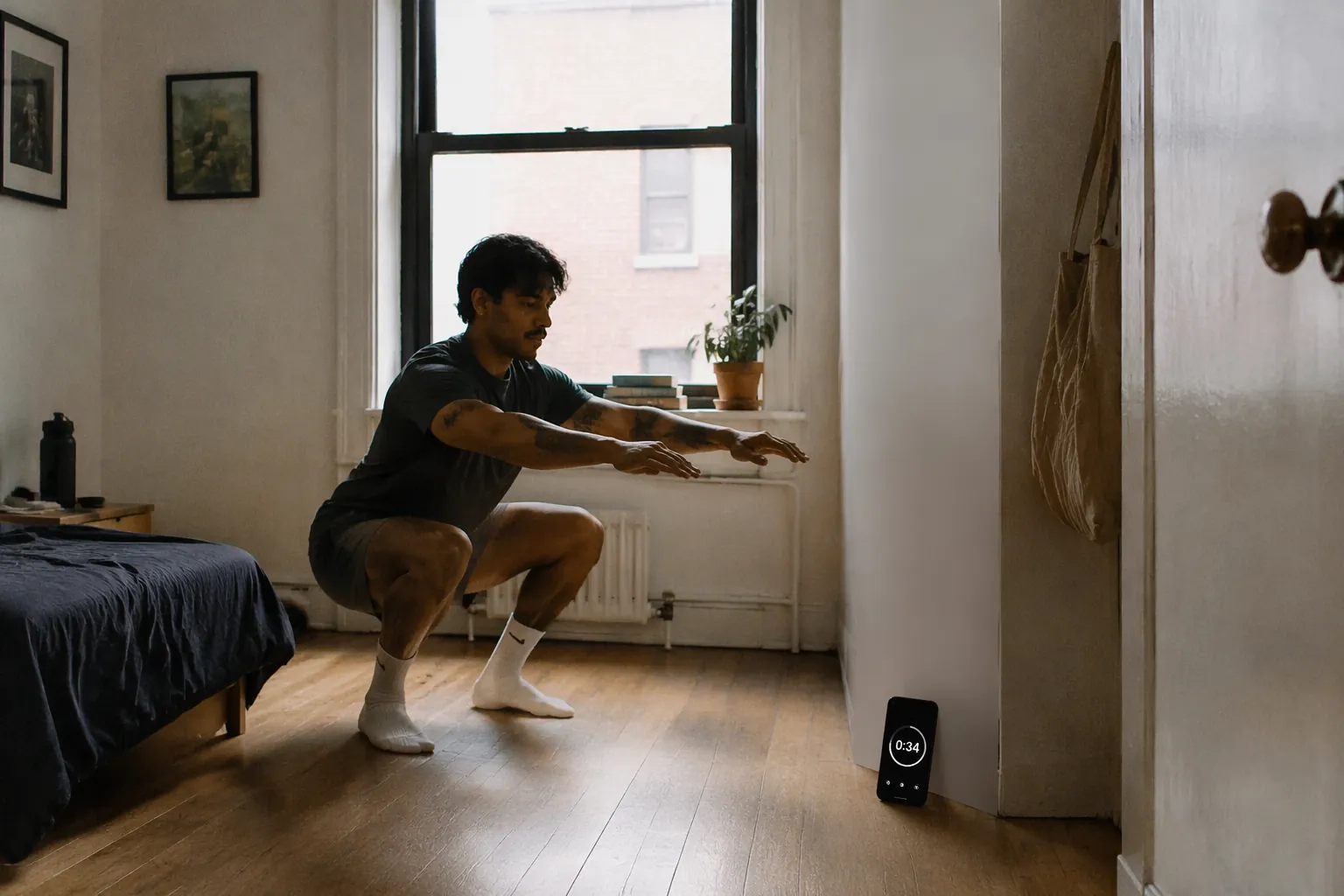
The honest version of how to train like a UFC MMA fighter at home starts on the floor, not in a cage. You have a few clear feet, a phone timer, maybe a neighbor underneath you, and no bag, rack, chin-up bar, or subscription to hide behind. The question is whether that room can produce anything close to fight conditioning, or whether it is just another sweaty circuit with fighter branding taped on top.
It can work, but only if the workout keeps the parts of fight training that matter when equipment disappears: timed rounds, short rests, repeatable effort, controlled tempo, lower-body volume, trunk fatigue, and enough pacing discipline that minute five feels different from minute one.
Mike Swick is the useful proof point here, with one important caveat. UFC.com reported that Swick maintained a reported 4% body fat while using a bodyweight-heavy regimen that included 5 sets of max push-ups daily, 5 sets of max chin-ups three times per week, and 2 sets of 100 bodyweight squats; he also earned Knockout of the Night at UFC 189.[1] That does not mean apartment push-ups make someone UFC-ready. Swick was a professional fighter inside a broader fight camp, with sparring, coaching, drilling, and recovery support. What it does prove is narrower and more useful: bodyweight work can be serious enough to belong in elite fight preparation.
What Makes Bodyweight Training Feel Like Fight Training
The exercises are not the magic part. Push-ups, squats, mountain climbers, planks, sprawls, and burpees are ordinary until the structure makes them unpleasant in the right way. In MMA, fatigue is not smooth. You surge, brace, scramble, breathe, strike, clinch, and suddenly your shoulders are full of cement while your legs still have to move.
That is why the round format matters. A standard UFC round lasts 5 minutes, with 1 minute of rest between rounds. Verywell Fit uses that same 5:1 work-to-rest setup in a home MMA circuit built around movements such as push-ups, mountain climbers, planks, burpees, and crunches.[2] For this zero-equipment version, the clock is the main piece of gear.
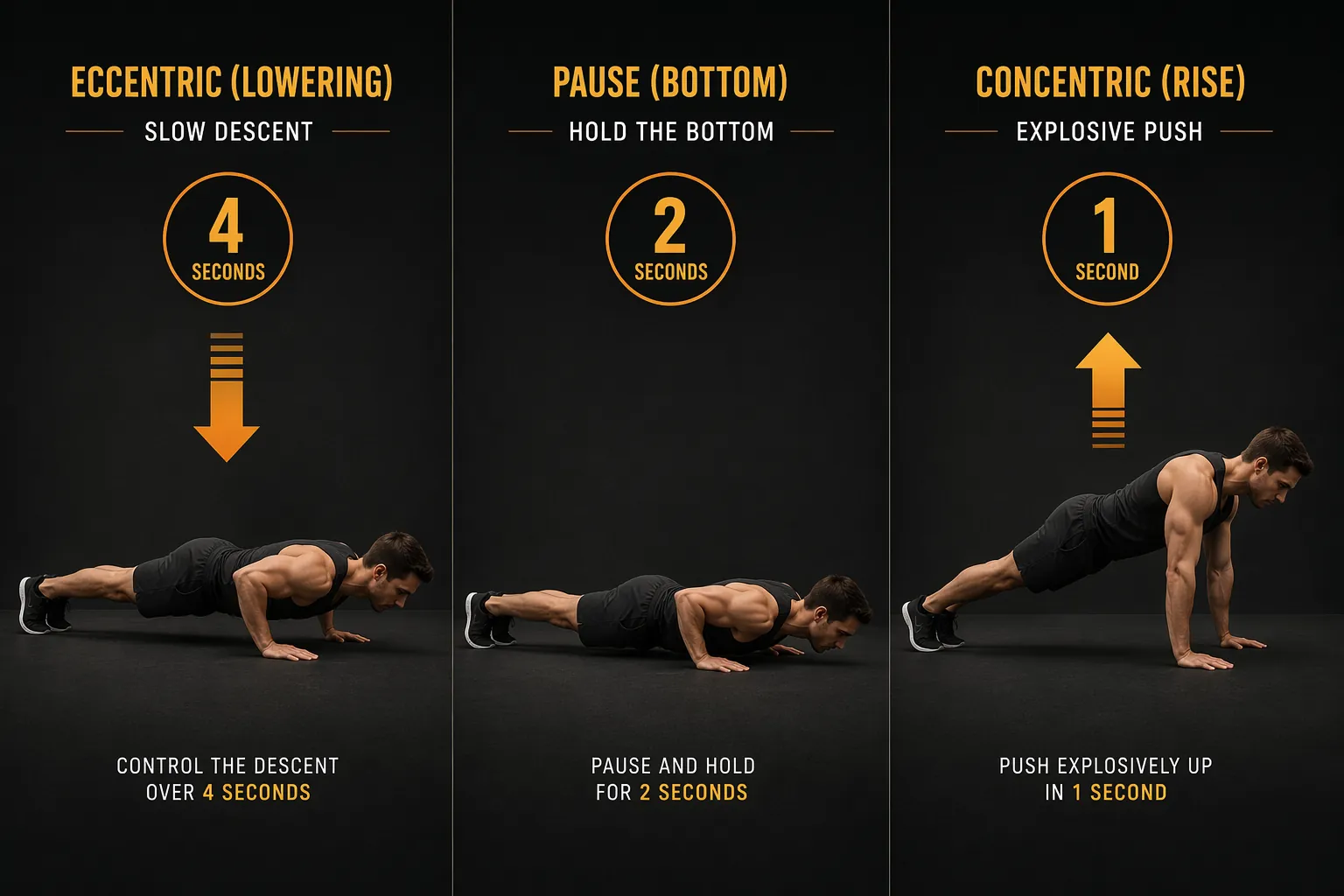
The second lever is tempo. Andy Hennebelle, a UFC Gym strength coach, has described starting new members on bodyweight work with a 4-2-1 cadence: 4 seconds lowering, 2 seconds holding, 1 second driving back up.[3] That is not a peer-reviewed promise that one push-up equals a bench press. It is a coaching method that solves a real home-training problem: when there is no external load, you make each rep spend more time under tension.
The Zero-Equipment UFC-Style Home Workout
Clear enough floor space for a push-up and a reverse lunge. Put your phone where you can see it. Set the timer for 5-minute rounds and 1-minute rests. The full session takes about 24 minutes including warm-up if you move on time.
| Part | Time | Job |
|---|---|---|
| Warm-up | 5 minutes | Raise temperature, loosen hips and shoulders, practice quiet footwork |
| Round 1 | 5 minutes | Strength endurance with tempo push-ups and squats |
| Rest | 1 minute | Walk, breathe through the nose if possible, do not sit |
| Round 2 | 5 minutes | Scramble conditioning with sprawls, climbers, and plank work |
| Rest | 1 minute | Shake arms out, reset stance, control breathing |
| Round 3 | 5 minutes | Explosive fatigue tolerance without wrecking the floor |
| Cool-down | 3-5 minutes | Bring breathing down, stretch hip flexors, calves, chest, and upper back |
Warm-Up: 5 Minutes, Quiet Enough for an Apartment
- 60 seconds: shadow skipping or fast feet in place, staying light on the floor
- 60 seconds: alternating reverse lunges with a reach overhead
- 60 seconds: inchworms to a push-up position, then walk the hands back
- 60 seconds: hip switches or seated shin-box switches
- 60 seconds: easy shadowboxing with slips, level changes, and relaxed shoulders
Jump rope shows up constantly in fight gyms, and home programs often use it as a warm-up progression: beginners may work 5 rounds of 1 minute, intermediates 5 rounds of 3 minutes, and advanced trainees 5 rounds of 5 minutes.[2][4] Since this workout promises zero equipment, do not buy a rope for it. Mimic the rhythm with low-bounce shadow skipping, or use fast feet if your floor can handle it.
Round 1: Strength Endurance
Set 5 minutes. Move through the sequence until the round ends. Do not chase perfect symmetry if the timer cuts you off; that is part of round training.
| Move | Prescription | Intensity Rule |
|---|---|---|
| Tempo push-up | 6-10 reps at 4-2-1 tempo | Stop 1-2 reps before your form caves |
| Bodyweight squat | 25 reps, smooth and deep enough to own | Keep heels down and torso tall |
| Shoulder-tap plank | 20 taps total | Hips stay quiet; widen feet if needed |
| Reverse lunge | 10 reps per side | Step softly and drive through the front foot |
| Hollow hold or dead bug | 20-30 seconds | Lower back stays controlled |
This round should feel like slow pressure. If the push-ups become sloppy, switch to hands-elevated push-ups on a couch or desk. If the squats are too easy, use the same 4-2-1 tempo for 8-12 reps instead of racing through 25.
Round 2: Scramble Conditioning
The second round is where the workout starts behaving more like MMA conditioning. You are not pretending to wrestle a person. You are training the repeated level changes, trunk stiffness, and shoulder fatigue that make even simple movement expensive.
| Move | Prescription | Apartment Modification |
|---|---|---|
| Step-back sprawl | 8-12 reps | Step back instead of jumping both feet out |
| Mountain climber | 30-40 seconds | Use controlled knee drives if fast reps shake the floor |
| Push-up position hold | 20-30 seconds | Drop to knees only after bracing first |
| Lateral bear crawl | 3 steps each way for 30 seconds | Use a slow crawl on carpet or a mat |
| Sit-through or hip escape | 6-8 reps per side | Move deliberately; do not slam the hip |
The sprawl is the one move to police hard in an apartment. A jump-back burpee may look tougher, but a step-back sprawl done repeatedly for 5 minutes is plenty honest and does not make the ceiling below you hate your hobbies.
Round 3: Explosive Fatigue Tolerance
The last round should not be a circus. It should ask whether you can still produce sharp reps while tired. Keep the landings quiet, the rests short, and the transitions clean.
| Move | Prescription | If You Need Less Impact |
|---|---|---|
| Squat to calf raise | 15-20 reps | Replace jump squats with a hard calf raise |
| Fast-feet burst | 10 seconds hard, 10 seconds easy for 60 seconds | March fast with active arms |
| Tempo push-up | 4-6 reps at 4-2-1 tempo | Use knees or hands elevated |
| Alternating knee drive from plank | 30 seconds | Slow mountain climbers |
| Shadowboxing flurry | 20 seconds fast, 20 seconds relaxed | Punch at chest height and keep feet quiet |
If you still have more than controlled aggression left in the final minute, you probably paced the first two rounds too gently. If your push-ups turn into neck stretches and your form collapses, you went too hot too early. Both are useful feedback.
Use the 4-2-1 Tempo Where Load Would Normally Go
Tempo is the difference between bodyweight strength work and simply surviving a list of calisthenics. A normal push-up can disappear in one second. A 4-2-1 push-up makes you control the lowering phase for 4 seconds, pause near the bottom for 2 seconds, then press up in 1 second.[3]
That changes the rep. The lowering phase forces control. The pause removes the bounce. The return asks for intent when the muscle is already under tension. You can use the same idea on squats, split squats, reverse lunges, and even plank transitions.
| Exercise | 4-2-1 Version | What It Trains |
|---|---|---|
| Push-up | Lower 4 seconds, hover 2 seconds, press 1 second | Chest, triceps, shoulder endurance, trunk stiffness |
| Squat | Lower 4 seconds, hold bottom 2 seconds, stand 1 second | Leg endurance, hip control, posture under fatigue |
| Reverse lunge | Lower 4 seconds, hold 2 seconds, drive up 1 second | Single-leg strength endurance and balance |
| Mountain climber | Drive knee in, pause briefly, return under control | Hip flexor endurance and anti-rotation control |
| Plank shoulder tap | Lift hand slowly, pause, replace without shifting | Core control while the shoulders are tired |
Do not use tempo on everything at once. In the workout above, Round 1 carries most of the tempo work. Round 2 moves more like a scramble. Round 3 asks for sharper output under fatigue. If every movement is slow, the session stops feeling like a round and turns into a long strength class.
How Hard Each Round Should Feel
A no-equipment workout gets its intensity from density, tempo, range of motion, and rest discipline. You are not adding plates, so you have to be honest about the clock.
| Round | Target Feel | Common Mistake |
|---|---|---|
| Round 1 | Hard but controlled; breathing rises by minute three | Doing fast, shallow reps and calling it strength |
| Round 2 | Messy breathing, steady movement, shoulders and trunk working | Jumping too much and losing apartment-friendly control |
| Round 3 | Short bursts with clean form under fatigue | Turning the last round into random flailing |
The 1-minute rest is not a bonus break. It is part of the workout. Walk, breathe, and get ready. If you need 3 minutes before Round 2, the first round was too hard for today’s version of the plan.
A 4-Week Progression Without Buying Anything
The fastest way to ruin this is to make every session a personal test. Fighters do hard work, but they also repeat enough structure to see whether it is working. Keep the same basic session for 4 weeks and change only one or two variables at a time.
| Week | Sessions | Progression |
|---|---|---|
| Week 1 | 2-3 sessions | Learn the rounds; leave 1-2 clean reps in reserve on tempo work |
| Week 2 | 3 sessions | Add 1 small lap through each round, or reduce transition time between moves |
| Week 3 | 3 sessions | Make one exercise per round harder: slower tempo, deeper range, or more controlled reps |
| Week 4 | 2-3 sessions | Keep form strict and try to finish more total quality work inside the same 5-minute rounds |
If you finish that month and want a longer path, move into a 6-week no-equipment UFC training plan instead of constantly inventing new circuits. If your main goal is hitting harder and moving faster, use a power-focused no-equipment MMA routine as the next branch.
Where Research Helps, and Where It Does Not
Structured programming matters more than the motivational label attached to the workout. In a 2018 study published in the Journal of Sports Science and Medicine, national-level fighters completed 4 weeks of EXOS-style strength and high-intensity interval programming and improved bench press by 16%, squat by 20%, and deadlift by 20%.[5]
That study does not prove this apartment routine will produce the same strength gains. The original context included loaded strength work, so copying its numbers onto a zero-equipment plan would be sloppy. The useful takeaway is more conservative: fighters respond to organized strength and HIIT programming over short training blocks, and home training should borrow that structure rather than just stack exercises until the floor is wet.
Bodyweight work also has a practical recovery advantage. It usually creates less external loading than heavy barbell work, which matters when someone is already absorbing striking, grappling, running, or a normal workday. That does not make it harmless. Wrists, elbows, knees, and hips still complain if volume jumps too fast or every session becomes a max-effort burpee contest.
Skill Work Still Has to Be Named Honestly
This routine builds a fighter-style base: strength endurance, conditioning, trunk control, lower-body volume, and the ability to keep working inside a 5-minute clock. It does not teach you how to defend a takedown, escape mount, check a kick, spar safely, or make decisions against another trained person.
If you want to add skill-minded work without pretending your apartment is a full gym, pair this conditioning plan with fight-analysis home training drills. If you want a striking-specific complement with shorter rounds, use a home boxing training plan. If you eventually decide to add dumbbells or bands, a small-space progression like Bogdan Guskov-inspired knockout power training makes more sense than buying random gear because a highlight clip made it look useful.
Beginner Fixes That Keep the Workout Real
| Problem | Fix |
|---|---|
| Push-ups fail in Round 1 | Use hands-elevated push-ups and keep the 4-2-1 tempo |
| Burpees or sprawls shake the floor | Use step-back sprawls or squat-to-calf-raise reps |
| Mountain climbers irritate wrists | Use forearm plank knee drives or slow standing knee drives |
| Legs burn out too early | Cut squat reps by one-third and keep depth honest |
| Breathing falls apart before minute three | Start the next session at 80% speed and keep the same round length |
The room does not need to look like a fight camp. It needs a timer, enough space to move, and rules you do not negotiate halfway through. Five minutes of work, 1 minute of rest, tempo where load would normally go, and progression slow enough that you can train again tomorrow.
That is the credible promise: zero-equipment apartment training can build a fighter-style conditioning base, strength endurance, and explosive fatigue tolerance. It cannot replace coaching, sparring, grappling, or live fight preparation. The next session still starts in the same unglamorous place: clear the floor, set the clock, and make the round honest.
References
- Elite UFC training made simple — EXOS program, UFC.com
- The MMA Workout You Can Do at Home, Verywell Fit
- UFC Gym Training: No Machines, Just Muscle, UFC.com
- UFC FIT Home Workouts, UFC FIT
- The Effect of a Short-Term High-Intensity Strength and Conditioning Training Program on Physical Fitness of Well-Trained Mixed Martial Arts Athletes, Journal of Sports Science and Medicine, 2018
What a small equipment investment adds
We don't have a build tagged to this exact tier yet. Browse all builds.
How often should you repeat this?
See our recovery and rest reference for citation-anchored rest-interval guidance.
Spot something off?
Tell us if a movement, tier assumption, or duration didn't match your experience.