
Turn UFC Fight Analysis Into Home Training Drills
Learn how to translate pro-level UFC fight analysis into measurable drills you can do at home with limited equipment. This article maps insights like reading tells and tracking composure directly into round-based workouts that build fight IQ and conditioning.
- Equipment tier required
- none
- Duration
- 15 min
- Difficulty
- beginner
- Target area
- full body
- Space footprint needed
- small (25-80 sq ft)
A UFC finish is usually the loudest part of the exchange, which is exactly why it is often the least useful part to copy in a small home gym. The punch, kick, level change, or choke is the visible receipt. The training value is usually two beats earlier: the weight shift the winner noticed, the composure break they pressed on, the habit that finally became obvious.
That is where UFC fight analysis becomes useful instead of decorative. Drew Dober’s tape-watching advice starts with a simple correction: stop chasing the limbs and watch the center of the chest, because the core gives away weight shifts before the strike arrives.[1] For a home trainee, that turns analysis into something trainable. You are no longer trying to imitate a knockout. You are practicing whether you can see the body load, stay calm, and move on time.
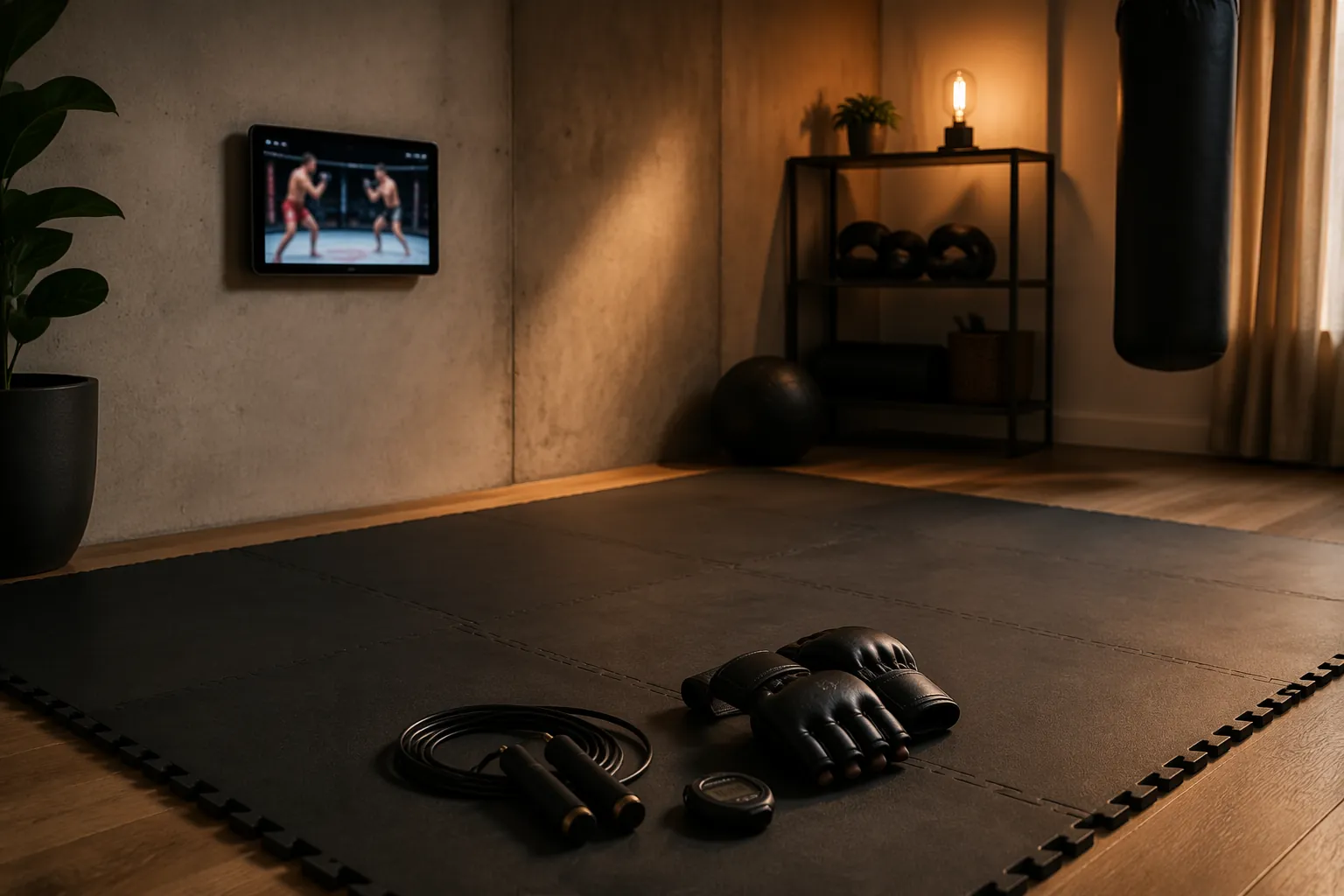
The whole session can fit on a mat. You need a timer more than you need a highlight reel. Each viewing insight becomes a round, each round gets a measurable output, and the score is not whether you looked violent. The score is whether your attention stayed sharp when breathing got expensive.
The Training Map: Turn One Read Into One Round
Use the fight broadcast as the scouting room, then use the home session as the lab. The map below is not a full martial arts curriculum. It is a way to stop wasting Monday’s workout on random sweat.
| Fight analysis cue | What you watch | Home drill | Measured output |
|---|---|---|---|
| Watch the core, not the limbs | Chest center, hip load, weight shift | 5-minute chest-center shadowboxing round | Number of clean reads before movement |
| First exchange is information | Posture, stance pressure, first feint response | Cold-start round | Seconds before first committed attack |
| Tells get louder under fatigue | Dropped hands, loading habits, rushed exits | Bodyweight fatigue circuit plus self-audit | Round-by-round tell score |
| Composure matters | Breathing, reset speed, decision quality | Mirror callout and verbal sparring | Correct callouts while tired |
For timing, borrow the fight shape before you borrow the fight fantasy. Chris Camozzi’s home MMA workout uses three 5-minute rounds with rest periods, separating punching, kicking, and combined work.[2] That structure is useful because it makes attention measurable. A 5-minute round is long enough for laziness to show up, but short enough that you can repeat it in 25 to 80 square feet without pretending your living room is a full gym.
Watch the Chest Center First
Limbs lie fast. A jab can twitch, a kick can feint, a shoulder can bluff. The center of the chest is harder to fake because it has to organize the body before force travels outward. Dober’s framework treats the chest and core as the first read for weight shifts, and he pairs that with mirror work and shadowboxing callouts.[1]

The drill is deliberately plain. Set a 5-minute timer. Shadowbox at a pace you can control. Before every entry, say the read out loud: “weight left,” “loaded rear side,” “chest square,” “pressure forward,” “backing out.” Then move. The verbal callout matters because it prevents you from turning the round into choreography. If you cannot name the read, you are just throwing.
- Round 1: shadowbox with no power and call out chest-center shifts before every entry.
- Round 2: add defensive exits after each combination, still naming the chest-center read first.
- Round 3: combine punching, kicking, or level-change footwork if you can do it safely in your space.
- Score: count only entries where the read came before the movement, not after.
A clean round might not look impressive. That is fine. The goal is to train the order of operations: observe, decide, move, reset. If you reverse that order, you will feel busy and learn very little.
Use a UFC Exchange Before the Round
Pick one short exchange from a fight. Watch it once at normal speed. On the second watch, ignore the finish and pause before the decisive action. Ask what changed in the body: did the fighter overstep, square up, lean past the lead hip, freeze after a feint, or breathe with their mouth open after a scramble? Then run the 5-minute round around that one read.
This is where fight analysis stops being entertainment. You are not collecting techniques. You are collecting conditions that made techniques available.
Cold-Start Rounds: Spend the First 30 Seconds Reading
A lot of solo training begins too confidently. The timer beeps, the hands start flying, and the round becomes a performance of activity. A cold-start round fixes that by making the opening phase observational.
Set the timer for 5 minutes. For the first 30 seconds, you are allowed to feint, step, shift stance, and defend, but not commit to a full attack. Your job is to read an imaginary opponent’s pressure line: are they giving ground, crashing forward, circling, or waiting to counter? After 30 seconds, begin normal shadowboxing, but every committed attack still needs a stated reason.
- Begin with stance movement, hand positioning, and small feints.
- Delay your first committed strike or shot entry until the 30-second mark.
- After each exchange, reset your breathing before starting the next one.
- Score whether your first committed action had a read attached to it.
The point is not that real fighters always wait 30 seconds. The point is to train the habit of gathering information before spending energy. Establish the Run’s MMA analysis framework separates control, effective offense, cardio, and durability as things worth tracking rather than simply asking who seems to be winning.[3] In a home round, that vocabulary becomes practical: did you control space, create a real opening, keep output sustainable, and stay durable in posture when tired?
When Tells Get Louder, Train Your Own
Dober’s tell-reading work makes one especially useful point for home conditioning: tells become easier to read as fatigue sets in, especially in later rounds when composure starts breaking down.[4] That cuts both ways. You can practice spotting tells on film, but you also need to know what your own body gives away when tired.
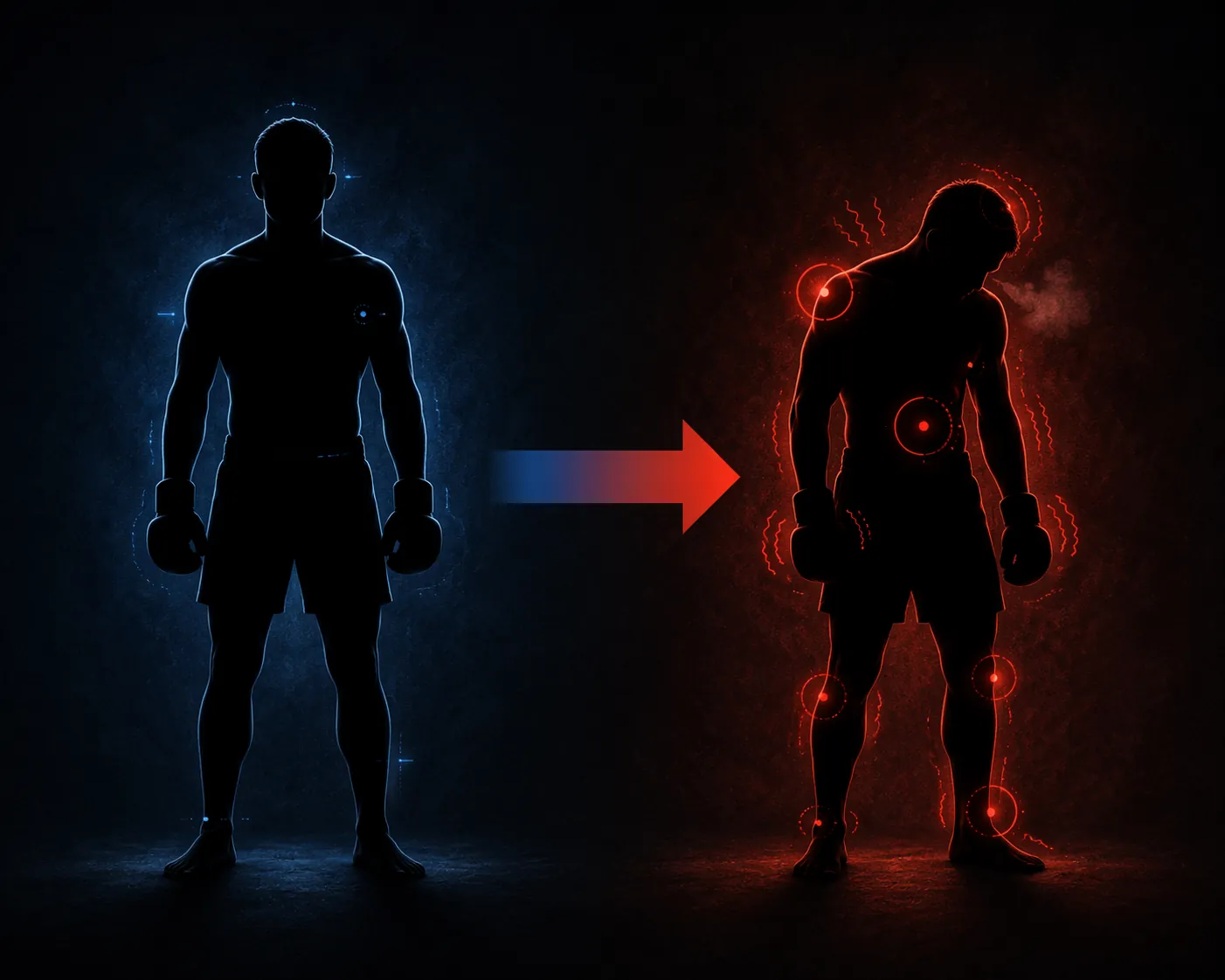
This is where Matt Marsden’s hotel-room fighter circuit earns its place. The circuit uses five bodyweight exercises — push-ups, mountain climbers, plank, burpees, and crunches — for three rounds, designed for fighters training with minimal space and no equipment.[2] On its own, it is a conditioning circuit. Paired with tell-reading, it becomes a composure test.
| Exercise | What fatigue may expose | Self-audit cue |
|---|---|---|
| Push-ups | Sagging hips, flared elbows, rushed reps | Can I keep one body line? |
| Mountain climbers | Bouncing shoulders, shallow breathing | Can I move fast without losing posture? |
| Plank | Neck tension, breath holding | Can I breathe quietly under strain? |
| Burpees | Sloppy landings, panic pace | Can I return to stance cleanly? |
| Crunches | Pulling the neck, rushing the finish | Can I control the last reps? |
Run the circuit, then immediately do 60 seconds of light shadowboxing in front of a mirror or phone camera. Do not add power. Look for tells: hands dropping after a combination, chin lifting during exits, feet crossing when you are tired, shoulders rising when you need air. Give yourself a simple 1-to-3 score after each round: 1 means composed, 2 means readable, 3 means loud.
That score is more useful than pretending every hard circuit is fight conditioning. If your burpees improve but your stance collapses every time your heart rate climbs, the circuit is teaching you something. The conditioning is exposing the tell; the next round is where you try to quiet it.
Mirror Callouts Beat Silent Shadowboxing
Silent shadowboxing can drift into habit very quickly. Mirror callouts make the round less comfortable and more honest. Dober describes verbal sparring and calling out weight shifts as part of film and solo work, which is the piece most home trainees should steal first.[1]
Stand in front of a mirror or a phone camera. Move lightly. Every time your own chest crosses your base, call it: “leaning,” “square,” “loaded,” “overstepped,” “reset.” Then throw only after the call. If you feel ridiculous, good. The embarrassment is cheaper than building a habit you cannot see.
- Begin with 2-minute rounds if speaking and moving at once breaks your rhythm.
- Progress to 5-minute rounds once callouts stay consistent.
- Use the final minute after a fatigue circuit to test whether your callouts disappear.
- Review video without sound once, then with sound, to see whether your words matched your movement.
The camera does not need to be fancy. A phone propped against a shoe is enough. What matters is whether your body confirms the story your mouth told during the round.
Build the Week Around Movement, Not Muscle Parts
Fight-specific home training gets messy when it is bolted onto a bodybuilding split. The EXOS/UFC strength material from Brett Bartholomew emphasizes training movements rather than isolated muscles, with ground-based, multi-joint, multi-planar patterns.[5] The exact older rep schemes are less important here than the principle: build a body that can push, pull, hinge, rotate, brace, and change levels without each quality living on a separate island.
A simple week can use three conditioning or strength days as the backbone, with fight-IQ rounds placed where attention will still be decent. If you only train three days, attach one read-based round to the front of each session. If you train five days, keep two shorter days for film-to-drill work and composure testing.
| Day | Session focus | Home version |
|---|---|---|
| Day 1 | Chest-center reads plus strength | 5-minute callout round, then push/pull/hinge work |
| Day 2 | Conditioning and tells | Marsden-style bodyweight circuit, then 60-second mirror audit |
| Day 3 | Recovery or film note | Watch one exchange and write the read, not the finish |
| Day 4 | Cold-start rounds | Three 5-minute rounds with first 30 seconds observational |
| Day 5 | Movement quality | Ground-based multi-joint work, light shadowboxing resets |
If your setup is still changing, keep the program equipment-neutral first. Bodyweight-only work covers shadowboxing, mirror callouts, cold starts, planks, burpees, mountain climbers, push-ups, and crunches. A jump rope helps with rhythm and footwork fatigue. Dumbbells let you load hinges, carries, rows, and squats. A bag gives you impact feedback, and kettlebells make swings, cleans, carries, and rotational control easier to program.
For a small-space build, use a home gym under $500 if you are starting from the mat-and-timer stage, or compare compact home gym budget builds if you are deciding whether the next purchase should be load, impact, or conditioning. If you already own a mixed setup, a home gym exercise routine built for the equipment you own is the better continuation than buying more gear first.
What to Score After Each Session
The notebook matters more after the round than before it. Do not write a full essay. Score the parts that decide whether fight analysis became training.
| Score | Question | Useful answer |
|---|---|---|
| Read count | How many attacks started after a named read? | A number, not a feeling |
| Composure | Did posture and breathing change under fatigue? | 1 quiet, 2 readable, 3 loud |
| Reset quality | Did you return to stance after each exchange? | Clean, late, or absent |
| Output control | Did volume rise because of intent or panic? | Intent, panic, or unclear |
| Film link | Which UFC exchange fed the drill? | Fighter, round, and cue |
This keeps the analysis honest. Dober’s work is a pro fighter’s practical framework, not peer-reviewed research. Camozzi’s and Marsden’s workouts give usable home structures, not proof that three rounds in a spare room make someone fight-ready. Establish the Run’s article is written for fight analysis in a betting context, so its value here is the vocabulary for watching control, offense, cardio, and durability, not the gambling angle.[1][2][3]
That boundary is not a weakness. It keeps the goal clean. You are training observation, timing, composure, and conditioning in a limited space. You are not certifying yourself for a cage because you shadowboxed well next to a couch.
A Fight Night Becomes the Next Session
The next time an analyst explains why a strike landed, pause before the replay turns into admiration. Watch the center of the chest. Look for the weight shift, the stalled reset, the fading composure, the tell that got louder. Write down one read.
The next home session does not need to copy the finish. Choose one drill from the map, run it in measurable rounds, and score whether the read survived fatigue. If your attention held up when breathing got hard, the broadcast gave you more than a highlight. It gave you a training input.
References
- Fight Analysis, drewdober.com, May 2026
- The MMA Workout You Can Do at Home, Verywell Fit, 2024
- How to Analyze MMA, Establish the Run
- How to Read a Fighter's Tells, drewdober.com
- Elite UFC Training Made Simple, UFC
What a small equipment investment adds
We don't have a build tagged to this exact tier yet. Browse all builds.
How often should you repeat this?
See our recovery and rest reference for citation-anchored rest-interval guidance.
Spot something off?
Tell us if a movement, tier assumption, or duration didn't match your experience.