
A Home Gym Exercise Routine Built for the Equipment You Own
Find the right home gym exercise routine for the equipment you actually own — dumbbells, resistance bands, a multi-gym, or just bodyweight — with complete workouts for beginner and intermediate levels, plus progression methods that work without adding plates.
- Duration
- 30 min
Start with the equipment in the room, not the routine someone else is running. A good home gym exercise routine has to answer a plain question first: what can you repeat and progress with the tools you already own?
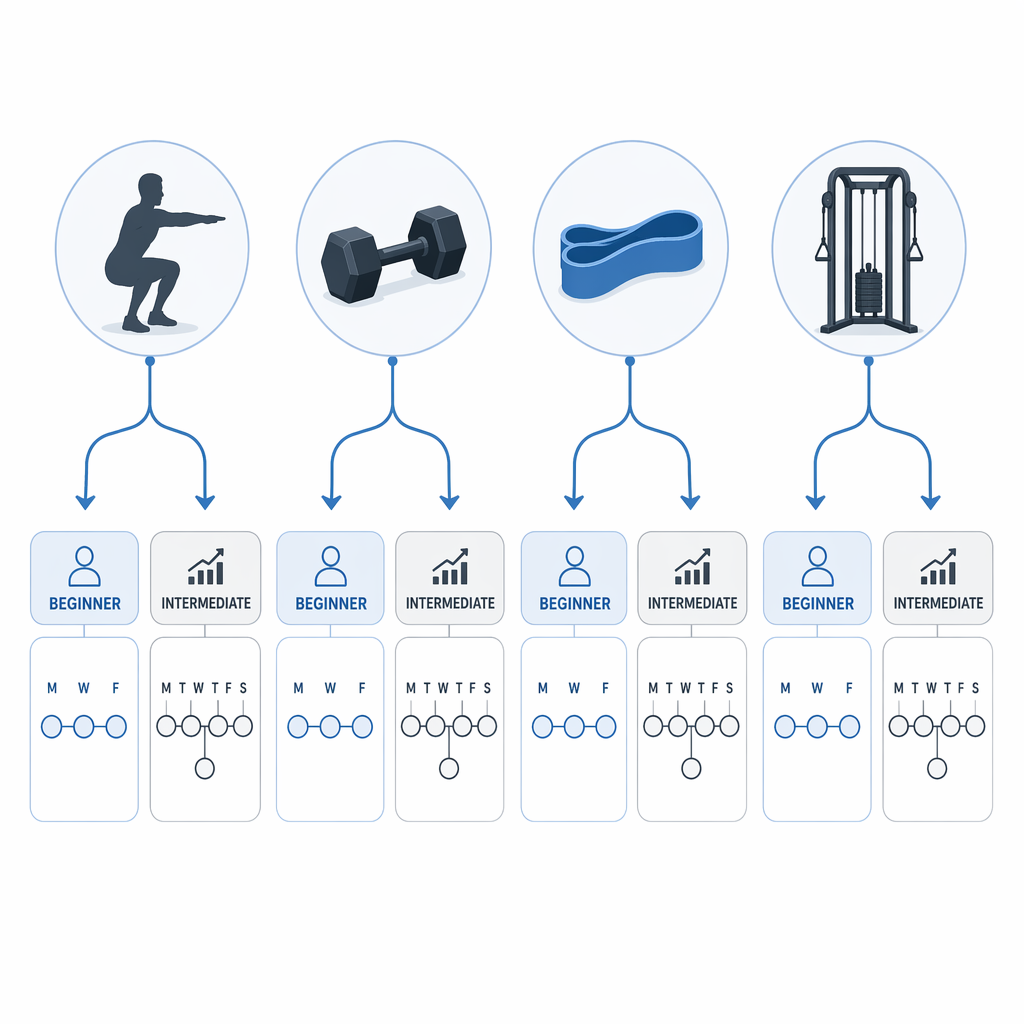
| Equipment you have | Beginner route | Intermediate route | Best progression lever |
|---|---|---|---|
| Bodyweight only | 3 days per week full-body circuit | 3 days per week harder exercise ladder | Exercise difficulty, reps, slower tempo |
| Dumbbells only | 3 days per week full-body dumbbell routine | 3 days per week full-body dumbbell routine with double progression | Reps first, then load |
| Resistance bands | 3 days per week full-body band routine | 3 to 4 days per week band routine with added tension and tempo | Band thickness, stretch, tempo, pauses |
| Multi-gym or cable machine | 3 days per week full-body machine routine | 4 days per week upper/lower split | Weight stack, sets, exercise slots |
Dumbbells deserve the most space here because they are common enough to shape the practical answer. Industry data summarized by PTPioneer from Statista and CivicScience reports that 30.4% of home exercisers own weightlifting equipment, while 38.6% spent under $500 on their home fitness setup, so the most useful routine cannot assume racks, benches, machines, and endless plates are available [1].
The weekly structure also matters. Schoenfeld’s 2016 meta-analysis found that training a muscle group twice per week produced greater hypertrophy than once per week, which is why most of the routines below keep the whole body showing up repeatedly instead of copying a once-a-week body-part split into a spare room [2]. At the same time, a 2024 systematic review and meta-analysis by Ramos-Campo and colleagues reported similar hypertrophy between full-body and split routines when weekly volume was equated, so the split is not a badge of seriousness; it is just a better fit when the equipment supports more exercise slots [3].
Progression is the part most home routines leave fuzzy. Cleveland Clinic describes progressive overload through variables including weight, repetitions, sets, tempo, and rest, which is useful at home because adding load is only one option, and often not the first one available [4].
Dumbbells: Use the 3-Day Full-Body Routine
For most dumbbell-only homes, the cleanest setup is three nonconsecutive training days: Monday, Wednesday, Friday; Tuesday, Thursday, Saturday; or any pattern that leaves at least one rest day between sessions. The structure below follows the same practical full-body logic used in Muscle & Strength’s 3-day dumbbell program, then adapts it around progression rules that work when your heaviest pair may be sitting in the corner already [5].
| Day | Exercise | Sets | Reps | Rest |
|---|---|---|---|---|
| Day 1 | Goblet squat | 3 | 8–12 | 60 seconds |
| Day 1 | Dumbbell floor press | 3 | 8–12 | 60 seconds |
| Day 1 | One-arm dumbbell row | 3 each side | 8–12 | 60 seconds |
| Day 1 | Dumbbell Romanian deadlift | 3 | 8–12 | 60 seconds |
| Day 1 | Standing dumbbell curl | 2 | 10–15 | 45–60 seconds |
| Day 1 | Plank | 3 | 30–45 seconds | 45–60 seconds |
| Day 2 | Reverse lunge | 3 each side | 8–12 | 60 seconds |
| Day 2 | Standing dumbbell shoulder press | 3 | 8–12 | 60 seconds |
| Day 2 | Dumbbell hip thrust or glute bridge | 3 | 10–15 | 60 seconds |
| Day 2 | Chest-supported row alternative: bent-over dumbbell row | 3 | 8–12 | 60 seconds |
| Day 2 | Overhead dumbbell triceps extension | 2 | 10–15 | 45–60 seconds |
| Day 2 | Dead bug | 3 each side | 8–12 | 45–60 seconds |
| Day 3 | Dumbbell front squat or suitcase squat | 3 | 8–12 | 60 seconds |
| Day 3 | Push-up or dumbbell floor press | 3 | 8–12 | 60 seconds |
| Day 3 | One-arm dumbbell row | 3 each side | 10–12 | 60 seconds |
| Day 3 | Dumbbell deadlift | 3 | 8–12 | 60 seconds |
| Day 3 | Lateral raise | 2 | 12–15 | 45–60 seconds |
| Day 3 | Side plank | 2 each side | 20–40 seconds | 45–60 seconds |
Beginners should use the low end of the sets when needed: two working sets for the main lifts during the first week is fine if form is still settling. Intermediate lifters can run the full table, keep the 60-second rest periods honest, and add a fourth set only to the first two exercises of a day when recovery is clearly keeping up.
The routine works best with double progression. Pick a weight you can lift for the bottom of the rep range with good control. When you can complete every set at the top of the range, increase the dumbbell weight next time and return to the lower end of the range.
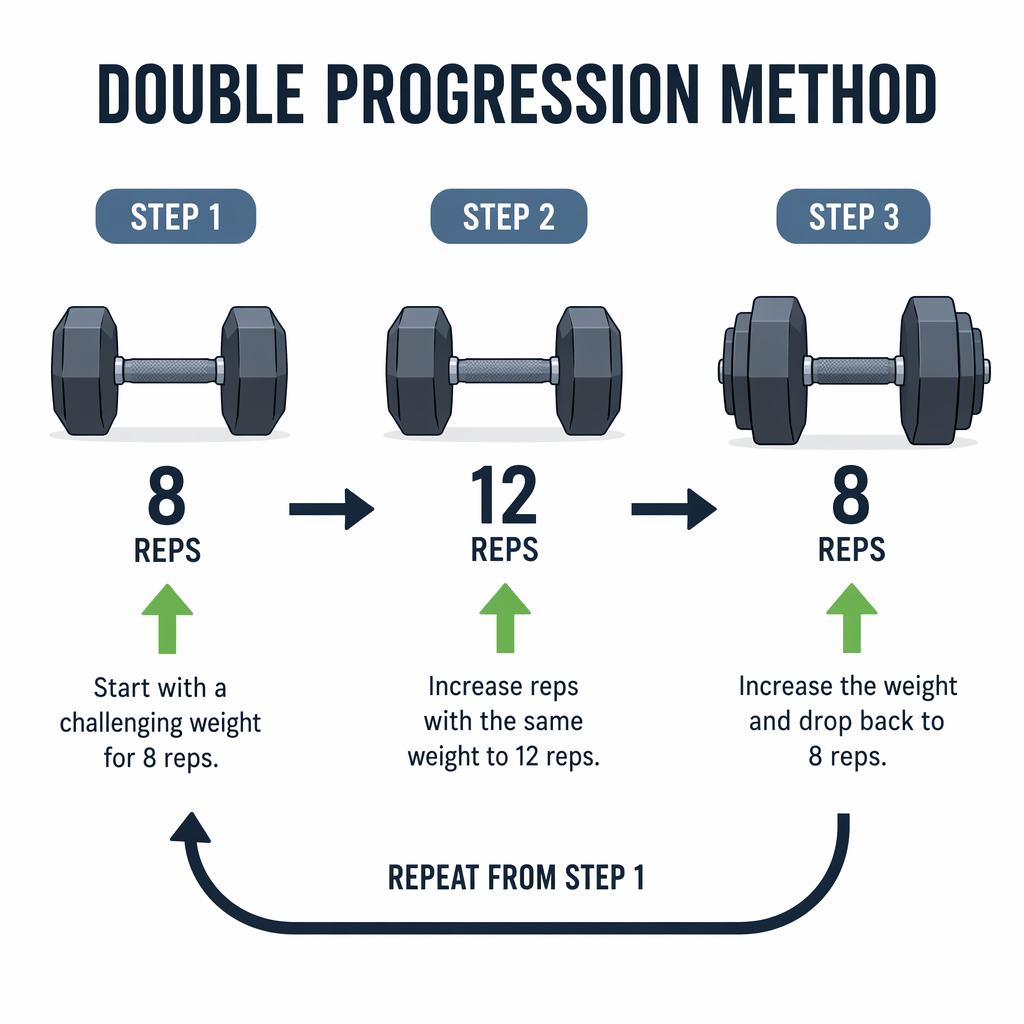
- If you hit 8, 8, and 7 reps, keep the same weight next time.
- If you hit 12, 11, and 10 reps, keep the same weight and try to complete all sets at 12.
- If you hit 12, 12, and 12 reps with clean form, move up in weight and start again near 8 reps.
- If your dumbbells are too light, slow the lowering phase, add a pause, add one set, or shorten rest before buying more equipment.
A bench is useful, but this version does not require one. Floor presses, push-ups, rows, squats, lunges, hinges, carries, and planks are enough to train the whole body while keeping each muscle group exposed more than once per week. If you do have a bench and adjustable dumbbells, the next logical step is an extended 8-week dumbbell-and-bench plan. If you want a shorter no-bench option, use this 30-minute full-body dumbbell workout as a standalone session.
No Equipment: Run a Circuit You Can Make Harder
Bodyweight training needs a different kind of order. Without load jumps, the routine has to make the movement harder over time. Nerd Fitness uses a beginner bodyweight format built around simple circuit exercises such as squats, push-ups, rows or pulling substitutions, lunges, planks, and jumping jacks, which is a sensible starting point because the exercises are easy to arrange and repeat [6]. Healthline’s at-home exercise reference also separates beginner, intermediate, and advanced bodyweight movements, which is useful when choosing the next variation rather than merely adding more repetitions forever [7].
| Level | Workout | How to run it | Progression |
|---|---|---|---|
| Beginner | Bodyweight squat, incline push-up, glute bridge, bird dog, plank, brisk marching or jumping jacks | 2–3 rounds, 8–12 reps per move, 20–40 seconds for holds | Add reps first, then add a round, then choose a harder variation |
| Intermediate | Split squat, push-up, single-leg glute bridge, prone Y raise or towel row setup, side plank, mountain climber | 3–4 rounds, 10–15 reps per move, controlled pace | Move from bilateral to single-leg work, lower the incline on push-ups, slow the tempo |
A beginner can train this routine three days per week, resting at least one day between sessions. Keep one or two reps in reserve on most exercises. The point is not to finish wrecked; it is to learn the movements well enough that the next session is repeatable.
Bodyweight progression ladders
| Pattern | Start here | Next | Harder |
|---|---|---|---|
| Squat | Chair squat | Bodyweight squat | Split squat |
| Push | Wall push-up | Incline push-up | Floor push-up |
| Hinge/glutes | Glute bridge | Feet-elevated glute bridge | Single-leg glute bridge |
| Core | Dead bug | Plank | Side plank or long-lever plank |
| Pull substitute | Prone Y raise | Towel isometric row setup | Door-anchor band row if bands become available |
The weak point in no-equipment routines is usually pulling. If you have no bar, rings, suspension trainer, or bands, do not pretend prone raises fully replace rows and pull-ups. Train the upper back as well as your setup allows, then consider the no-equipment upper-body workout if you need a more focused push-and-pull balance. Absolute beginners who want the first month mapped out can start with your first 4 weeks of no-equipment strength training.
Resistance Bands: Progress Tension and Time Under Tension
Bands are not just lighter dumbbells. Their tension changes through the range of motion, and small setup changes can make the same band feel very different. That is why band routines should track anchor point, distance from the anchor, tempo, and the band used, not only sets and reps.
| Level | Weekly structure | Workout |
|---|---|---|
| Beginner | 3 full-body days | Band squat, band chest press, seated or standing band row, band Romanian deadlift, band pull-apart, Pallof press |
| Intermediate | 3 full-body days or 4 alternating days | Band split squat, band chest press or push-up with band, one-arm band row, band good morning, band face pull, band curl, band triceps pressdown, Pallof press |
| Exercise | Sets | Reps | Tempo |
|---|---|---|---|
| Band squat or split squat | 3 | 10–15 | 2 seconds down, 1 second pause |
| Band chest press | 3 | 10–15 | Controlled return |
| Band row | 3 | 10–15 | 1 second squeeze |
| Band hinge or good morning | 3 | 10–15 | Slow lowering |
| Band pull-apart or face pull | 2–3 | 12–20 | Smooth, no snapping |
| Pallof press | 2–3 each side | 8–12 | Pause fully extended |
For bands, write down the color or thickness, where it was anchored, and where your feet were. A row done one step farther from the door is not the same exercise dose as a row done close to the anchor. If you cannot add a thicker band yet, add a pause at the hardest point, slow the return, or add reps until the top of the target range is solid.
- Move farther from the anchor only if the band stays secure and the movement path stays clean.
- Use thicker bands for large patterns such as squats, hinges, rows, and presses.
- Use lighter bands for face pulls, pull-aparts, curls, triceps work, and shoulder isolation.
- Stop a set when tension pulls you out of position, even if the rep target says more.
Multi-Gym or Cable Machine: Use the Extra Exercise Slots
A cable stack or compact multi-gym changes the problem. You usually have a more stable way to train rows, presses, pulldowns, leg extensions or curls, and direct arm work. That makes a 4-day upper/lower split easier to run, not because it is automatically better than full body, but because the equipment can support more focused sessions without turning every workout into a long setup puzzle.
| Day | Focus | Exercises |
|---|---|---|
| Day 1 | Upper A | Cable chest press, lat pulldown, seated cable row, cable lateral raise, cable triceps pressdown, cable curl |
| Day 2 | Lower A | Goblet squat or machine squat pattern, cable Romanian deadlift or pull-through, leg extension if available, leg curl if available, standing calf raise, cable crunch |
| Day 3 | Rest or easy movement | Walking, mobility, or full rest |
| Day 4 | Upper B | Incline cable press or push-up, one-arm cable row, straight-arm pulldown, face pull, overhead triceps extension, hammer curl |
| Day 5 | Lower B | Split squat, cable pull-through, step-up or lunge, leg curl if available, calf raise, Pallof press |
| Exercise type | Beginner sets | Intermediate sets | Rep range |
|---|---|---|---|
| Main press, row, squat, hinge, or pulldown | 2–3 | 3–4 | 8–12 |
| Single-leg or accessory lower-body work | 2 | 3 | 10–15 |
| Lateral raise, face pull, curls, triceps | 2 | 2–3 | 12–15 |
| Core | 2 | 2–3 | 8–15 or timed holds |
Beginners with a multi-gym do not need to start with four days. Three full-body days are still easier to learn: press, row or pulldown, squat or lunge, hinge, core. Move to the upper/lower split when setup time is low, soreness is predictable, and you can recover from the extra weekly work.
Cable owners should progress the weight stack when possible, but the same rules still apply: finish the top of the rep range across all working sets, then increase the load and return to the lower end. If the next plate jump is too large, add a rep, add a set to one major movement, slow the lowering phase, or trim rest slightly. If the machine itself is the bottleneck, a compact home gym decision guide can help compare smart machines, free weights, and cable systems before you buy around the wrong limitation.
How to Choose Beginner or Intermediate
Choose beginner if you are still learning the movement names, cannot yet predict how sore a session will make you, or need more than one warm-up set to find a stable position. Choose intermediate if you can repeat the same exercises with consistent form, track performance from session to session, and recover well enough to train each pattern again later in the week.
| Signal | Beginner choice | Intermediate choice |
|---|---|---|
| Training history | Less consistent or returning after a long break | Several months of repeatable training |
| Form | Still changing exercise setup often | Stable enough to compare sessions |
| Recovery | Soreness disrupts the next workout | Soreness is manageable and predictable |
| Progress tracking | Mostly learning reps and positions | Able to use rep ranges, load changes, and set additions |
This is also where many people pick a split too early. A four-day split can be useful, but only if it helps you train more clearly. If it just creates four underloaded sessions with missed days, a three-day full-body routine is the better home gym exercise routine for now. For a deeper comparison of weekly schedules, use the guide to choosing a 3-day, 4-day, or 5-day home gym split.
Progress the Routine You Have Before Replacing It
Most home gym plateaus are not proof that the routine is wrong. They are usually tracking problems. The notebook says “rows,” but not which dumbbell. It says “bands,” but not the anchor distance. It says “push-ups,” but not the incline height. Once the setup changes every week without being recorded, the body may be working hard while the plan has no way to progress.
| Equipment tier | Progress first | Progress second | Use cautiously |
|---|---|---|---|
| Bodyweight | More reps within a clean range | Harder exercise variation | Endless high-rep sets that stop building strength |
| Dumbbells | Double progression in a rep range | More load or one added set | Adding random exercises because the weights feel familiar |
| Resistance bands | More reps and cleaner tension | Thicker band, farther anchor distance, slower tempo | Unsafe anchor setups or snapping through reps |
| Multi-gym/cable | Rep-range completion before weight jumps | Additional sets for main lifts | Turning every session into a long accessory list |
Run one routine for at least several weeks before deciding it has failed. Change one main progression variable at a time: reps, then load or difficulty, then sets, then tempo or rest. If you change all of them at once, you will not know which part actually helped.
Once you have chosen the tier, the next step is not to redesign everything. Use this 4-week progressive home gym program to structure your first month, or read how to design your own home gym workout plan if you want to build beyond the templates. If the equipment itself is clearly limiting the exercises you can progress, use a home exercise equipment decision guide before buying the next thing.
The best routine is the one whose structure matches the equipment in front of you and gives you a clear next move when the current session gets easier.
References
- Home Fitness Industry Statistics and Trends for 2026, PTPioneer.
- Effects of Resistance Training Frequency on Measures of Muscle Hypertrophy: A Systematic Review and Meta-Analysis, PubMed, 2016.
- Ramos-Campo et al. 2024, PubMed, 2024.
- Your Simple Guide to Progressive Overload, Cleveland Clinic.
- 3 Day Full Body Dumbbell Workout, Muscle & Strength.
- Bodyweight Workout for Beginners, Nerd Fitness.
- 30 At-Home Workout Moves, Healthline.
What a small equipment investment adds
We don't have a build tagged to this exact tier yet. Browse all builds.
How often should you repeat this?
How Whoop and Oura Ring track recovery for home workouts
For home exercisers deciding between WHOOP and Oura Ring, the better sleep and recovery tracker depends on training style: WHOOP's strength-aware tracking fits dumbbell and grip-heavy sessions, while Oura's sleep-first scoring suits yoga and indoor cycling. The verdict hinges on how each builds its daily recovery score, their home-workout tracking gaps, and who pays for hardware versus subscription.
Spot something off?
Tell us if a movement, tier assumption, or duration didn't match your experience.