
Compact Home Gym Decision Guide: Smart Machine, Free Weights, or Cable System?
Choosing between an all-in-one smart gym, a modular free-weight setup, or a wall-mounted functional trainer depends on your specific space, noise tolerance, budget, and strength goals. This guide provides a structured framework to help you decide which compact home gym system fits your situation.
- Space type
- apartment
Items included: —
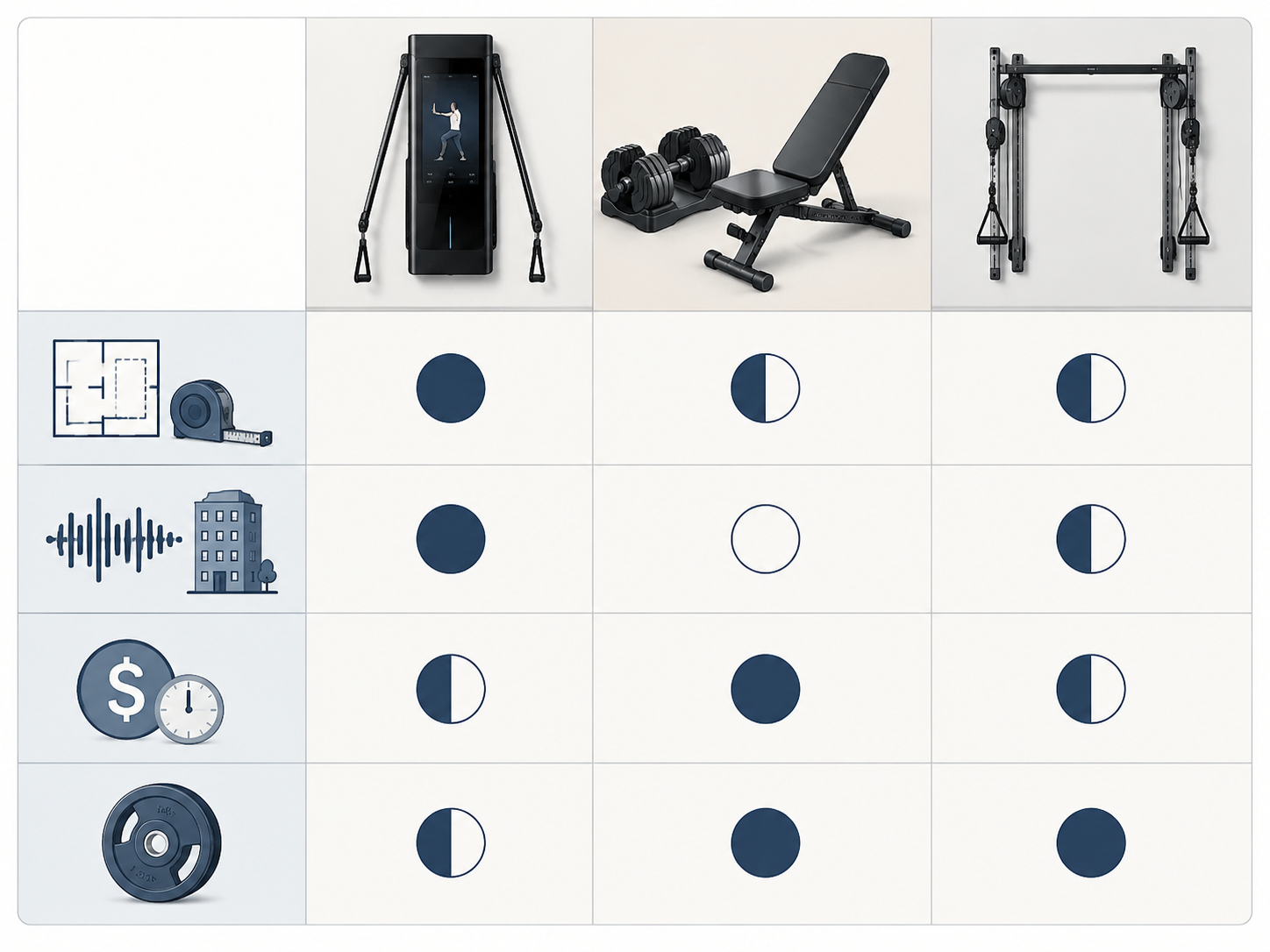
| Constraint | All-in-one smart gym | Modular free weights | Wall-mounted cable or functional trainer |
|---|---|---|---|
| Usable space | Strong if the wall is usable and the training zone stays clear; weak if the room cannot spare wall clearance or installation access. | Strong for storage, mixed during training; dumbbells, bench setup, and movement paths still need floor space. | Strong stored footprint, but depends on wall structure, drilling permission, and cable travel clearance. |
| Noise and shared walls | Usually controlled and quiet because loads are guided and there is little plate handling. | Manageable with flooring and habits, but dropped dumbbells, bench movement, and plate changes carry more neighbor risk. | Generally controlled like a cable station, though installation, attachments, and any rack work can add noise. |
| Five-year cost | High exposure when hardware and monthly subscription are both required. | Usually best for cost control, repair, upgrade, resale, and subscription-free ownership. | Mid-to-high upfront cost; fewer subscription issues, but installation and accessory costs matter. |
| Max resistance | Best for general strength and guided training; capped for heavy long-term barbell-style goals. | Best ceiling if you expect heavy squats, deadlifts, presses, or gradual loading over years. | Useful cable resistance, but the pulley ratio and stack size decide whether it replaces heavy free-weight work. |
The first decision in a compact home gym is not brand. It is category. A smart wall unit, a pair of adjustable dumbbells with a folding bench, and a wall-mounted cable system can all look reasonable in a small room, but they fail in different ways once a real lease, a downstairs neighbor, a monthly bill, and progressive overload enter the picture.
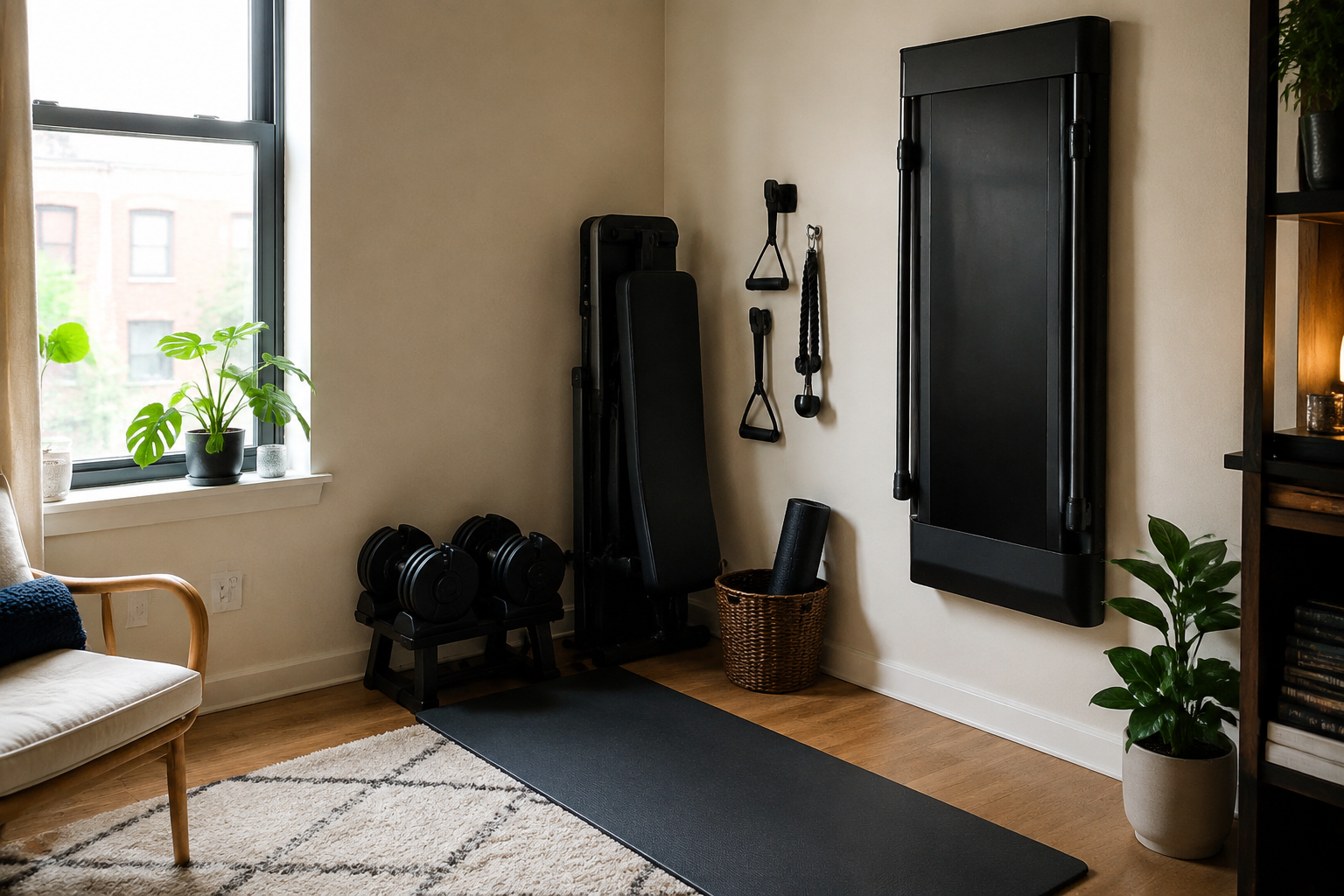
Product photos tend to show the stored footprint. Buyers live with the working footprint. The difference is where most bad compact-gym decisions happen: the bench has to unfold, dumbbells have to be picked up without scraping a dresser, cables need room to travel, and a wall-mounted unit still needs a person standing in front of it with arms extended.
That is why the right question is narrower than “What is the best compact home gym?” The useful question is: which category gives up the least on the constraint that matters most in this room?
Start With the Constraint That Can Actually Stop You
A small-space setup usually breaks on one of four axes: usable floor and wall space, noise tolerance, total cost, or resistance ceiling. It is tempting to average those together. That produces tidy rankings and mediocre rooms.
If the room is under 100 square feet, space is not just square footage. It is the shape of the open area, the direction a bench faces, where doors swing, whether a closet can hold accessories, and whether the only clear wall has a window, radiator, outlet, or lease problem. Wall-mounted systems look wonderful until the usable wall is the same wall the bed needs.
If noise is the limiting factor, the best equipment on paper may be the worst equipment in the building. Adjustable dumbbells can be quiet when handled carefully, but they are still loose weight in a shared structure. A controlled smart gym or cable system is easier to keep quiet during reps, while flooring does more to reduce vibration and protect surfaces than to make heavy impacts disappear.
If budget is tight, separate the purchase price from the ownership price. A machine with a polished screen and coaching may be affordable on day one and expensive by year five. A dumbbell-and-bench setup may look less futuristic, but it does not send a monthly invoice to stay useful.
If strength progression matters most, decide early how heavy “heavy” means. General fitness, hypertrophy work, and guided resistance training can live comfortably below the ceiling of many smart systems. Long-term barbell-style goals are different. Someone who already expects a heavy squat or deadlift path should treat max resistance as a hard filter, not a feature comparison.
Smart Gyms: Clean Footprint, Real Subscription, Defined Ceiling
The case for an all-in-one smart gym is strongest when the room has a usable wall, the buyer wants guided programming, and the whole setup needs to look calm when training is over. Tonal 2 is the cleanest example in the current category: it is wall-mounted, costs $4,295, requires a $59.95 monthly subscription, and has a 250-pound digital resistance cap according to Garage Gym Reviews’ compact equipment coverage.[1]
That footprint deserves credit. A small wall-mounted unit can make more sense than a rack, plates, a bench, and a dumbbell stand in a bedroom corner. It also removes a lot of beginner friction: no plate math, less setup between exercises, built-in tracking, and fewer ways to wander into random programming.
The catch is that wall-mounted does not mean universally apartment-friendly. Professional wall mounting and structural requirements matter. If the lease says no drilling, if studs are not where the unit needs them, or if the only suitable wall is shared with a neighbor’s bedroom, the small stored footprint stops being the whole story.
The subscription also changes the math. Tonal 2’s $59.95 monthly fee equals $719.40 per year at the pricing cited above.[1] Over five years, that subscription exposure is large enough that it should be treated as part of the machine, not as a small accessory cost. Subscription pricing can change, so a five-year comparison should be read as a framework based on current published pricing rather than a guaranteed future bill.
Tempo Move sits at a different point in the smart-gym category. Garage Gym Reviews lists it under $500 with a $39 monthly subscription, using a phone or tablet for tracking and working with dumbbells capped at 35 pounds.[1] That is a much easier entry price, and for someone building consistency, coaching and tracking may matter more than owning a heavier system immediately. But 35-pound dumbbells are not a long runway for lower-body strength or stronger intermediate lifters.
A smart machine is easiest to recommend when quiet controlled training, a clean room, and coaching are the reasons the user will actually train. It is harder to recommend when the buyer is trying to minimize five-year cost, avoid wall installation, or build toward very heavy loading.
Modular Free Weights: Best Long Runway, More Room Discipline Required
A modular free-weight setup usually starts less dramatically: adjustable dumbbells, bands, a folding bench, maybe a mat, maybe a doorway pull-up bar if the frame allows it. That modest beginning is the point. It can be repaired, upgraded, sold, rearranged, and used without a subscription.
Garage Gym Reviews lists REP QuickDraw adjustable dumbbells from $335.99 and says they replace 12 to 16 pairs of fixed dumbbells.[1] That is the kind of compact claim that survives contact with an actual apartment: not because the dumbbells disappear, but because one pair can replace a wall of small increments.
The bench is where many small rooms get exposed. A folding bench such as the Ironmaster bench, listed by Garage Gym Reviews at $499, can store more cleanly than a fixed bench.[1] During training, though, it still needs enough length for presses, rows, split squats, step-ups, and room to walk around loaded dumbbells. A folding bench is compact storage, not magic floor expansion.
Garage Gym Reviews’ budget setup article says its recommendations draw from more than 107,000 user consultations in 2024, and it presents adjustable dumbbells, resistance bands, and a foldable bench as a high-variety setup for spaces under 75 square feet.[2] That is useful evidence, especially because it reflects repeated buyer constraints rather than a single showroom layout. It still should not be treated as a universal law. Some rooms under 75 square feet have terrible geometry.
Noise is the price of the freedom. Dumbbells can be set down softly, but they can also land hard. Benches shift. Collars rattle. A tired person at the end of a set is not always delicate. Foam interlocking tiles, rubber tiles, and stall mats all appear in Garage Gym Reviews’ apartment equipment guidance, with Amazon Basics foam tiles cited around $1 per square foot.[3] Foam is inexpensive and useful for surface protection, but serious impact control often requires better habits as much as better flooring.
The free-weight path gets more compelling as strength goals rise. If the user expects to keep adding load for years, modular equipment can grow in a way most smart systems cannot. The first phase can be dumbbells and bands. The next can be heavier handles, more plates, a better bench, or a folding rack if the room and lease allow it.
PRx-style folding racks show both the appeal and the limit of that upgrade path. Garage Gym Reviews lists a PRx folding rack at $1,099, with a 12-inch stored depth and 1,000-pound capacity.[1] Its apartment-focused coverage also cites the PRx Profile PRO at a 12-inch stored depth and gives it a 4.6 out of 5 tested rating.[3] That is a serious strength ceiling in a small stored footprint, but it is still a wall-mounted rack. Studs, drilling, ceiling height, and lease permission decide whether the spec sheet matters.
Wall-Mounted Cable Systems: The Middle Path With Installation Strings Attached
Wall-mounted cable and functional trainer systems are attractive because they promise the part of a commercial gym many small setups miss: adjustable pulling angles, smooth resistance, and enough exercise variety to keep training from turning into only dumbbell presses and goblet squats.
The REP wall-mounted Athena is one example from Garage Gym Reviews’ compact equipment coverage, with 220-pound-per-side weight stacks at a 2:1 pulley ratio.[1] The ratio matters. A 220-pound stack does not feel like 220 pounds in hand on a 2:1 system. That can be excellent for controlled cable work and less convincing for someone trying to replace heavy barbell loading.
This category often looks like the compromise: quieter than most free-weight work, more upgradeable than many smart systems, and less visually dominant than a full rack. In a room with the right wall, it may be exactly that. In a rental with uncertain studs, strict lease terms, or no confidence in installation, it becomes a nonstarter before the first attachment is clipped on.
Cable systems also need working clearance that photos understate. Lateral raises, rows, presses, chops, pulldowns, and split-stance cable work all pull the user away from the wall. A unit can store flat and still demand a meaningful training lane. If that lane crosses a bed, desk chair, closet door, or walking path, the room will remind the owner every session.
Space Means Stored Footprint Plus Training Clearance
A compact home gym plan should measure two states: where the equipment lives when stored and what the room looks like during the hardest exercise to set up. The stored state sells the product. The training state decides whether it stays in use.
- For a smart wall unit, measure the wall, the standing zone, arm reach, and whether other furniture blocks diagonal movements.
- For adjustable dumbbells, measure the storage spot, the bench footprint when unfolded, and a safe pickup and set-down area on both sides.
- For a folding rack, measure stored depth, unfolded depth, ceiling height, bar path, plate loading space, and whether the rack blocks daily use of the room.
- For a wall-mounted cable system, measure the pull direction for the exercises you actually plan to do, not just the width of the tower.
This is where brand-published layout guidance can be helpful but should be handled carefully. A company selling home gym equipment has every reason to show its product in the most favorable room. Independent testing dimensions and your own taped-out floor plan deserve more weight than a clean rendering.
Noise Is a Neighbor Problem, Not Just a Comfort Feature
Apartment noise has two parts: sound in the room and vibration through the structure. A machine can feel quiet to the person using it while still sending thuds through the floor. That is why “quiet” equipment claims should be matched to the actual movement pattern.
Garage Gym Reviews’ apartment-specific testing notes that magnetic resistance equipment, including examples such as the Niceday Elliptical under $600 and LEIKE X Bike under $200, is measurably quieter than air or friction resistance.[3] That finding is about cardio equipment, but the principle carries over: guided, smooth resistance is usually easier to control than equipment that depends on impacts, fans, or rough contact.
For strength equipment, the quietest setup is often the one that reduces transitions. A smart gym has fewer plates to move. A cable system keeps resistance on a track. Adjustable dumbbells can be quiet if the user has space, patience, and a floor plan that does not require twisting around furniture with load in hand.
Flooring helps, but it should not be asked to do everything. Foam tiles can protect laminate and reduce small contact noise. Rubber can handle more abuse. Stall mats may be durable but can be heavy and awkward in upstairs apartments. The better rule is simple: if the training style includes failed reps, dropped weights, or fast floor contact, the room may not be suitable no matter how compact the equipment is.
Five-Year Cost Changes the Winner
The average home gym cost is about $2,000, with a broad range from $300 to $15,000 according to Garage Gym Reviews’ budget setup guidance.[2] That range is wide enough to be almost useless unless the buyer separates upfront price, recurring cost, installation, accessories, flooring, and likely upgrades.
| Example category | Known current cost signals | What to watch |
|---|---|---|
| Smart gym | Tonal 2 at $4,295 plus $59.95/month; Tempo Move under $500 plus $39/month. | Subscription exposure, installation limits, and whether the resistance ceiling fits future training. |
| Modular free weights | REP QuickDraw adjustable dumbbells from $335.99; Ironmaster folding bench at $499. | Storage, flooring, heavier future increments, and whether a rack upgrade is realistic. |
| Wall-mounted rack or cable system | PRx folding rack at $1,099; REP wall-mounted Athena with 220 lb per side stacks at 2:1. | Mounting permission, installation confidence, pulley ratio, accessories, and working clearance. |
Tempo Move’s $39 monthly subscription equals $468 per year at the cited price.[1] Tonal 2’s fee equals $719.40 per year.[1] Those numbers do not make either system a bad buy by themselves. They do mean a buyer comparing a $500-ish smart entry point with a dumbbell setup should not stop at the checkout page.
Free weights tend to win cost control because useful pieces remain useful after the training plan changes. A bench still works without software. Bands can be replaced cheaply. Dumbbells can move to another apartment. A rack may be resold. The tradeoff is that the buyer becomes the programmer, organizer, and noise manager.
Resistance Ceiling Should Be the Last Hard Filter
Resistance caps matter less for a beginner’s first month than for the second year. A compact system that gets someone training consistently has real value. Still, a ceiling is a ceiling. If the buyer already knows they want long-term heavy squats, deadlifts, and presses, modular free weights or a rack-based path should become the default.
Tonal 2’s 250-pound digital resistance cap is substantial for many movements and limiting for others.[1] Tempo Move’s 35-pound dumbbell limit is approachable but much narrower.[1] A cable system with a 2:1 ratio can feel smooth and useful while still delivering less in-hand load than the stack number suggests. None of these details are flaws in isolation. They are boundaries.
For general strength, hypertrophy, conditioning circuits, guided training, and controlled apartment sessions, those boundaries may be acceptable. For someone who wants a compact version of a barbell gym, they are usually not.
A Practical Category Decision
Choose a smart machine if the room has a suitable wall, controlled noise matters, coaching will improve consistency, and the subscription is acceptable as part of the real cost. This is the cleanest choice for someone who wants the gym to disappear visually between sessions and does not need a very high loading ceiling.
Choose modular free weights if long-term strength, cost control, repairability, resale, and upgrade flexibility matter most. This path asks more from the user: better storage habits, better flooring choices, and more care with noise. In return, it keeps the training ceiling open.
Choose a wall-mounted cable or functional trainer if cable versatility is the missing piece, the wall can legally and structurally support the system, and the pulley ratio and stack size match the exercises you care about. It can be the best small-room compromise, but only when installation is genuinely allowed.
From there, the next reading path should be narrower. If the smart-gym category fits, compare current smart systems and look closely at what smart home gym systems actually cost over five years. If the modular path fits, use a phased purchase-sequence guide or compact budget setup plan. If the apartment itself is the limiting factor, start with apartment-tested equipment and a flooring guide before buying anything heavy.
References
- Best Compact Exercise Equipment, Garage Gym Reviews
- Budget Home Gym Setups, Garage Gym Reviews
- Apartment Home Gym Equipment Guide, Garage Gym Reviews
Some links on this page are affiliate links — they may earn us a commission at no extra cost to you. Our tier and tests are decided before we ever check which links pay; see our full affiliate disclosure.
Spot something off?
Noise and floor-damage claims carry real deposit-risk consequences if we get them wrong — tell us if your experience with this build didn't match what's above.