
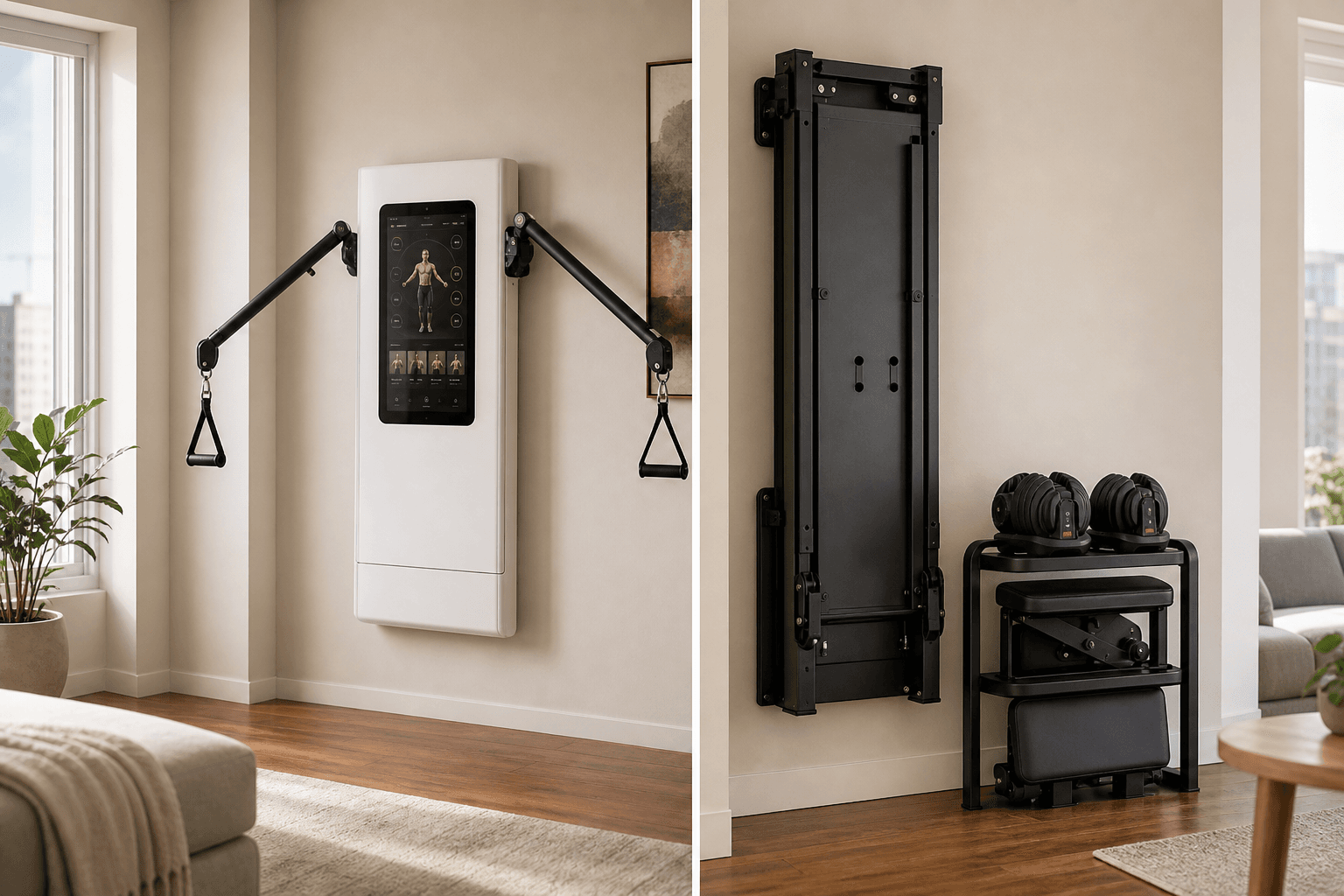
Tonal 2 over three years costs $6,095. That number — $4,295 for the unit plus $50 a month for the membership — is not hidden in fine print. It sits right there in the spec sheets and review roundups. But most buyers I talk to only see the $4,295. They forget the subscription is not optional. Over 36 months, the membership alone adds $1,800. At that point you are not buying a gym. You are signing a lease.
Now consider what $6,095 buys on the other side of the compact home gym market. A PRx Profile PRO rack, a barbell, 300 pounds of plates, an adjustable bench, a pair of PowerBlock adjustable dumbbells — that whole setup runs about $2,549, and it never asks for another dollar. You still have $3,500 left over, or you can spend it on plates you will actually outgrow instead of a subscription you will never stop paying.
The Resistance Ceiling
Smart gyms market their total resistance as if it applies to every exercise. Tonal 2 says 250 pounds. Speediance says 220. Those numbers are true for two-arm movements like squats, deadlifts, and overhead presses. For single-arm exercises — rows, chest flyes, curls, lateral raises — the ceiling drops to 125 pounds per arm.
One hundred twenty-five pounds is not enough for a barbell row or a squat. It is not enough for most lifters past their first year of serious strength training. And it is not a limit you can work around. The machine cannot add more resistance. That is the hard ceiling.
Compare that to a PRx Profile PRO with a 1,000-pound capacity. You will never hit that ceiling. A barbell and plates can be loaded incrementally for decades. The traditional setup scales with your strength. The smart gym does not.
| Product | Type | Price | Subscription | Max Resistance | Folded Depth |
|---|---|---|---|---|---|
| Tonal 2 | Smart gym | $4,295 | $50/mo | 250 lbs total (125 per arm) | 5.25" |
| Speediance Gym Monster | Smart gym | $3,199 | None | 220 lbs total | 14.96" |
| PRx Profile PRO | Traditional rack | $1,099 | None | 1,000+ lbs | 9" |
| Beyond Power Voltra I | Smart accessory | $2,199 | None | 200 lbs | Portable |
Space: The Gap Is Narrower Than You Think
The assumption that smart gyms are always more space-efficient is the first myth to break. Tonal 2 protrudes 5.25 inches from the wall and needs seven feet of clear wall width. The PRx racks fold to nine inches deep — that is four inches off the wall when stored. A set of adjustable dumbbells on a small stand and a folding bench tuck underneath. The floor is clear.
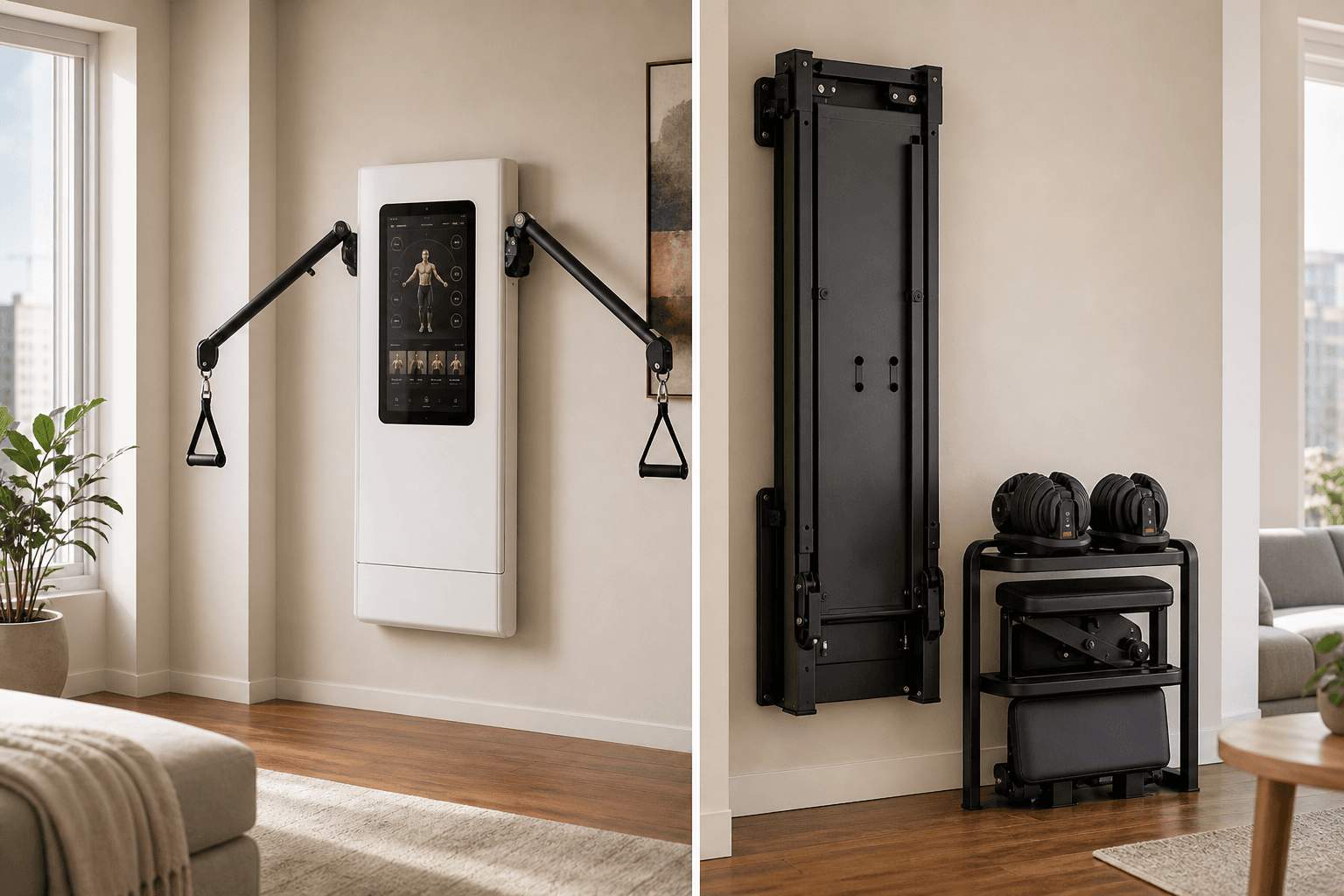
Speediance unfolds to 49 by 28 inches and needs nearly 10 square feet of floor space when in use. Folded, it is 15 inches deep — still thicker than the rack. And unlike the rack, you cannot store anything underneath it.
| Setup | Wall Depth (folded) | Floor Space Required (in use) | Wall Width Required |
|---|---|---|---|
| PRx Profile PRO | 9" (4" off wall) | 0 sq ft (folds to wall) | ~48" |
| Tonal 2 | 5.25" | 0 sq ft (wall-mounted) | 84" |
| Speediance | 14.96" | 9.6 sq ft | 49" |
| Bells of Steel Cable Tower | 31" x 28.5" base | 6.2 sq ft | 31" |
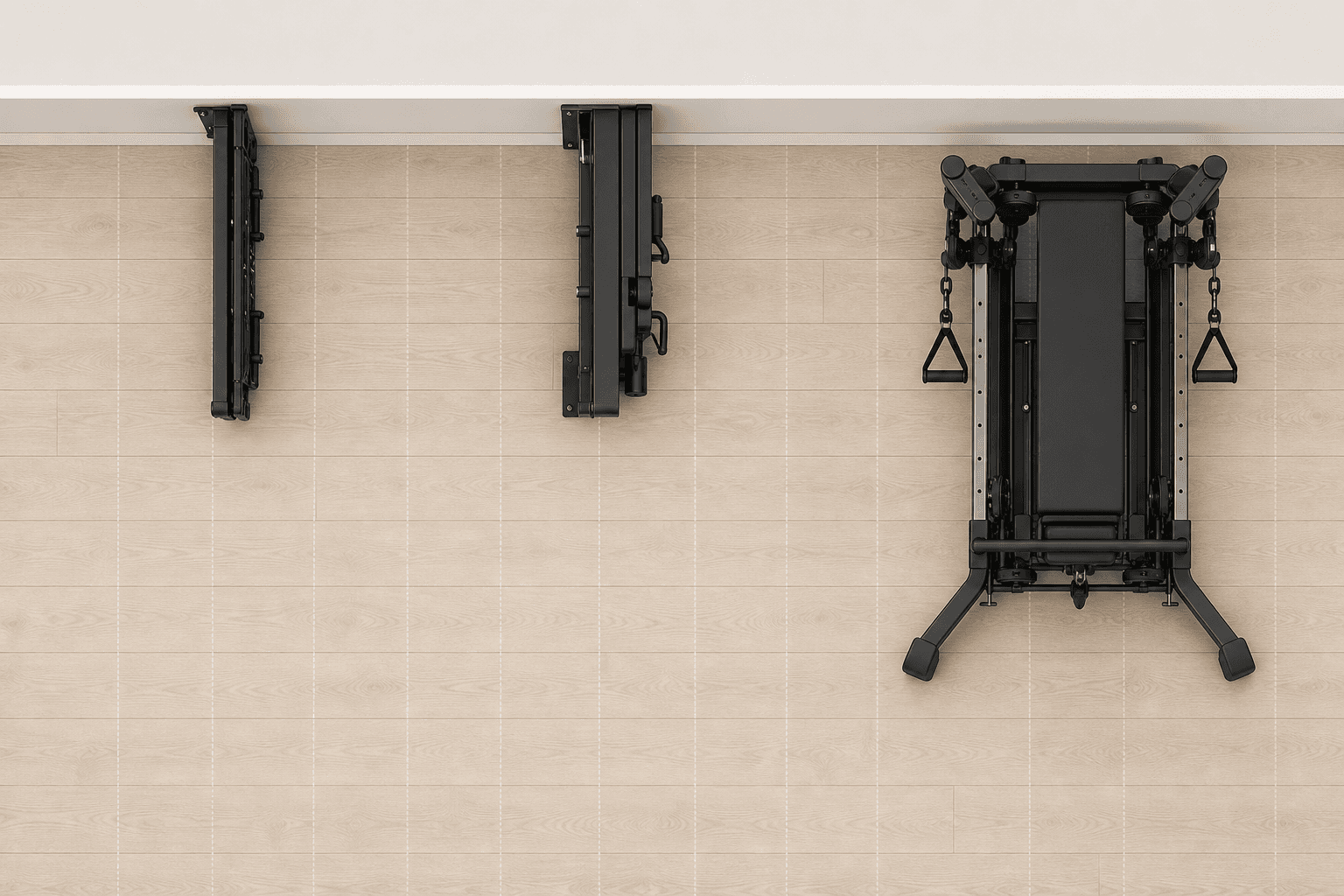
Conclusion: for pure wall-space efficiency, the rack wins. For a renter who cannot drill into walls or wants a single unit that does everything, the smart gym still makes sense. But the gap is narrower than most marketing suggests.
The $6,095 Question (Again)
This is the number that should be printed on every Tonal 2 box. Let me break it down line by line.
| Cost Item | Smart Gym (Tonal 2) | Traditional (PRx + accessories) |
|---|---|---|
| Hardware | $4,295 | $1,099 (rack) + $300 (barbell) + $500 (300 lb plates) + $250 (bench) + $400 (dumbbells) = $2,549 |
| Subscription (3 years) | $1,800 ($50/mo) | $0 |
| Total 3-year cost | $6,095 | $2,549 |
| Resale value after 3 years | ~$500–$800 (if company still supports it) | ~$1,500–$1,800 (60–70% of original) |
The $3,546 gap is not pocket change. That is a year of gym membership, or a set of premium calibrated plates, or a vacation. And the gap only widens over time. Year four of the Tonal costs another $600 in subscriptions. Year four of the traditional setup costs nothing.
I have seen articles that compare the Tonal to a commercial gym membership and claim it breaks even in two years. That math works only if you ignore the opportunity cost of the $4,295 upfront, and if you pretend the subscription is not a permanent line item. It is.
What You Lose Over Time: Exercise Variety and Resale Value
Smart gyms advertise hundreds of guided exercises. And they deliver — if you like cable-style movements and bodyweight variations. But the library is bounded by the machine's mechanics. You cannot do a barbell hip thrust, a landmine press, a rack pull, or a farmer's carry. You cannot add chains or bands. You cannot change the force curve with a different attachment.
A traditional setup with a rack, barbell, dumbbells, and a cable attachment or landmine handle covers every major movement pattern. The exercise library is effectively infinite because you can combine tools. And you are not capped by a software update.
- Smart gym strength ceiling: 125 lbs per arm / 250 lbs total.
- Traditional setup: can load 500+ lbs on a barbell, 125+ lbs per hand with adjustable dumbbells (e.g., REP x PÉPIN FAST Series go up to 125 lbs).
- Traditional cable attachment (e.g., REP Athena): 220 lbs per side at 2:1 ratio, feels like 110 lbs — still competitive with smart gym resistance for single-arm cable work.
For most people training for strength, the ceiling of a smart gym will be reached in under two years. After that, every session is maintenance, not progression. That is a dealbreaker for anyone who wants to get stronger.
Steel holds value. Software does not.
A used PRx rack from three years ago sells for 60–70% of its original price. The same is true for Olympic plates, barbells, and adjustable dumbbells. They are tools. They do not wear out, they do not need server support, and they do not become obsolete when the company pivots.
A used Tonal or Speediance? The resale market is thin. Most buyers will not pay more than a few hundred dollars for a unit that requires professional installation, has a software dependency, and comes with no guarantee the subscription continues. If the manufacturer stops supporting the device — as several smart gym startups have done in the last five years — the unit becomes a wall decoration.
That asymmetry matters over a five- to ten-year horizon. The traditional setup is an asset. The smart gym is an expense.
Who Should Pick Which Path?
After the numbers, the profiles write themselves.
- Pick the smart gym (Tonal 2, Speediance) if you are a space-constrained renter who cannot drill into walls, values guided coaching and form feedback, will never need more than 125 pounds per arm, and is comfortable with a recurring software cost.
- Pick the traditional setup (PRx rack + barbell + plates + bench) if you train for strength, plan to progress beyond year one, hate monthly fees, and want your equipment to hold value.
- Consider the hybrid path (Beyond Power Voltra I + a rack) if you want digital resistance for isolation work but need unlimited capacity for compound lifts, and refuse to pay a subscription.
The hybrid option is the most interesting recent development. The Beyond Power Voltra I ($2,199) offers 200 pounds of digital resistance, weighs 12.8 pounds, and requires no subscription. It is a smart accessory, not a smart gym. You pair it with a traditional rack for barbell work and use it for cable-style movements. It solves the ceiling problem while keeping a digital training layer for isolation exercises. But 200 pounds is still a ceiling for heavy compound lifts. It is a complement, not a replacement.
The Bottom Line
The crossover point between smart and traditional is not at $2,500–$3,500. For strength-oriented buyers, it is lower — around $1,500–$2,500. Once you need a barbell and plates, the smart gym loses its value proposition entirely.
Here is the decision rule: add up the three-year cost of the smart gym you are considering. Then price out a traditional setup that covers the same exercises. If the traditional setup costs less — and it almost always will — and you have space for a rack, buy the rack. The subscription burden is the decisive factor. Everything else is marketing.
If you want to read more about how barbells and machines compare for muscle building, see our comparison of full body workout machines vs free weights. And for more details on the foldable rack option, our guide to the best power rack for small spaces covers space-saving racks in depth.
Comments
Join the discussion with an anonymous comment.