
The “Compact” Lie
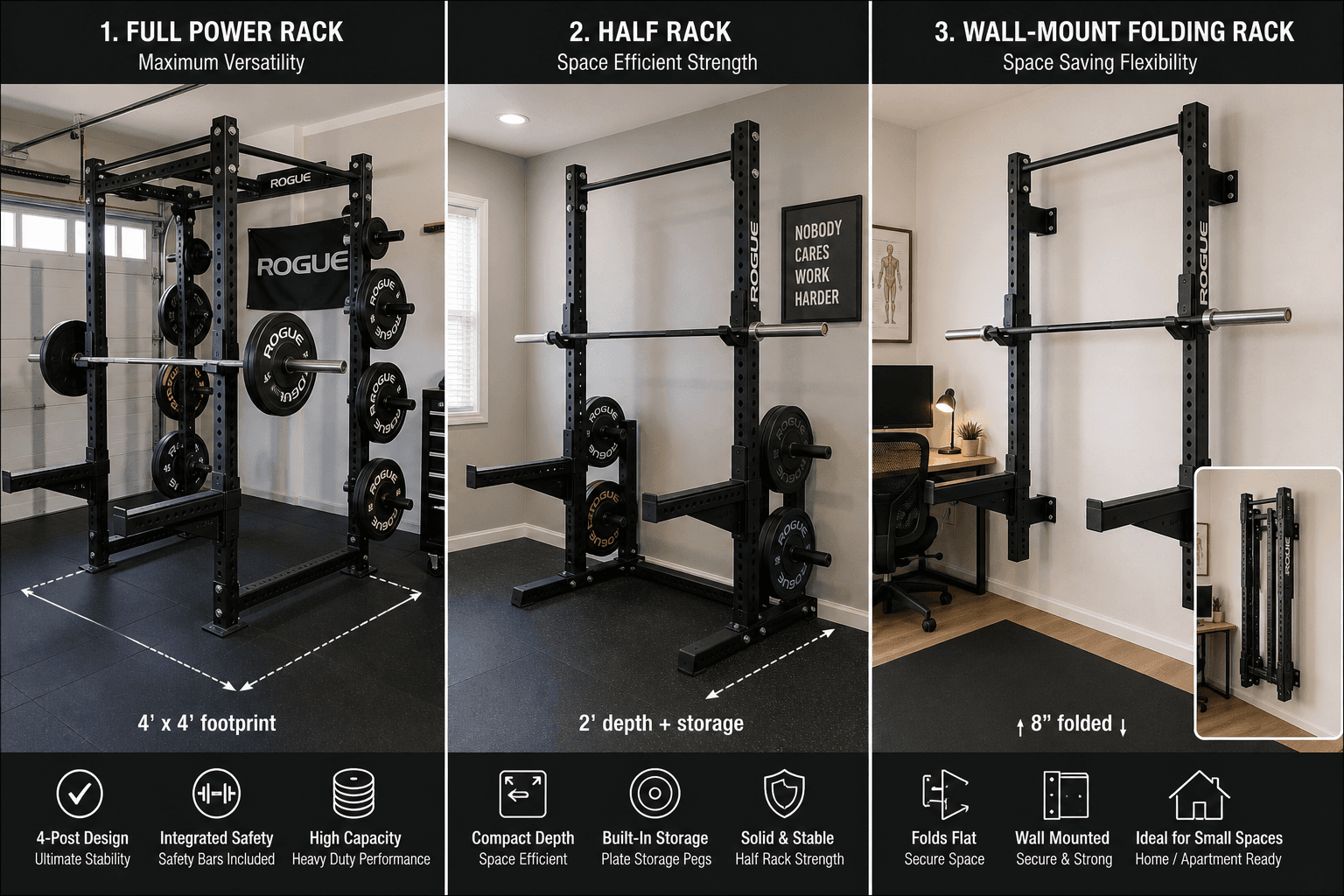
If you are shopping for a power rack for a small space, every listing says “compact.” I believed it once. I learned the hard way. The average home-gym power rack measures 46.5" deep by 51.8" wide by 87.5" tall — that is a 4' x 4' footprint built for an 8-foot ceiling. That is not compact. That is a piece of furniture that owns your room. Most apartment ceilings are 7 to 7.5 feet. Most basements are under 8 feet. And that rack? It does not fit through a 32-inch doorframe assembled, let alone stand up in a 7-foot basement. The label “compact” tells you nothing about whether the thing will even sit in the space you have.
A rack that does not fit is useless. No attachment, no weight capacity changes that. So I am not going to ask “what is the best power rack?” The only question that matters is “which rack fits through your doorway, stands under your ceiling, and still lets you do the movements you need?” Four physical constraints answer that. Almost no buying guide takes them seriously.
Four Measurements, No Exceptions
Before you look at weight capacity, steel gauge, or color options, measure these four things in your room:
- Footprint depth. How much floor does the rack take when you are using it? Standard racks need about 46.5 inches. A short-base compact like the Titan T-3 drops to 32.75 inches. A folding rack like the PRx Profile PRO deploys at 29.25 inches and stores at 8 inches. If you share the room with a desk or a bed, depth is the first dealbreaker.
- Overall width. This is not just the frame width — it includes plate storage on the posts and space to load the bar. Most racks are 52–54 inches wide. That fits through a standard 32-inch door only when disassembled. Measure your door and hallway before you buy.
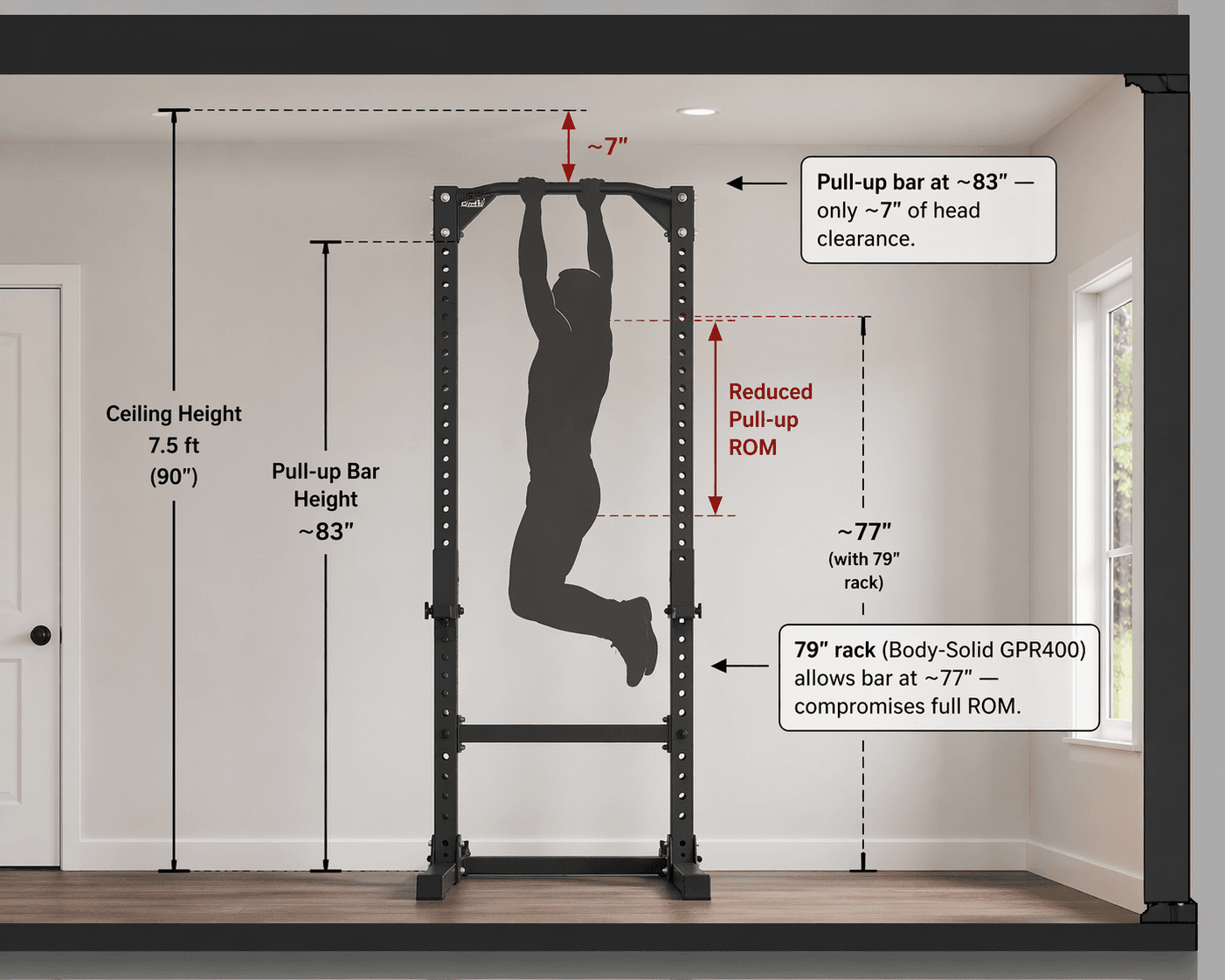
- Ceiling height clearance. The rack’s height is one number; the pull-up bar height is the real one. A 79-inch rack (Body-Solid GPR400) puts the pull-up bar at roughly 77 inches. If your ceiling is 84 inches, a 5'8" person has enough clearance, but a 6'2" person is hitting their head. If your ceiling is 80 inches, that rack is not going in.
- Storage mode. Does the rack stay in one place forever, or can it fold away? A folding rack that compresses to 8" depth (PRx) turns your gym back into a living room. A bolt-down compact rack stays put. Storage mode determines whether the rack owns the room or the room owns the rack.
These are hard constraints. If the rack fails any one of them, it does not matter how many J-hooks it comes with. The rest of this guide walks through each solution type — folding, short, and compact — using these axes as your criteria.
Weight Capacity? Do Not Bother Yet
Every rack on this list — the PRx Profile PRO (1,000 lbs), the Body-Solid GPR400 (1,000 lbs), the Titan T-3 (1,000+ lbs), the Sportsroyals (700 lbs on safeties) — has enough capacity for 99% of home lifters. The real differentiator is not whether the rack can hold 1,200 lbs. It is whether the rack fits your room. If the rack is 87 inches tall and your ceiling is 84 inches, that 1,200 lbs means nothing because you cannot assemble it.
I have watched people agonize over 1,000 lb vs 1,500 lb ratings while ignoring that the rack needs a 4-foot depth they do not have. Capacity is a secondary filter. After you verify the rack physically fits — depth, width, height, storage — then compare capacity. In a small space, capacity is almost never the limiting factor.
The Folding Solution: Wall-Mounted Racks and the PRx Profile PRO
If your space is truly tight — a corner of a bedroom, a narrow basement, a room that doubles as an office — the folding rack is the cleanest solution. The PRx Profile PRO is the best-known example. Deployed, its footprint is 29.25" deep by 53" wide. Folded, it sits 8 inches from the wall — the room is essentially empty again. That is a game changer for apartment dwellers.
But the PRx is not a magic bullet. It costs $1,099.99. It requires mounting into wall studs — which means landlord permission if you rent. And it comes in three height options: 81", 89", or 95". The 81-inch version is the one for standard 8-foot ceilings, but the pull-up bar sits at roughly 79 inches. A 6-foot user will have about 3 inches of pull-up clearance. It works, but you are not getting full range of motion overhead.
| Model | Deployed Depth | Folded Depth | Width | Height Options | Price | Weight Capacity |
|---|---|---|---|---|---|---|
| PRx Profile PRO | 29.25" | 8" | 53" | 81", 89", 95" | $1,099.99 | 1,000 lbs |
| Body-Solid GPR400 | 53" | N/A (non-folding) | 52" | 79" | $840 | 1,000 lbs |
| Sportsroyals | 61.9" | N/A (non-folding) | 67.9" | 83.6" | $639 | 700 lbs (safeties) |
| Titan T-3 (short) | 47" (std) or 32.75" (deep) | N/A | 48" | 73.5" | $379.99 | 1,000 lbs |
If you can mount into studs and have the budget, the PRx is the only rack that truly disappears. Every other rack in this guide stays put and takes up floor space when not in use.
Short Racks for Low Ceilings: The Pull-Up Problem
This is where most small-space buying guides go quiet. They say a rack is “pull-up capable” and leave you to discover the hard way that you cannot actually do a full pull-up without banging your head or dragging your knees on the floor.
The Body-Solid GPR400 stands 79 inches tall. The pull-up bar on that model sits at roughly 77 inches. A 6-foot (72-inch) person hanging from the bar has about 5 inches of headroom. That is enough for a chin-up, but if you try a pull-up with full extension, your feet may still touch the floor and your head may brush the ceiling if the rack is under a 7-foot ceiling. A 5'8" person will have significantly more clearance. The Sportsroyals at 83.6 inches tall is borderline for 7-foot ceilings — you need at least 85 inches of actual ceiling height to have any reasonable space for a pull-up. If your ceiling is exactly 84 inches, this rack is too tall to even assemble.
Here is the concrete judgment: if you are over 5'10" and your ceiling is under 84 inches, accept that you will not get full-range pull-ups on a short rack. Either choose a folding rack (which can mount the bar higher, like the PRx in 89" or 95" version if your ceiling permits), or use multi-grip bars that sit lower and let you do neutral-grip pull-ups with restricted ROM. Or skip pull-ups entirely and do bent-over rows and lat pulldowns with a band setup.
| User Height | Body-Solid GPR400 (bar ~77") | Sportsroyals (bar ~81") | PRx Profile PRO 81" (bar ~79") |
|---|---|---|---|
| 5'6" (66") | ~11" headroom – full ROM | ~15" headroom – full ROM | ~13" headroom – full ROM |
| 5'10" (70") | ~7" headroom – limited ROM | ~11" headroom – good | ~9" headroom – good |
| 6'0" (72") | ~5" headroom – limited | ~9" headroom – adequate | ~7" headroom – adequate |
| 6'2" (74") | ~3" headroom – poor | ~7" headroom – limited | ~5" headroom – limited |
One more thing: short racks are often light. The Body-Solid GPR400 weighs about 180 lbs and does not require bolting, but the Titan T-3 short squat stand at 73.5" tall is relatively short and may tip forward if you rack the bar aggressively. Bolting it down is recommended for stability, which is a problem if you rent or have concrete floors.
Compact Four-Post Racks: When Floor Space Is Tight but Ceiling Is Fine
If you have adequate ceiling height (8 feet or more) but limited floor depth (narrow garage, spare room corner), a compact four-post rack like the Titan T-3 is the simplest option. The T-3 comes in a 32.75" depth option — a full 14 inches shallower than the average rack. At 54 inches wide, it fits through a standard 32-inch door when disassembled. Price starts at $379.99, making it the most affordable option on this list.
The trade-off is stability. A 32.75-inch-deep rack has a shorter base, which means it is more prone to tipping under heavy use — especially if you do not bolt it down. The Titan X-3 flat-foot model ($565) solves this with a wider footprint that does not require bolting, but it is also deeper. If you own the space, bolting the T-3 is fine. If you rent, the flat-foot X-3 or the folding PRx are better choices.
The T-3 also comes in a 91-inch height option, which works well for 8-foot ceilings. The pull-up bar sits around 89 inches — plenty of clearance for most users. If your ceiling is exactly 96 inches, the 91-inch version leaves 5 inches of overhead, which is fine for pull-ups. Just make sure you have enough clearance to hang from the bar without touching a light fixture or ceiling joist.
Your Fit Checklist: Match Your Room to the Right Model
Here is a practical decision flow you can walk through right now with a tape measure:
- Measure your ceiling height. If it is under 84 inches, you need a rack under 80 inches tall (Body-Solid GPR400 at 79") or a folding rack that mounts the bar at a height that works for you. If it is 84 inches or more, you have more options but still need to check the pull-up clearance against your height.
- Measure your available floor depth. If you cannot spare 4 feet of permanent depth, look at folding racks (PRx) or short-base compact racks (Titan T-3 32.75" depth). If you have at least 4 feet and can leave the rack in place, the standard T-3 at 44.75" depth is fine.
- Check your door width. The rack frame width is 48–54 inches, but it will need to be carried in disassembled. Make sure a 54-inch piece can fit through your door at an angle, or that you are comfortable disassembling it fully.
- Decide on storage mode. Do you need the room to revert to non-gym use? If yes, folding rack. If not, any rack works.
Once you have your answers, use the comparison table below to find the model that matches your constraint profile.
| Model | Deployed Depth | Width | Ceiling Height Required | Pull-Up Bar Height (approx) | Weight Capacity | Price | Best For |
|---|---|---|---|---|---|---|---|
| PRx Profile PRO | 29.25" D (8" folded) | 53" | 81" version: 84" min | ~79" (81" version) | 1,000 lbs | $1,099.99 | Apartment, shared room, renter with stud access |
| Body-Solid GPR400 | 53" D | 52" | 80" min (recommend 84") | ~77" | 1,000 lbs | $840 | 7' ceiling, short user, non-folding |
| Sportsroyals | 61.9" D | 67.9" | 85" min | ~81" | 700 lbs | $639 | Low ceiling but needs cable station (all-in-one), user <6' |
| Titan T-3 (short depth) | 32.75" D | 54" | 84" min (82" height option) | ~80" (82" version) | 1,000+ lbs | $379.99 | Narrow garage, budget, will bolt down |
| Titan T-3 (standard depth) | 44.75" D | 54" | 93" min (91" height option) | ~89" | 1,000+ lbs | $449.99 | Standard room with adequate depth |
| Titan X-3 flat foot | ~48" D | 52" | ~84" min | ~82" (80" version) | 1,650 lbs | $565+ | Homeowner, wants bolt-free stability |
Where to Go From Here
Measure your room before you look at any other spec. Footprint depth, ceiling height, door width, and storage mode are hard constraints. Weight capacity, attachments, and brand are variables you can adjust only after the dimensional check passes.
Do not buy a rack that “almost” fits. A 79-inch rack under a 7-foot ceiling with a 6'2" user will not work for pull-ups — and you will resent it every time you hit your head. A folding rack that costs $1,100 is still cheaper than a rack you cannot use. Pick the model that passes your four-axes test, and ignore the rest.
Comments
Join the discussion with an anonymous comment.