
The 7-Minute Workout for Beginners: How to Modify It Safely
This guide provides specific, exercise-by-exercise modifications to the classic 7-minute workout, making it accessible for true beginners with no equipment. Includes a 2-week ramp-up schedule to gradually build strength and confidence.
The classic 7 minute workout looks simple until you try to do it as an actual beginner on an actual living-room floor. Jumping jacks may bother your knees or downstairs neighbor. Push-ups may feel impossible. A full plank may turn into wrist pain before your muscles get any useful work.
That reaction is not a failure of willpower. WebMD describes the 7-minute workout as “not good for beginners,” and Cleveland Clinic cautions that it assumes a baseline level of fitness rather than starting from zero.[1][2] The fix is not to abandon the format. The fix is to keep the structure, lower the impact, shorten the leverage, add support where balance is shaky, and progress at a pace your joints can tolerate.
A modified version will usually be less intense than the original high-intensity circuit. That means it may burn fewer calories and create a smaller cardiovascular challenge. It can still be worth doing if it lets you finish the session with controlled breathing, stable joints, and enough confidence to come back tomorrow.
The classic circuit you are modifying
The widely shared 7-minute workout uses 12 bodyweight exercises, usually performed for short work intervals with brief rests. The standard sequence includes jumping jacks, wall sit, push-up, abdominal crunch, step-up onto a chair, squat, triceps dip on a chair, plank, high knees running in place, lunge, push-up with rotation, and side plank.[2]
For a beginner, the problem is not the number 7. The problem is that several of those movements combine speed, impact, wrist loading, deep knee angles, or balance demands before your body has had time to learn the pattern. Chris Jordan, one of the creators associated with the original 7-minute workout, published a lower-impact “Gentle Workout” approach in 2025, which gives welcome legitimacy to modifying the circuit rather than treating modifications as a consolation prize.[3]
| Classic exercise | Beginner modification | Main reason for the swap |
|---|---|---|
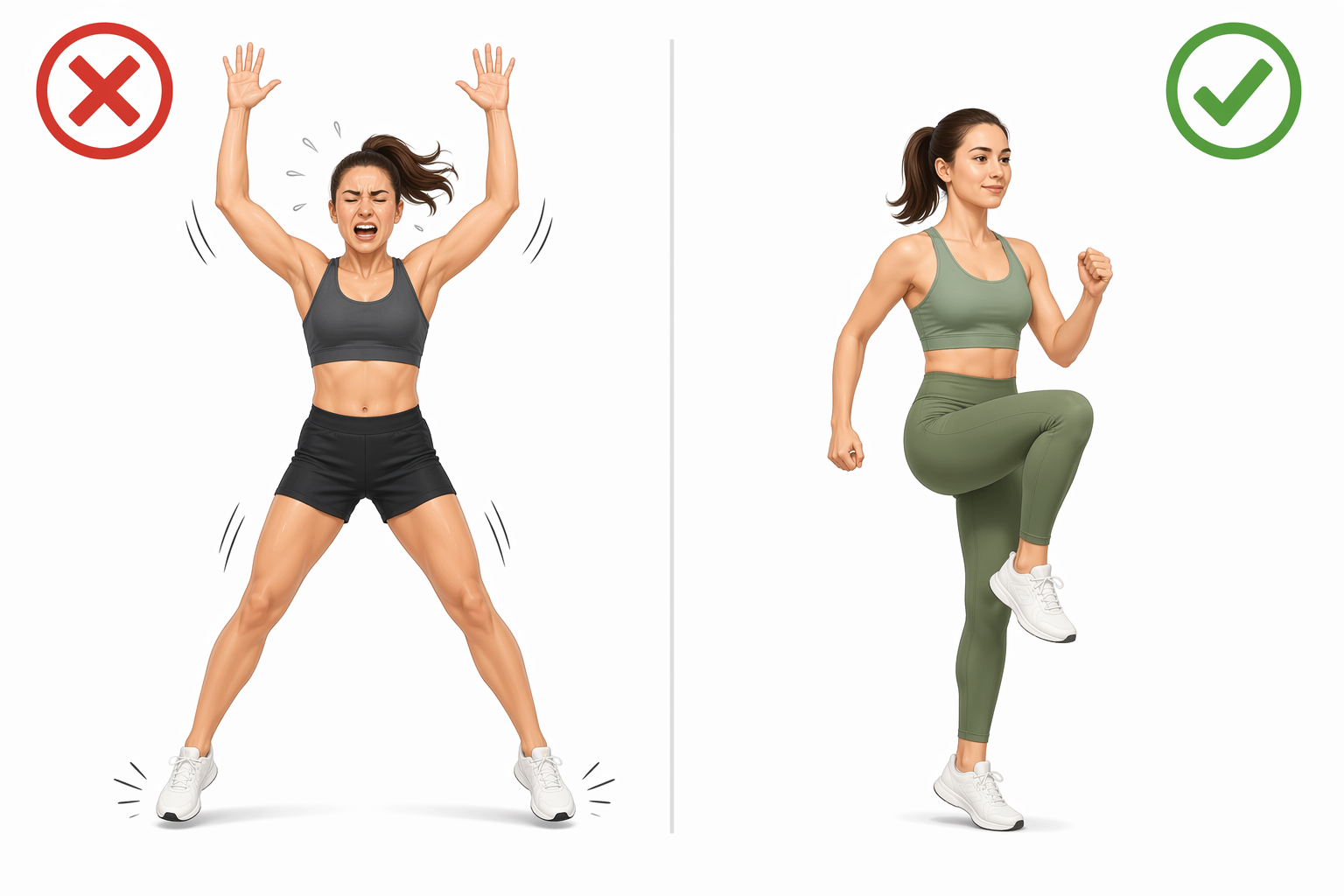
| Jumping jacks | Marching jacks | Lower impact; easier to control breathing and balance |
| Wall sit | Shallow wall sit, around a 45-degree knee bend | Less knee demand; easier to exit safely |
| Push-up | Incline push-up against a wall, counter, or sturdy sofa | Less bodyweight through arms; lower wrist and shoulder load |
| Abdominal crunch | Small-range crunch or heel taps | Less neck pulling; easier trunk control |
| Step-up onto chair | Low step-up onto a bottom stair or low sturdy platform | Lower balance risk; less knee and hip demand |
| Squat | Chair squat or partial squat | Clear depth target; more confidence on the way down |
| Triceps dip on chair | Wall triceps press or very small-range supported dip | Less shoulder strain and wrist extension |
| Plank | Knee plank or elevated plank | Shorter lever; less pressure through wrists and low back |
| High knees running in place | Steady high-knee march | No jumping; easier to keep posture |
| Lunge | Chair-assisted reverse lunge or split-stance bend | More balance support; less forward knee stress |
| Push-up with rotation | Incline push-up only, or incline push-up with tiny chest opening | Removes the hardest wrist, shoulder, and trunk rotation demand |
| Side plank | Side plank from knees | Shorter lever; easier shoulder and hip control |
How to do each beginner version safely
Use a timer if it helps, but do not let the timer become the boss. For the first week, stopping with good form is better than completing every second badly. If an exercise causes sharp pain, dizziness, chest pain, or joint pain that changes how you move, stop that exercise and choose an easier option or skip it for the day.
1. Marching jacks instead of jumping jacks
Stand tall with your feet under your hips. Step one foot out to the side while raising both arms overhead or to shoulder height. Step back in, then repeat on the other side. Keep the movement quiet enough that someone in the next room would barely hear it.
This keeps the arm-and-leg coordination of jumping jacks without the landing force. If raising both arms overhead makes your shoulders tense, raise them only to chest or shoulder height. If balance is a problem, make the step smaller and slower.
2. Shallow wall sit instead of a deep wall sit
Place your back against a wall and walk your feet a small step forward. Slide down only until your knees are slightly bent, aiming for roughly a 45-degree bend rather than thighs parallel to the floor. Keep your knees pointing in the same direction as your toes.
A shallow angle still asks your thighs and hips to work, but it gives your knees a friendlier starting point. You should be able to stand back up without pushing off your thighs or twisting sideways. If you cannot, you went too low.
3. Incline push-ups instead of floor push-ups
Put your hands on a wall, kitchen counter, or the arm of a sturdy sofa. Step your feet back until your body forms one long line from head to heels. Bend your elbows and bring your chest toward the surface, then press away.
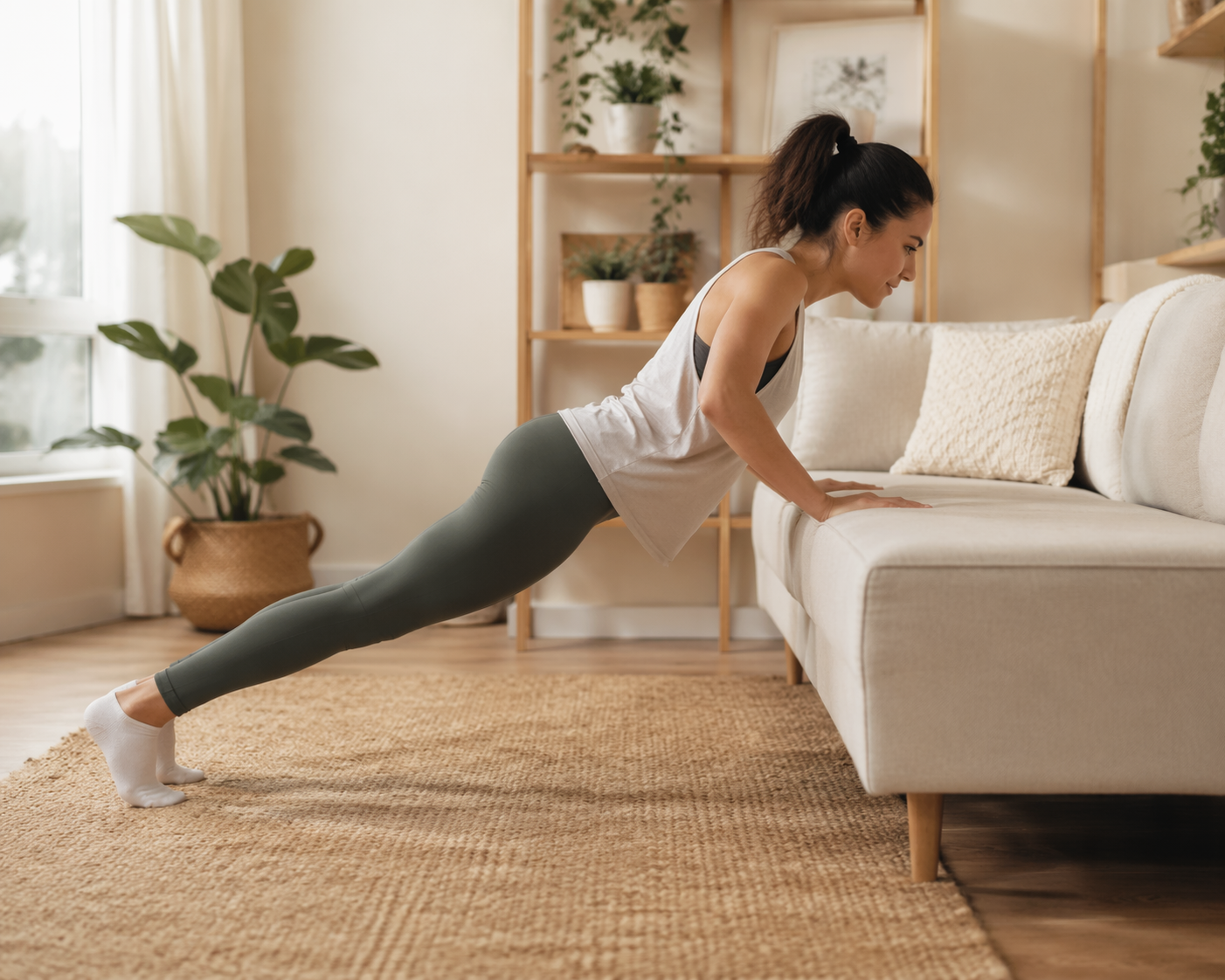
The higher your hands are, the easier the push-up becomes. A wall is the easiest version. A counter is harder. A low sofa is harder again. Choose the height that lets you lower and press without sagging through your low back or shrugging your shoulders up to your ears.
For sore wrists, a wall often feels better than the floor because the angle is smaller and the load is lighter. Stop if you feel sharp wrist, elbow, or shoulder pain rather than ordinary muscle effort.
4. Small-range crunch or heel taps instead of forcing a full crunch
For a small crunch, lie on your back with knees bent and feet on the floor. Support your head lightly with your hands, then lift your shoulder blades just a little. Think of your ribs moving toward your hips, not your neck yanking your head forward.
If crunches bother your neck, use heel taps instead. Stay on your back with knees bent, tighten your midsection gently, and tap one heel slightly farther away, then bring it back. Alternate sides. Your low back should not arch dramatically off the floor.
5. Low step-ups instead of chair step-ups
The standard circuit often uses a chair for step-ups, but a chair is too high and too unstable for many beginners. Use a bottom stair, a low aerobic step if you already own one, or another low, sturdy surface that will not slide.
Step up with one foot, bring the other foot up lightly, then step down with control. Hold a wall or railing if needed. Keep your knee tracking over your toes, and do not let the working knee collapse inward. If stepping down feels jarring, lower the height or switch to marching in place.
6. Chair squat or partial squat instead of a fast squat
Stand in front of a chair with your feet about hip- to shoulder-width apart. Send your hips back as if you are about to sit, lightly touch the chair if you can, then stand up. If the chair is too low, use a shallower range and stop before your knees or back complain.
The chair gives you a target, not a place to collapse. Keep your chest relaxed but lifted, and press through your whole foot as you stand. If you feel your heels lifting or your knees diving inward, slow down and reduce the depth.
7. Wall triceps press instead of chair dips
Chair dips can be surprisingly rough on shoulders and wrists, especially when someone is new to upper-body training. A wall triceps press is a safer first stop. Stand facing a wall, place your hands on it at about chest height, and keep your elbows close to your sides. Bend your elbows so your body moves slightly toward the wall, then press away.
You should feel the backs of your arms working, not a pinching sensation in the front of your shoulders. If you strongly prefer the chair version, keep the movement tiny, keep your hips close to the chair, and stop before your shoulders roll forward.
8. Knee plank or elevated plank instead of a full plank
For a knee plank, come to the floor on your forearms and knees. Move your knees back until your body forms a straight line from shoulders to knees. Gently tighten your stomach and glutes. Keep your neck long and look at the floor.
The knee version shortens the lever, which makes it easier to keep your low back from sagging. If getting on the floor is the main barrier, use an elevated plank with your hands or forearms on a counter or sturdy sofa. End the hold when your back position changes, even if the timer has time left.
9. High-knee march instead of high knees running in place
March in place and lift one knee at a time toward hip height, or lower if that is what you can control. Swing your arms naturally. Keep your torso tall rather than leaning back to pull the knee higher.
This is still a cardio interval if you move steadily. The goal is a pace that raises your breathing without turning the movement into stomping, flailing, or holding your breath.
10. Chair-assisted reverse lunge instead of unsupported lunges
Stand beside a chair or wall and use one hand for balance. Step one foot backward into a short stance, bend both knees a little, then return to standing. Alternate sides slowly.
A reverse lunge is often easier to control than a forward lunge because you are not dropping your weight onto the front leg. Keep the step short at first. If even that feels unstable, skip the step and use a split-stance bend: one foot forward, one foot back, small bend, stand tall, then switch sides halfway through.
11. Incline push-up only instead of push-up with rotation
The push-up with rotation is not just a push-up. It adds a turning plank, shoulder stability, and balance demand after your arms are already tired. For a true beginner, repeat the incline push-up from exercise 3 and leave out the rotation.
If the incline push-up feels controlled, you can add a very small chest opening at the top: press away from the wall or counter, lift one hand a few inches, and turn your chest slightly. Put the hand back down before the next rep. This should feel tidy, not like you are catching yourself from falling.
12. Side plank from knees instead of full side plank
Lie on one side with your knees bent and your forearm on the floor. Stack your shoulder over your elbow. Lift your hips so your body forms a straight line from shoulders to knees. Hold briefly, then lower with control. Switch sides halfway through the interval.
This version shortens the body lever and makes it easier to feel the side of your trunk working without dumping pressure into your shoulder. Stop if your shoulder pinches, your elbow slides, or you cannot keep your hips lifted without twisting.
A beginner 7-minute workout you can follow today
Before starting, clear enough floor space to step side to side and lie down if you are using floor options. Keep a sturdy chair, wall, counter, or sofa nearby. Wear shoes if they help your feet feel supported; go barefoot only if your floor is not slippery and your feet tolerate it well.
| Order | Exercise | Beginner version |
|---|---|---|
| 1 | Jumping jacks | Marching jacks |
| 2 | Wall sit | Shallow wall sit |
| 3 | Push-up | Wall, counter, or sofa incline push-up |
| 4 | Abdominal crunch | Small crunch or heel taps |
| 5 | Step-up | Low step-up or march in place |
| 6 | Squat | Chair squat or partial squat |
| 7 | Triceps dip | Wall triceps press |
| 8 | Plank | Knee plank or elevated plank |
| 9 | High knees | High-knee march |
| 10 | Lunge | Chair-assisted reverse lunge |
| 11 | Push-up with rotation | Incline push-up only |
| 12 | Side plank | Side plank from knees |
For your first attempt, use 20 seconds of work and take as much rest as you need between exercises. If you need 30 to 60 seconds to set up safely for the next move, take it. The workout may take longer than 7 minutes at first, and that is fine. The “7-minute” label should not rush you into sloppy transitions.
The 2-week ramp-up
Jordan’s gentle-workout approach supports the idea of progressing the format rather than throwing beginners directly into the original circuit.[3] The schedule below uses that logic cautiously. It is a practical ramp, not a medical prescription and not a guarantee that everyone will be ready for the standard workout on the same date.
| Phase | What to do | How it should feel | Move on when |
|---|---|---|---|
| Week 1 | Do 1 modified circuit at a reduced pace. Use about 20 seconds of work per exercise and full rest between moves. | Breathing increases, but you can still control your form and set up each exercise calmly. | You can finish the circuit without sharp pain, rushing, or losing balance. |
| Week 2 | Do 1 modified circuit closer to the standard rhythm. Try about 30 seconds of work with shorter rests, but keep the same beginner substitutions. | The circuit feels challenging, not chaotic. You may breathe hard, but your joints feel stable. | You can complete all 12 exercises with steady form and recover within a reasonable time. |
| Week 3 | Consider testing parts of the standard circuit, or keep the modified version and increase control, range, or pace gradually. | You feel ready to experiment, not pressured to prove something. | The modified workout feels controlled for several sessions in a row. |
Do not treat Week 3 as a deadline. Some people will stay with the modified circuit longer, especially if knees, wrists, shoulders, balance, or body weight make the standard version uncomfortable. That is still training. One 2023 study found that low-impact bodyweight exercise may improve aerobic fitness in previously inactive adults, so a gentler circuit can still build aerobic tolerance and strength confidence even when it does not match the intensity of the classic protocol.
How to know the modification is working
The right beginner version should feel like work, not like a test you are failing. During the circuit, you want effort in large muscles: thighs during squats and wall sits, chest and arms during incline push-ups, trunk during planks, and steady breathing during marches. You do not want sharp joint pain, numbness, dizziness, or the feeling that you are one bad rep away from falling.
- Make it easier if your form changes before the interval ends.
- Make it easier if you are holding your breath to survive the movement.
- Make it easier if a joint hurts more than the working muscle.
- Keep the same version if it feels challenging but repeatable.
- Make it slightly harder only when you can finish with control.
Slightly harder does not have to mean jumping. It might mean using a lower incline for push-ups, bending a little deeper in the chair squat, lifting the knees a little higher during marching, or resting a little less between exercises. Those small changes are often more useful than trying to copy the standard circuit before your body is ready.
Where to go after your first controlled circuit
Once you can complete the modified 7 minute workout with controlled breathing, stable joints, and no sharp pain, you have earned a next step. That might be repeating the same circuit a few times per week, learning more about what research says the 7-minute workout can and cannot do, or deciding how often to do the 7-minute workout without turning it into an everyday grind.
If you prefer being guided, a beginner-friendly app can help with timing and reminders, as long as it lets you modify movements instead of pushing one fixed version. You can compare no-equipment workout apps for beginners or use a first-30-days workout app plan if habit-building is the harder part.
And if the 7-minute format starts to feel too cramped, branch into a broader home cardio programming guide. For now, the useful win is simpler: one circuit completed cleanly, with movements your body could actually do.
References
- Seven-Minute Workout, WebMD.
- 7-Minute Workout, Cleveland Clinic.
- 7-minute workout low-impact exercises modified, The Washington Post, 2025.
This result comes from one real apartment under the stated conditions — it is a strong signal, not a guarantee your space will measure identically.
Builds this evidence supports
Cable Machine Alternatives That Save Space and Money
Compare the best cable machine alternatives for home gyms – from resistance bands and pulley systems to suspension trainers and compact digital units – and find the right option for your space and budget.
How to Choose a Compact Home Gym That Works for Your Space, Budget, and Noise Tolerance
This article provides a structured decision framework for apartment dwellers and small-space residents to match their specific floor footprint, noise sensitivity, and budget to the most suitable compact home gym strategy — whether that's an all-in-one machine, modular build, smart digital system, or band/bodyweight setup.
The Garage Gym Reality Check: What Equipment Actually Fits in a Single-Car Garage
Most garage gym guides assume a two-car space. This article uses real dimensions, real equipment footprints, and three layout templates to show what fits—and what doesn't—in a single-car garage (10x20 to 12x20 ft).
Spot something off?
If this result didn't match your own space, let us know — floor-damage and noise claims carry real deposit-risk consequences if we get them wrong.