
The $5,695 Bike That Costs More Than Triple Its Sticker
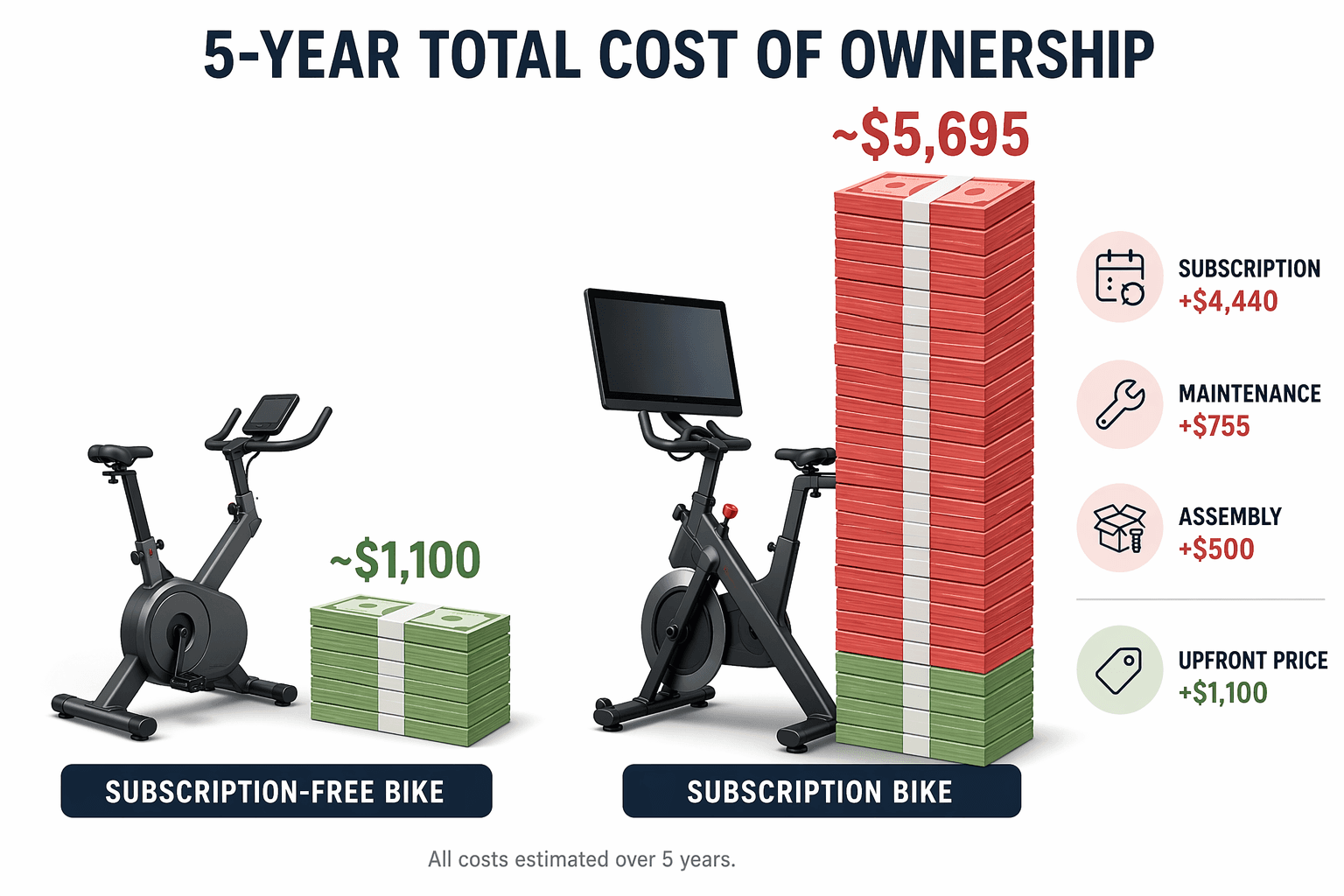
You see a $2,695 price tag on the Peloton Cross Training Bike+ and you think: that is the expensive one. It is not. Over five years that bike will cost you roughly $5,695 — more than double the sticker. Meanwhile the $1,100 Concept2 BikeErg, which has no subscription and almost no maintenance, costs exactly $1,100 total. That is not a rounding error. It is the difference between buying a bike and renting one with your attention.
The single most common mistake I see: people compare upfront prices and think they have done the math. They have not. The subscription fee, warranty duration, friction pad replacements, assembly charge, accessories — all of it adds up to three or four times the initial purchase. This article walks through every dollar you will actually hand over in the first five years. If you are shopping for the best home exercise bike, the only honest starting point is the five-year total.
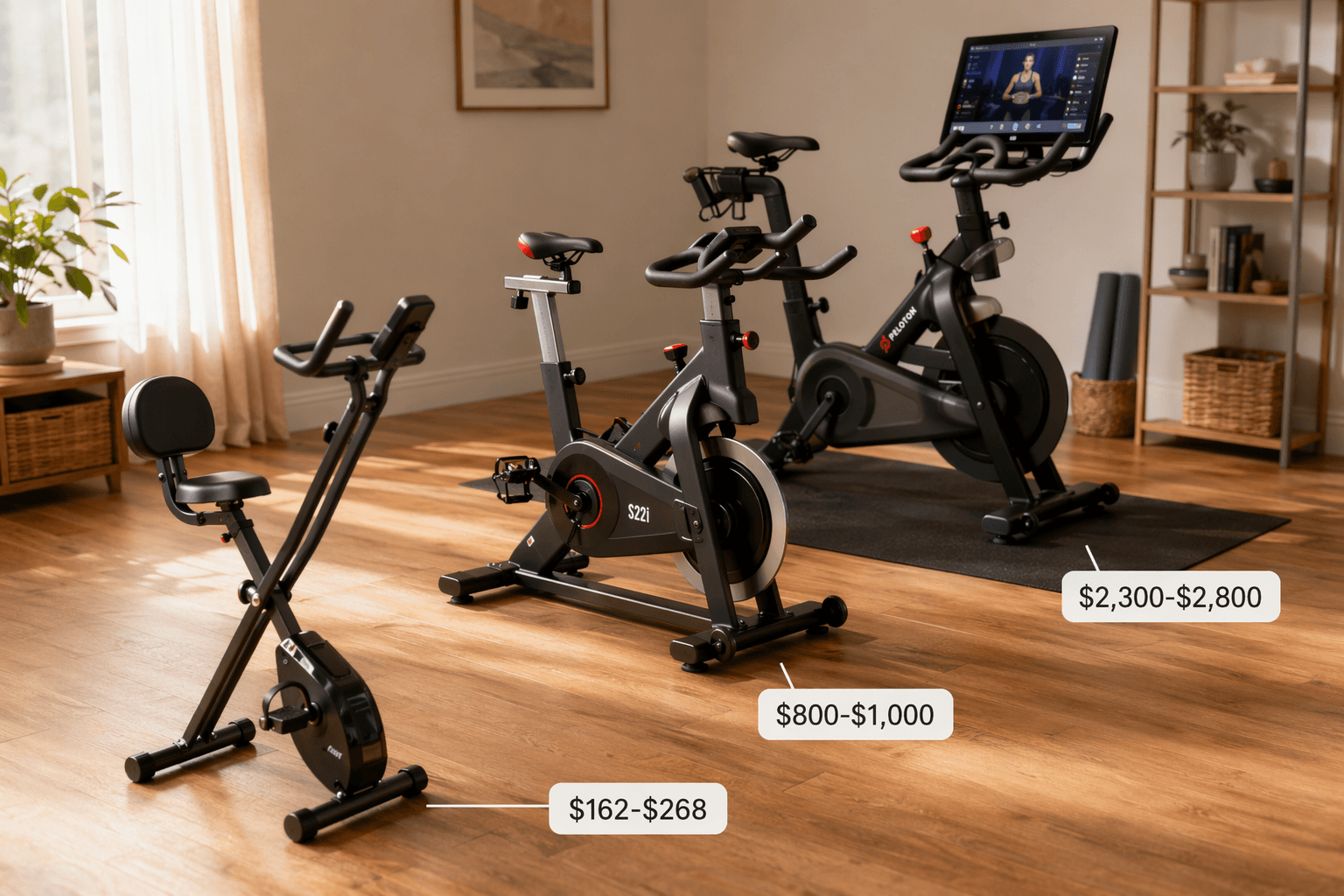
Here are the five-year totals for six representative models. I picked these to span the range from subscription-free workhorses to premium content-dependent machines. The math: upfront price plus five years of monthly subscription (if any) plus estimated maintenance and assembly. Resale is factored in later — for now, assume you keep the bike.
| Model | Upfront Price | Monthly Subscription | 5‑Year Subscription Total | Estimated Maintenance + Assembly | 5‑Year Total |
|---|---|---|---|---|---|
| Concept2 BikeErg | $1,100 | $0 | $0 | $50 | $1,150 |
| Rogue Echo Bike | $945 | $0 | $0 | $50 | $995 |
| Schwinn IC4 | $999 | Optional $13/mo (Peloton app) | $780 (if paid) | $120 | $1,899 |
| NordicTrack X24 | $2,299 | $15–$39/mo (iFIT) | $900–$2,340 | $150 | $3,349–$4,789 |
| Bowflex VeloCore | $2,199 | $11.99/mo (JRNY) | $719 | $200 | $3,118 |
| Peloton Cross Training Bike+ | $2,695 | $50/mo | $3,000 | $250 | $5,945 |
The table should make you stop. The Concept2 and Rogue Echo cost less than a thousand dollars total. The Peloton Bike+ costs nearly six thousand. That difference is not because the Peloton is a worse bike — it is a very good bike — but because the subscription alone eats $3,000 over five years. That is more than the bike itself.
The $50 Monthly Fee Only Works If You Ride Every Day
The biggest variable in total cost is the monthly fee. Some bikes require a subscription for core functionality; others let you use whatever app you want. Here are the published rates as of mid-2026.
| Brand | Subscription Cost | Required for Core Use? |
|---|---|---|
| Peloton (All-Access) | $49.99/mo | Yes – no content without it |
| NordicTrack iFIT | $15/mo (individual) – $39/mo (family) | Yes – no auto-resistance or classes |
| Echelon Premier | $40/mo | Yes – free tier very limited |
| Bowflex JRNY | $11.99 – $20/mo | Recommended, not strictly required |
| Aviron | $24/mo (annual) – $34/mo (monthly) | Yes for interactive games |
| Speediance VeloNix | $15/mo (Pro) | No – basic use free |
I do not buy the argument that a $50 monthly fee is fine because "you would pay that for a gym membership." That comparison works only if you actually use the bike every day. If you ride three times a week, each ride on a Peloton costs you about $4.17 in subscription alone. That is not cheap. If you ride twice a week, it is $6.25 per ride. Compare that to the $13/month Peloton digital app that you can use on a tablet — or free YouTube workouts — and the gap becomes obvious.
For a deeper dive into the subscription math alone, see our Exercise Bike Subscription Costs Decoded. This article covers the full TCO picture that goes beyond just the monthly fee.
The Costs You Don’t See — Including the Warranty Gamble
Most buyers never factor in maintenance, assembly, or accessories. These are small numbers individually, but they add up. And warranty length is not a feature bullet — it is a financial risk metric.
- Friction pad replacement: If you buy a budget bike with felt or leather resistance pads (Sunny, Yosuda, Marcy), you will need to replace them every one to two years. The pads cost $20–$50. Over five years, that is $50–$150 extra.
- Assembly: Having a professional assemble your bike costs $150–$300 unless you do it yourself. Many people do not have the tools or patience. That is a real cost.
- Accessories: Cycling shoes ($50–$200), a mat ($30–$60), hand weights ($20–$50), and possibly a heart rate monitor. If you are starting from zero, budget $100–$300.
- Magnetic resistance bikes (like the Schwinn IC4, Bowflex C6, and Horizon 7.0IC) have no pad replacement costs. That is a small but real advantage in a five-year TCO.
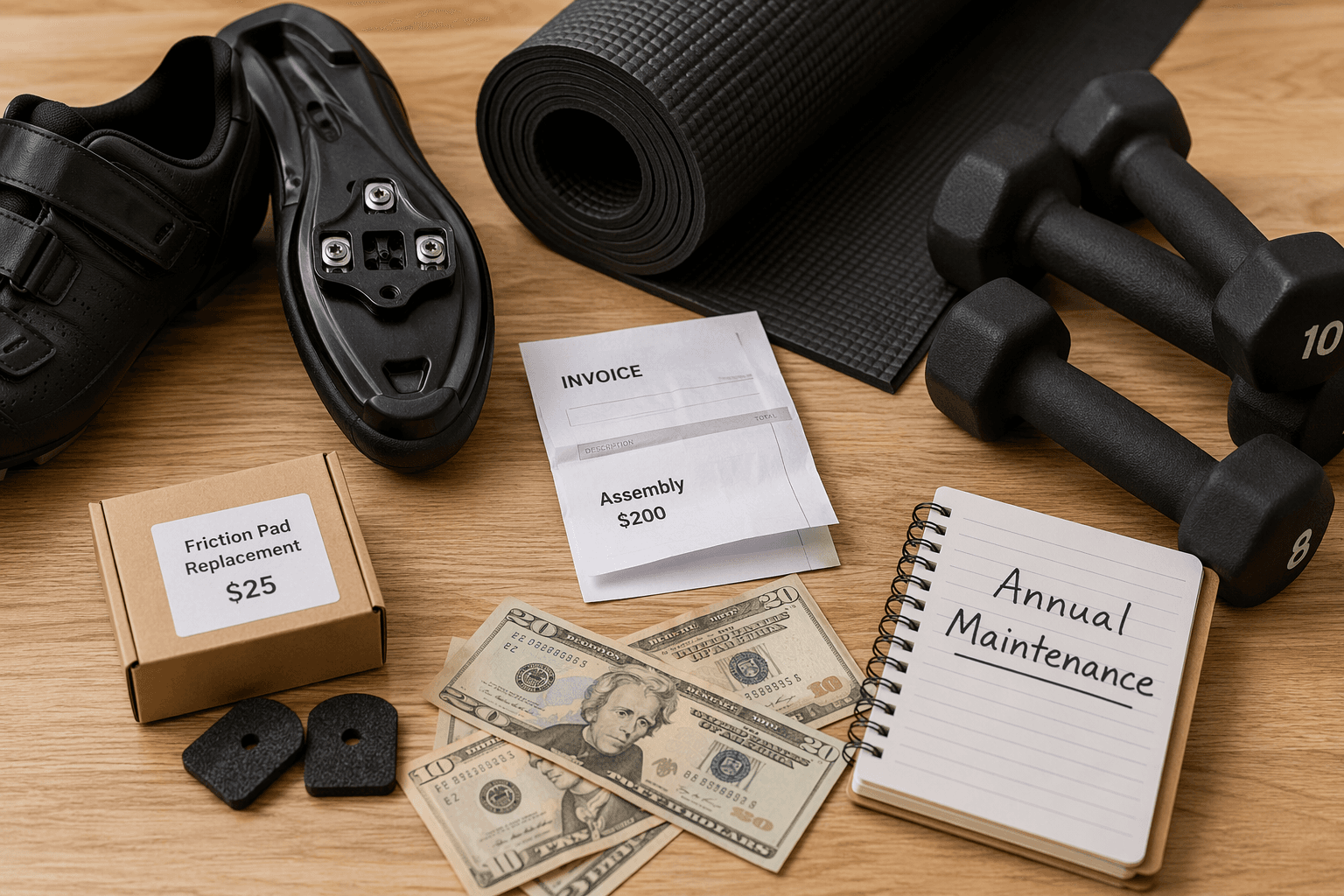
When I add these up for a typical budget buyer, the hidden costs run $200–$500 over five years. That is not huge relative to a premium bike's subscription, but it matters for someone on a tight budget. And it is completely avoidable if you have the skills to do your own assembly and choose a magnetic resistance bike.
Now, warranty. A one-year warranty on a $2,695 bike means that from year two onward, any repair is out of pocket. A screen replacement on a smart bike can cost $300–$500. Frame failure could total the bike. Meanwhile a 10-year frame warranty means you are covered for almost the entire ownership period.
| Model | Frame Warranty | Parts Warranty | Labor Warranty |
|---|---|---|---|
| Peloton Bike+ (new) | 1 year | 1 year | 1 year |
| Peloton Bike (refurbished) | 5 years | 1 year | 1 year |
| NordicTrack X24 | 10 years | 2 years | 1 year |
| Schwinn IC4 | 10 years | 3 years | 1 year |
| Sunny SF-B1002 | 3 years | 180 days | – |
| Rogue Echo Bike | 2 years | 2 years | 2 years |
| Aviron Fit Bike | 10 years | 1 year | – |
Look at the difference between the Schwinn IC4 and the Peloton Bike+. Both are high-quality bikes. The Schwinn gives you a 10-year frame warranty; the Peloton gives you one year. If the frame cracks in year three — and Peloton has had recalls for broken seat posts (35 reports for the original Bike in 2023, and a November 2025 recall for the Bike+ after two injuries, per Wirecutter) — you are on your own with the Peloton. With the Schwinn, you are covered. That is not a small distinction. It is a potential $500–$1,000 repair bill vs. zero.
I treat a short warranty as a hidden cost. The risk is real, and it should be factored into your mental TCO. If I were comparing two bikes at the same price point, one with a 1‑year warranty and one with a 10‑year frame warranty, I would subtract at least $100–$200 from the value of the short‑warranty bike to account for the risk you are shouldering.
Resale: Worth Noting, but Not a Game-Changer
Premium bikes tend to hold resale value better than budget models. A used Peloton Bike or Bike+ can still fetch 40–60% of its original price after two to three years. That helps offset the high upfront cost — but only if you sell. And here is the catch: subscriptions are non-transferable. The new owner still has to pay the $50/month fee. So the resale value advantage does not reduce the subscription burden for the original owner, and it does not help the new owner escape the monthly fee.
Subscription-free bikes like the Concept2 BikeErg also hold their value well. The community loves them because they are durable and have no lock-in. If you plan to keep the bike for more than a couple of years, resale becomes a secondary factor. The real decision is upfront: subscription or no subscription.
How to Compare Bikes Honestly
Here is the formula I use whenever someone asks me which bike to buy:
- Start with the upfront price.
- Add five years of subscription fees (estimated based on your expected usage).
- Add maintenance: $0 for magnetic resistance, $50–$150 for friction over five years.
- Add assembly ($150–$300) or subtract if you DIY.
- Add accessories ($100–$300).
- Subtract estimated resale value (only if you plan to sell within five years).
- Subtract warranty value: a longer warranty reduces your risk. I mentally discount a short-warranty bike by $100–$200.
Do the math before you swipe your card. The best home exercise bike is the one that costs the least over five years for the usage you actually get. For some people that is a $1,100 Concept2 BikeErg. For others it is a $999 Schwinn IC4 with a cheap app. For heavy users who love classes, a Peloton might still make sense — but they need to own the full number.
This article complements our Best Home Exercise Bike: A Decision-Matrix Guide which focuses on features and specs. Use that for bike selection, and this for the financial reality check. Also check the Exercise Bike Buying Guide for understanding the specs that matter.
Comments
Join the discussion with an anonymous comment.