
Best Home Exercise Bike: A Decision-Matrix Guide by Budget, Space, Resistance, and Subscription
Choosing the right exercise bike depends on more than just price. This guide helps you find the best bike by evaluating four co-equal axes — budget, space footprint, resistance type, and subscription appetite — with a decision flow chart, spec comparisons, and 5-year total cost of ownership.
Why the Best Exercise Bike Depends on Four Axes, Not One
Most exercise bike guides start with a simple question: "How much do you want to spend?" That single-axis approach works for low-consideration purchases, but a home exercise bike is a high-consideration investment — the average bike costs $1,409 and weighs 129 lbs, according to Garage Gym Reviews. A wrong choice means a heavy, bulky machine you either live with or pay to return.
The problem with price-tier-only thinking is that it ignores three other constraints that matter just as much: the physical space your home can spare, the type of resistance that matches your training style, and the monthly subscription cost that will follow you for years. A $2,299 bike with a $39/month subscription costs $4,639 over five years. A $999 bike with no subscription costs $999. Those are fundamentally different purchases, even though both fall into a "premium" budget tier.
This guide replaces the single-axis ranking with a decision-matrix approach. Instead of asking "What's the best bike?" it asks "What's the best bike for your specific intersection of budget, space, resistance preference, and subscription tolerance?" The answer is different for every reader, and that is the point.
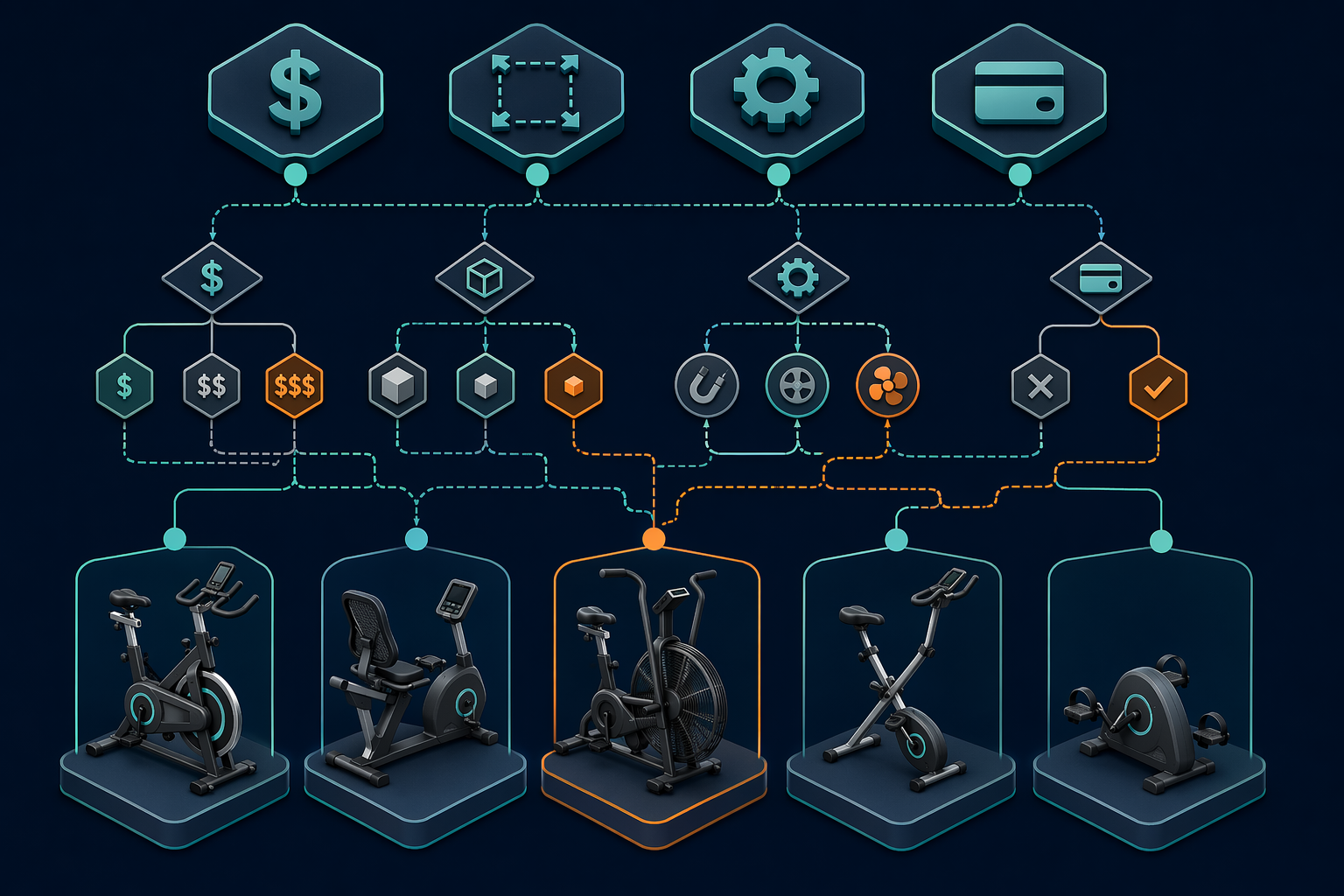
The Four Decision Axes: Budget, Space, Resistance, and Subscription
Before looking at any specific model, it helps to understand where you stand on each axis. These four dimensions are independent — a high budget does not solve a small-space problem, and a premium subscription does not improve magnetic resistance. Mapping your constraints first makes the model selection obvious.
Axis 1: Budget Tier
The exercise bike market clusters into three clear price bands. Under $500 buys a functional machine with friction or basic magnetic resistance, no connected features, and a smaller footprint. The $500–$1,500 range is the sweet spot for magnetic resistance, Bluetooth connectivity, and build quality without a mandatory subscription. Above $1,500, you are paying for large touchscreens, premium finishes, and the ecosystem lock-in of a connected platform.
Axis 2: Space Footprint
Footprint is measured in square inches of floor coverage. Compact bikes under 1,000 sq. in. fit comfortably in apartments, bedrooms, or shared living spaces. Standard bikes between 1,000 and 1,200 sq. in. need a dedicated corner. Large bikes over 1,200 sq. in. — typically recumbent or air bikes — require a home gym or garage setting. Folding models add another dimension: the Marcy Foldable collapses to 14 inches deep, weighing just 37 lbs, per Garage Gym Reviews.
Axis 3: Resistance Type
Three resistance systems dominate the market. Magnetic resistance is quiet, smooth, and virtually maintenance-free — it is the standard at most price points today. Friction resistance uses a felt pad against the flywheel; it is cheaper and provides a more direct road-like feel but wears out over time and requires pad replacement. Fan (air) resistance uses a large fan blade that increases resistance as you pedal harder; it is self-regulating and produces a distinctive wind noise — the Rogue Echo Bike registers 76.3 dB at maximum intensity, per Garage Gym Reviews.
Axis 4: Subscription Appetite
Subscription costs are the hidden multiplier in exercise bike ownership. A $44/month Peloton subscription adds $2,640 over five years. A $39/month iFIT subscription adds $2,340. Some bikes — like the Schwinn IC4 — require no subscription at all, though they offer an optional JRNY membership for $11.99/month. The decision is not just about monthly cash flow; it is about whether you want a bike that becomes a paperweight if you cancel the subscription.
Decision Flow Chart: Find Your Bike in Four Questions
The fastest way to narrow the field is to answer four questions in sequence. Each answer eliminates a set of models and surfaces the ones that match your constraints.
- What is your maximum budget for the bike itself? (Under $500 / $500–$1,500 / Over $1,500)
- How much floor space can you dedicate? (Under 1,000 sq. in. / 1,000–1,200 sq. in. / Over 1,200 sq. in.)
- Do you prefer magnetic, friction, or fan resistance? (Magnetic for quiet and low maintenance / Friction for road feel on a budget / Fan for self-regulating HIIT)
- Are you willing to pay a monthly subscription for guided classes and metrics? (No / Yes, but under $20/mo / Yes, up to $44/mo)
A reader who answers "Under $500," "Under 1,000 sq. in.," "Friction," and "No subscription" lands on the Yosuda Indoor Cycling Bike. A reader who answers "$500–$1,500," "1,000–1,200 sq. in.," "Magnetic," and "No subscription" lands on the Schwinn IC4. A reader who answers "Over $1,500," "Over 1,200 sq. in.," "Magnetic," and "Yes, up to $44/mo" has a choice between the Peloton Bike+ and the NordicTrack X24 — and the tiebreaker is screen size and ecosystem preference.
Budget Tier Breakdown: What You Actually Get at Each Price Level
Each budget tier delivers a different combination of resistance quality, build materials, connectivity, and subscription pressure. The table below maps the key models across all three tiers.
| Model | Price | Resistance | Weight Capacity | Footprint (sq. in.) | Subscription |
|---|---|---|---|---|---|
| Yosuda Indoor Cycling Bike | $340 | Friction, 35-lb flywheel | 270 lbs | 871 | None |
| Sunny SF-B1002 | $268 | Friction, 49-lb flywheel | — | 1,026 | None |
| Marcy ME-709 Recumbent | $210 | 8-level magnetic | 300 lbs | 1,435 | None |
| Schwinn IC4 | $999 | 100-level magnetic | 330 lbs | 1,036 | None (optional JRNY $11.99/mo) |
| Echelon EX-5 | $1,500 | 100-level magnetic | — | — | EchelonFit $40/mo |
| ProForm Studio Bike Pro | $1,404 | 22-level magnetic | 250 lbs | 1,237 | Includes 3-year iFIT |
| NordicTrack X24 | $2,299 | 100-level magnetic | 350 lbs | 1,150 | iFIT $39/mo |
| Peloton Bike+ | $2,695 | 100-level magnetic | 297 lbs | 1,200 | All-Access $44/mo |
| Bowflex VeloCore 22" | $2,199 | 100-level magnetic | 325 lbs | — | JRNY $11.99/mo |
Under $500: Functional, No-Frills, and Subscription-Free
The under-$500 tier is dominated by friction-resistance spin bikes and entry-level recumbent models. The Yosuda Indoor Cycling Bike ($340) is the standout pick for self-motivated riders. It uses a 35-lb flywheel with felt-pad friction resistance, measures 40.5" x 21.5" (871 sq. in.), and supports up to 270 lbs. There is no screen, no Bluetooth, and no subscription — just a belt-drive system that runs quietly enough for apartment use.
The Sunny Health & Fitness SF-B1002 ($268) offers a heavier 49-lb flywheel and operates at a measured 47.4 dB, per Garage Gym Reviews — quieter than many magnetic bikes at twice the price. Its 54" length makes it a tighter fit for shorter riders but gives a more stable ride at high cadence.
For readers who need a recumbent position — seniors, rehab patients, or anyone with lower-back concerns — the Marcy ME-709 ($210) provides 8 levels of magnetic resistance and a 300-lb weight capacity at a price that undercuts most upright models.
$500–$1,500: The Versatile Sweet Spot
This is the most competitive price band, and the Schwinn IC4 ($999) is the consensus leader. OutdoorGearLab scored it 80/100, noting its 100-level magnetic resistance, 330-lb weight capacity, and 1,036 sq. in. footprint. The IC4 is the same bike as the BowFlex C6 — compare prices before buying. Its Bluetooth connectivity works with Zwift, Peloton's app, and its own JRNY platform, but none of these require a subscription to use the bike. The IC4's power readings run approximately 10% high compared to a Garmin power meter, per OutdoorGearLab, so treat its watt numbers as relative rather than absolute.
The ProForm Studio Bike Pro ($1,404) takes a different approach: it includes a 3-year iFIT subscription in the purchase price, which effectively lowers the upfront cost if you would have subscribed anyway. Its 22 digital resistance levels are fewer than the IC4's 100, but the 10" swiveling touchscreen and included programming make it a strong choice for guided-class riders.
Premium $1,500+: Connected, Large-Screen, and Subscription-Bound
Above $1,500, the purchase price is only half the story. The NordicTrack X24 ($2,299) offers a 24" pivoting touchscreen, 350-lb weight capacity, and a 150mm Q-factor that approximates road bike geometry. It scored 85/100 from OutdoorGearLab, the highest of any bike tested. The Peloton Bike+ ($2,695) counters with a 170mm Q-factor, auto-resistance, and a movement-tracking camera for form correction, scoring 83/100. Both require subscriptions — iFIT at $39/month and Peloton All-Access at $44/month, respectively.
The Bowflex VeloCore ($2,199 for the 22" model) adds a unique leaning mechanism that lets the bike tilt side-to-side, engaging core muscles during rides. It uses 100-level magnetic resistance and the JRNY app ($11.99/month), which is significantly cheaper than iFIT or Peloton. Its 325-lb weight capacity and 26.2-lb felt weight make it easier to move than the 140-lb Peloton Bike+.
Space-Constrained Picks: Bikes That Fit Small Apartments and Rooms
For apartment dwellers and small-space setups, footprint and noise are the primary constraints. The table below compares the most compact models.
| Model | Footprint (sq. in.) | Dimensions (L x W) | Folding | Noise Level | Weight |
|---|---|---|---|---|---|
| Marcy Foldable | 576 (4 sq. ft.) | 32" x 18" unfolded | Folds to 14" deep | Quiet (magnetic) | 37 lbs |
| Yosuda Indoor Cycling | 871 | 40.5" x 21.5" | No | Moderate (belt-driven) | 68 lbs |
| Schwinn IC4 | 1,036 | 48.75" x 21.25" | No | Quiet (magnetic) | 106 lbs |
| Sunny SF-B1002 | 1,026 | 54" x 19" | No | 47.4 dB | 110.8 lbs |
The Marcy Foldable Exercise Bike ($162) is the clear winner for extreme space constraints. It occupies just 4 sq. ft. when unfolded and collapses to 14 inches deep for closet storage. Its 8 magnetic resistance levels and 250-lb weight capacity are modest, but at 37 lbs it is the only bike on this list that can be easily moved between rooms.
The Yosuda (871 sq. in.) and Schwinn IC4 (1,036 sq. in.) are both compact enough for a bedroom corner or living room nook. The Yosuda's belt drive is quieter than chain-driven alternatives, while the IC4's magnetic resistance is virtually silent. The Sunny SF-B1002's 47.4 dB noise level — measured by Garage Gym Reviews — is quieter than a normal conversation and well within apartment tolerance.
Subscription Costs Decoded: 5-Year Total Cost of Ownership
Subscription costs are the single most underestimated factor in exercise bike ownership. A bike that seems affordable at $2,299 can cost more than double that over five years. The chart below shows the true cost of ownership for the most popular connected bikes.
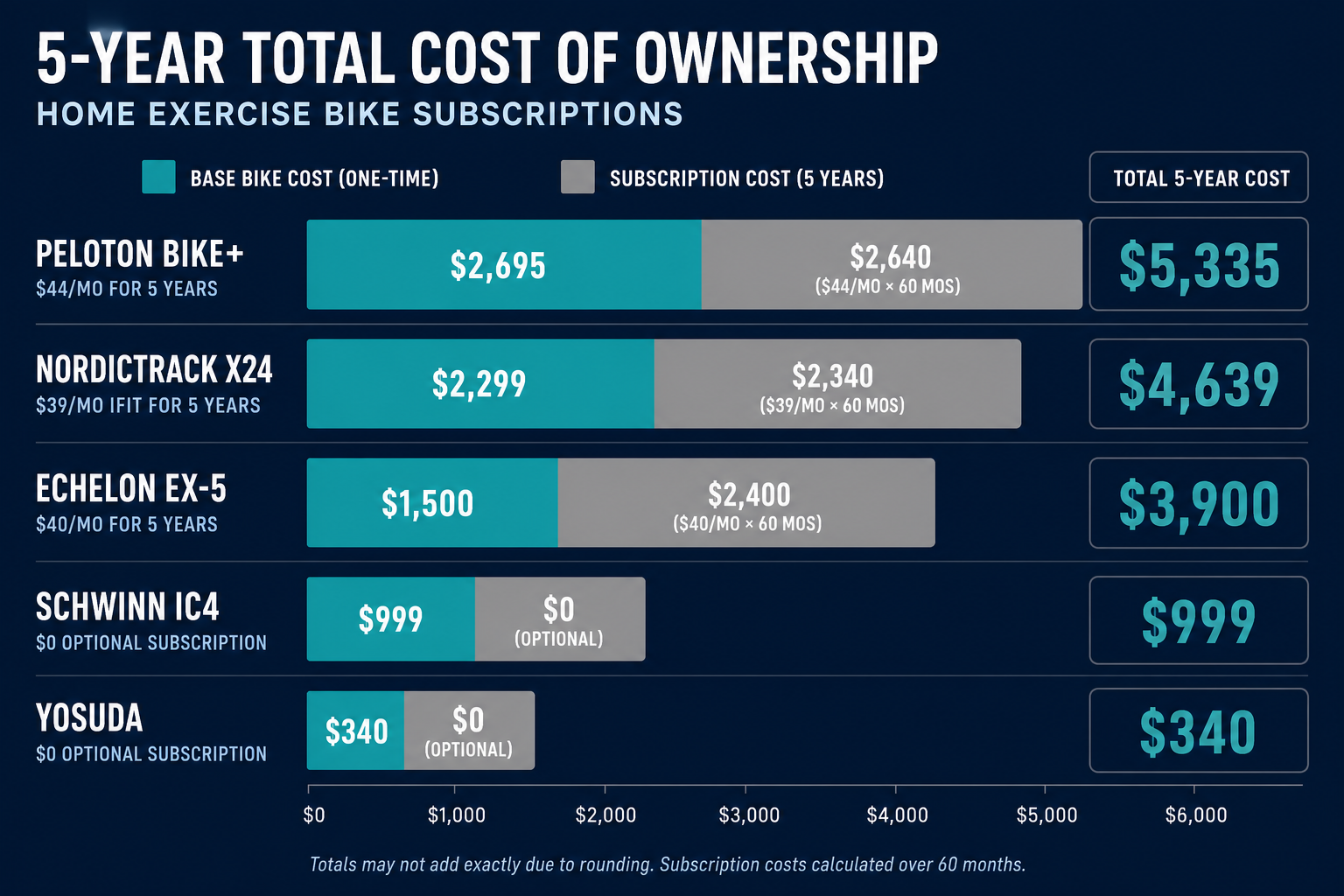
| Model | Purchase Price | Monthly Subscription | 5-Year Subscription Cost | 5-Year Total |
|---|---|---|---|---|
| Yosuda Indoor Cycling | $340 | $0 | $0 | $340 |
| Schwinn IC4 | $999 | $0 (optional JRNY $11.99) | $0 | $999 |
| Echelon EX-5 | $1,500 | $40 (EchelonFit) | $2,400 | $3,900 |
| NordicTrack X24 | $2,299 | $39 (iFIT) | $2,340 | $4,639 |
| Peloton Bike+ | $2,695 | $44 (All-Access) | $2,640 | $5,335 |
The gap between subscription-free and subscription-required models widens dramatically over time. A Peloton Bike+ owner pays $5,335 over five years — more than 15 times the cost of a Yosuda. Whether that premium is worth it depends entirely on how much you value guided classes, leaderboard competition, and ecosystem integration. For readers who want a deeper breakdown of how subscription costs accumulate across different ownership periods, see our exercise bike subscription cost analysis.
Model-by-Model Spec Comparison Table
The following table consolidates all key specifications for the models discussed in this guide. Use it to compare dimensions, weight limits, resistance systems, and warranty terms side by side.
| Model | Price | Dimensions (L x W x H) | Footprint | Weight Capacity | Resistance | Levels | Subscription | Warranty (Frame) | Weight |
|---|---|---|---|---|---|---|---|---|---|
| Yosuda Indoor Cycling | $340 | 40.5" x 21.5" x 45" | 871 sq. in. | 270 lbs | Friction (35-lb flywheel) | Infinite | None | — | 68 lbs |
| Sunny SF-B1002 | $268 | 54" x 19" x 45" | 1,026 sq. in. | — | Friction (49-lb flywheel) | Infinite | None | — | 110.8 lbs |
| Marcy ME-709 Recumbent | $210 | 58"–46" x 24.75" x 38.5" | 1,435 sq. in. | 300 lbs | Magnetic | 8 | None | — | — |
| Schwinn IC4 | $999 | 48.75" x 21.25" x 52" | 1,036 sq. in. | 330 lbs | Magnetic | 100 | None (optional JRNY) | 10 years | 106 lbs |
| Echelon EX-5 | $1,500 | — | — | — | Magnetic | 100 | EchelonFit $40/mo | — | — |
| ProForm Studio Bike Pro | $1,404 | 56.5" x 21.9" | 1,237 sq. in. | 250 lbs | Magnetic | 22 | Includes 3-year iFIT | — | — |
| NordicTrack X24 | $2,299 | 59.5" x 22.2" | 1,150 sq. in. | 350 lbs | Magnetic | 100 | iFIT $39/mo | 10 years | 205 lbs |
| Peloton Bike+ | $2,695 | 59" x 22" | 1,200 sq. in. | 297 lbs | Magnetic | 100 | All-Access $44/mo | — | 140 lbs |
| Bowflex VeloCore 22" | $2,199 | — | — | 325 lbs | Magnetic | 100 | JRNY $11.99/mo | — | 26.2 lbs (felt) |
Use-Case Recommendations: Best Bike for Your Constraint Set
No single bike wins across all constraint sets. The recommendations below map specific models to the most common reader scenarios.
- Best for budget-conscious apartment dwellers who want no subscription: Yosuda Indoor Cycling Bike ($340). Its 871 sq. in. footprint fits most living spaces, the belt drive is quiet enough for shared walls, and there is no app or subscription to maintain.
- Best versatile pick for most home gyms: Schwinn IC4 ($999). It works standalone, with the Peloton app, with Zwift, or with JRNY. The 100-level magnetic resistance and 330-lb weight capacity outperform any bike under $1,500, and the 10-year frame warranty provides long-term confidence.
- Best premium connected bike for serious cyclists: NordicTrack X24 ($2,299) or Peloton Bike+ ($2,695). Choose the X24 for its larger 24" screen, 350-lb capacity, and road-like 150mm Q-factor. Choose the Bike+ for its auto-resistance, movement-tracking camera, and larger class library. Both require subscriptions that add $2,340–$2,640 over five years.
- Best for seniors or rehab: Marcy ME-709 Recumbent ($210). The recumbent position reduces lower-back strain, the step-through frame makes mounting easy, and the 8 magnetic resistance levels provide gentle progression. The 300-lb weight capacity accommodates a wide range of riders.
- Best for extreme space constraints: Marcy Foldable Exercise Bike ($162). At 4 sq. ft. unfolded and 14" deep when folded, it is the only bike on this list that can be stored in a closet. The 37-lb weight makes it portable between rooms.
- Best for HIIT and CrossFit-style training: Schwinn Airdyne AD6 ($899) or Rogue Echo Bike ($945). Fan resistance increases with effort, making these ideal for interval work. The Airdyne AD6 has a 300-lb weight limit and no subscription. The Echo Bike is the official air bike of the CrossFit Games and produces 76.3 dB at maximum intensity.
These recommendations are starting points, not final answers. If your constraint set does not match any of the scenarios above, return to the four-axis framework and run through the decision flow again. The right bike is the one that aligns with your specific intersection of budget, space, resistance preference, and subscription tolerance — not the one that tops a generic ranking.
This result comes from one real apartment under the stated conditions — it is a strong signal, not a guarantee your space will measure identically.
Builds this evidence supports
Cable Machine Alternatives That Save Space and Money
Compare the best cable machine alternatives for home gyms – from resistance bands and pulley systems to suspension trainers and compact digital units – and find the right option for your space and budget.
How to Choose a Compact Home Gym That Works for Your Space, Budget, and Noise Tolerance
This article provides a structured decision framework for apartment dwellers and small-space residents to match their specific floor footprint, noise sensitivity, and budget to the most suitable compact home gym strategy — whether that's an all-in-one machine, modular build, smart digital system, or band/bodyweight setup.
The Garage Gym Reality Check: What Equipment Actually Fits in a Single-Car Garage
Most garage gym guides assume a two-car space. This article uses real dimensions, real equipment footprints, and three layout templates to show what fits—and what doesn't—in a single-car garage (10x20 to 12x20 ft).
Spot something off?
If this result didn't match your own space, let us know — floor-damage and noise claims carry real deposit-risk consequences if we get them wrong.