
Why Generic 'Best Of' Treadmill Lists Fail Home Buyers
Open any fitness site and you will find a "Best Treadmills of 2026" article. They typically list eight to twelve models ranked by price or a vague "best overall" tag, each with a paragraph of specs and a buy button. If you have ever tried to use one of those lists to make a real purchase decision, you know the problem: they present every option as equally relevant to every reader. A casual walker and a marathon runner are shown the same shortlist, and the only filter applied is budget.
This approach ignores the single most important variable in treadmill selection: how you move. A machine that feels smooth and stable at a 3.5 mph walking pace can feel underpowered and cramped at a 6.5 mph running pace. The motor that handles a 150-pound jogger may struggle to sustain speed for a 220-pound runner doing incline intervals. The deck that fits a 5'4" walker may force a 6'2" runner to shorten their stride.
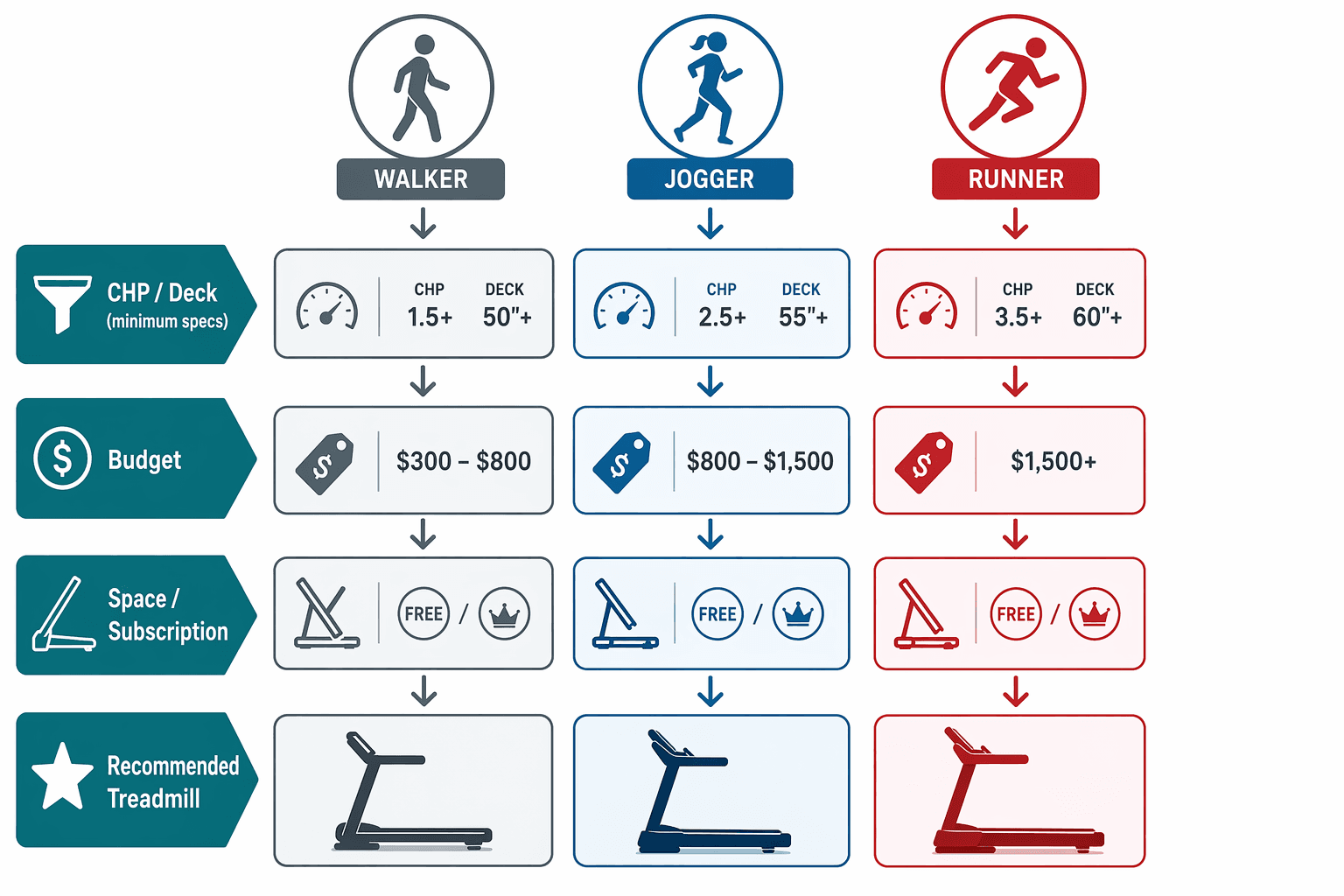
This guide takes a different approach. Instead of a flat list, it walks you through a decision tree with four axes: your movement profile (walker, jogger, or runner), your available space, your tolerance for monthly subscription fees, and your budget. By the time you reach the end, you will have eliminated roughly 80% of the market and landed on a shortlist of two to three models that actually match your specific situation.
Decision Axis 1: What Kind of Mover Are You?
Before you look at a single price tag, you need to know your movement profile. This is the axis that determines the minimum motor power and deck size you can accept. Buy below these thresholds and you will be stuck with a machine that overheats, feels unstable, or forces you to shorten your stride.
Motor CHP Thresholds
Continuous horsepower (CHP) is the measure of a treadmill motor's sustained output. Peak horsepower ratings are marketing numbers — CHP tells you what the motor can deliver over a full workout.
According to Garage Gym Reviews, the CHP requirements break down by activity level:
| User Profile | Minimum CHP | Recommended CHP | Example Model at Minimum |
|---|---|---|---|
| Walker (≤ 3.5 mph) | 1.5 CHP | 2.0–2.5 CHP | Horizon T101 — 2.5 CHP |
| Jogger (3.5–5.5 mph) | 2.5 CHP | 3.0 CHP | Bowflex T6 — 2.5–3.0 CHP range |
| Runner (≥ 5.5 mph) | 3.0 CHP | 3.5–4.0+ CHP | Horizon 7.0 AT — 3.0 CHP |
| Incline Runner | 3.5 CHP | 4.0+ CHP | NordicTrack Commercial 1750 — 4.25 CHP |
Deck Size Minimums
Deck length determines whether you can maintain a natural stride. A deck that is too short forces you to take shorter, choppier steps, which alters your gait and increases the risk of tripping.
Garage Gym Reviews notes that a 60-inch running deck accommodates just about everyone, including users who are 6 feet or taller, while a 55-inch deck fits most people but may feel tight for taller runners.
| User Profile | Minimum Deck Length | Recommended Deck Length | Deck Width |
|---|---|---|---|
| Walker | 55 inches | 55–60 inches | 20 inches |
| Jogger | 55 inches | 60 inches | 20 inches |
| Runner (under 6'0") | 55 inches | 60 inches | 20–22 inches |
| Runner (6'0" and over) | 60 inches | 60–65 inches | 22 inches |
For example, the Horizon T101 has a 20" x 55" deck and is rated for walking and light jogging. The Horizon 7.0 AT and Sole F63 both offer 20" x 60" decks that accommodate runners. The NordicTrack Commercial 1750 and Sole F80 step up to a 22" x 60" deck, which provides extra lateral room for runners who want a more spacious feel.
Cushioning and Joint Impact
Deck cushioning matters most for runners and heavier joggers who generate higher impact forces with each stride. The Sole F80 uses a Cushion Flex Whisper Deck that TreadmillReviews.net reports reduces joint impact by up to 40% compared to running on asphalt. That is a meaningful difference for anyone logging more than 10 miles per week or returning from a lower-body injury.
If you are a runner who wants a deeper look at how CHP, deck length, and cushioning interact with specific training styles like marathon prep or HIIT sprints, our Best Home Treadmill for Your Running Style guide covers that in detail.
Decision Axis 2: Space and Storage Constraints
Once you know your minimum motor and deck requirements, the next filter is physical space. A treadmill that meets your CHP and deck needs is useless if it does not fit in your home or cannot be stored when not in use.
Footprint Comparison of Key Models
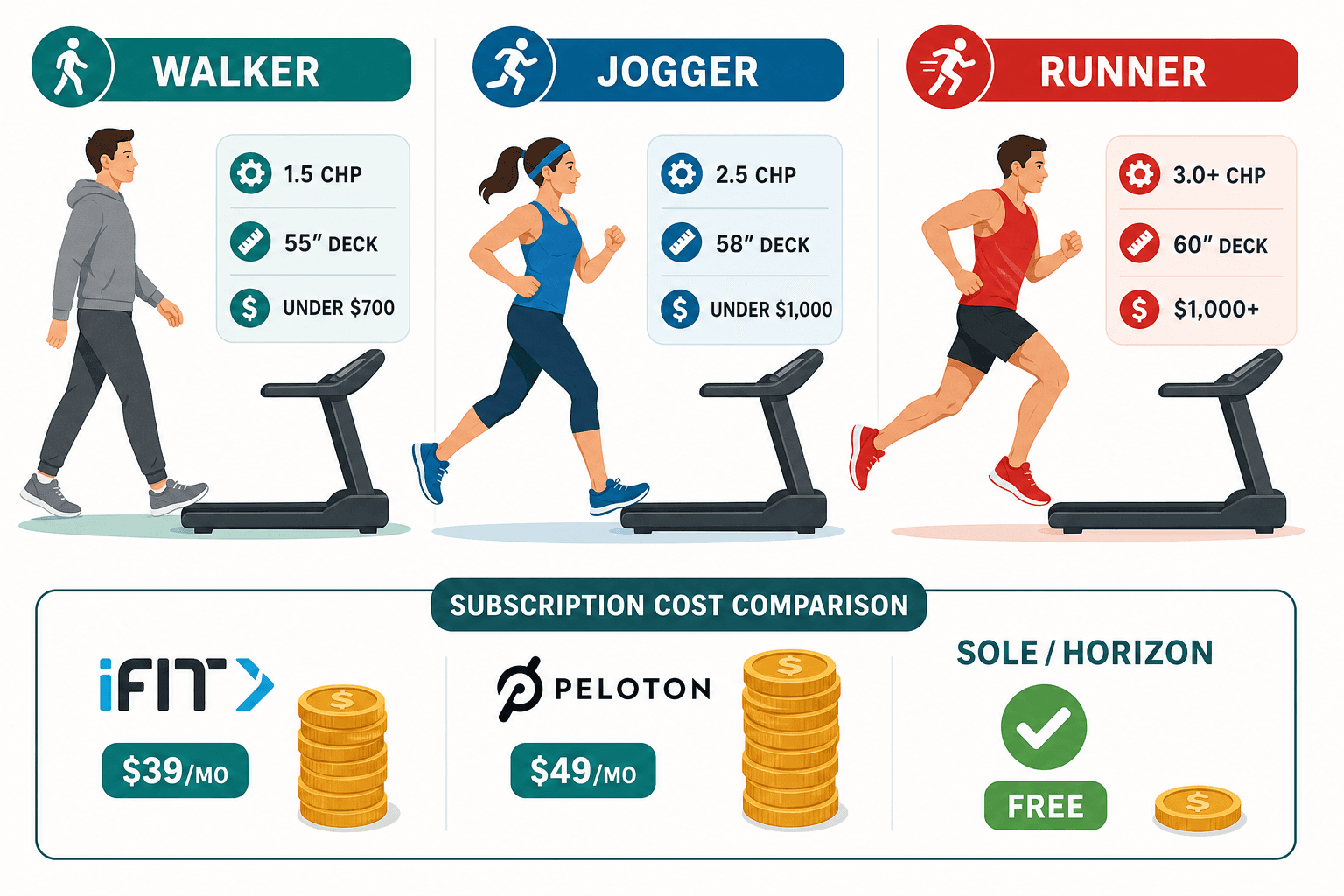
Treadmills vary significantly in their floor footprint. The difference between a compact folding model and a full-size non-folding machine can be over six inches in length and three inches in width — enough to determine whether the machine fits in a spare bedroom or forces you to rearrange your living room.
| Model | Dimensions (L x W x H) | Folded Depth | Weight | User Capacity |
|---|---|---|---|---|
| Horizon T101 | 71" x 34" x 57" | ~40" (hydraulic fold) | 180 lbs | 300 lbs |
| Sole F63 | 74" x 36" x 67" | ~38" (folded) | 252 lbs | 325 lbs |
| Horizon 7.0 AT | 76" x 36" x 63" | ~42" (folded) | 260 lbs | 325 lbs |
| NordicTrack Commercial 1750 | 77.3" x 37" x 59.5" | ~41" (EasyLift Assist) | 295 lbs | 400 lbs |
| Sole F80 | 82.5" x 38" x 66" | ~40" (folded) | 278 lbs | 350 lbs |
The Horizon T101 is the most compact option at 71 inches long and 34 inches wide, making it a viable choice for apartments or rooms where floor space is at a premium. The NordicTrack Commercial 1750 is six inches longer and three inches wider, but it supports up to 400 lbs despite folding via EasyLift Assist — a feature TreadmillReviews.net highlights as unusual for a folding treadmill in this weight class.
Folding vs. Non-Folding: The Real Trade-Off
Folding treadmills have improved dramatically in the last five years. Models like the NordicTrack 1750 and Sole F80 use hydraulic or EasyLift assist mechanisms that make folding manageable for a single person, and their welded steel frames provide stability that rivals non-folding machines at similar price points.
That said, folding still involves trade-offs. The hinge point introduces a potential failure mode over years of use, and folded treadmills still occupy floor space — they are not wall-mounted. If you plan to leave the treadmill set up permanently, a non-folding model may offer slightly better long-term rigidity. If you need to reclaim the room for other uses between workouts, a folding model with assist technology is the practical choice.
For a detailed breakdown of when folding makes sense and when it does not, see our Folding vs. Non-Folding Treadmill: When Does the Space Tradeoff Actually Cost You?
Decision Axis 3: Subscription Tolerance — Free vs. Connected
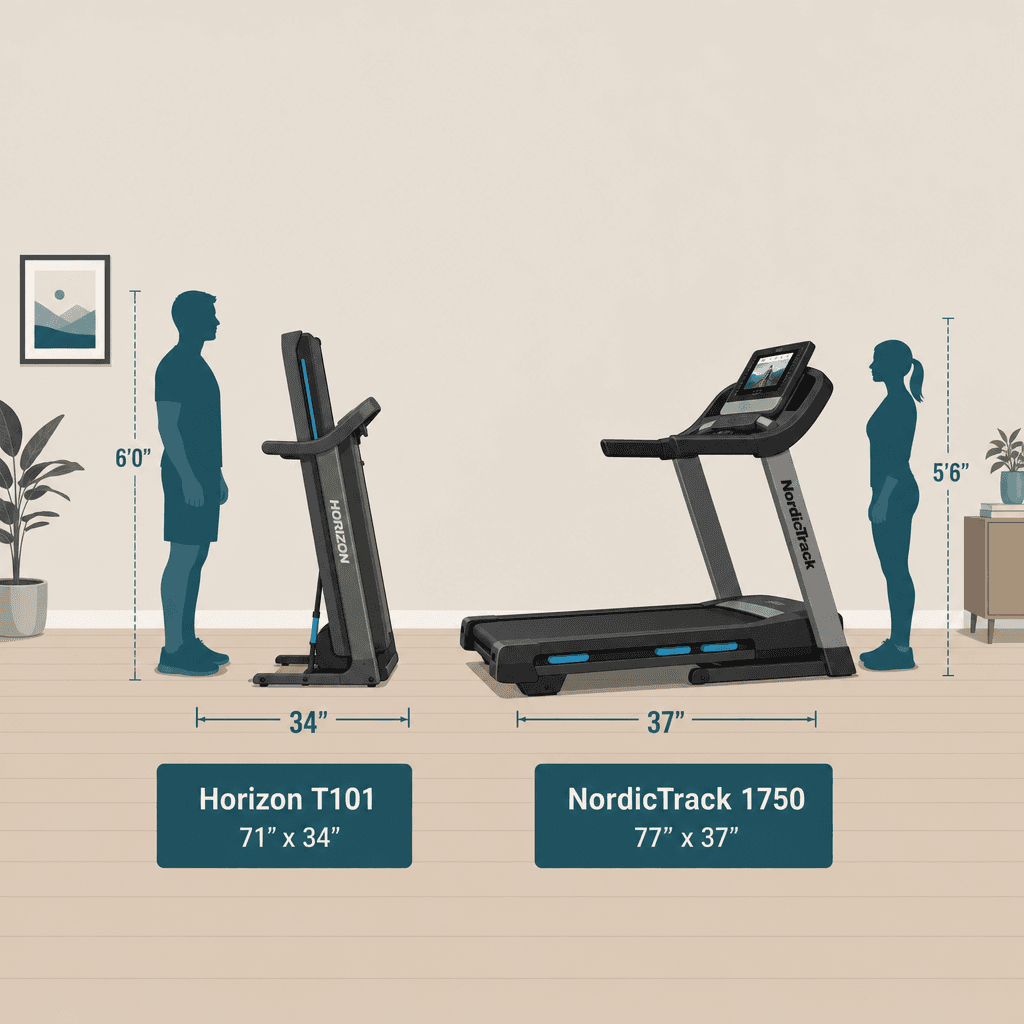
Subscription costs are the most overlooked element of treadmill total cost of ownership. A machine that seems affordable at $1,500 can cost over $2,000 in its first three years once you factor in a mandatory membership.
| Subscription Model | Monthly Cost | Annual Cost | 3-Year Cost | Example Treadmills |
|---|---|---|---|---|
| No subscription (built-in programs) | $0 | $0 | $0 | Sole F80, Horizon 7.0 AT, Horizon T101 |
| iFIT (NordicTrack) | $39 | $468 | $1,404 | NordicTrack Commercial 1750 |
| Peloton Membership | $49 | $588 | $1,764 | Peloton Tread |
| Aviron | $29 | $348 | $1,044 | Aviron Impact |
The Sole F80 includes 10 built-in programs and requires no monthly fee, as TreadmillReviews.net confirms. The Horizon 7.0 AT has 8 built-in programs and is designed for use with third-party apps like Peloton and Zwift via Bluetooth — you can stream classes without paying a treadmill-specific subscription. These subscription-free options save an estimated $200 to $500 per year compared to connected machines, depending on the membership tier.
That does not mean connected treadmills are a bad value. The NordicTrack 1750's 16-inch HD touchscreen and iFIT library of studio classes, outdoor runs, and trainer-led programs provide a genuinely different experience. The question is whether that experience is worth $468 per year to you.
Decision Axis 4: Budget Tiers and What You Get at Each Level
With your movement profile, space constraints, and subscription preference established, budget becomes a straightforward filter. Here is what each price tier delivers in Q2 2026.
| Budget Tier | Price Range | Typical CHP | Typical Deck | Key Trade-Offs | Recommended Models |
|---|---|---|---|---|---|
| Entry-Level Walking | Under $700 | 2.0–2.5 CHP | 55" x 20" | Limited incline (0–10%), lower weight capacity (300 lbs), shorter warranty | Horizon T101 ($649) |
| Value Jogging | $700–$1,000 | 2.5–3.0 CHP | 60" x 20" | Better motor and deck, but may lack Bluetooth/app integration | Horizon 7.0 AT ($999), Bowflex T6 |
| Mid-Range Running | $1,000–$2,000 | 3.0 CHP | 60" x 20" | Solid motor, good warranty, may have basic display vs. touchscreen | Sole F63 ($1,199) |
| Premium Running | $2,000+ | 3.5–4.25 CHP | 60" x 22" | Touchscreen, subscription content, higher weight capacity, longer warranty | NordicTrack 1750 ($2,499), Sole F80 ($1,899) |
At the under-$700 level, the Horizon T101 is the standout. It has a 2.5 CHP motor, a 55-inch deck, and a lifetime frame and motor warranty — unusual for a treadmill at this price. Runner's World named it "Best Value" and noted its one-step hydraulic fold and six built-in programs.
The $700–$1,000 tier is where you get a 60-inch deck and a motor capable of handling regular jogging. The Horizon 7.0 AT at $999 offers a 3.0 CHP motor, 60-inch deck, 0–15% incline, and QuickDial controls for speed and incline. TreadmillReviews.com named it "Best Treadmill Under $1000" and noted it has one of the fastest accelerations and incline changes of any treadmill in its class.
The $1,000–$2,000 range is the sweet spot for most runners. The Sole F63 at $1,199 delivers a 3.0 CHP motor, 60-inch deck, and a lifetime frame and motor warranty. The Sole F80 at $1,899 adds a 3.5 CHP motor, a wider 22-inch deck, the Cushion Flex Whisper Deck, and 10 built-in programs with no subscription.
Above $2,000, you are paying for higher motor power, larger touchscreens, and subscription content ecosystems. The NordicTrack Commercial 1750 at $2,499 has a 4.25 CHP motor, a 22" x 60" deck, a 16-inch HD touchscreen, and iFIT integration. Wirecutter named it their top pick, though they noted a touchscreen responsiveness issue that NordicTrack said would be fixed via a hardware update.
Combined Decision Matrix: Matching Your Profile to a Shortlist
The following matrix combines all four decision axes. Find your movement profile, then read across to see which models survive the CHP, deck, space, subscription, and budget filters.
| Your Profile | Minimum CHP | Minimum Deck | Subscription-Free Option | Connected Option | Best Budget Pick |
|---|---|---|---|---|---|
| Walker (≤ 3.5 mph, under 6'0") | 1.5 CHP | 55" | Horizon T101 ($649) | N/A at this tier | Horizon T101 |
| Walker (≤ 3.5 mph, 6'0"+) | 1.5 CHP | 60" | Horizon 7.0 AT ($999) | N/A at this tier | Horizon 7.0 AT |
| Jogger (3.5–5.5 mph) | 2.5 CHP | 55–60" | Horizon 7.0 AT ($999) | Bowflex T6 ($1,299) | Horizon 7.0 AT |
| Runner (≥ 5.5 mph, under 200 lbs) | 3.0 CHP | 60" | Sole F63 ($1,199) | NordicTrack 1750 ($2,499) | Sole F63 |
| Runner (≥ 5.5 mph, over 200 lbs) | 3.5 CHP | 60" | Sole F80 ($1,899) | NordicTrack 1750 ($2,499) | Sole F80 |
| Incline Runner | 3.5 CHP | 60" | Sole F80 ($1,899) | NordicTrack 1750 ($2,499) | Sole F80 |
For example, a 5'10" runner who weighs 185 lbs and jogs at 6 mph needs at least 3.0 CHP and a 60-inch deck. The Sole F63 at $1,199 meets those specs with no subscription. If the same runner wants interactive training content, the NordicTrack 1750 at $2,499 adds a 4.25 CHP motor and iFIT access at $39 per month.
If you prefer a traditional tiered list rather than the decision-tree approach, our Best Treadmill for Home: Tiered Picks by Budget, Space, and Subscription Cost article organizes the same models by budget tier with full subscription cost transparency.
Warranty and Total Cost of Ownership
Warranty terms vary significantly across manufacturers and directly affect long-term ownership cost. A treadmill with a lifetime frame and motor warranty may cost more upfront but can save hundreds in repair costs over a decade of use.
| Model | Frame Warranty | Motor Warranty | Parts Warranty | Labor Warranty |
|---|---|---|---|---|
| Sole F80 | Lifetime | Lifetime | 3 years | 1 year |
| Sole F63 | Lifetime | Lifetime | 3 years | 1 year |
| Horizon 7.0 AT | Lifetime | Lifetime | 3 years | 1 year |
| Horizon T101 | Lifetime | Lifetime | 3 years | 1 year |
| NordicTrack Commercial 1750 | 10 years | Lifetime | 2 years | 1 year |
| Peloton Tread | 5 years | 5 years | 5 years | 1 year |
| Echelon Stride-6 | 5 years | 5 years | 2 years | 1 year |
Sole and Horizon offer the strongest warranty packages in the sub-$2,000 range, with lifetime coverage on both frame and motor. NordicTrack matches the lifetime motor warranty but limits the frame to 10 years. Peloton and Echelon cap both at 5 years.
Operating costs are minimal. TreadmillReviews.net measured typical home treadmill power consumption at 600–700 watts per hour, which works out to less than $2 per month for daily 30-minute sessions at average US electricity rates.
Quick-Reference Spec Table of Recommended Models
The table below compresses every recommendation from this guide into a single scannable reference. Use it to compare your final shortlist side by side before making a purchase decision.
| Model | Price | CHP | Deck | Incline | Weight Capacity | Warranty (Frame/Motor) | Subscription |
|---|---|---|---|---|---|---|---|
| Horizon T101 | $649 | 2.5 CHP | 55" x 20" | 0–10% | 300 lbs | Lifetime / Lifetime | None (6 programs) |
| Horizon 7.0 AT | $999 | 3.0 CHP | 60" x 20" | 0–15% | 325 lbs | Lifetime / Lifetime | None (8 programs, Bluetooth) |
| Sole F63 | $1,199 | 3.0 CHP | 60" x 20" | 0–15% | 325 lbs | Lifetime / Lifetime | None |
| Sole F80 | $1,899 | 3.5 CHP | 60" x 22" | 0–15% | 350 lbs | Lifetime / Lifetime | None (10 programs) |
| NordicTrack 1750 | $2,499 | 4.25 CHP | 60" x 22" | -3% to 15% | 400 lbs | 10 yr / Lifetime | iFIT ($39/mo) |
| Peloton Tread | $3,295 | 3.0 CHP | 59" x 20" | 0–12.5% | 300 lbs | 5 yr / 5 yr | Peloton ($49/mo) |
Comments
Join the discussion with an anonymous comment.