
All-in-One Home Gym Equipment: Why Under $1,500 Is a Gamble (and Where the Viable Floor Starts)
Most all-in-one home gyms under $1,000 use thin steel, plastic pulleys, and sub-150 lb resistance that fail within months. This guide analyzes why $1,300–$1,500 is the real minimum for a machine that genuinely replaces multiple exercises, with data-backed comparisons and 'buy cheap twice' math for budget-conscious buyers.
You see an all-in-one home gym on Amazon for $699. The listing headlines "300 lb weight capacity" and shows a muscular model performing lat pulldowns. I have watched this pattern, and I can tell you what that $699 actually buys: 14-gauge steel, plastic pulleys, a weight stack that stops around 130–150 pounds, and a warranty that expires about when the wobble starts.
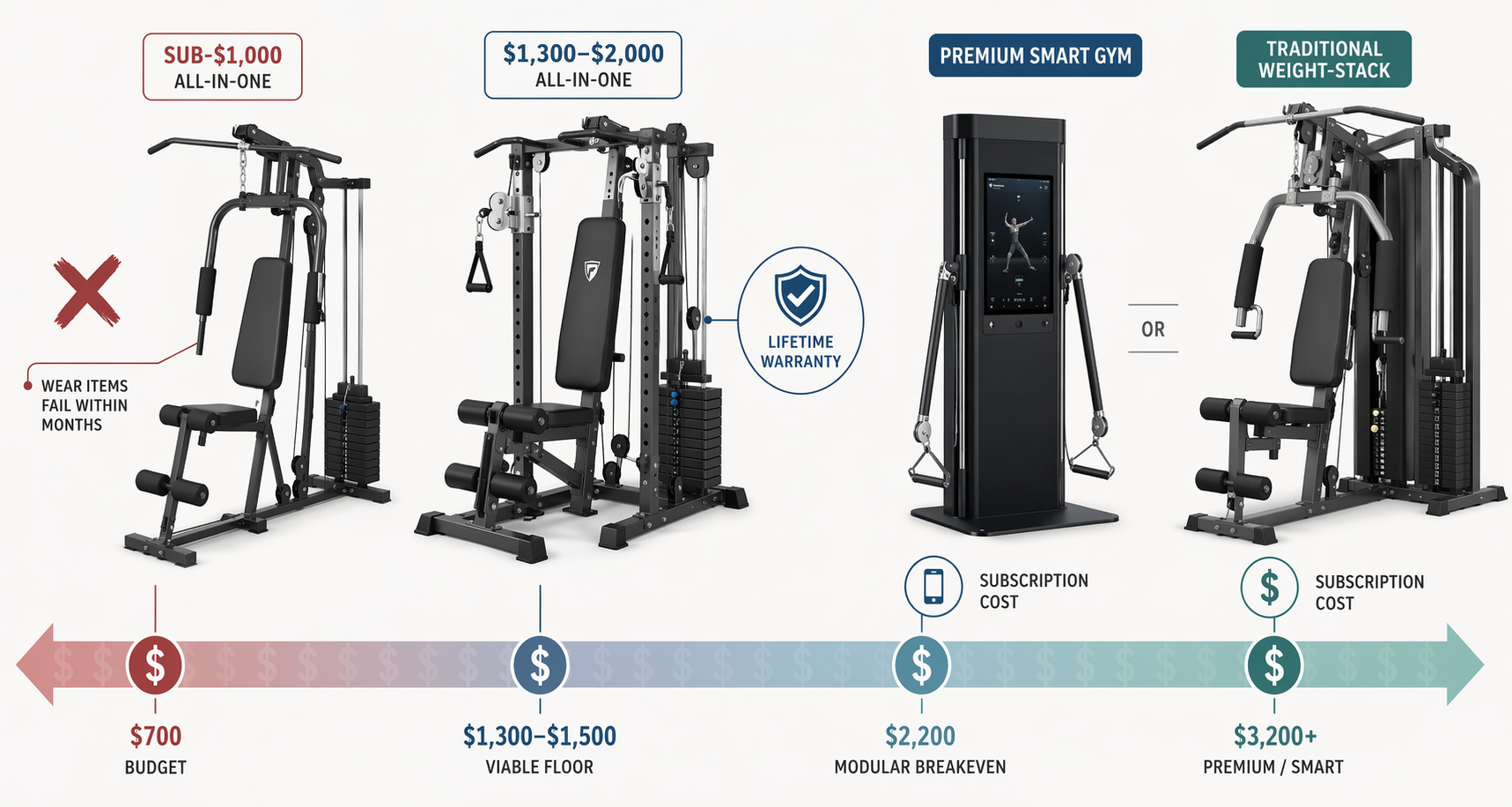
The RitFit engineering analysis on steel gauge is blunt: 11-gauge steel uprights flex less than 12- or 14-gauge steel under heavy loads. Cheap all-in-one units with thin steel and plastic components develop wobble, friction, and play over time. That is not a theoretical risk — it is a timeline. I have seen sub-$1,000 machines develop noticeable frame sway within three months, their plastic pulley grooves wearing unevenly by month six, cables fraying at the attachment points by month eight. The listing says "all-in-one." What it should say is "all-in-one for now."
What $700 Buys: 14-Gauge Steel, Plastic Pulleys, and a Countdown
Let me be specific about what is inside that $699 machine. Steel gauge — typically 14-gauge, sometimes even lighter. Pulleys — molded plastic, not aluminum, not even nylon-reinforced. Resistance — a 130–150 lb weight stack (often advertised as "210 lb" by including the selector rod and frame weight). Cable travel — jerky, because the plastic pulleys and unsealed bearings create friction from the start. Welds — cosmetic-grade, with no QA cert. Warranty — one year on moving parts, if that.
These machines work for light accessory work. You can do bicep curls, tricep pushdowns, lat pulldowns at 50–100 lbs. But try a seated cable row at 120 lbs, or a standing chest press at 150 lbs, and the frame starts to rock. That rocking is the 14-gauge steel flexing, and each rep accelerates the wear on the plastic pulleys. RitFit's observation is correct: cheap all-in-one units with thin steel and plastic components develop wobble, friction, and play over time. I have seen this progression in owner forums: month three the wobble, month six the friction, month nine the play.
The $1,300 Floor: Where the Steel Gets Thicker
The viable floor for a machine that genuinely replaces multiple exercises without frustration is $1,300–$1,500. That is not an arbitrary number. It is the price at which the specifications change from plastic to metal, from thin steel to structural steel.
Consider the Bells of Steel All-in-One Home Gym at $1,299.99. Garage Gym Reviews tested it and reported: 12-gauge steel (one full gauge thicker than the budget tier), aluminum pulleys with sealed bearings, a 200 lb weight stack (upgradable), and a limited lifetime warranty. That is the baseline. At $1,299 you get a frame that does not flex, pulleys that do not bind, and a warranty that covers the structure for as long as you own it.
At $1,499 you have the Bowflex Xtreme 2 SE. Bowflex uses Power Rod resistance (not a weight stack), and the GGR rating is 3.9/5 overall, but durability scores only 3/5. Strong Home Gym gives it 74/100 and notes 210 lbs of resistance (upgradeable to 410). The Power Rods feel different from a weight stack — smoother but with a non-linear resistance curve. The Bowflex is viable, but it is a different instrument. I would only recommend it if you specifically want that band-like resistance feel and do not plan to do heavy compound lifts with the cables.
The average price across all home gyms tested by Garage Gym Reviews is $1,855. Strong Home Gym's survey of over 1,000 people found the average cost to build a home gym from separate equipment is $3,141. Those numbers tell me that informed buyers — the people who actually use these machines long-term — are spending well above $1,000. The idea that a $700 all-in-one is a starting point is false; it is a detour.
Specs That Matter: $700 vs $1,400
| Specification | Sub-$1,000 Tier | $1,300–$1,500 Tier |
|---|---|---|
| Steel gauge | 14-gauge (or thinner) | 12-gauge (Bells of Steel) / 11-gauge (Bowflex Xtreme 2SE) |
| Pulley material | Plastic — friction and wear within months | Aluminum with sealed bearings — smooth, long-lasting |
| Max resistance (as tested) | 130–150 lbs (often inflated in marketing) | 200–210 lbs (upgradable to 410 on Bowflex) |
| Warranty | 1 year on parts | Limited lifetime (Bells of Steel) / 2-year frame (Bowflex) |
| Estimated lifespan with maintenance | 8–12 months before noticeable degradation | 5–10 years (well-built machines last over a decade) |
| Who it fits | Light accessory work, absolute beginners | Full-body training, capable of compound lifts up to intermediate level |
The table makes it visible: the jump from plastic to aluminum pulleys alone eliminates the primary failure mode of cheap machines. The thicker steel removes the flex that makes the machine feel unstable during pressing movements. The weight stack crosses the threshold where you can do meaningful lat pulldowns, rows, and leg presses without maxing out.
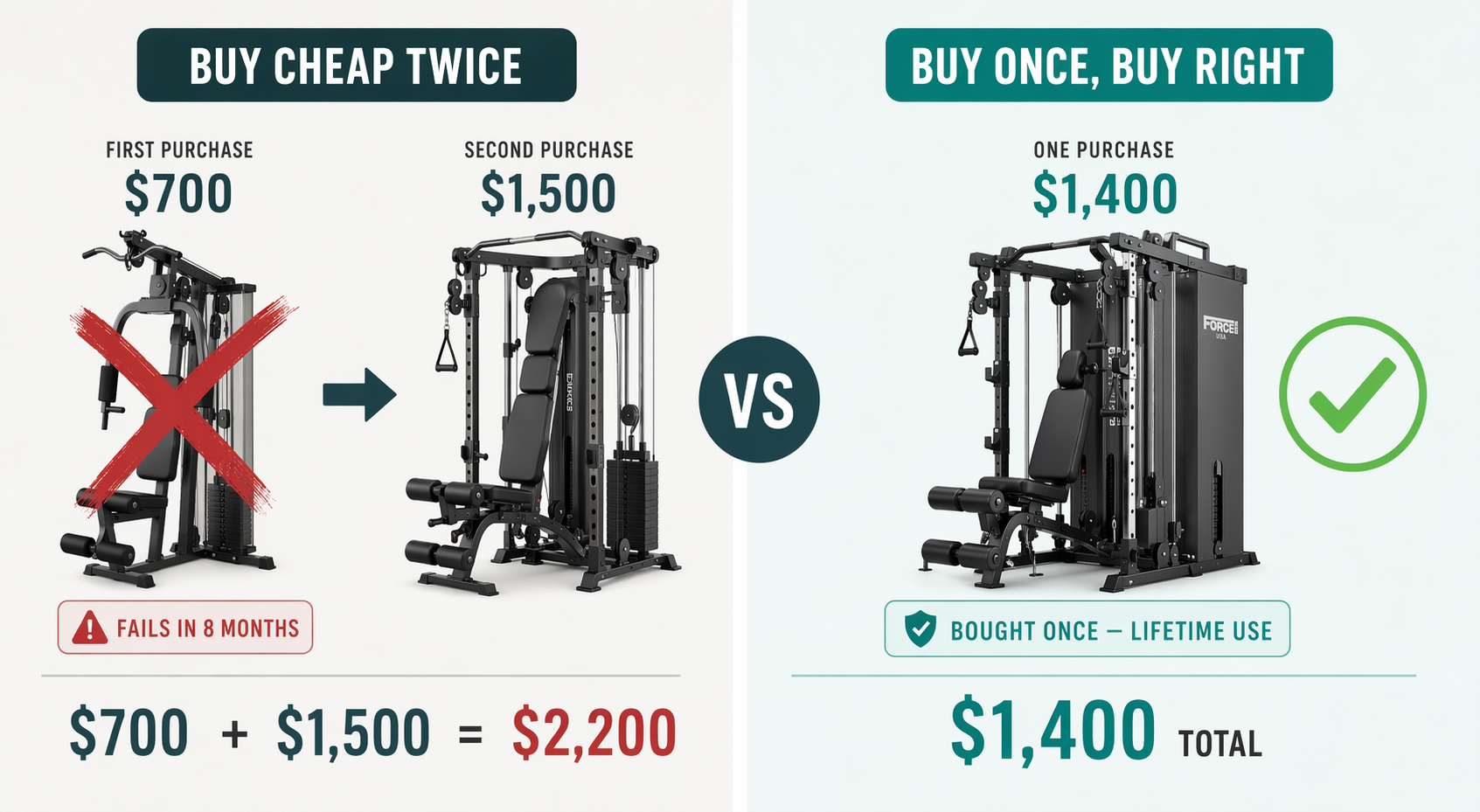
The $700 + $1,500 Math
Here is the calculation that matters most. You buy a $700 machine. Within 8 months you hit the wall: the pulley is grinding, the frame wobbles even on moderate rows, and you have already maxed out the weight stack on lat pulldowns. You now have two choices: live with a frustrating machine or buy a proper one. If you buy the proper one at $1,400, your total is $2,100 — $700 more than buying the $1,400 machine in the first place. And you still have a broken $700 machine taking up floor space.
The failure patterns are not hypothetical. Wobble from thin steel appears at 3–6 months. Plastic pulley wear becomes noticeable at 6–12 months. The 135-pound bench press threshold — the point at which your chest press demands more resistance than a typical budget machine can provide — is reachable by a male beginner in roughly 3–4 months of consistent training. Once you cross that line, the sub-$1,000 machine stops being a training tool and starts being a limited accessory station.
The average home gym cost across Garage Gym Reviews users is $1,500–$2,500 (that includes buyers who purchased separate pieces). Even people who buy modular equipment spend in that range. Expecting a decent all-in-one for less than half that is not being frugal — it is being optimistic about materials science. The math only holds if the cheap machine actually fails within the timeline described. Some budget machines may last 18 months if used very lightly. But the risk is real, and the cost of being wrong is a higher total spend and a period of training frustration. If you are certain you will train at moderate intensity for under an hour a week, the risk is lower. If you expect to progress beyond the basics, the cheap route is the expensive route.
Who Can Make a Budget Machine Work — and Who Will Hate It in Three Months
I am not saying all budget all-in-one machines are useless. A true beginner — someone who has never done a lat pulldown, who is starting with bodyweight and light bands, who expects to stay under 100 pounds on any movement for the first year — can make a $700 machine work for that period. The clock is ticking, but it is a slow clock. If your goals are maintenance and low-intensity accessory work, and you accept that you are renting the machine, not owning it, then a budget unit can serve.
But if you are an intermediate lifter, or you plan to progress beyond a 135-pound bench press and 150-pound lat pulldown, the budget machine will become a limitation within months. The 135-pound threshold is not arbitrary — it is the point at which a male lifter with six months of consistent training typically starts exceeding the max resistance on a budget all-in-one for pressing movements. Even the Bowflex Xtreme 2SE at $1,499 hits its default 210 lb ceiling for powerlifters doing heavy rows or leg presses within a year. The survey data from the Garage Gym Experiment supports this: 44% of home gym enthusiasts plan to spend at least $1,000 on their setup in 2026. The market already knows that sub-$1,000 is not the norm. The 44% figure tells me that most buyers are already above the budget trap zone. If you are reading this and wondering how much to spend, you are in the group that should set the floor at $1,300.
The Verdict: Set Your Floor at $1,300
Here is the honest recommendation: if you want an all-in-one home gym that genuinely replaces multiple exercises without frustration, your minimum budget is $1,300–$1,500. That floor buys you:
- 12-gauge steel (or better) — no wobble, no frame flex
- Aluminum pulleys with sealed bearings — smooth cable travel that lasts
- 200+ lb weight stack — enough resistance for compound lifts up to intermediate level
- Limited lifetime warranty — the manufacturer trusts the structure
- 5–10 year realistic lifespan with basic maintenance
Specific models that clear the bar:
- Bells of Steel All-in-One ($1,299.99) — the baseline. 12-gauge steel, aluminum pulleys, limited lifetime warranty, upgradable weight stack.
- Bowflex Xtreme 2 SE ($1,499) — viable if you prefer Power Rods and do not do heavy compound cable lifts. Know that the 210 lb default ceiling will come up faster than you think.
If your budget is below $1,300, you have three honest options: save longer, buy a modular piece (like a squat stand and bench + separate cable tower), or accept that you are buying a temporary machine that you will likely need to replace. If you choose the temporary route, skip the $500 Amazon specials and look at the used market for a quality older machine — at least you will get thicker steel for the same money.
The buy-cheap-twice math is not a scare tactic. It is a pattern I have seen repeat. The $1,300 floor is not arbitrary — it is the price point where the materials stop compromising the function. Set your floor there, buy once, and train.
This result comes from one real apartment under the stated conditions — it is a strong signal, not a guarantee your space will measure identically.
Builds this evidence supports
Cable Machine Alternatives That Save Space and Money
Compare the best cable machine alternatives for home gyms – from resistance bands and pulley systems to suspension trainers and compact digital units – and find the right option for your space and budget.
How to Choose a Compact Home Gym That Works for Your Space, Budget, and Noise Tolerance
This article provides a structured decision framework for apartment dwellers and small-space residents to match their specific floor footprint, noise sensitivity, and budget to the most suitable compact home gym strategy — whether that's an all-in-one machine, modular build, smart digital system, or band/bodyweight setup.
The Garage Gym Reality Check: What Equipment Actually Fits in a Single-Car Garage
Most garage gym guides assume a two-car space. This article uses real dimensions, real equipment footprints, and three layout templates to show what fits—and what doesn't—in a single-car garage (10x20 to 12x20 ft).
Spot something off?
If this result didn't match your own space, let us know — floor-damage and noise claims carry real deposit-risk consequences if we get them wrong.