
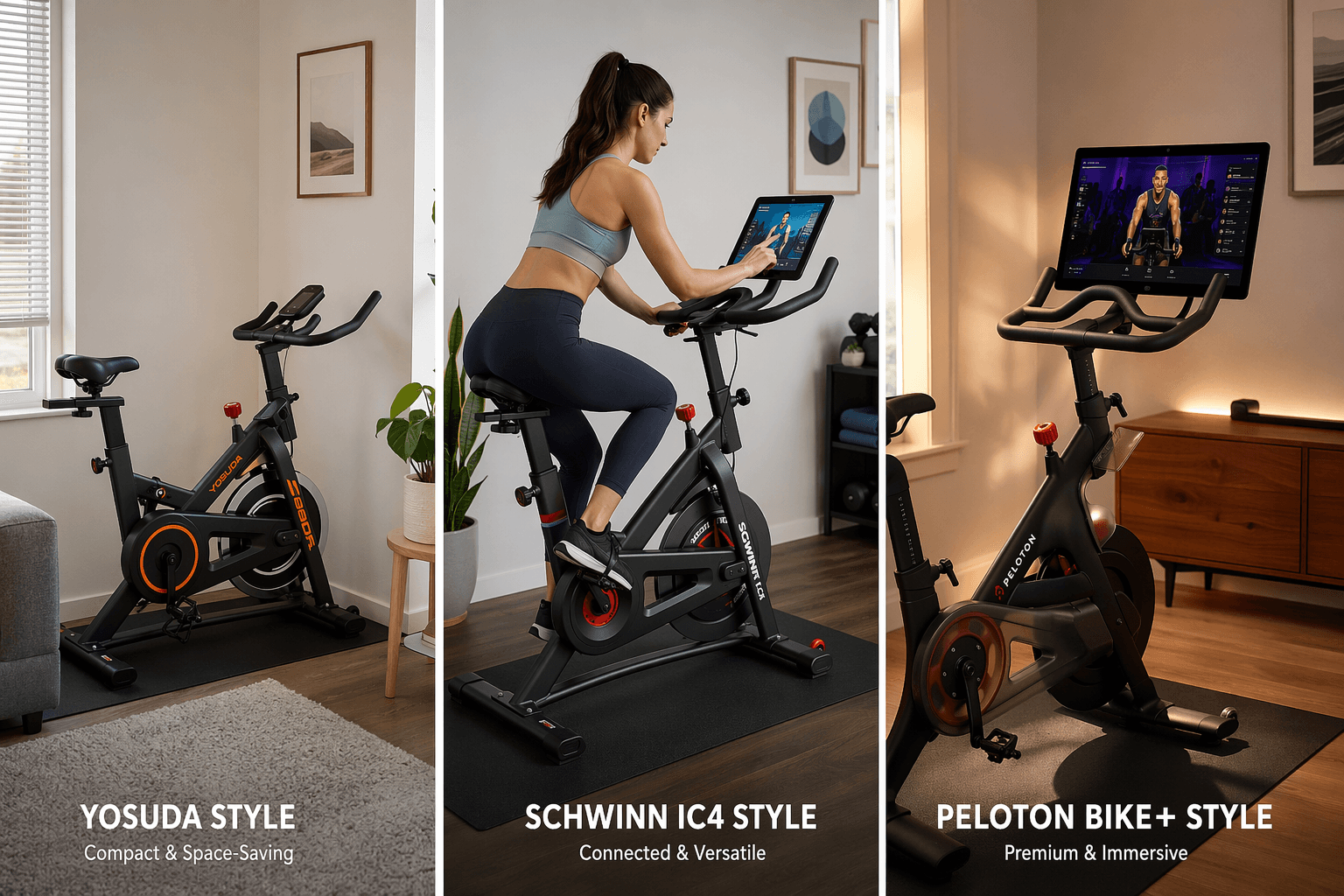
A Peloton Bike+ costs $2,695 upfront plus $50 a month. A Yosuda costs $250. One is the wrong bike for someone who just wants to pedal quietly in their apartment. The other is the wrong bike for someone who needs structured coaching and a leaderboard. Which one is wrong depends entirely on who you are.
Generic "best exercise bike" lists fail because they treat every buyer as the same. A recommendation that makes sense for a data-driven athlete (Schwinn IC4, $899–999, no subscription) wastes the money of a rider who wants classes (Peloton Bike+, $2,695, $50/month). And a recommendation that works for a large dedicated space fails the apartment dweller who needs the bike to fit under a bed. The only "best" bike is the one matched to your rider profile.
Many review sites get test units from manufacturers; I put more weight on Outdoor Gear Lab and Consumer Reports, who bought their bikes. If a recommendation ignores total cost of ownership or floor space, I question it. This article uses the latest prices as of June 2026 — Peloton is at $50/month, iFIT at $39. Those numbers can shift, so verify before you commit.
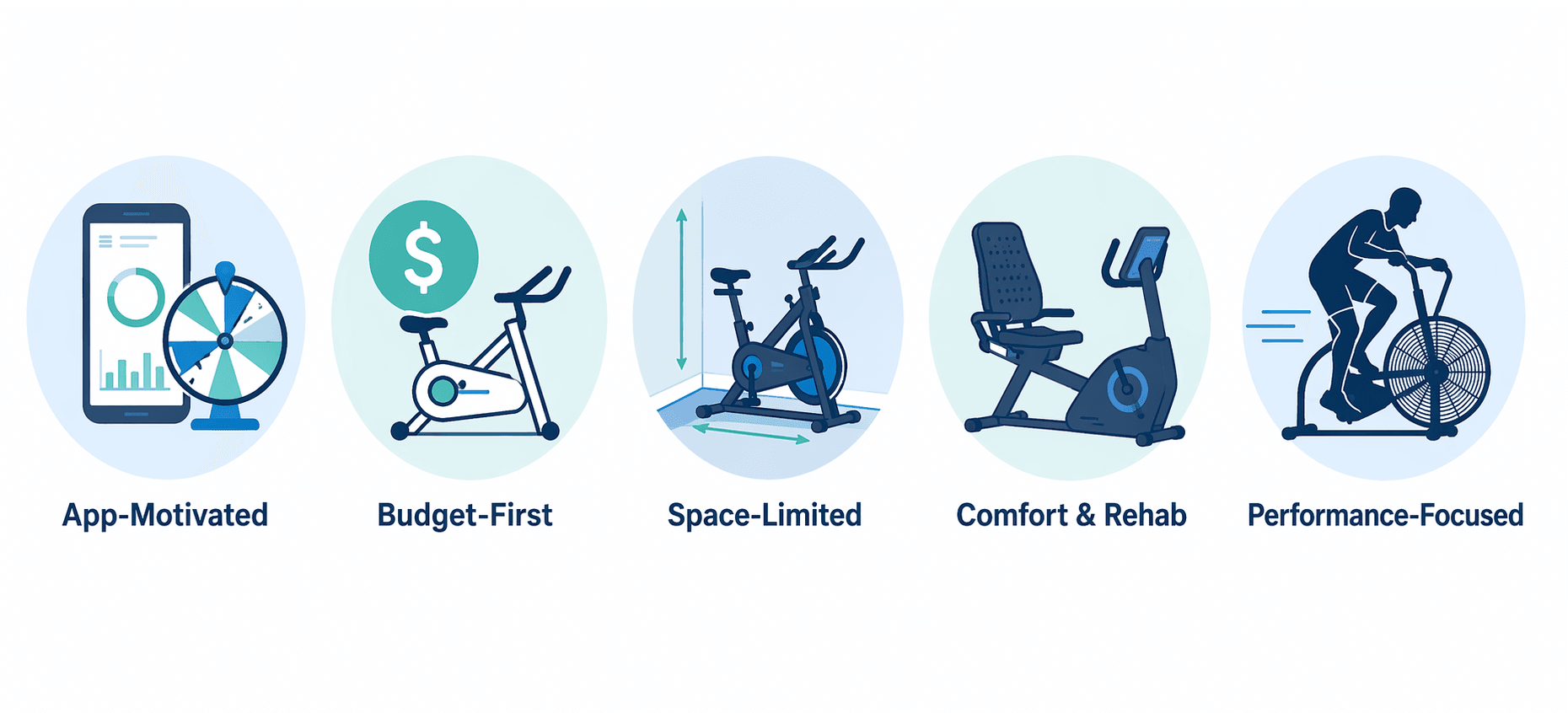
Five rider profiles at a glance
Below is a quick scan of five common rider types. Read the key constraint and the one-line reason. If you see yourself, jump to that section for the full breakdown.
| Profile | Key constraint | Top pick | Why it fits |
|---|---|---|---|
| App-Motivated | Wants classes and leaderboards | Peloton Bike+ / NordicTrack X24 | Best app ecosystems; subscription required |
| Budget-First | Under $500, no hidden costs | Yosuda | Low price, no subscription, solid build for casual riding |
| Space-Limited | Small apartment, may need to fold or move | Yosuda (or folding compact) | Smallest footprint (6.11 sq ft), no noise complaints |
| Comfort & Rehab | Back pain, joint issues, low-impact | Schwinn 290 Recumbent | Padded reclined seat, less strain on lower back |
| Performance-Focused | Data, power, HIIT intensity | Schwinn IC4 / Assault AirBike | High resistance range, app connectivity, no mandatory sub |
App-Motivated: Will you actually use the classes?
If you rely on live classes, leaderboards, and guided programs, a connected bike with a large screen is the only real option. The Peloton Bike+ ($2,695) and the NordicTrack X24 ($2,299) lead this category. Both have 100 levels of magnetic resistance, rotating touchscreens, and deep content libraries. The trade-off: you pay $39 to $50 every month on top of the upfront price. Over three years that adds $1,404 to $1,800 — whether you finish using the bike or not.
Peloton issued a seat-post recall on the original Bike in May 2023 and another on the Bike+ in November 2025. If you buy used, check whether the fix has been applied. For a deeper look at what subscriptions actually cost over time, read Exercise Bike Subscription Costs Decoded.
If you like the idea of app-connected riding but don't want to be locked into a subscription forever, the Schwinn IC4 ($899–999) works with Peloton, Zwift, and other apps without any mandatory monthly fee. You don't get the built-in screen, but you get the same magnetic resistance and Bluetooth connectivity. No subscription lock-in.
Budget-First: Under $500, no monthly bills
You want a bike that works, not one that bills you every month. The Yosuda Indoor Cycling Bike ($250–340), Sunny Health & Fitness SF-B1002 ($399), and Wenoker ($350) all sit well south of $500. No subscription. No app requirement. A 35–40 lb flywheel provides a stable ride. The trade‑off: most budget bikes use felt-pad friction resistance instead of magnetic, which is noisier and wears out over time. They also lack the smart coaching features you get at higher price points.
If you want a broader look at building a home gym on a budget, see Home Fitness on a Budget.
Space-Limited: Every square foot counts
A spin bike like the Yosuda occupies about 6.11 sq ft (40.5 × 21.5 inches). That fits in a corner of a living room or even a coat closet. A recumbent bike like the Schwinn 290 takes up more than twice that — 12.91 sq ft — and needs another foot of space behind it for the fully reclined position. If you live in a 400-sq-ft apartment, the recumbent is out.
Noise is the other hidden constraint. Friction‑resistance bikes under $500 are louder than magnetic ones, but still quieter than an air bike. The Assault AirBike Classic — a favorite for HIIT — sounds like a small jet engine when you push the pace. In a thin-walled apartment, the neighbors will hear it. If noise is your biggest worry, focus on magnetic resistance and belt‑driven models.
I detailed noise levels, footprint comparisons, and portability in The Best Exercise Bikes for Apartments. That guide covers folding options and weight limits for hauling up stairs. If you are in a tight space, read it before you buy anything.
Comfort & Rehab: Low impact, high support
If you have back pain, joint issues, or need low-impact cardio, a recumbent bike puts your body in a more supportive position — the seat has a backrest and your legs extend forward rather than below your hips. The Schwinn 290 Recumbent ($799) and Horizon 5.0R (about the same price) are the two most recommended recumbents. Both have magnetic resistance, padded seats, and built-in programs.
The downside: recumbents are long. The Schwinn 290 is 64.5 inches from end to end. You need at least a 6‑foot‑long space to ride comfortably. And they are not suited for HIIT — you can pedal hard, but the reclined position limits the explosive movement you get from an upright spin bike.
| Model | Price | Resistance | Footprint | Weight limit | Best for |
|---|---|---|---|---|---|
| Schwinn 290 Recumbent | $799–999 | 25 levels magnetic | 64.5 × 28.5 in (12.91 sq ft) | 330 lb | Back support, low‑impact |
| Horizon 5.0R Recumbent | ~$1,000 | 100 levels magnetic | 55 × 28 in (10.69 sq ft) | 300 lb | Quiet, built‑in fan |
| Marcy ME-709 Recumbent | ~$300 | 8 levels magnetic | 54 × 25 in (9.38 sq ft) | 300 lb | Budget recumbent |
Performance-Focused: Data, power, or pure punishment
If you train with power data, track intervals, and need a bike that doesn't limit your output, you have two paths. The Schwinn IC4 / BowFlex C6 ($899–999) gives you 100 magnetic resistance levels, Bluetooth, and a 330‑lb weight limit. It works with Zwift, TrainerRoad, and Peloton Digital — no subscription required. The bike is heavy (106 lb), built to take a pounding. Note that the IC4 and C6 are identical rebadged products. Don't pay a premium for one over the other.
For pure HIIT, air bikes like the Assault AirBike Classic ($699) and Schwinn Airdyne AD6 ($899) deliver the toughest wind‑resistance workout. The harder you pedal, the more resistance you get — no programming needed. But they are loud, and they take up space comparable to a spin bike (about 46 × 25 inches). They also lack built-in programs; the LCD shows basic metrics only.
If you want lab‑grade power measurement, the Wattbike Air (around $2,000) records peak power up to 2,500W and transmits via Bluetooth/ANT+. It is aimed at serious cyclists who need precise wattage data. No screen, no classes — just raw measurement.
Compare your finalists: A decision framework
If you are torn between two profiles — say, you love classes but also want data — here is a side‑by‑side look at the key specs for each top pick. Rider height range is included because fit matters, and many buyers forget to check it.
| Model | Price | Footprint (sq ft) | Subscription | Warranty (frame) | Rider height | Weight limit |
|---|---|---|---|---|---|---|
| Peloton Bike+ | $2,695 | 9.0 | $50/mo | 5 years | Not specified* | 297 lb |
| NordicTrack X24 | $2,299 | 9.1 | $39/mo iFIT | 10 years | Not specified* | 350 lb |
| Schwinn IC4 | $899–999 | 7.2 | None | 10 years | ~5'0"–6'5" | 330 lb |
| Yosuda | $250–340 | 6.11 | None | 1 year parts | ~5'1"–6'2" | 270–300 lb |
| Sunny SF-B1002 | $399 | 8.0 | None | 3 years | ~5'3"–6'0" | 275 lb |
| Schwinn 290 Rec | $799–999 | 12.91 | None | 10 years | ~5'2"–6'3" | 330 lb |
| Assault AirBike | $699 | 7.9 | None | 5 years | ~5'3"–6'4" | 300 lb |
If you want to compare by attributes alone — budget, space, resistance type, subscription cost — the decision-matrix guide lines up every dimension in one table. Use that after you have narrowed your profiles.
Common mistakes (by profile)
- Buying a connected bike for someone who hates being told what to do. If the rider will never use the classes, the $50/month subscription is wasted.
- Buying a recumbent for a HIIT enthusiast. The reclined position limits explosive pedaling — recumbents are for low-impact steady cardio, not interval sprints.
- Ignoring the floor space for a fully reclined recumbent. The Schwinn 290 needs at least 6 ft of clear floor to ride safely. Measure the room length, not just the bike's listed footprint.
- Buying a premium bike on a budget without including the subscription. A $2,695 Peloton plus $1,800 over three years means the total cost is $4,495 — more than double the sticker.
The only 'best bike' is the one that fits you
There is no single exercise bike that serves every buyer. The Peloton Bike+ is an excellent tool for app-motivated riders who have the budget and space. The Yosuda is a smart, cheap pick for anyone who just wants to ride. But swap their users, and both recommendations fall apart. Self-identify honestly — your constraints, your preferences, your willingness to pay over time — and the right bike becomes clear.
Once you have chosen your profile, the recommendations here stand on testing from Outdoor Gear Lab, Wirecutter, BarBend, and others. If you want to dig deeper, the decision-matrix guide lets you compare every model side by side. But the real shortcut is knowing who you are before you start shopping.
Comments
Join the discussion with an anonymous comment.