
Can you ride this bike at 6 AM without waking the neighbor?
I live on the third floor of a prewar walk-up. The person below me works nights. So when I started testing exercise bikes for this guide, I didn't care about cadence metrics or streaming-class variety. I cared about one question: can I ride this bike at 6 AM without being that neighbor?
Most generic reviews treat an exercise bike as a piece of gym equipment. They compare resistance types, screen size, and subscription value. Those things matter — but not if the bike is too loud for your floor, too long for your wall, or too heavy to move into a closet when guests come over. For apartment dwellers, the real buying criteria are noise (decibels), footprint (square inches), and portability (pounds and handles). I call it the three-axis tradeoff, and most reviews ignore at least two of them.
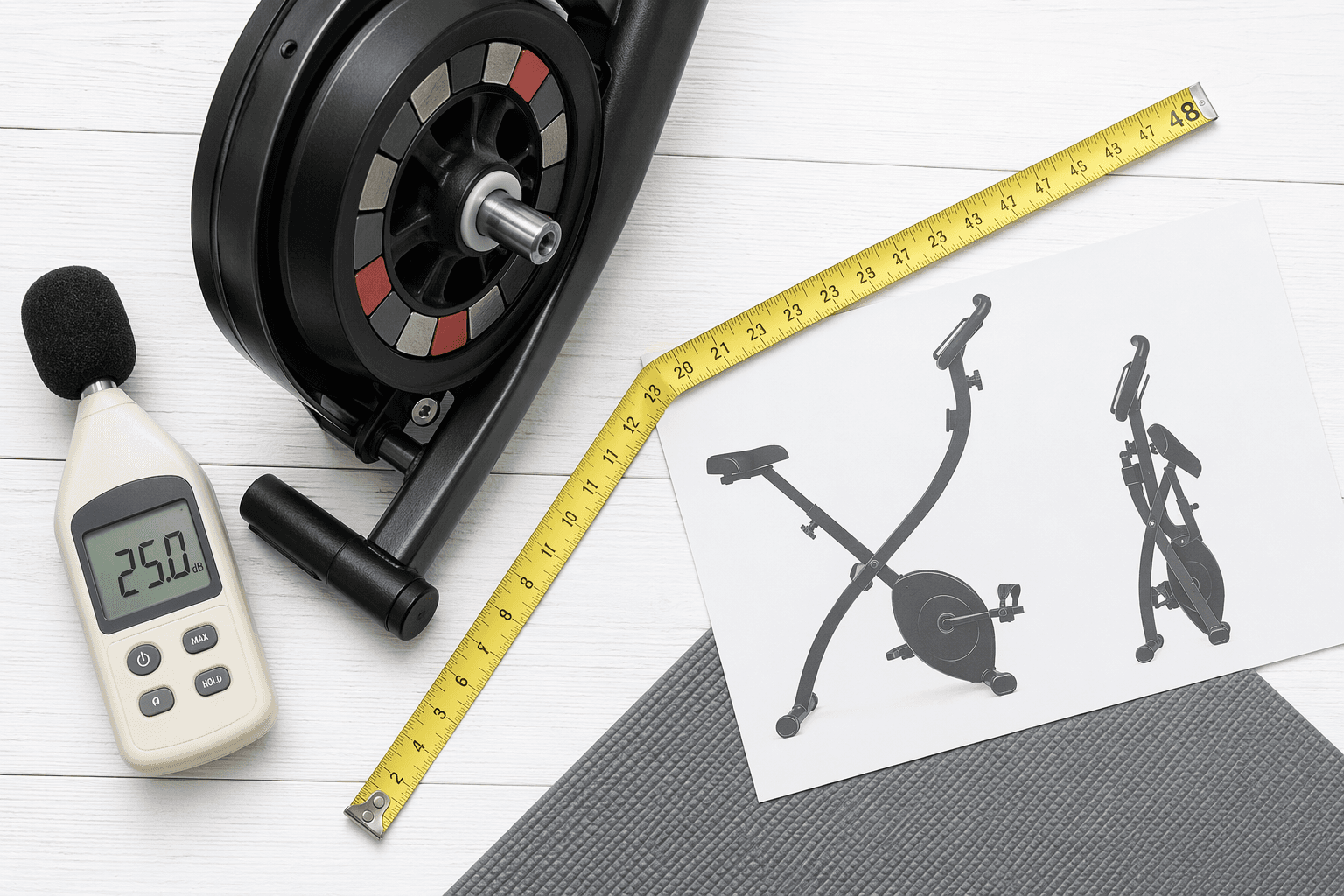
Look at that decibel reading: 25 dB. That's quieter than a whisper, about the level of a library. But note the source — that number comes from the manufacturer, not an independent lab. I treat it as directional, not absolute. Still, magnetic resistance is objectively the quietest system. No belts, no direct friction, just magnets. The PVC mat in the photo isn't just for floor protection. On a thin apartment floor — hardwood over wood frame, for instance — vibration transfers straight down. That mat kills it. Test this yourself: pedal the bike on bare floor, then put a mat under it. You'll feel the difference in your feet.
The folding silhouette tells the other story. Unfolded, the bike occupies a rectangle roughly the size of a door. Folded, it tucks behind a couch or into a closet. That's the footprint axis. But folding bikes often come with a cost: the frame flexes more under hard pedaling, and the ride feels less solid. That's the tradeoff. If you're on a fifth-floor walk-up, portability becomes the dominant axis — you need a bike you can carry, not drag. The folding bike in that silhouette weighs under 60 pounds. That's manageable. A heavy magnetic upright bike might weigh 120 pounds. No handles. Good luck getting that up three flights.
So the three axes interact. Noise is the most critical for early-morning riders. Footprint for tight spaces. Portability for stairs and storage. Most reviews pick one — usually the smart screen or the subscription — and ignore the rest. That's why you end up with a bike that sounds like a blender at 6 AM. I recommend deciding which axis matters most to you, then weighing the others. The bike that works in a house with a dedicated gym room won't work in a 600-square-foot apartment. That's the reality.
Comments
Join the discussion with an anonymous comment.